
船舶用複合ホース
Marine Composite Hose for Ship-to-Shore, Dock and Terminal Duty
A marine composite hose is the large-bore build for a working jetty: salt air, constant vessel movement, heavy flanges, and a hose that is dragged rather than carried. Five builds cover the terminal: tanker, marine ship-to-shore, dock, vapour recovery and a nylon rope cover for abrasion-heavy routes. Bore runs 50 to 250 mm, working pressure 14 to 15 bar, temperature -40 to +180 °C, with heavy hot dip galvanized or stainless helices and a 4:1 to 5:1 safety factor.

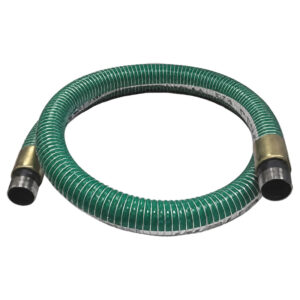
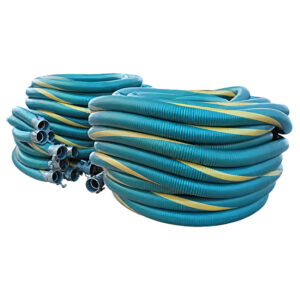


Five Builds for the Jetty
| Build | ボア | 使用圧力 | Burst or safety factor | 温度 | Duty |
|---|---|---|---|---|---|
| Tanker | 2 to 4 inch | 0.7, 1.05 or 1.52 MPa (102, 152, 220 psi) | Burst 2.8, 4.2, 6.1 MPa (4:1) | -30 to +90 °C | Road and rail tanker, anti-static |
| Marine, ship-to-shore | 50 to 250 mm | 14 bar (200 psi) | 5:1 | -40 to +180 °C | Ship to ship and ship to shore, oils and aromatics |
| Dock | 2 to 10 inch | 15 bar | Burst 60 bar | -30 to +100 °C | Refinery and terminal dock, fuel or chemical by type |
| Vapour recovery | 1 to 10 inch | 150 psi | Burst 600 psi | -40 to +150 °C | Vapour return, bottom loading and ship-to-shore lines |
| Nylon rope cover | 1 to 10 inch | 150 to 500 psi | on drawing | -40 to +100 °C | Dragged routes: concrete, steel edges, jetty decks |
Dock Hose: Five Material Types Under One Name
Dock hose is the one product in this category where the type code, not the bore, decides whether the hose survives. Five builds share the same dimensions and differ in wire and liner.
| 種類 | Inner wire | Outer wire | ライナー | Use |
|---|---|---|---|---|
| A | Hot dip galvanized steel | Hot dip galvanized steel | Polypropylene | Petrol, diesel, crude, lube oil, ethanol blends, biodiesel |
| B | Polypropylene covered steel | Hot dip galvanized steel | Polypropylene | Corrosive chemical fluids, no metal contact in the bore |
| C | Stainless steel | Stainless steel | Polypropylene | Corrosive fluid plus salt-laden atmosphere |
| D | Stainless steel | Hot dip galvanized steel | PTFE | Aggressive chemicals, sheltered installation |
| F | Stainless steel | Stainless steel | PTFE | Full stainless duty, offshore and washdown |
How a Marine Hose Is Built Differently
The construction logic is the same family as a plant composite hose, and the proportions change for jetty duty.
- ヘリックス — heavy hot dip galvanized high tensile steel, or stainless on the corrosive builds. It is heavier than a plant helix because it has to hold the bore open under wave bending and its own filled weight.
- ライナー — polypropylene for petroleum, PTFE on dock types D and F for aggressive chemicals, with a high tensile polypropylene fabric and film carcass behind it.
- Wall — thicker than a plant hose of the same bore, which is where the 5:1 factor comes from and why the bend radius is larger.
- 表紙 — abrasion and ageing resistant PVC, doubled on the dragged routes, with a spiral nylon rope wrap where the deck has fittings.
- Ends — fixed or floating flanges to EN 1092, ANSI B16.5 or JIS, with a support collar that takes the lifting load off the hose body.
What a Jetty Does to a Hose
Three load cases make marine duty different from plant duty, and each one is answered by a different part of the construction.
- Wave and swell load the hose in bending rather than tension. The 5:1 factor and the heavy helix are what keep the bore open through that cycle; a plant hose at 3:1 has no margin left for it.
- Vessel movement puts torsion into the assembly at the flange. Use a swivel or an elbow at the manifold, and never pull a tight bend into the flange to make it fit — twist shortens life faster than any other abuse.
- Dead weight of a filled 10 inch line is carried by the flange collar and the lifting slings, never by the hose body. A 20 m filled assembly is not something two people move by hand.
Abrasion: Where Nylon Rope Earns Its Place
The cover is the wear part on a dragged hose. Where the route crosses concrete, steel edges or a deck with fittings, a spiral nylon rope wrap takes the abrasion instead of the cover, and the rope is replaceable in a way the cover is not. State the route at enquiry: the same bore and pressure can be supplied with a standard cover, a double PVC cover or the rope wrap, and only one of them will survive your deck.
Flanges, Lifting and Inspection
End connections follow EN 1092, ANSI B16.5 or JIS patterns, fixed or floating, with reducing flanges to match an existing manifold. Fixed and floating are not interchangeable: a floating flange takes up bolt-hole misalignment, a fixed flange does not. Document pack on a terminal order normally includes the pressure test record, material declaration and lifting data.
Inspect before every transfer campaign and record the result: cover cracking or exposed fabric, a flattened or polished outer helix, loose collars and worn seals, and continuity on conductive builds after any repair. Retire the assembly after a kink that does not recover, a cover softened by chemical attack, or a failed continuity test.
用途
- Ship to shore — crude, refined product and bulk chemical discharge at a terminal berth
- Ship to ship — lightering and bunkering between vessels
- Dock and jetty — refinery and terminal berths handling both fuel and chemicals under one type code
- Vapour recovery — vapour return lines on loading and discharge
- Road and rail tanker — terminal-side tanker loading with anti-static construction
- Offshore supply — deck transfer where the hose is dragged across a steel deck
Installation, Handling and Service Life
Installation
Support the assembly so the cold, filled weight sits on the structure rather than the flange bolts. Keep the bend radius at the bore centreline under pressure, allow for tidal and vessel movement in the length, and fit a breakaway coupling where a drive-away is possible. Check the flange face and gasket before every connection; a scored flange face is the most common source of a drip on a jetty.
Handling
Lift by the collar or the slings, never by the body. Drain the hose before moving it — a filled 10 inch assembly is several times the handling weight of an empty one. Store coiled on a rack, not on the deck, and cap the ends to keep salt and grit out of the bore.
Service life
Three to five years on a terminal with scheduled inspection; shorter where the hose is dragged over concrete daily or runs continuously at the top of its temperature range. The cover and the outer helix are the wear items, and both are visible, which is why a written inspection record is more useful here than on any other build.
Customization, MOQ and Price
- Length — 15 m standard on marine and dock; assembled lengths to order with ±1 % tolerance
- Ends — fixed or floating flange to EN 1092, ANSI B16.5 or JIS; camlock for barge connections; reducing flanges
- Lifting — support collar and slings fitted and tested before dispatch
- 表紙 — standard, double PVC, or spiral nylon rope wrap
- MOQ — standard sizes from 100 m; assemblies with fixed flanges and slings built to order
- リードタイム — 15 to 20 working days after drawing approval for flanged assemblies
Marine assemblies are priced on bore, type, flange pattern and lifting arrangement rather than on metres alone, because the fittings and the test record are a larger share of the cost. Tell us the berth, the manifold and the medium and the quotation itemises each.
Built in Hengshui on 12 production lines across 18,000 m², supplying 70 countries since 2010, with every marine assembly proof tested and documented before it leaves the plant.
Where This Category Stops
- LNG and liquid nitrogen go to the cryogenic category; a marine build is not a cold-service build.
- In-plant lines below 50 mm belong to the chemical or petroleum category.
- Above 40 bar, either duty, specify a wire spiral hose.
Products in This Category
- Tanker composite hose, 0.7 to 1.52 MPa
- Marine composite hose, 14 bar, 50 to 250 mm
- Dock composite hose, types A to F, 15 bar
- Vapour recovery composite hose, 150 psi
- Composite hose with nylon rope cover
Part of the composite hose range, which covers six families from 25 to 254 mm.
よくある質問
What is the difference between marine hose and dock hose?
Marine hose is the ship-to-ship and ship-to-shore build at 14 bar with a 5:1 factor and a -40 to +180 °C window. Dock hose is the terminal-side build at 15 bar with a 60 bar burst, supplied as types A to F so one dock can handle fuel and chemicals with a clear type code.
Why 5:1 instead of 3:1?
Wave, swell and vessel movement add bending and torsion that a plant line never sees. The higher factor is the margin for those loads, not for pressure. A 14 bar marine hose and a 14 bar plant hose look similar and are not interchangeable.
Which dock type do I need?
Type A for fuel, B for corrosive fluid where the bore must not touch metal, C for corrosive fluid in salt air, D for aggressive chemicals on a sheltered dock, F for full stainless duty. Give us the medium list for the berth and the type follows.
Can the hose be lifted when full?
Only by the flange collar or the fitted lifting slings. Lifting a filled assembly by the body loads the plies at the fitting and is one of the most common causes of a failure we are asked to investigate.
What temperature can marine hose take?
-40 to +180 °C on the ship-to-shore build, -30 to +100 °C on dock, -30 to +90 °C on tanker, and -40 to +150 °C on vapour recovery. The nylon rope cover build is limited to +100 °C.
Fixed or floating flange?
A floating flange takes up bolt-hole misalignment at the manifold and is the usual choice on a berth that moves. A fixed flange is stronger and better where alignment is controlled. They are not interchangeable on site, so state which manifold you have.
What documentation ships with a terminal order?
Pressure test record, material declaration, and lifting data. Where a classification society survey is required, tell us at enquiry so the test schedule matches what the surveyor will ask for.
What are the order quantity and lead time?
Standard sizes start at 100 m. Assemblies with fixed flanges and lifting slings are built to order and normally ship 15 to 20 working days after drawing approval.
Send the berth, not just the bore. Medium, flow rate, manifold flange pattern and the route the hose has to cross — from that we specify the build and the cover through the quotation form.
- 油圧ホース2323個の商品
- スチールワイヤー撚り込み式油圧ホース66個の商品
- スチールワイヤー編組油圧ホース1010個の商品
- 繊維補強油圧ホース33個の商品
- 熱可塑性樹脂製油圧ホース33個の商品
- 工業用ホース7575個の商品
- 油圧継手166166個の商品
- 再利用可能なホース継手66個の商品
- ソケットレスホース継手88個の商品
- JIC 油圧継手1616個の商品
- メートル法の油圧継手4141個の商品
- NPT油圧継手66個の商品
- BSP油圧継手2626個の商品
- SAE油圧継手3030個の商品
- バンジョー式油圧継手44個の商品
- ORFS油圧継手1111個の商品
- フェルール1111個の商品
- フランジ継手2626個の商品
- ワンピース用フィッティング2424個の商品
- 油圧アダプター149149個の商品
Factory Strength & Manufacturing Capability
Our Positioning
As a leading china-based rubber hose factory with 35000㎡ campus, HENGHUA integrates R&D, production, and global logistics under one roof. Our mission: Deliver reliable fluid transfer solutions that minimize downtime and reduce total ownership cost for customers worldwide.
Physical Scale & Infrastructure
- Total area: 35,000㎡ (production: 22,000㎡, warehouse: 8,000㎡, R&D center: 3,000㎡, office: 2,000㎡)
- Location: Ningbo, China – 45km from Ningbo-Zhoushan Port (world’s busiest port)
- Layout: Dedicated zones for raw material storage, mixing, extrusion, braiding/spiraling, vulcanization, assembly, and QC
Production Capacity & Equipment
- Annual output: 20 million meters (15,000 tons) of rubber hose
- Daily capacity: 100,000 meters finished hoses
- Production lines: 95 automated lines including:
- 40 Wire Braided Hose lines
- 25 Wire Spiral Hose lines
- 15 textile braid lines
- 10 thermoplastic hose lines
- 5 large-bore suction/discharge lines
- Key equipment: German Mayer braiders, Italian OMAG spiral winders, 20 fully automated autoclave vulcanizers, CNC crimping machines
- Mold library: 500+ mandrels covering ID from 3mm to 200mm, SAE/ISO/EN/GB standards
Technical R&D & Quality Assurance
- R&D team: 25 engineers (12 senior, 5 with PhDs)
- Annual R&D investment: 5% of revenue
- Patents: 38 (15 invention, 23 utility model)
- Testing laboratory: CNAS-accredited (China National Accreditation Service)
- Key test equipment:
- 10-station impulse test bench (SAE/ISO pulse cycles)
- 500-ton burst pressure tester
- Ozone aging chamber
- Spectrophotometer for material analysis
- Tensile strength tester
- Executable tests: Full ISO 1402, SAE J343, GB/T 5563 standards
Quality Certifications
- IATF 16949 (Automotive quality management)
- ISO 9001:2015
- ISO 14001 (Environment)
- ISO 45001 (Occupational health & safety)
- MSHA (Mining safety)
- ABS/DNV (Marine type approval)
Raw Material Control
Strategic partnerships with:
- DuPont (EPDM polymers)
- Lanxess (NBR rubber compounds)
- Hyosung (high-tensile steel wire)
- Cabot (carbon black for UV resistance)
Human Resources
- Total employees: 380 (including 120 production technicians, 60 QC personnel)
- Average industry experience: 12 years
- Management team: 8 executives with 20+ years in rubber engineering
Environmental & Safety Compliance
- Closed-loop wastewater treatment (zero discharge)
- Carbon black dust collection system (99.9% efficiency)
- ISO 45001 certified safety management
- Monthly safety drills and training
Core Competitive Advantages
- Scalability: 20 million meters annual capacity ensures on-time delivery for bulk orders
- Flexibility: Quick-change tooling for small-batch OEM ODM orders (MOQ as low as 500 meters)
- Quality assurance: End-to-end traceability via unique ID card system
- Cost leadership: Vertical integration reduces cost by 25-30% vs. competitors
Future Outlook
Investing $5 million in Smart Factory 2.0 initiative (2025-2027) including AI-powered defect detection and automated guided vehicle (AGV) logistics systems.
Why HENGHUA is Your Trusted Partner in Power
HENGHUA: Your Global Water Hose Solution Partner
For over 15 years, HENGHUA has evolved from a regional rubber hose producer into a top-tier china-based manufacturer serving 70+ countries. Our water hose division combines German engineering standards, American testing protocols, and Chinese manufacturing efficiency to deliver High Pressure Hose solutions that rival Parker, Gates, and Eaton at 30-40% lower cost.
Why Industry Leaders Choose HENGHUA:
Vertical integration: We control every step – from rubber mixing to final hose assembly. No hidden defects, no quality variations.
Certification readiness: All products meet SAE, ISO, EN, and GB standard with pdf specification available for audit.
Flexible supply: Bulk orders, just-in-time delivery, or wholesale distribution – we scale with your business.
Technical support: Our 25-person engineering team provides application engineering, failure analysis, and custom solution design.
One-stop shopping: fittings, adapters, flanges, protective sleeves – complete fluid connection source.
Commitment to Partnership: HENGHUA doesn’t just supply hoses. We become your reliability partner. Request a sample, visit our factory, or audit our lab. Experience the HENGHUA difference.
Contact us for discount price quotes and OEM ODM collaboration.
Send a Mail
henghua@hhgpipe.com
Make a Call
+15822925523
86-22-83859963
Mon - Sun: 09:00 am - 22:00 pm
Main Office
Tianjin, China
Hezhong Building, Youyi North Road
 English
 Spanish
 Portuguese
 French
 German
 Arabic
 Russian
 Indonesian
 Japanese
 Korean