
極低温用複合材ホース
Cryogenic Composite Hose for LNG and Liquid Nitrogen
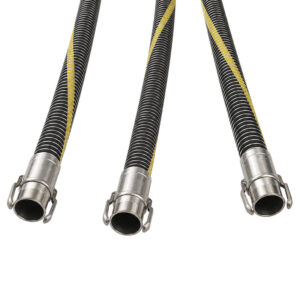
A cryogenic composite hose carries liquefied gas at temperatures where ordinary materials turn brittle: LNG at about -162 °C and liquid nitrogen at -196 °C, inside one build rated from -200 to +80 °C. Both helices are 316 stainless steel, the body is a low-temperature thermoplastic with a polyester and polyamide liner, and the cover is a polyester fabric that insulates and carries rope lagging. Bore runs 1 to 10 inch at 10 bar working pressure, maximum length 20 m.
1件の結果を表示中
Why a Standard Composite Hose Cannot Do This
Below about -40 °C the standard build stops being the right product, and the reason is mechanical rather than chemical. The polymer films lose elongation, the ply bond becomes brittle, and a hose that flexes happily at ambient will crack at the liner on the first tight bend. Steel is not exempt either: a galvanized helix becomes notch-sensitive and a bend that was routine at ambient becomes a stress riser.
So the cryogenic build changes three things at once: both helices move to 316 stainless, the liner and body move to low-temperature thermoplastics, and the cover becomes an insulating fabric rather than an abrasion-resistant PVC. None of those substitutions is optional.
建設
| レイヤー | 素材 | Role at -200 °C |
|---|---|---|
| Inner helix | 316 stainless steel | Keeps toughness where galvanized steel would become notch-sensitive |
| Liner and body | Polyester and polyamide low-temperature films and fabrics | Retain elongation below -100 °C so the hose still flexes |
| Insulation | Multiple low-temperature fabric and film plies | Reduce boil-off and keep the outer surface workable |
| 表紙 | Polyester fabric, with rope lagging | Protects the insulation and carries the lagging on long runs |
| Outer helix | 316 stainless steel | Protects the cover and holds the shape under its own cold weight |
仕様
| パラメータ | 値 |
|---|---|
| ボア | 1 to 10 inch (25 to 254 mm), nine sizes |
| 使用圧力 | 10 bar (145 psi) |
| 温度 | -200 to +80 °C |
| Maximum length | 20 m (65 ft) |
| Inner and outer helix | 316 stainless steel |
| Media | LNG, LPG, butane and propane mixtures, butadiene, liquid nitrogen |
Size Table
| Bore (inch) | Bore (mm) | Bend radius (mm) | Working pressure (bar) | Maximum length (m) |
|---|---|---|---|---|
| 1 | 25 | 150 | 10 | 20 |
| 1 1/2 | 38 | 175 | 10 | 20 |
| 2 | 50 | 185 | 10 | 20 |
| 3 | 75 | 280 | 10 | 20 |
| 4 | 102 | 500 | 10 | 20 |
| 5 | 125 | 610 | 10 | 20 |
| 6 | 152 | 660 | 10 | 20 |
| 8 | 204 | 940 | 10 | 20 |
| 10 | 254 | 1905 | 10 | 20 |
The 20 m limit is not a manufacturing constraint. A longer cold line carries more boil-off, more weight at the flange and a larger thermal gradient along its length, and the hose is not the right component for the distance — a vacuum-insulated pipe is. Where a 20 m hose will not reach, the answer is two assemblies and a breakaway coupling, not a longer hose.
The Number That Matters: -162, -196 or -200
| Figure | What it is | Where it comes from |
|---|---|---|
| -162 °C | LNG at atmospheric pressure | The working temperature of most LNG transfer |
| -196 °C | Liquid nitrogen at atmospheric pressure | The coldest common duty, and the usual LN2 figure |
| -200 °C | The rating of this build | Rated range with margin below the coldest common duty |
Specify the medium and its actual transfer temperature. Quoting -200 °C for an LNG line is not wrong, but it is not useful either: the design case is -162 °C and the handling rules that follow from it are different.
Pre-Cool, Not Shock
Cryogenic service rewards a slow pre-cool and punishes thermal shock. The failure is not a burst: it is a liner that contracts faster than the plies around it and separates, or a fitting that sees a gradient it was not designed for. A controlled cool-down lets the whole assembly reach temperature together, and the first transfer after installation is the one that matters most.
- Cool the line in stages rather than opening the valve fully on a warm hose.
- Keep the bend radius with the bore at temperature, not the radius it had on the pallet.
- Support the assembly so the cold weight is carried by the structure, not the flange bolts.
- Do not use a cryogenic hose for ambient LPG; the insulation and the liner are wrong for it.
用途
- LNG transfer — bunkering, truck loading and satellite station filling
- LPG and petrochemical gas — butane, propane mixtures and butadiene
- Liquid nitrogen — tanker unloading, purging and cold-test rigs
- Gas terminals — ship-to-shore and truck-to-ship transfer legs that need flexibility
- Industrial gas distribution — cylinder filling plants and cold storage top-up
Installation, Inspection and Service Life
Installation
Support the assembly along its length so the cold weight sits on the structure. Keep the bend radius with the bore cold, and allow a little slack for contraction — a cryogenic hose shortens as it cools, and a line pulled tight at ambient pulls on both fittings at temperature. Fit a breakaway coupling wherever a drive-away is possible, and lag the flanges so the cold path does not reach the bolts.
Inspection
Check the cover for cuts, tears and crushed insulation — a damaged cover is where ice forms first, and ice tells you the insulation has failed. Check the helices for deformation, the fittings for frost patterns that suggest a cold leak path, and continuity where the medium is flammable. Retire the assembly after a cover breach that exposes the body, a kink that does not recover, or any sign of ply separation at the fitting.
Service life
Five years or more on intermittent transfer duty with correct pre-cool. Thermal cycling is what ages a cryogenic hose: an assembly that goes cold once a week lasts far longer than one cycled several times a day, because each cycle works the ply bond.
Customization, MOQ and Price
- Length — built to order in 5 m increments up to 20 m, with ±1 % tolerance
- ボア — 1 to 10 inch from stock tooling; larger bores are engineered to order
- Ends — flange to EN 1092 or ANSI B16.5, camlock, quick couplings; lagged flange option
- Insulation — standard fabric cover, with rope lagging for long horizontal runs
- MOQ — built to order; standard sizes start at 100 m equivalent, and each assembly is tested individually
- リードタイム — 20 to 30 working days depending on flange pattern and lagging
Cryogenic assemblies are priced per assembly rather than per metre: the stainless helices, the low-temperature body and the individual pressure test dominate the cost. Tell us the medium, the transfer temperature and the flange pattern on each end and the quotation itemises the build.
Manufactured in Hengshui on 12 production lines across an 18,000 m² site, supplying 70 countries since 2010. Each cryogenic assembly is pressure tested before dispatch and the record names the bore, the body lot and the test pressure.
Where This Category Stops
- Ambient and chilled LPG (to -40 °C) belongs to the petroleum category with a conductive helix.
- Above -30 °C and below +100 °C, a standard build is cheaper and just as durable.
- Long distances at cryogenic temperature need insulated pipe, not a longer hose.
- Above 10 bar at these temperatures, the duty has to be engineered rather than taken from the table.
Product in This Category
Part of the composite hose range, which covers six families from 25 to 254 mm.
よくある質問
What is a cryogenic composite hose used for?
Transferring LNG, LPG, butane and propane mixtures, butadiene and liquid nitrogen at temperatures down to -200 °C. It is a transfer hose at 10 bar, used where a fixed insulated pipe cannot follow the movement of a vessel, a tanker or a loading arm.
Why are both helices stainless?
A galvanized helix becomes notch-sensitive at low temperature and a bend that is routine at ambient becomes a crack initiation point. 316 stainless keeps its toughness at -196 °C, so both the inner and the outer helix are stainless on this build.
Can it be used for LPG at ambient temperature?
No. Ambient and chilled LPG to -40 °C runs on the petroleum suction and discharge or tanker build. A cryogenic hose is specified for LNG at about -162 °C and liquid nitrogen at -196 °C, and using it elsewhere pays for insulation you do not need.
Why is the maximum length 20 m?
Boil-off, cold weight at the flange and the thermal gradient along the assembly all grow with length. Beyond 20 m the correct component is a vacuum-insulated pipe; for a longer reach, use two assemblies with a breakaway coupling.
How should the line be cooled down?
In stages. Opening a valve fully on a warm hose puts a thermal gradient through the liner and the fitting that the construction is not designed for. Cool the assembly progressively and let it reach temperature before full flow.
Is it conductive?
The stainless helices provide a continuous path, and where the medium is flammable the assembly must still be bonded to the vessel and to earth before transfer. State the earthing requirement at enquiry so the continuity test is included in the dispatch record.
What does ice on the cover mean?
It means moisture is reaching a cold surface, which usually means the insulation has been breached. Ice on the body or at a fitting is an inspection trigger, not condensation to be wiped off.
What are the order quantity and lead time?
These are built to order rather than stocked: standard sizes start at 100 m, and each assembly is pressure tested before dispatch. Allow 20 to 30 working days depending on the flange pattern and whether lagging is specified.
Tell us the medium and the real transfer temperature. LNG, LN2 and LPG mixtures have different design cases even when they share a hose through the quotation form.
- 油圧ホース2323個の商品
- スチールワイヤー撚り込み式油圧ホース66個の商品
- スチールワイヤー編組油圧ホース1010個の商品
- 繊維補強油圧ホース33個の商品
- 熱可塑性樹脂製油圧ホース33個の商品
- 工業用ホース7575個の商品
- 油圧継手166166個の商品
- 再利用可能なホース継手66個の商品
- ソケットレスホース継手88個の商品
- JIC 油圧継手1616個の商品
- メートル法の油圧継手4141個の商品
- NPT油圧継手66個の商品
- BSP油圧継手2626個の商品
- SAE油圧継手3030個の商品
- バンジョー式油圧継手44個の商品
- ORFS油圧継手1111個の商品
- フェルール1111個の商品
- フランジ継手2626個の商品
- ワンピース用フィッティング2424個の商品
- 油圧アダプター149149個の商品
Why HENGHUA is Your Trusted Partner in Power
HENGHUA: Your Global Water Hose Solution Partner
For over 15 years, HENGHUA has evolved from a regional rubber hose producer into a top-tier china-based manufacturer serving 70+ countries. Our water hose division combines German engineering standards, American testing protocols, and Chinese manufacturing efficiency to deliver High Pressure Hose solutions that rival Parker, Gates, and Eaton at 30-40% lower cost.
Why Industry Leaders Choose HENGHUA:
Vertical integration: We control every step – from rubber mixing to final hose assembly. No hidden defects, no quality variations.
Certification readiness: All products meet SAE, ISO, EN, and GB standard with pdf specification available for audit.
Flexible supply: Bulk orders, just-in-time delivery, or wholesale distribution – we scale with your business.
Technical support: Our 25-person engineering team provides application engineering, failure analysis, and custom solution design.
One-stop shopping: fittings, adapters, flanges, protective sleeves – complete fluid connection source.
Commitment to Partnership: HENGHUA doesn’t just supply hoses. We become your reliability partner. Request a sample, visit our factory, or audit our lab. Experience the HENGHUA difference.
Contact us for discount price quotes and OEM ODM collaboration.
Send a Mail
henghua@hhgpipe.com
Make a Call
+15822925523
86-22-83859963
Mon - Sun: 09:00 am - 22:00 pm
Main Office
Tianjin, China
Hezhong Building, Youyi North Road
 English
 Spanish
 Portuguese
 French
 German
 Arabic
 Russian
 Indonesian
 Japanese
 Korean