
The composite hose vs metal hose choice is settled by three numbers: the pressure the line must hold, the temperature of the product, and how much warning you need before a failure. A composite hose covers 4, 10 or 14 bar depending on type, and up to +150 °C on Type 4, all inside one standard family. It also tends to weep before it bursts, a mechanism covered in our leak-before-burst explanation. A corrugated metal hose with a stainless braid goes far beyond that pressure and temperature, but it gives little warning when a corrugation fatigues.
This comparison sets the two constructions side by side on pressure, temperature, weight, bend radius, chemical range and failure behaviour. It also separates a braided metal hose from a braided PTFE hose, because buyers often quote the two as if they were the same product. The closing sections list the duties where each one is the better answer and the fields that belong in the enquiry.
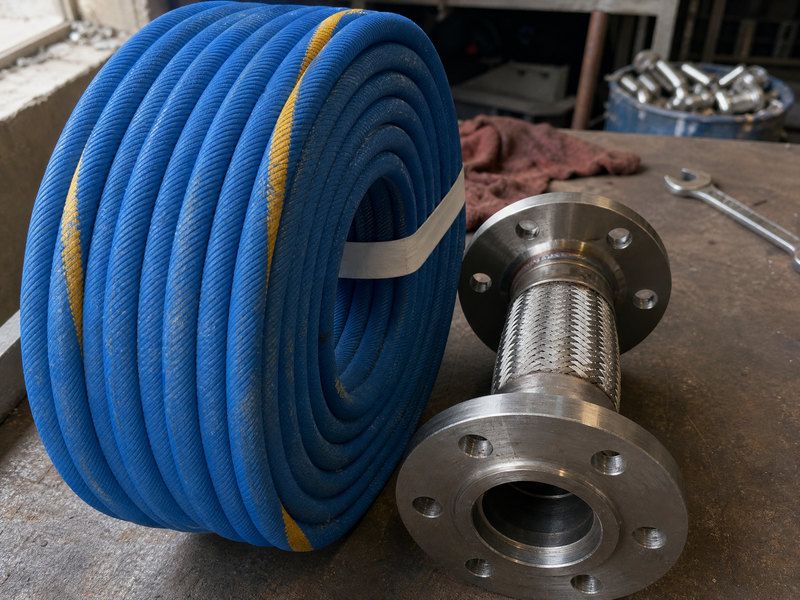
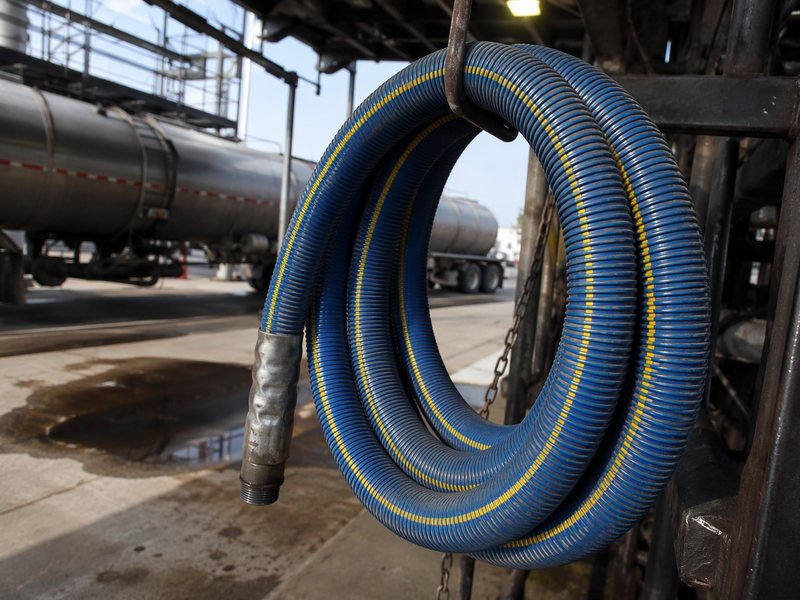
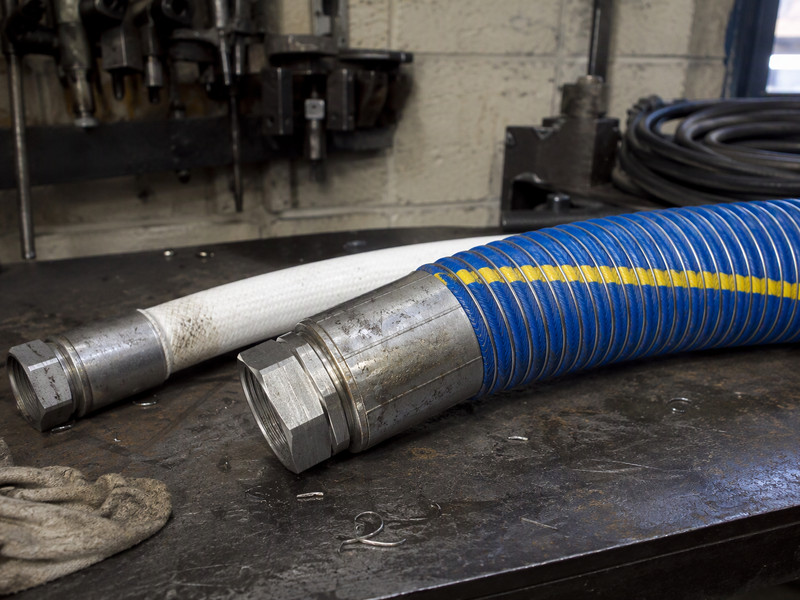
Figure 1. A coiled composite hose next to a braided stainless assembly with flanges on a workshop bench.
What Is the Structural Difference?
A composite hose is a stack of layers. The bore is sealed by thermoplastic film, woven fabric carries the load, and two steel wire helixes hold the shape, one inside the bore and one outside the cover. Nothing is vulcanised, so the layers stay separate and each can be selected for the duty.
A metal hose is a thin corrugated tube, usually stainless steel, with a braid wrapped over it. The corrugation gives flexibility and the braid carries the end load that pressure creates. ISO 10380 is the standard that covers corrugated metal hose assemblies, and it governs the pressure, bend and test requirements for that product.
The third construction is a PTFE tube inside a stainless braid. It looks like a metal hose from the outside and behaves like a chemical hose from the inside. That is why the composite hose vs metal hose question often turns into a question about linings.
Side by Side
| Property | Composite hose | Corrugated metal hose with braid |
|---|---|---|
| Bore range in EN 13765 | 25 mm to 300 mm | Set by the manufacturer, wider at both ends |
| 使用圧力 | 4, 10 or 14 bar by type | Set by corrugation profile, braid layers and bore |
| Proof pressure | 6, 15 or 21 bar by type | Set by the assembly rating |
| Minimum burst | 16, 40 or 56 bar by type | Set by the assembly rating |
| Working temperature | −20 °C to +150 °C by type | Far above composite limits, set by alloy and braid |
| 真空度 | 0.5 bar for Type 1, 0.9 bar for Types 2 to 4 | High, limited by corrugation support |
| Mass at equal bore | Low, thin wall and low density materials | High, steel tube plus steel braid |
| Bend radius | Fixed by the standard table, 4x bore at large sizes | Tight, but cycling inside it consumes fatigue life |
| Chemical range | Set by the lining, PP to PTFE | Set by the alloy, chlorides are the usual limit |
| Electrical continuity | Through the wire helixes, bonded at the fittings | Inherent through tube and braid |
| Warning before failure | Leak through the wall plies | Little, a fatigue crack can open quickly |
| First cost | 中程度 | High, and higher again in large bore |
Table 1. Composite hose vs metal hose on the properties that decide a transfer line. Values for the composite column follow the EN 13765 type table, values for the metal column depend on the assembly.
The table shows why the two products rarely compete directly. Metal hose wins on the extremes and loses on handling, while the composite hose owns the middle band of chemical transfer at moderate pressure.
How High Does Metal Hose Pressure Rating Go?
A braided metal hose has no single ceiling, because the rating is built rather than standardised. The corrugation sets how much movement the tube allows, and the braid sets how much end load it can hold. A small bore assembly with two braid layers can therefore be rated far above the 14 bar that EN 13765 allows.
The rating falls quickly as bore grows. End load rises with the square of the diameter. An 8 inch assembly therefore needs roughly four times the braid strength of a 4 inch one at the same pressure to hold the same stress. That is why large bore metal hose is expensive and why a metal hose pressure rating quoted without a bore figure means very little.
Because a metal hose pressure rating is a built figure, two suppliers can quote the same bore with different ratings and both be right. Ask for the rating at the working temperature, the braid construction behind it, and the proof pressure that was applied. A figure offered at ambient with no braid detail is a number rather than a specification.
A metal hose rating belongs to the assembly that was tested, not to the corrugation alone. That is why this page quotes no metal pressure figure: the figure would have to come from a tested assembly with its own braid, fittings and length.
For a composite hose the numbers are published. Type 1 is rated 4 bar, Types 2 and 3 are rated 10 and 14 bar, and Type 4 is rated 14 bar. Proof pressure follows at 6, 15, 21 and 21 bar, with a minimum burst of 16, 40, 56 and 56 bar. A buyer can put those figures in a tender without asking the supplier to confirm them.
Which Construction Handles More Heat?
Composite hose stops at +150 °C. Type 4 holds that limit with a working range of −30 °C to +150 °C, while Type 3 stops at +80 °C and Type 1 at +60 °C. Above the range the standard allows a higher figure only by agreement with the manufacturer, and the rest of the requirements still apply.
A metal hose has no such wall. A stainless tube with the right braid handles steam, hot oil and exhaust service well above +150 °C, and the limit becomes the alloy rather than the construction. A braided PTFE hose sits between the two, usually quoted from about −70 °C to +260 °C for the tube, with the assembly rating set by the braid and the fittings.
Temperature also changes the comparison at the fitting. A composite hose is crimped or flanged onto a thermoplastic wall that softens before steel does, so the end connection, not the hose, often sets the practical ceiling in a hot duty.
That is why the composite hose vs metal hose comparison belongs at the temperature of the duty. A rating quoted at ambient says nothing useful about a line that runs at +140 °C for six hours a shift.
Does Weight or Bend Radius Decide It?
Weight usually decides the argument on a dock. Steel is about eight times the density of the polyolefins used in a composite lining, and a metal assembly adds a tube, one or two braid layers and steel fittings. At 6 inch bore the difference is a two-person lift against a one-person lift, repeated every shift.
Bend radius runs the other way. A corrugated metal hose bends to a tighter radius than a composite hose of the same bore, and in a cramped pump room that may be the only workable option. The catch is fatigue: every cycle inside the rated radius uses up corrugation life. A hose flexed daily on a loading arm will crack long before one installed once and left alone.
The composite figures are fixed by the standard. A 50 mm bore needs 200 mm to 225 mm depending on type, and a 100 mm bore needs 400 mm for every type. A 150 mm bore needs 575 mm for Types 1 to 3. Those numbers are checkable against a route drawing before the order is placed.
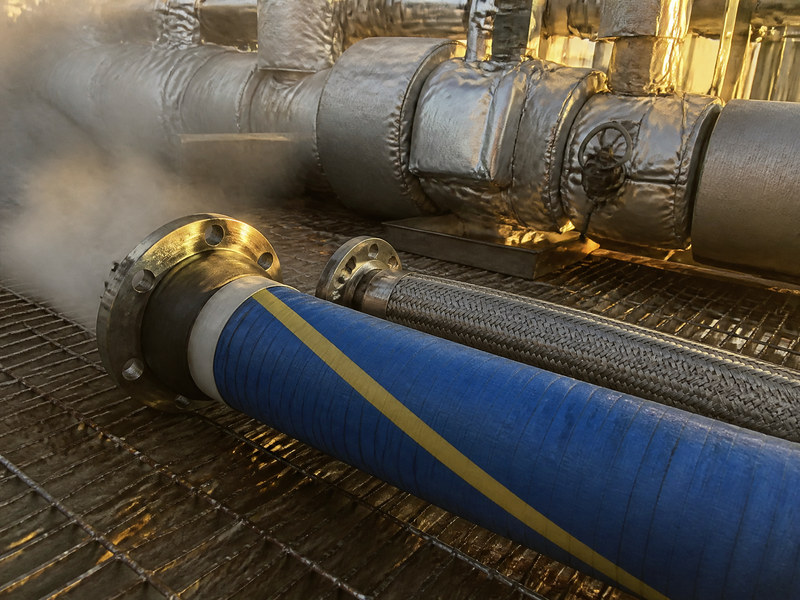
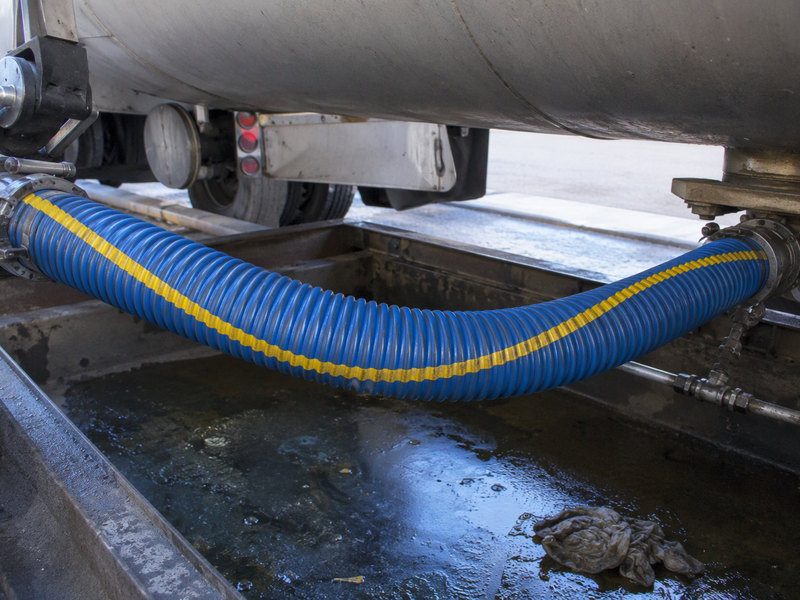
Figure 2. A black composite assembly and a braided stainless assembly on the same steam header, with the insulation and the vent in view. The braided one is there for temperature rather than pressure, and the two envelopes are compared in Table 2.
Composite Hose vs PTFE Hose: Is PTFE a Third Option?
Not quite. PTFE appears in two different products and buyers mix them up. A PTFE-lined composite hose keeps the composite construction, with a PTFE film as the product contact layer, and inherits the pressure, vacuum and bend behaviour of the standard types. A braided PTFE hose is a PTFE tube inside a stainless braid, and it inherits the pressure behaviour of a metal assembly.
The lining choice matters more than the label. Most composite hose vs ptfe hose questions are really about permeation and temperature rather than pressure, and those two decide the lining. PTFE covers the concentrated acids and aggressive solvents that defeat polypropylene and XLPE, and it tolerates the top of the composite temperature range. Against that, PTFE permeates some low molecular weight products, costs more than a polyolefin lining, and is harder to bond, so the end fitting work is more demanding.
The composite hose vs ptfe hose decision is therefore a lining decision inside one construction. Buyers who need metal-level pressure should look at a braided PTFE hose, and buyers who need chemical range at 14 bar or less are usually better served by a PTFE-lined composite. Our PTFE composite hose range lists the linings against the pressure types.
How Do the Failure Modes Compare?
| 故障モード | Composite hose | Corrugated metal hose |
|---|---|---|
| Fatigue | Film cracking after repeated tight bends | Corrugation crack at a flex point, often hidden by braid |
| Warning sign | Damp patch or blister before a leak | Little, a crack can open in one cycle |
| Crush and kink | Inner helix resists, permanent kink retires the hose | Corrugation flattens and does not recover |
| Corrosion | Wire helix attacked if the coating is breached | Chloride attack in 316L at raised temperature |
| Permeation | Lining dependent, PTFE the lowest | None through the tube |
| Mechanical damage | Cut through the cover exposes fabric | Braid damage removes the pressure path |
| Overpressure | Burst at the standard minimum | Burst at the assembly rating |
Table 2. Failure modes for both constructions. The composite column is the basis of our leak-before-burst explanation, which covers the mechanism in detail.

Figure 3. A fatigue crack across a corrugation on one side, and a localised leak at a film breach on the other, shown side by side.
The practical difference is what happens in the ten minutes after damage. A composite hose tends to leak product through the wall at a rate the crew can see and stop, because the fabric and wires keep the bore together. A metal hose can hold pressure until the crack reaches critical length, then release the full line contents at once.
Stainless Steel Braided Hose: Where It Is the Right Answer
A stainless steel braided hose is the better choice in five situations, and each one is a limit that the composite standard does not reach.
- Steam and hot oil above +150 °C, where the thermoplastic wall has no rating.
- Small bore high pressure, such as hydraulic and gauge lines, where a braid can be built to suit.
- Product that must not permeate, where a metal tube is the only barrier that holds.
- High vibration with proper support, where the assembly is designed for movement rather than handling.
- Fire-exposed routes, where a steel tube survives conditions that destroy a fabric cover.
A braided hose is also the answer when the line must conduct static reliably through the tube itself rather than through bonded wire ends. That is a system question, and it belongs in the risk assessment rather than in the hose datasheet.
One more case is worth naming. A stainless steel braided hose can be routed through a hot zone where a fabric cover would age and crack, and that single advantage sometimes outweighs the weight penalty on a short run.
Where Does Composite Hose Win?
Composite hose wins on chemical transfer between 4 and 14 bar, and it wins clearly once the bore passes 3 inch. A dock line, a tanker unloading arm and a rail car connection all need a hose that two people can rig without a crane, and that is the composite case.
It also wins where the product list is mixed. One composite hose with a PTFE lining can cover several products that would need three different metal assemblies, and the spare parts inventory shrinks with the product range. Our comparison with rubber hose covers the same argument against a vulcanised alternative.
The third win is vacuum. A composite hose is rated 0.5 bar for Type 1 and 0.9 bar for Types 2 to 4, tested for 30 minutes with no damage. A suction line that runs dry will kink a metal hose at the corrugation, while the composite helix holds the bore round up to its rating.
Does the Choice Change Once the Hose Is Installed?
Two identical hoses behave differently as soon as they are rigged, and the composite hose vs metal hose comparison is often settled by the route rather than by the datasheet.
A metal assembly installed with a bend at each end and then left alone will outlast one that is flexed every shift on a loading arm. Flexing is what cracks a corrugation, and the braid hides the crack until it opens. A composite hose dragged over a kerb loses its cover first and its fabric next, whatever its pressure rating says.
Support spacing is the second site factor. A heavy metal hose needs saddles close together to stop the braid sagging into the bend, while a lighter composite line needs fewer. Both need the hose clear of the deck, because product standing in a low point is how a cover blisters from the inside.
The third factor is the crew. A hose that one person can lift gets inspected properly, and inspection quality decides how much warning either construction gives before it fails.
What Belongs in the Enquiry?
An enquiry that names only the bore and the product will produce a quote for the wrong hose. Eight fields settle the composite hose vs metal hose question before the price is discussed.
Cost splits differently on the two sides. A metal assembly is priced by alloy, corrugation count, braid layers and end fittings, so a small bore with two braids can cost more than a large composite hose. A composite assembly is priced by bore, lining, helix grade and ends, and the lining is usually the largest single step.
| Field | Unit or form | Why it decides the construction |
|---|---|---|
| Design pressure at temperature | bar at °C | Separates the standard types from a special build |
| Relief valve setting and static head | bar | Sets the burst factor a terminal will check |
| Temperature range, including cleaning | °C | Rules Type 1 and Type 3 in or out |
| Product list and concentration | list | Chooses the lining, not just the material family |
| Bore and length | mm and m | Sets the pressure capability of a braided assembly |
| Vacuum or suction duty | bar | Requires an inner helix rating, not just a pressure rating |
| Bend radius available on site | mm | Checked against the standard table before order |
| End fitting standard and orientation | flange, camlock, thread | Fixed or floating flange changes the assembly work |
Table 3. Fields for a composite hose vs metal hose enquiry. Fill the pressure, temperature and product list first, because those three eliminate one construction before any price is quoted.
A buyer who fills this sheet can compare quotes on equal terms. A buyer who sends a bore and a product name will receive two prices for two different products and will choose on price alone, which is how the wrong hose gets installed.
よくある質問
Can a composite hose replace a metal hose?
Only inside its ratings. A composite hose covers 4 to 14 bar and up to +150 °C, so it can replace a braided assembly on chemical transfer within that envelope. Above those limits the metal hose stays.
Which one is safer on a dock line?
Composite, in most terminal duties, because a damaged wall leaks before it bursts and the crew sees the product. A metal hose gives less warning when a corrugation cracks under a loading arm.
Is a metal hose stronger than a composite hose?
In pressure terms, yes at small bore, where a braid can be built to hold far more than 14 bar. In crush and handling terms the comparison is less clear, because a flattened corrugation cannot be recovered either.
Does a braided metal hose need a bigger pump?
No, but it changes the pressure budget. A corrugated bore has a rougher wall than a thermoplastic lining, so friction loss per metre is higher at the same bore and flow.
Which one lasts longer?
It depends on the duty rather than the material. A static metal hose in a hot line can outlast several composite hoses, and a composite hose on a dock that is rigged daily usually outlasts a metal assembly flexed the same way.
Can both be used on one manifold?
Yes, provided each is rated for its own duty and the flanges match. The risk is substitution during a night shift, so tag each hose with its construction and pressure.
Does the composite hose vs metal hose choice affect the standard I quote?
Yes. A composite hose is quoted to EN 13765 and its four types, and a metal assembly is quoted to ISO 10380. Naming the wrong standard in a tender produces a compliant offer for the wrong product, and our type guide explains what each type covers.
HENGHUAについて
The composite hose HENGHUA makes carries UHMWPE, XLPE, PTFE and polypropylene linings, a woven fabric reinforcement, and a stainless steel or coated carbon steel helix. Ends are crimped or flanged, with fixed or floating flanges, and we supply custom lengths, sheath printing and OEM or private label work.
The range is listed in our full composite hose range, and the pressure and temperature data used above comes from the standard rather than from a marketing sheet. We do not build metal hose, so when a duty needs one we say so. If you are weighing composite hose vs metal hose for a specific line, send the eight fields from Table 3 and we will answer for that duty. Our steam and braided hose comparison covers the adjacent case of a rubber steam line against a braided assembly.
 English
 Spanish
 Portuguese
 French
 German
 Arabic
 Russian
 Indonesian
 Japanese
 Korean