
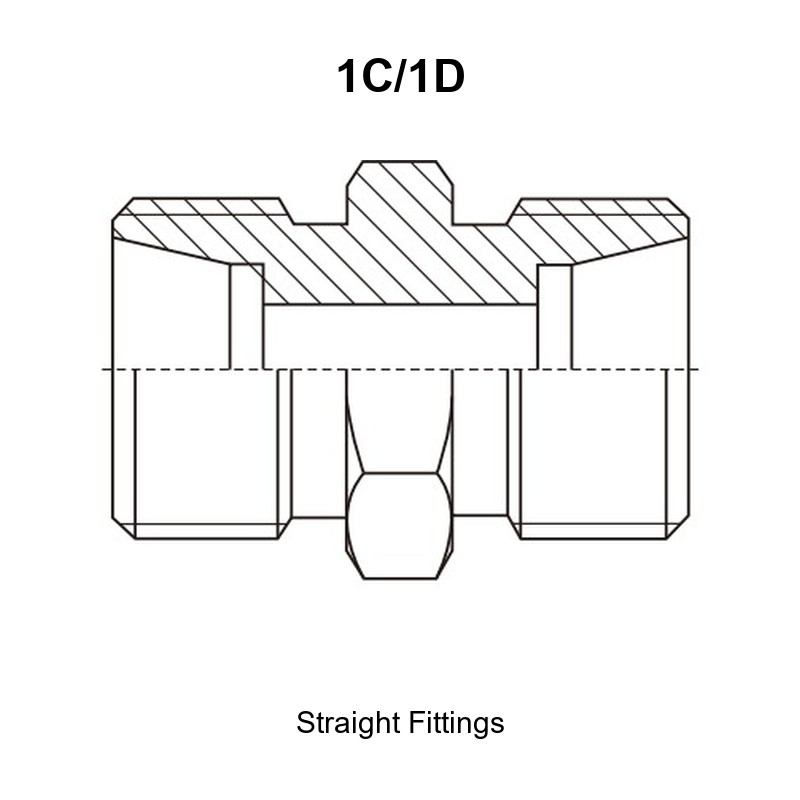
Why This straight hydraulic adapter 1C/1D Passes the Compliance Gate
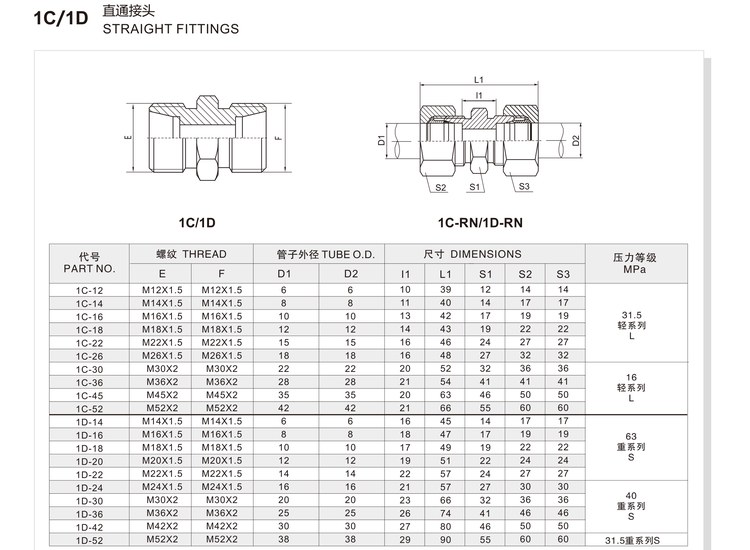
The straight hydraulic adapter 1C/1D is a straight fitting with a metric male stud end at each end, E and F, in one thread size per row. Ports range from M12x1.5 to M52x2, and the data sheet pairs every row with its tube outside diameters D1 and D2, its length and hex columns, and a pressure class expressed in MPa together with the series code used by the connection: light series L or heavy series S. Because the pressure class is printed per row, the buyer can check the working pressure against the circuit before ordering instead of assuming one family figure.
The 1C group covers the light L series from 6 mm to 42 mm tube, and the 1D group covers the heavy S series from 6 mm to 38 mm tube. Maintenance engineers and manifold builders use these fittings to join two stud-ended lines of the same thread size, and the tabulated pressure class makes the light and heavy groups easy to tell apart at the counter.
Core Advantages
- Pressure class printed per row. 31.5 MPa and 16 MPa for the light L rows, 63 MPa, 40 MPa and 31.5 MPa for the heavy S rows, exactly as the data sheet lists them.
- Two matched metric stud ends. E and F carry the same thread in every row, so the fitting joins two ports of one size.
- Light and heavy groups in one table. Ten light rows and ten heavy rows share one dimension set of I1, L1, S1, S2 and S3.
- Tube sizes tabulated on both ends. D1 and D2 give the tube outside diameter the fitting is dimensioned for, so the tube callout and the part number stay linked.
- Documented, traceable supply. Batch traceability, dimensional records and material test reports support incoming inspection.
- OEM marking. Laser marking of your part number, logo and batch code is available on the body or the hex.
Especificaciones técnicas
What Is a straight hydraulic adapter 1C/1D?
It is a straight fitting with an external metric thread at each end and a machined bore through the body, dimensioned to the tube sizes D1 and D2 and rated by the light L series or heavy S series pressure class printed in the matrix. It is the plain straight member of the 1C/1D family: the same table also covers the BSP stud end version, the ISO 6149 metric O-ring version, the JIC 74 degree cone version and the weld version, and those sealing systems are not interchangeable with the L and S series stud ends.
The data sheet shows two outlines, 1C/1D and 1C-RN/1D-RN, and one matrix covering both, so the same part number carries the same thread, tube and pressure data whichever outline your drawing follows. Confirm the mating port seat against the drawing issued with your order, because the L and S series codes printed in the pressure column identify the connection family and not a universal thread.
Connection 1 – Metric male stud end (E)
| Attribute | Specification |
|---|---|
| End form | Metric male stud end, external thread |
| Threads in this series | M12X1.5, M14X1.5, M16X1.5, M18X1.5, M20X1.5, M22X1.5, M24X1.5, M26X1.5, M30X2, M36X2, M42X2, M45X2, M52X2 |
| Series | Light series L (1C rows), heavy series S (1D rows) |
| Tube outside diameter D1 | 6 mm to 42 mm across the light group, 6 mm to 38 mm across the heavy group |
| Hex S1 | 12 mm to 55 mm, per row of the matrix |
Connection 2 – Metric male stud end (F)
| Attribute | Specification |
|---|---|
| End form | Metric male stud end, external thread, same size as connection 1 in every row |
| Tube outside diameter D2 | Identical to D1 in every row of the data sheet |
| Hex S2 and S3 | 14 mm to 60 mm, per row of the matrix |
| Body length L1 | 39 mm to 90 mm, per row of the matrix |
| Bore I1 | 10 mm to 29 mm, per row of the matrix |
Dimensional Data
| Symbol | Meaning | Unit |
|---|---|---|
| E, F | Metric male stud threads at the two ends, identical in every row of this series | – |
| D1, D2 | Tube outside diameter the fitting is dimensioned for, identical to each other in every row | mm |
| I1 | Bore dimension through the body, as defined on the data-sheet drawing | mm |
| L1 | Overall length, as defined on the data-sheet drawing | mm |
| S1, S2, S3 | Hex across-flats (wrench sizes) on the body and the two ends | mm |
| Pressure class MPa | Pressure class in MPa with the series code (light L / heavy S) | MPa |
Full Dimension Table (Part Number Matrix)
| PART NO. | THREAD E | THREAD F | TUBE O.D. D1 | TUBE O.D. D2 | I1 | L1 | S1 | S2 | S3 | Pressure class MPa |
|---|---|---|---|---|---|---|---|---|---|---|
| 1C-12 | M12X1.5 | M12X1.5 | 6 | 6 | 10 | 39 | 12 | 14 | 14 | 31.5 (light series L) |
| 1C-14 | M14X1.5 | M14X1.5 | 8 | 8 | 11 | 40 | 14 | 17 | 17 | 31.5 (light series L) |
| 1C-16 | M16X1.5 | M16X1.5 | 10 | 10 | 13 | 42 | 17 | 19 | 19 | 31.5 (light series L) |
| 1C-18 | M18X1.5 | M18X1.5 | 12 | 12 | 14 | 43 | 19 | 22 | 22 | 31.5 (light series L) |
| 1C-22 | M22X1.5 | M22X1.5 | 15 | 15 | 16 | 46 | 24 | 27 | 27 | 31.5 (light series L) |
| 1C-26 | M26X1.5 | M26X1.5 | 18 | 18 | 16 | 48 | 27 | 32 | 32 | 31.5 (light series L) |
| 1C-30 | M30X2 | M30X2 | 22 | 22 | 20 | 52 | 32 | 36 | 36 | 31.5 (light series L) |
| 1C-36 | M36X2 | M36X2 | 28 | 28 | 21 | 54 | 41 | 41 | 41 | 31.5 (light series L) |
| 1C-45 | M45X2 | M45X2 | 35 | 35 | 20 | 63 | 46 | 50 | 50 | 16 (light series L) |
| 1C-52 | M52X2 | M52X2 | 42 | 42 | 21 | 66 | 55 | 60 | 60 | 16 (light series L) |
| 1D-14 | M14X1.5 | M14X1.5 | 6 | 6 | 16 | 45 | 14 | 17 | 17 | 63 (heavy series S) |
| 1D-16 | M16X1.5 | M16X1.5 | 8 | 8 | 18 | 47 | 17 | 19 | 19 | 63 (heavy series S) |
| 1D-18 | M18X1.5 | M18X1.5 | 10 | 10 | 17 | 49 | 19 | 22 | 22 | 63 (heavy series S) |
| 1D-20 | M20X1.5 | M20X1.5 | 12 | 12 | 19 | 51 | 22 | 24 | 24 | 63 (heavy series S) |
| 1D-22 | M22X1.5 | M22X1.5 | 14 | 14 | 22 | 57 | 24 | 27 | 27 | 63 (heavy series S) |
| 1D-24 | M24X1.5 | M24X1.5 | 16 | 16 | 21 | 57 | 27 | 30 | 30 | 63 (heavy series S) |
| 1D-30 | M30X2 | M30X2 | 20 | 20 | 23 | 66 | 32 | 36 | 36 | 40 (heavy series S) |
| 1D-36 | M36X2 | M36X2 | 25 | 25 | 26 | 74 | 41 | 46 | 46 | 40 (heavy series S) |
| 1D-42 | M42X2 | M42X2 | 30 | 30 | 27 | 80 | 46 | 50 | 50 | 40 (heavy series S) |
| 1D-52 | M52X2 | M52X2 | 38 | 38 | 29 | 90 | 55 | 60 | 60 | 31.5 (heavy series S) |
All dimensions are in millimetres and are transcribed row by row from the product data sheet. The pressure column is reproduced exactly as printed: the light L rows run at 31.5 MPa up to 1C-36 and then 16 MPa for 1C-45 and 1C-52, while the heavy S rows run at 63 MPa up to 1D-24, 40 MPa for 1D-30 to 1D-42, and 31.5 MPa for 1D-52. Where the data sheet prints a merged pressure cell, the same class applies to every row inside that cell.
Thread Size and Dash Chart
| Metric stud thread (E, F) | Light series rows | Heavy series rows | Tube O.D. D1/D2 light | Tube O.D. D1/D2 heavy | Pressure class |
|---|---|---|---|---|---|
| M12x1.5 | 1C-12 | – | 6 | – | 31.5 MPa, L |
| M14x1.5 | 1C-14 | 1D-14 | 8 | 6 | 31.5 MPa, L / 63 MPa, S |
| M16x1.5 | 1C-16 | 1D-16 | 10 | 8 | 31.5 MPa, L / 63 MPa, S |
| M18x1.5 | 1C-18 | 1D-18 | 12 | 10 | 31.5 MPa, L / 63 MPa, S |
| M20x1.5 | – | 1D-20 | – | 12 | 63 MPa, S |
| M22x1.5 | 1C-22 | 1D-22 | 15 | 14 | 31.5 MPa, L / 63 MPa, S |
| M24x1.5 | – | 1D-24 | – | 16 | 63 MPa, S |
| M26x1.5 | 1C-26 | – | 18 | – | 31.5 MPa, L |
| M30x2 | 1C-30 | 1D-30 | 22 | 20 | 31.5 MPa, L / 40 MPa, S |
| M36x2 | 1C-36 | 1D-36 | 28 | 25 | 31.5 MPa, L / 40 MPa, S |
| M42x2 | – | 1D-42 | – | 30 | 40 MPa, S |
| M45x2 | 1C-45 | – | 35 | – | 16 MPa, L |
| M52x2 | 1C-52 | 1D-52 | 42 | 38 | 16 MPa, L / 31.5 MPa, S |
Material and Heat Treatment
| Artículo | Standard supply (typical) | On request |
|---|---|---|
| Body material | Carbon steel | Austenitic stainless steel for corrosive and offshore duty |
| Heat treatment | Stress relief applied as required by the drawing for carbon steel bodies | Grade and condition agreed per drawing |
| Surface treatment | Zinc-based plating | Zinc-nickel, chrome-free passivation, stainless passivation |
| Dimensional inspection | Sample and batch dimensional records | Full-lot dimensional report |
| Pruebas de presión | Batch pressure test with recorded results | Third-party witnessed testing |
| Documentation | Batch certificate and traceability record | Material test report on request |
The values above describe normal commercial practice for this family and are confirmed on the order drawing, not replaced by it.
Working Pressure and Operating Envelope
Working pressure for the straight hydraulic adapter 1C/1D is read directly from the pressure column of the matrix, converted where needed at 1 MPa about 145 psi: 31.5 MPa is roughly 4,570 psi, 16 MPa about 2,320 psi, 40 MPa about 5,800 psi and 63 MPa about 9,135 psi. Those figures are the series pressure classes for the connection and the tube range shown in the same row.
A pressure class is only one input. The finished assembly is only as strong as its weakest member, so the tube wall, the mating port, the seal form and the assembly method must all hold the same class. Ask for a rating table with your enquiry and we will state the figure, the tube range and the test method that apply to your combination.
Rango de temperatura
The typical service window is -40 °C to +120 °C for the standard construction, set by the seal materials in the joint rather than by the steel body. Where a different elastomer is fitted, the window follows that material. Confirm the seal and the fluid with us before ordering for hot or aggressive service.
How to Read the Part Number Matrix
The order code carries two pieces of information: the series prefix and the thread and tube size group.
- Prefix – 1C or 1D. 1C identifies the light L series rows, 1D identifies the heavy S series rows. The prefix therefore carries the pressure class with it.
- Size group. In 1C-22 the group 22 identifies the metric stud thread, M22x1.5, on both ends, which the data sheet pairs with 15 mm tube and a 31.5 MPa light series class.
- Second example – 1D-22. The same thread in the heavy series is 1D-22 with 14 mm tube and a 63 MPa heavy series class, so the prefix is what separates a light fitting from a heavy one at the same thread size.
A third example shows the pressure break inside one group. 1C-36 runs at 31.5 MPa with 28 mm tube, while 1C-45 steps down to 16 MPa with 35 mm tube, and 1D-52 steps down to 31.5 MPa with 38 mm tube inside the heavy group. Always order by part number and confirm the printed class.
Selection and Ordering
| Question | What to confirm before ordering |
|---|---|
| Which series does the port use? | Light L and heavy S fittings differ in body, thread range and pressure class, so confirm the series first. |
| What is the stud thread? | Read the port callout, for example M22x1.5, and do not infer the thread from the port bore diameter. |
| What tube size does the line use? | Match D1 and D2 in the matrix; the fitting is dimensioned to those tube sizes. |
| What pressure class does the circuit need? | Read the printed class for the row and check it against the circuit working pressure, not the burst figure. |
| Does the mating port take this seat form? | The L and S series codes identify the connection family; confirm the port seat against the ordered drawing before substitution. |
| Will the hexes clear? | S1, S2 and S3 are the wrench sizes; check access on both ends before choosing a large row. |
Cross Reference Service
Send an old part number, a photograph or a worn sample of the straight hydraulic adapter 1C/1D and we will cross it to the closest row of this matrix. The answer states thread, tube size, pressure class and hex explicitly so you can verify it against your own measurement, the service is free, and we never re-label another maker’s part as our own.
Packaging and Logistics
Fittings ship in individual bags inside cartons, grouped by part number, with batch code and quantity on the outer label. Mixed cartons are routine for distributors and repair workshops. Material test reports travel with the goods when ordered, standard rows ship quickly from stock, and air freight covers urgent shutdown dates.
Installation and Fitment Guide
Step-by-Step Assembly
- Confirm the series, the thread and the printed pressure class against the circuit before starting work.
- Check both port seats for burrs, paint or old sealant, and confirm the seat form matches the connection family.
- Thread the first end in by hand until it seats, then the second, so the fitting is not loaded by misalignment.
- Tighten both ends to the torque value for the thread size and material from the applicable standard data table.
- Check that the tube callout and the fitting’s D1 and D2 match before the line is fixed in place.
- Pressure test the finished assembly at the circuit working pressure and record the result.
Torque and Sealing Notes
Tighten stud ends to the torque values for the thread size, material and coating from the applicable standard data table, and treat those figures as a starting point to be confirmed against your own test. Do not add thread sealant unless the drawing calls for it, because sealant in a machined seat can hold the fitting off its seat. Over-tightening does not improve the seal and can stretch the thread or distort the seat. Where the drawing specifies a seal at the stud end, fit a new seal whenever the joint is broken.
Installation Warnings
- ✔ Confirm the series prefix, thread and pressure class before fitting this straight adapter.
- ✔ Check the mating port seat form against the ordered drawing.
- ✔ Use a spanner on the correct hex and hold the body steady when breaking a joint.
- ✔ Fit a new seal whenever the joint is broken, where the drawing specifies one.
- ❌ Never substitute a light series row for a heavy series row, or the reverse, even when the thread looks the same: the pressure class differs.
- ❌ Never fit 1C/1D parts into an ISO 6149 O-ring port (1CH/1DH), a BSP O-ring port (1CG/1DG) or a JIC 74 degree cone port (1CJ/1DJ). Those are different sealing systems and the joints will not seal correctly.
- ❌ Never use thread tape or sealant to cure a weep instead of correcting the seat or the torque.
- ❌ Never exceed the pressure class printed in the matrix for the row you ordered.
Applications and Industries
The straight hydraulic adapter 1C/1D appears wherever two stud-ended ports of one thread size must be joined in a straight line.
- Line build and repair. A damaged straight section is replaced with the same series and thread, keeping the printed pressure class with the circuit.
- Manifold and power unit assembly. Straight fittings join blocks and tube runs where an elbow would not fit the envelope.
- Test rigs and benches. Light and heavy rows let one bench carry a low-pressure instrument line and a high-pressure test line from the same stock.
- Industrial plant. Lubrication, cooling and clamp circuits use straight fittings to keep the line centred on the port.
- Mobile and construction machinery. Heavy series rows are chosen where the pressure class of the circuit demands it, with the light rows reserved for return and pilot lines.
Tags: hydraulic adapter, straight hydraulic fitting, light series L, heavy series S, metric stud end adapter, ISO 8434-1 fitting, DIN 2353 fitting, straight stud end fitting.
OEM Customization and Quality Traceability
We manufacture matching hydraulic adapters and hose assemblies alongside our hose range, so specials are quoted engineering work rather than a favour. Laser marking of your part number, logo, date code and batch code is available on the body or the hex, and custom finishes, non-standard threads, special body lengths and non-standard pressure classes are quoted from your drawing or sample, normally within 24 hours.
Every batch is traceable from raw material to finished part. Batch records, dimensional results and material test reports are available with the goods, third-party inspection such as BV or SGS can be arranged, and finished assemblies are pressure tested with results recorded for the lot. Ordering the straight hydraulic adapter 1C/1D on a repeat schedule keeps one drawing, one tube callout and one traceability record behind every line.
FAQ
Q: What do the light series L and heavy series S codes mean in the pressure column? A: They identify the connection series and carry the pressure class with them. The light L rows are printed at 31.5 MPa up to 1C-36 and 16 MPa for 1C-45 and 1C-52, while the heavy S rows are printed at 63 MPa up to 1D-24, 40 MPa for 1D-30 to 1D-42 and 31.5 MPa for 1D-52.
Q: Can I substitute a light series row for a heavy series row if the thread matches? A: No. The two groups are printed with different pressure classes and different tube ranges, so a light row is not a heavy row with a different name. Order the prefix that matches the circuit pressure class.
Q: What pressure can the straight hydraulic adapter 1C/1D take? A: Read the pressure class printed in the matrix for the row you ordered: 31.5, 16, 63, 40 or 31.5 MPa depending on the row. That class applies to the connection and tube range in the same row, and the finished assembly is only as strong as its weakest member.
Q: Is this the same as the ISO 6149 O-ring version of the same family? A: No. The 1CH/1DH rows in this family are ISO 6149 metric O-ring stud ends, the 1CG/1DG rows are BSP thread stud ends with O-ring sealing, and the 1CJ/1DJ rows are JIC 74 degree cone. The base 1C/1D rows are the L and S series straight fittings, and the sealing systems are not interchangeable.
Q: How do I convert the pressure class to psi? A: At 1 MPa about 145 psi, 31.5 MPa is roughly 4,570 psi, 16 MPa about 2,320 psi, 40 MPa about 5,800 psi and 63 MPa about 9,135 psi.
Q: Why are D1 and D2 identical in every row? A: The data sheet pairs one tube size with each thread size for this straight fitting, so D1 and D2 match. If your drawing needs different tube sizes at each end, send it and we will quote the special.
Q: Can you mark our part number on the fitting? A: Yes. Laser marking of part number, logo and batch code is available on the body or the hex, and made-to-drawing specials are normally quoted within 24 hours.
Solicitar un presupuesto
Send the series needed, the stud thread on each end, the tube outside diameter, the circuit working pressure, and the material and surface treatment you require. To speed up a quotation on the straight hydraulic adapter 1C/1D, add the drawing and a note of the port seat form. We reply with part number, printed pressure class, confirmed dimensions, price and lead time within 24 hours, and trial samples can be arranged at the same time.
Browse the full Hydraulic Adapters range for the complete family, or contact us to request a quote, mill test reports, and samples.


 English
  Spanish
  Portuguese
  French
  German