
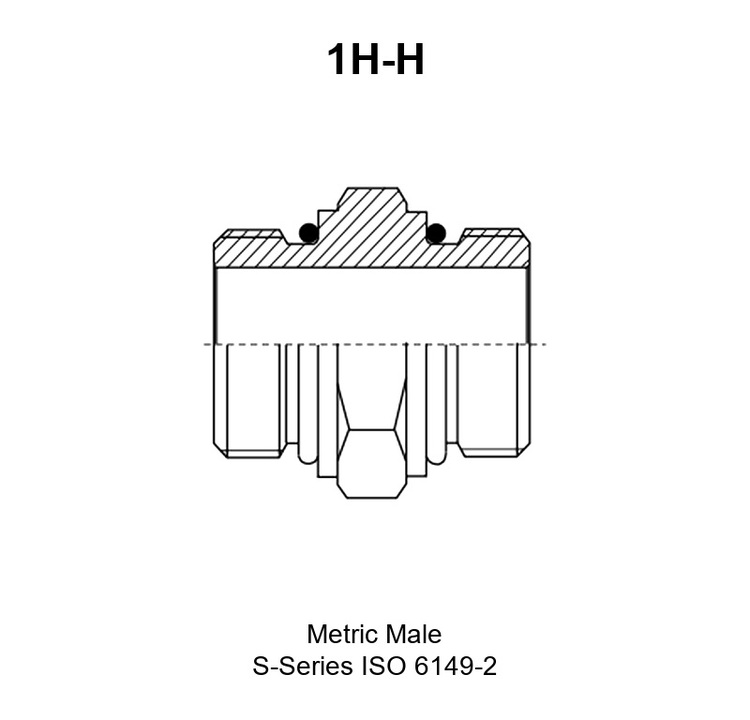
The 1H-H adapter is a straight hydraulic adapter with a metric male ISO 6149-2 O-ring stud end at each end, so it joins two metric O-ring ports of one thread size using an elastomer O-ring as the seal at both ends. It is the heavy duty S series member of the ISO 6149 metric O-ring family, and its stud ends are longer and heavier than the light duty L series form at the same thread size. This page gives the printed dimension table, the S series against L series duty comparison, the printed port note, and the installation rules for the 1H-H adapter.
Ventajas principales
- Two identical ISO 6149-2 S series stud ends on one straight body, so one part joins two ports of the same metric size.
- Heavy duty stud end form: longer thread length and longer body than the equivalent ISO 6149-3 L series size.
- Metric O-ring sealing per ISO 6149, where the thread clamps and the O-ring in the port recess seals.
- Eleven sizes from M10X1 to M48X2, including an M20X1.5 step that the light duty range does not carry.
- Carbon steel with trivalent chromium zinc plating, or 304 / 316 stainless steel for corrosive service.
- Seal material options of NBR, FKM and EPDM to match the fluid and the temperature window.
1. What a 1H-H Fitting Does
A 1H-H adapter is a straight male-to-male adapter: one machined body with a metric threaded stud end at each end and a hex between them, used to join two ports that both accept the same metric O-ring stud end. Each end has its own O-ring groove and seals in its own port recess, and because both ends are the same size by design the part is a coupling with no size change.
The core value of this part is dimensional match. Each sealing end has to match its mating port exactly, because that match is the precondition for eliminating leakage at the joint. A stud end made to ISO 6149-2 has a defined heavy duty thread length, a defined groove position and a defined shoulder, and a port made to ISO 6149-1 has a matching recess, so the O-ring is compressed by a controlled amount and the shoulder stops against the port face.
The sealing principle of this series is a straight metric thread with an elastomeric seal. This O-ring adapter clamps with the thread and seals with the ring: the thread carries the pressure load and holds the stud end in position, while the ring compressed in the port recess does the sealing work. The thread is not a sealing element, which is why thread tape and paste are not used on this joint.
2. 1H-H Specifications
2.1 Connection 1 – Metric Male ISO 6149-2 S Series Stud End
Connection 1 is a metric male stud end with a parallel metric thread made to ISO 6149-2, the heavy duty metric stud end standard that defines this ISO 6149 adapter series. The printed range covers M10X1, M12X1.5, M14X1.5, M16X1.5, M18X1.5, M20X1.5, M22X1.5, M27X2, M33X2, M42X2 and M48X2, eleven sizes from the smallest metric port in the range up to M48. The thread is male and external, and the stud end carries an O-ring groove behind the lead thread.
Sealing is by an elastomer O-ring on the stud end, compressed in the machined recess of the mating port face. The mating port is a metric port with an O-ring recess as described by ISO 6149-1, and the printed note under the chart records that the stud end fits that port. The O-ring column of the table lists the ring for this end as O-RING E.
2.2 Connection 2 – Metric Male ISO 6149-2 S Series Stud End
Connection 2 mirrors connection 1. It is the same metric male ISO 6149-2 stud end, with the same thread size as connection 1 on every row of the printed range, the same groove and the same sealing principle in its own port recess. The table lists it separately as thread F and O-RING F, and on every row E equals F and the E ring equals the F ring.
Presenting the two ends separately makes the part easy to specify against a drawing. A buyer can confirm from the table that thread lengths A and B are equal for each size, that both rings are the same, and that the adapter introduces no size change, so nothing is left to interpretation between the two ends of a straight thread adapter.
2.3 Construction and Materials
The body is machined from bar stock on CNC lathes, so both threads, both O-ring grooves and the hex are produced to a common centreline and stay concentric. The hex is dimension S1 in the table and runs from 14 mm on 1H-10H to 55 mm on 1H-48H. It sits between the two stud ends, so the body can be held on the hex while one end is run into a port.
There is no third connection, no branch and no drive feature; the internal bore is a straight passage joining the two ports. The groove on each stud end is a machined feature rather than a loose accessory, so the ring cannot be lost in transit.
Body material options are carbon steel, 304 stainless steel, 316 stainless steel and brass. The standard export build is carbon steel with trivalent chromium zinc plating (Cr3+), with zinc-nickel plating available where a harder finish is preferred. Stainless steel is selected for corrosive environments, offshore and marine work and water-based fluids. Plating thickness and salt-spray performance are confirmed per order. Seal options are NBR, FKM and EPDM, and replacement O-rings can be supplied separately. Every batch is checked against the drawing with thread gauges and dimensional checks before packing.
2.4 Pressure and Temperature
Working pressure for these sizes is confirmed per order by HENGHUA engineering, based on the thread size, sealing method and material selected. The printed chart carries no pressure column, so no per-size rating is quoted on this page. On a straight-thread O-ring joint the pressure capability is governed by the port wall and the housing as much as by the hydraulic adapter, and the S series and L series differ in stud end proportions rather than in a published pressure figure.
Temperature is a material fact. NBR suits approximately -30°C to +100°C, FKM approximately -20°C to +200°C, and EPDM approximately -40°C to +120°C. The steel body is not the limiting element in normal service; the elastomer is. Select the compound against the fluid first, then confirm the temperature window against the same compound.
2.5 Part Number and Dimension Table
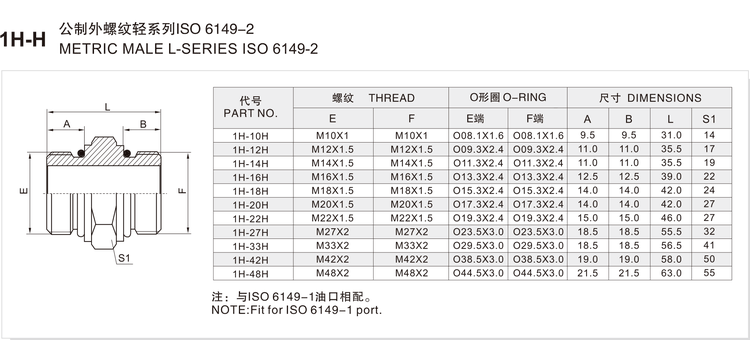
| N.º DE PIEZA. | E | F | O-RING E | O-RING F | A | B | L | S1 |
|---|---|---|---|---|---|---|---|---|
| 1H-10H | M10X1 | M10X1 | O08.1X1.6 | O08.1X1.6 | 9.5 | 9.5 | 31.0 | 14 |
| 1H-12H | M12X1.5 | M12X1.5 | O09.3X2.4 | O09.3X2.4 | 11.0 | 11.0 | 35.5 | 17 |
| 1H-14H | M14X1.5 | M14X1.5 | O11.3X2.4 | O11.3X2.4 | 11.0 | 11.0 | 35.5 | 19 |
| 1H-16H | M16X1.5 | M16X1.5 | O13.3X2.4 | O13.3X2.4 | 12.5 | 12.5 | 39.0 | 22 |
| 1H-18H | M18X1.5 | M18X1.5 | O15.3X2.4 | O15.3X2.4 | 14.0 | 14.0 | 42.0 | 24 |
| 1H-20H | M20X1.5 | M20X1.5 | O17.3X2.4 | O17.3X2.4 | 14.0 | 14.0 | 42.0 | 27 |
| 1H-22H | M22X1.5 | M22X1.5 | O19.3X2.4 | O19.3X2.4 | 15.0 | 15.0 | 46.0 | 27 |
| 1H-27H | M27X2 | M27X2 | O23.5X3.0 | O23.5X3.0 | 18.5 | 18.5 | 55.5 | 32 |
| 1H-33H | M33X2 | M33X2 | O29.5X3.0 | O29.5X3.0 | 18.5 | 18.5 | 56.5 | 41 |
| 1H-42H | M42X2 | M42X2 | O38.5X3.0 | O38.5X3.0 | 19.0 | 19.0 | 58.0 | 50 |
| 1H-48H | M48X2 | M48X2 | O44.5X3.0 | O44.5X3.0 | 21.5 | 21.5 | 63.0 | 55 |
Dimensions are millimetres unless the column states a thread size. Printed note under the table: “Fit for ISO 6149-1 port.”
What each column means
- N.º DE PIEZA. – the ordering code, built from the series prefix 1H plus a two digit size code and the letter suffix H marking the heavy duty S series stud end.
- E – the thread size and pitch of connection 1, written as the nominal metric diameter followed by the pitch, for example M20X1.5.
- F – the thread size and pitch of connection 2. In this series F always equals E, because both ends are the same stud end.
- O-RING E – the O-ring for connection 1, printed as O plus inside diameter in millimetres and cord diameter in millimetres, so O17.3X2.4 is a 17.3 mm inside diameter ring with a 2.4 mm cord.
- O-RING F – the O-ring for connection 2, identical to the E ring on every row of the range.
- A – the thread length of connection 1, measured from the sealing face to the end of full thread.
- B – the thread length of connection 2, identical to A on every row of the range.
- L – the overall length from one sealing face to the other.
- S1 – the width across the flats of the central hex, which decides the spanner size.
There is no pressure column and no seat angle column in the printed chart.
Thread size and dash chart
| Dash size | Thread | O-ring | Stud end standard | Hex across flats |
|---|---|---|---|---|
| 10H | M10X1 | O08.1X1.6 | ISO 6149-2 S series | 14 mm |
| 12H | M12X1.5 | O09.3X2.4 | ISO 6149-2 S series | 17 mm |
| 14H | M14X1.5 | O11.3X2.4 | ISO 6149-2 S series | 19 mm |
| 16H | M16X1.5 | O13.3X2.4 | ISO 6149-2 S series | 22 mm |
| 18H | M18X1.5 | O15.3X2.4 | ISO 6149-2 S series | 24 mm |
| 20H | M20X1.5 | O17.3X2.4 | ISO 6149-2 S series | 27 mm |
| 22H | M22X1.5 | O19.3X2.4 | ISO 6149-2 S series | 27 mm |
| 27H | M27X2 | O23.5X3.0 | ISO 6149-2 S series | 32 mm |
| 33H | M33X2 | O29.5X3.0 | ISO 6149-2 S series | 41 mm |
| 42H | M42X2 | O38.5X3.0 | ISO 6149-2 S series | 50 mm |
| 48H | M48X2 | O44.5X3.0 | ISO 6149-2 S series | 55 mm |
About the printed page header. The printed header on this chart reads “METRIC MALE L-SERIES ISO 6149-2”, which is a mixed header: the L series designation belongs to ISO 6149-3, the light duty stud end, while ISO 6149-2 is the heavy duty S series standard. The part is the ISO 6149-2 heavy duty stud end, and the dimensions confirm it, because the thread and overall lengths in the table above are longer than those of the L series at the same thread size.
3. How to Read a 1H-H Adapter Part Number
A 1H-H adapter part number has two fields: the base series, the size code, and the suffix that states the duty. The prefix 1H identifies the metric ISO 6149 O-ring stud end family, the two digit code follows the nominal metric thread size, and the letter H marks the heavy duty S series stud end made to ISO 6149-2. The combination 1H-H is the ordering code for this series.
Worked example, 1H-20H: 1H is the family prefix, 20 is the size code for the M20X1.5 thread, and H marks the ISO 6149-2 heavy duty stud end, shown in the table with thread lengths A and B of 14.0 mm, overall length L of 42.0 mm, hex S1 of 27 mm and an O17.3X2.4 O-ring at each end. The suffix carries the meaning, so it should never be dropped from an order: 1H-20 is the light duty L series stud end and 1H-20H is the heavy duty S series stud end. The M20X1.5 step exists only in the S series range.
4. Installation and Fitment
This heavy duty stud end is a straight-thread O-ring part, so the O-rings are the seals and the threads are only clamps. Never ask the thread to seal. Do not wrap the threads with PTFE tape, do not brush on a thread sealant or paste, and never fit the part with one O-ring omitted. A sealant adds nothing to a straight-thread joint and can push into the recess and change how the ring is compressed, and contamination in that same recess is one of the most frequent causes of a weep on an otherwise correct assembly.
Torque practice is a sequence rather than a number. Confirm both ports are clean, fit the O-rings to their grooves without stretching them, start each thread by hand to prove it is not cross-threaded, then bring the metric adapter in with a spanner until the shoulder contacts the port face. Because the part has two ends, work one end at a time: seat the first, hold the body by the hex, then seat the second. An over-tightened hydraulic adapter distorts the O-ring and can flare the port.
Common fitment errors and their symptoms:
- One O-ring missing. A leak at one end only, present as soon as pressure is applied.
- Ring of the wrong size or cord. An immediate low-pressure leak, or a pinched or cut ring on removal.
- Over-compressed ring. A slow weep that grows with temperature, with a flattened ring inside.
- Cross-threading. High turning effort before the shoulder lands, with metal particles at the thread.
Assembly steps:
- Confirm both ports carry metric threads with an O-ring recess and that the threads match the part.
- Inspect both recesses for burrs, chips, old seal material and the retaining-ring detail, and blow them clean.
- Check both O-rings for size and cord, and fit them to their grooves without twisting.
- Lubricate the threads and rings with a light film of system fluid compatible with the compound.
- Run the first end in by hand, seat that shoulder, then hold the hex and seat the second end the same way.
- Pressure test, inspect both shoulders and record the seating positions for later refits.
The steel body can be cleaned, inspected and refitted when both threads and both shoulders are undamaged, but the O-rings are single-use elastomer items and should be replaced whenever the part is removed.
5. Applications and Industries
As an ISO 6149 adapter this heavy duty part suits hydraulic systems, water jetting equipment, oil and gas skids, industrial machinery, construction machinery, agricultural equipment, marine installations and material handling units wherever a metric O-ring port has to be extended or joined under heavier duty.
Concrete scenarios:
- High pressure manifolds and valve stacks. Where a metric port carries a heavier load case or sits in a thick-walled housing, the longer ISO 6149-2 stud end gives the thread engagement and shoulder support that the light duty form does not.
- Mobile and construction machinery. Pulsating loads and vibration make a longer, heavier stud end the safer choice on a metric O-ring port, and this straight thread adapter keeps the joint rigid.
- Extending a port out of a thick housing. Where a port sits deep in a casting, the extra thread length of the S series stud end reaches a defined, accessible position that a shorter stud end cannot.
6. Replacement and Cross-Reference Guide
A metric adapter replacement is identified by standard, thread and sealing method, never by brand. The 1H-H adapter is a metric ISO 6149-2 S series O-ring stud end supplied as a straight thread adapter, so a correct substitute has to match the metric thread and pitch, the ISO 6149 O-ring sealing method, and the heavy duty stud end dimensions.
S series against L series. This comparison decides most metric O-ring orders, because both forms use the same ISO 6149-1 port and both thread into the same hole, and the difference is entirely in the stud end. The ISO 6149-2 S series stud end on this page is the heavy duty form; the ISO 6149-3 L series stud end is the light duty form and is shorter for the same thread size. Reading the two printed tables side by side makes the step visible at every size: at M16X1.5 the L series has a thread length of 11.5 mm and an overall length of 34 mm against 12.5 mm and 39.0 mm for the S series, and at M48X2 it is 17.5 mm and 53 mm against 21.5 mm and 63.0 mm. The S series also covers an M20X1.5 step that the L series range does not offer.
For an ISO 6149 adapter the rule is that the port is fixed and the stud end is the variable, so duty decides the form: a heavier load case, a thicker housing or a deeper port points to the S series, while a light, compact assembly with a thin housing points to the L series. The exception is a machine repaired with a non-standard port, because a port cut to the light duty dimensions will not accept the longer heavy duty stud end correctly, and it shows up at assembly as a stud end that bottoms or a shoulder that never lands.
The printed port note. The note printed under the chart on this page reads “Fit for ISO 6149-1 port.” The companion L series chart in the same catalogue carries the longer form of the same note, “Fit for ISO 9974-1 port or ISO 6149-1 port when useless of retaining ring”, and both statements describe the same metric port family. Both refer to the retaining ring at the port, not to the O-ring on the stud end: the O-ring still seats in the recess of the port face and still performs the sealing, and the retaining ring is a port-side detail that holds it in place. For an O-ring adapter this is a fitment statement rather than a change of seal. Where a machine also carries an ISO 9974-1 port, confirm the port standard on the enquiry so the retaining-ring detail is matched to the hardware.
Make these three measurements before ordering:
- Thread. Measure the outside diameter and the pitch, and record M22X1.5 rather than M22, because the pitch separates a metric stud end from a similar-looking thread of another family.
- Seal type. Read the port, not only the part. A metric O-ring port has a machined recess; a 60° cone seat is a metal seat with no recess; a flat face for a bonded seal washer is plain.
- Seat and duty. Record thread length A or B and overall length L, and establish whether the port was cut for the light duty or the heavy duty stud end.
7. Ordering, Packaging and Delivery
To order, give the series code, the full part number, the thread size, the seal material, the body material and plating, and the quantity: for example, 1H-H adapter, part number 1H-20H, M20X1.5 at both ends, O-rings in NBR, carbon steel with trivalent chromium zinc plating, 200 pieces. Keeping the H suffix on the order line matters, because the same size code without it is a light duty part.
Packaging is arranged for two routes. For distributor shelves, these metric adapters are packed in labelled cartons marked with the part number, thread size and seal material so a box can be identified without opening it. For direct-to-line OEM delivery, parts are packed in bulk or in kitting trays for line-side handling.
8. FAQ
What is the difference between a straight-thread O-ring seal and a tapered pipe thread?
A straight-thread O-ring joint, such as the 1H-H adapter in an ISO 6149-1 port, seals on an elastomer O-ring compressed in a machined recess in the port face, and the parallel metric thread only clamps the parts. A straight thread adapter therefore needs no sealant, while a tapered pipe thread seals by interference between the thread flanks plus a filler such as tape or paste. A tapered port cannot accept an O-ring, because it has no recess to hold one.
Can BSP and NPT be interchanged?
No. BSP and NPT are different thread families with different forms and flank angles, and they are not interchangeable even when the nominal sizes look close. The same applies to mixing a metric ISO 6149 port with an imperial BSPP port: both seal on a recessed O-ring, but the thread form and the recess dimensions differ, so the joint will not seal. The exception is a dedicated cross standard adapter made with one thread of each family; never force one thread into the other.
How do I identify the correct 1H-H adapter size?
Read the thread marking on the ports or measure it, then confirm the duty. The printed range covers M10X1, M12X1.5, M14X1.5, M16X1.5, M18X1.5, M20X1.5, M22X1.5, M27X2, M33X2, M42X2 and M48X2, which correspond to the 1H-10H to 1H-48H part numbers. Match the measured pair to the table, then confirm thread length A and B and hex S1 so the part seats and stays accessible.
What is the difference between the metric L series and the metric S series, and which one is this page?
Both use the same ISO 6149-1 port, but the stud ends differ. The S series is the heavy duty form and follows ISO 6149-2, with a longer thread length and a longer body; the L series is the light duty form and follows ISO 6149-3. This page is the heavy duty S series, so the part number carries the H suffix, and the printed page header on the chart carries a mixed L and S designation that the dimensions correct. Select the duty that the port and the load case require.
What seal material should I select for my fluid and temperature?
NBR is the general-purpose choice for mineral hydraulic oil and covers approximately -30°C to +100°C. FKM suits higher temperatures and many aggressive fluids and covers approximately -20°C to +200°C. EPDM covers approximately -40°C to +120°C and is the usual choice for water-based fluids, but it is not suitable for mineral oil. Confirm the compound against the actual fluid and temperature before ordering.
How is the working pressure of this fitting determined?
The printed chart for the 1H-H series has no pressure column, so working pressure is confirmed per order by HENGHUA engineering, based on the thread size, sealing method and material selected. The reason is that on a straight-thread O-ring joint the capability is set by the port and the housing as much as by the hydraulic adapter. The rule is that the rating must be established against the actual port, material and duty cycle; the exception is that the heavy duty stud end of an O-ring adapter does not by itself raise the permissible pressure of a light duty port.
What is the minimum order quantity and can I get samples?
Minimum order quantity is confirmed per order, because it depends on the size, the material and the plating selected. Sample pieces can be supplied before a production order so that both thread fits and both O-ring seatings can be checked against the real ports. Send the part number, thread size and seal material with the request so the sample is quoted in the correct configuration.
To close, HENGHUA invites your 1H-H adapter enquiry: send the part number, thread size, seal material, body material and quantity, and our engineering team will confirm the configuration, the heavy duty stud end against your port, the working pressure for your housing, and the lead time for your order.
Related series in the same family: the 1H adapter and the 4H plug. Browse the full Hydraulic Adapters range for the complete ISO 1179 BSP, ISO 6149 metric, ISO 11926-3 SAE O-ring boss and SAE J513 cone families.


 English
  Spanish
  Portuguese
  French
  German
  Arabic