


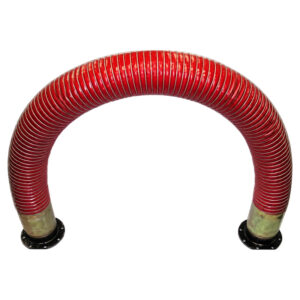
The light oil composite hose is built for petrol, kerosene and light diesel lines where permeation, weight and static build-up matter at the same time. It carries 10 bar (145 psi) across seven bores from 25 mm to 152 mm (1 in to 6 in) and runs from -40°C to +200°C. A modified PTFE and nylon liner backed by cross-linked PE holds the light fractions in, while the twin helix keeps the bore open and the assembly conductive end to end. Maximum length is 30 m.
Product Overview
The light oil composite hose is a non-vulcanised, multi-layer thermoplastic hose. That places it in the composite family covered by EN 13765:2018, not the rubber hose family, because layers are compressed mechanically instead of bonded by vulcanisation. On light distillates at 10 bar it sits in Type 2 liquid service: standard duty, continuous unloading.
In one sentence, it is a modified PTFE and nylon liner over a cross-linked PE barrier, wrapped in fabric plies and clamped between an inner and an outer helix under a coated fabric cover. Helices can be stainless, hot-dip galvanised, aluminium or coated steel.
Three numbers define it. Working pressure is 10 bar with 40 bar burst on a 4:1 factor. Bores run from 25 mm to 152 mm, covering tanker tails, railcar manifolds and most fixed arms. The window is -40°C to +200°C, enough for a cold rail yard and a hot terminal.
Four advantages decide most purchases. As a low permeation hose it holds the petrol specification through a long transfer. Weight starts at 0.75 kg/m. The 7 mm to 12 mm wall resists kinking behind the crimp. And the helix is bonded to both fittings, so the assembly is conductive.
As a fuel transfer hose it serves fuel terminals, tanker fleets, rail racks, exchange stations and depots moving petrol and light diesel. Equipment includes loading arms, bottom loading skids, pump sets and transfer carts. Most sites buy in bulk and keep a spare length on the rack.
The problem is quiet but expensive. Light distillates creep through a standard liner, so the hose sweats odour and leaves a film that attacks the cover. A low permeation hose cuts that loss, and a static conductive build takes the nozzle charge to a controlled value.
Quality is easy to audit. We hold ISO 9001 and ISO 18752, with MSHA, CE, CCS, ABS, DNV, API, GOST-R, RoHS and California Proposition 65 scope in the same file. Every assembly is proof tested and every crimp recorded digitally.
Product Advantages of the Light Oil Composite Hose
- Low-permeation liner: the cross-linked PE barrier holds light ends and keeps the cover dry.
- Light handling weight: from 0.75 kg/m, so two people move a full length.
- Static conductive as standard: the helix bonded to both fittings gives end-to-end continuity.
- Wide temperature window: -40°C to +200°C covers cold yards and hot terminals.
- Long single lengths: up to 30 m, which removes a coupling from most arms.
- Crimp records per assembly: every ferrule is swaged in-house with digital traceability.
Applicable users: terminal operators, tank truck fleets, rail racks, depot maintenance teams and industrial diesel users.
Detailed Technical Specifications
| Bore DN | Bore (in) | ID (mm) | OD (mm) | Bend radius (mm) | WP (bar) | Weight (kg/m) | Max length (m) |
|---|---|---|---|---|---|---|---|
| 25 | 1 | 25 | 38 | Quoted per size | 10 | Quoted per size | 30 |
| 38 | 1.5 | 38 | 50 | Quoted per size | 10 | Quoted per size | 30 |
| 50 | 2 | 50 | 64 | Quoted per size | 10 | Quoted per size | 30 |
| 64 | 2.5 | 64 | 76 | Quoted per size | 10 | Quoted per size | 30 |
| 76 | 3 | 76 | 89 | Quoted per size | 10 | Quoted per size | 30 |
| 102 | 4 | 102 | 127 | Quoted per size | 10 | Quoted per size | 30 |
| 152 | 6 | 152 | 178 | Quoted per size | 10 | Quoted per size | 30 |
- Temperature: -40°C to +200°C continuous; excursions above need written approval.
- Safety factor: 4:1, giving 40 bar burst against 10 bar working pressure.
- Wall: 7 mm to 12 mm by bore, which sets bend radius and abrasion reserve.
- Bend radius: 65 mm at the smallest bore to 710 mm at the largest; per-size values ship with the drawing.
- Weight: 0.75 kg/m to 10.5 kg/m across the range.
- Testing and tolerance: proof at 1.5 times working pressure to EN ISO 1402, dimensions to EN ISO 1307.
- Custom lengths: any length to 30 m, cut and crimped to order.
Structure and Materials
- Inner helix: stainless, hot-dip galvanised, aluminium alloy, or PP or PTFE-covered steel.
- Liner: modified PTFE and nylon film over a cross-linked PE barrier.
- Carcass: multiple fabric plies that carry axial load and stop liner extrusion.
- Portada: abrasion-resistant coated fabric that resists drag and splash.
- Outer helix: galvanised or stainless steel, formed over the cover for hoop load.
- End fittings: crimped ferrules with NPT or BSP male, camlock, flange or flare ends.
Why the composite build holds up
Two helices and a stack of fabric plies do different jobs. The inner helix is a spring inside the bore: when a pump pulls vacuum or an operator lifts a full length, it resists collapse and keeps the flow area round. The outer helix carries hoop load, so the carcass never needs to be stiff itself. The fabric plies take the axial pull that appears when 30 m hangs off an arm.
The plies are strong in tension and flexible in bending, so the hose bends like a rope while holding pressure like a pipe. A wire braided rubber hose of the same bore cannot do both: its reinforcement is bonded into a cured tube, so the same bend radius takes more force and the tube fatigues at the fitting. Mechanical compression lets each layer move slightly instead.
The liner is the chemical barrier. Modified PTFE and nylon resist swelling in light distillates, and the cross-linked PE layer blocks the small molecules that migrate through a plain film. Permeation depends on film thickness, temperature and concentration, so we build the barrier from several thin plies rather than one thick sheet: more interfaces, fewer pinholes, better flex life.
Safety factor, proof pressure and burst margin
The 4:1 factor is a build instruction, not a marketing line. Burst strength is four times the working pressure, so this hose is built to survive 40 bar. Every assembly is proof tested at 1.5 times working pressure, 15 bar here, held long enough to expose a liner or crimp fault that a visual check would miss.
Buyers should ask three questions. What is the burst figure at service temperature, because thermoplastics soften as they warm. What proof pressure was applied to this serial number. And what factor the standard requires, because EN 13765 sets 4:1 while some marine work asks for 5:1.
We proof test every light oil composite hose assembly, not a sample. The crimp record and proof record travel with the serial number, so a terminal audit can reconstruct what happened to that hose. If your line runs near the limit, say so and we will quote the next pressure class rather than stretch this one.
Chemical Compatibility and Media Guide
Ratings describe the standard light oil hose liner at ambient temperature. Heat, concentration and contact time each move a medium one column to the left.
| Media | Valoración | Note |
|---|---|---|
| Mineral hydraulic oil | Excelente | Low swell, mineral base stocks |
| Diesel | Excelente | Primary duty |
| Gasolina | Excelente | Low-permeation build |
| Kerosene | Excelente | No odour bleed |
| Crude oil | Bien | Varies by field |
| Lubricating oil | Bien | Additive packages vary |
| Vegetable oil | Bien | Rinse after transfer |
| Biodiesel B100 | Limited | Confirm blend |
| Ethanol E100 | Bien | Water carry-over matters |
| Methanol | Limited | Permeates faster |
| Toluene | Limited | Aromatic swelling |
| Xylene | Limited | Aromatic swelling |
| MEK | Limited | Short contact only |
| Acetone | Limited | Short contact only |
| Ethyl acetate | Limited | Short contact only |
| Dichloromethane | Not recommended | Use PTFE liner |
| Trichloroethylene | Not recommended | Chlorinated attack |
| 30% sulphuric acid | Bien | Static transfer |
| 98% sulphuric acid | Not recommended | Use PTFE liner |
| 35% hydrochloric acid | Bien | Vent vapor space |
| 50% sodium hydroxide | Bien | Ambient service |
| 10% ammonia | Bien | Check fittings |
| Sodium hypochlorite 12% | Limited | Oxidiser |
| Hydrogen peroxide 30% | Not recommended | Strong oxidiser |
| Phosphoric acid 85% | Bien | Ambient only |
| Nitric acid 65% | Not recommended | Use PTFE liner |
| Acetic acid 99% | Limited | Glacial acid swells PE |
| Ethylene glycol | Excelente | Coolant service |
| Propylene glycol | Excelente | Coolant service |
| Water | Excelente | Drain after use |
| Sea water | Excelente | Rinse fittings |
| Steam condensate | Limited | Heat is the limit |
| Jet A-1 | Excelente | Refueller service |
| MTBE | Limited | Ether permeates PE |
| LPG, liquid phase | Not recommended | Use cryogenic build |
| Isopropanol | Bien | Additive carrier |
| Benzene | Limited | Confirm before use |
Three rules apply. Derate for temperature, because a medium rated Excellent at +20°C can fall to Limited at +80°C, and the -40°C to +200°C window is a mechanical limit rather than a chemical licence. Check concentration, because 30% acid is not 98% acid. Respect contact time, because a flushed hose behaves differently from one that stands full.
Where a medium sits in the Limited column, the answer is usually a different liner rather than a thicker wall. Ask us to cross-check and request the compatibility chart as a PDF before a bulk order.
Applications and Industries
- Road tanker fuel transfer hose: 76 mm and 102 mm tails on pump sets with camlock or flange ends.
- Railcar transfer: top and bottom rack connections, where a 30 m length reaches the manifold without an extra coupling.
- Terminal loading arms: 102 mm and 152 mm assemblies sized to the arm outlet, not to the pump.
- Exchange stations and depots: 50 mm and 64 mm hoses on transfer carts for petrol and light diesel top-up.
- Aviation fuel depots: 38 mm and 50 mm refueller lines where low permeation protects the fuel specification.
- Industrial diesel day tanks: 25 mm and 38 mm suction and delivery lines on generator house pumps.
Selection Guide for Light Oil Composite Hose
Size, flow and pressure drop
Size the bore from flow rate and allowed pressure drop, not from the pump outlet. A 50 mm bore passes about four times the flow of a 25 mm bore at the same velocity, and velocity is what erodes a liner. Keep liquid velocity below roughly 6 m/s on continuous transfer.
Every extra metre adds friction loss and one more place to bend. If 30 m lets you remove a coupling, take it: fewer joints means fewer leak paths. Measure along the path the hose will take.
End fittings and hose assembly
Fittings are crimped, not clamped. A swaged ferrule compresses the carcass and helix onto a machined insert, so pull strength comes from the whole wall. We crimp in-house with digital records tied to your serial number. Standard ends are NPT male, BSP male, camlock, fixed, floating or reducing flange, tank coupling and 37 degree flare adapters, in stainless or carbon steel.
Stainless is the default for marine and chemical work; coated carbon steel suits a dry depot hose. A floating flange saves time on a misaligned face, and a reducing flange removes an adapter. Give us the mating flange standard and bolt pattern.
How it compares
| Option | Typical use | Trade-off against this hose |
|---|---|---|
| This light oil composite hose | Petrol, kerosene, light diesel, 10 bar | Low permeation, light, conductive |
| PP chemical composite hose | Acids, alkalis, general solvents | Better acid resistance, more permeation on light ends |
| PTFE composite hose | Aromatics, chlorinated solvents, oxidisers | Wider chemistry, higher cost per metre |
| Marine composite hose, 14 bar | Ship to shore, large bore | Higher pressure, heavier and stiffer |
| Rubber hose to EN 1765 | Dock oil suction and discharge | Heavier, wider bend radius, shorter flex life |
A rubber hose of the same bore needs a wider bend radius, weighs more per metre, and fatigues sooner at the fitting.
What drives the price
Four things set cost per metre: bore, helix material, liner build and end fittings. Stainless helices cost more than hot-dip galvanised steel, and a PTFE-covered inner helix more again. A low-permeation liner adds plies and a barrier film. Fittings are priced per pair and can rival the hose on short assemblies.
Bulk and wholesale pricing is quoted per metre against annual demand, so ask for the cost at 100 m, 500 m and 1,000 m.
Common selection mistakes
- Sizing from the pump flange instead of the flow rate, which doubles velocity and liner wear.
- Ordering a 10 bar assembly for a line that sees 12 bar whenever a valve closes.
- Reading the compatibility table at +20°C only, on an aromatic or oxygenated stream.
- Bonding one end of the assembly and assuming the hose itself carries continuity.
Installation, Operation and Maintenance
Installation
- Support horizontal runs on saddles every 1.5 m, so weight never hangs from the fittings.
- Keep the rated bend radius clear at each end, which means 710 mm from the fitting face at the largest bore.
- Leave a slight sag between arm and tank, because a hose pulled dead straight feeds vibration into the crimp.
- Never twist the assembly during connection. Lay it out, then tighten.
- Bond both ends to earth so the static conductive path is continuous, then check it on site.
- Fit a protective sleeve or guard wherever the cover can touch a steel edge.
Inspection and retirement
Check the hose before each shift and log what you find. Look for cover blisters, soft spots behind the ferrule, exposed fabric, a helix starting to protrude, and any kink that will not spring back. Run a hand along the first 300 mm behind each fitting, because that is where the liner flexes hardest.
Retire on evidence, not on age alone. Put a proof test at 1.5 times working pressure into the annual routine, and pull any hose that fails to hold, bulges or leaks at a crimp. We recommend a documented review at six years for petroleum service, earlier where the hose is dragged or runs above +80°C.
Cleaning, storage and service life
Flush with the next product or a compatible cleaner, drain, and hang to dry with both ends open. Never leave a petrol-filled hose in the sun: vapor pressure builds, permeation rises and the cover softens. Store coiled on a rack, off the floor, out of sunlight, and never under something heavy that can flatten the bore.
Quality Assurance and Test Data
Incoming inspection checks film thickness, fabric weight and helix wire diameter against specification, and quarantines any roll without a mill certificate. Extrusion and film forming follow, then helix forming to a bore-specific pitch. Assembly stacks liner, plies and cover over the inner helix before the outer helix is formed.
The stack is compressed without cure. There is no vulcanisation step, so the process is mechanical and repeatable: one press setting gives one wall thickness on every run. Proof testing follows at 1.5 times working pressure, held and recorded per assembly, then marking with size, pressure class, batch and serial number.
Tests follow EN ISO 1402 for proof, EN ISO 6803 for impulse where specified, EN ISO 8031 for electrical resistance, EN ISO 1746 for bend and EN ISO 1307 for dimensions. Traceability ties the finished hose to the liner roll, the helix wire lot and the crimp record.
Packaging is film wrap plus plywood case or pallet for LCL, and bubble wrap with a reel for FCL. Coils are strapped so the bore cannot ovalise.
Normas y certificaciones
| Estándar | What it covers | What it means for the buyer |
|---|---|---|
| EN 13765:2018 | Thermoplastic multi-layer hose for hydrocarbons and chemicals | Type 2 liquid service fits this 10 bar product |
| EN ISO 1402 | Hydrostatic pressure testing | Proof at 1.5 times working pressure |
| EN ISO 6803 | Impulse testing | Flex fatigue under pressure cycling |
| EN ISO 8031 | Electrical resistance and continuity | Conductive build verified end to end |
| EN ISO 1307 | Dimensions and tolerances | Bore and length match the drawing |
| EN 1765 | Rubber hose for oil suction and discharge | Comparison reference only |
Company certifications held: ISO 9001, ISO 18752, MSHA, CE, CCS, ABS, DNV, California Proposition 65, RoHS, API, GOST-R and MA metrology accreditation. Market requirements such as IMO IBC Code or OCIMF guidance apply to terminals and vessels, not to us, so we cite them only to help you specify.
Preguntas frecuentes
What is the light oil composite hose made of?
A modified PTFE and nylon liner over a cross-linked PE barrier, multiple fabric plies, a coated fabric cover and steel or aluminium helices inside and out. Layers are compressed, not vulcanised.
What does the 10 bar rating mean?
It is continuous working pressure at rated temperature, with 40 bar burst behind it on a 4:1 factor. Spikes above 10 bar should be discussed before they become routine.
Can this hose handle vacuum?
A suction build is available for the bores we can rate, and we confirm the figure in writing per order. Do not infer vacuum capability from the pressure rating.
What is the temperature limit?
-40°C to +200°C continuous, the range published for this build. Above +200°C the film stack degrades, so a hotter stream needs our high temperature composite hose.
Which media are not suitable?
Aromatic solvents, chlorinated hydrocarbons and strong oxidisers sit outside the standard liner. Toluene, xylene, dichloromethane and 98% sulphuric acid need a PTFE composite hose build.
How is it different from a rubber hose?
It is lighter and bends tighter than a rubber fuel transfer hose, and reaches vacuum capability with a twin helix instead of a heavy wire carcass.
When should I choose PTFE instead?
When the medium falls in the Limited column, or when the stream is aromatic, chlorinated or oxidising. The PTFE composite hose costs more and covers far more chemistry.
What is the minimum order and lead time?
Custom sampling runs on a 48-hour basis and bulk orders on standard specifications ship in about 7 days. The smallest economic order depends on the bore and end configuration, so we quote it per enquiry.
How do I get a quote or PDF datasheet?
Send medium, temperature, pressure, bore, length, end connection and quantity through the contact form. We return a quotation, drawing and datasheet PDF, usually the same day.
Why Source Composite Hose from HENGHUA
We build this product in an 18,000 m2 plant near Hengshui, with a Tianjin office handling export paperwork and 8 high-speed lines running 25 million metres a year. That scale is why a 1,000 m order in one bore does not queue behind a container load, and why we hold liner film and helix wire for the fastest-moving bores.
Certification is broad because our customers are. ISO 9001 and ISO 18752 cover the quality system, and the same file holds MSHA, CE, CCS, ABS, DNV, API, GOST-R, RoHS, California Proposition 65 and MA metrology scope. Buyers in 70+ countries have used those documents at their own audits.
Assembly is in-house: cutting, helix forming, crimping and proof testing under one roof, so the ferrule on your hose is not a third-party operation. Digital crimp records and batch traceability let us answer a question about a serial number two years later. OEM and ODM work is routine, including custom labelling and private label packaging.
Speed is part of the offer. Custom sampling takes 48 hours, standard bulk specifications turn around in about 7 days, and real-time order tracking keeps a distributor informed. Add sizing support in English and after-sales replacement of any assembly that fails its proof test, and the commercial risk of switching supplier drops.
We are a manufacturer and exporter, not a trading house, so the specification conversation happens with the people who set the press. That is why we ask for the medium in writing: a light oil hose is only as good as the match between liner and fluid.
Solicitar un presupuesto
Send your medium, concentration, temperature, pressure, bore, length, end connection, quantity and destination port, and our sales engineers will return a quotation with a drawing and a datasheet PDF. Tell us whether the assembly needs a conductive build, a protective sleeve or a rope cover for abrasive ground, and we will quote the finished hose assembly rather than a bare length. We can supply the compatibility chart, a sample for trial and a certificate pack for your audit. Browse the composite hose range or contact us through the site form.


 English
 Spanish
 Portuguese
 French
 German
 Arabic
 Russian
 Indonesian
 Japanese
 Korean