
A straight air hose stores flat and delivers the largest bore and flow; a coiled hose is heat-set into a helix so it retracts itself, stays off the floor, and needs no reel. That self-storage comes at the cost of a smaller standard bore, a lower pressure rating, and a constant pull force against your tool. Choose the coil for short, repetitive work at a fixed station; choose the straight hose for long runs, high-flow tools, and anywhere you need 3/8 or 1/2 inch bore.
This comparison sets out how a coiled hose is made, the eight differences that change how each hose performs, a size-and-length table, and the failure modes specific to coils — including the one that kills most of them. For the straight-hose side of that choice, see our PVC, rubber, and hybrid air hose comparison and the air hose buyer’s guide.
About a 13-minute read at 250 words per minute; rated ranges follow ISO 5774:2023 and ISO 2398:2024.
Air Hose vs Coiled Air Hose: The Short Answer
- Coiled hose — a self-retracting polyurethane air hose or nylon helix, usually 1/4-inch bore, working lengths of 10 to 50 feet. Best for a fixed station: tire bays, assembly benches, blow guns, small die grinders.
- Straight air hose — flat-stored rubber, hybrid, or PVC hose in 1/4 to 1/2 inch bore, any length. Best for long runs, high-flow tools, and mobile work.
- The deciding factors are flow and pull. A coil’s smaller bore limits air-hungry tools, and its spring force pulls back against you all day.
What Is a Coiled Air Hose?
A coiled hose — also sold as a recoil hose, self-coiling hose, or air line coil — is a length of flexible tubing wound into a helix and heat-set so the polymer retains the spiral. Release one end and the hose retracts toward its coiled length under its own elasticity. A polyurethane air hose is the version most workshops meet, with nylon as the stiffer alternative.
Two polymer families dominate. Polyurethane (PU) is the most common: light, abrasion-resistant, and it holds a helix well. Nylon coils are stiffer, take more heat and pressure, and feel heavier in the hand.
The helix is not a spring made of metal — it is the material’s own memory. That has a consequence most buyers discover later: heat-set memory relaxes over time and with heat exposure, so a coil that has been stretched and left in the sun will hang lower and retract weakly.
How a Coiled Air Hose Is Made (and Why It Matters to You)
Manufacturers extrude tubing, then wind it onto a mandrel and heat it above the polymer’s softening point before cooling it in the coiled position. The polymer crystallizes in that shape, which sets the memory.
Three production variables decide how the coil behaves in your hand:
- Mandrel diameter sets the coil’s outer diameter and its retraction force.
- Wall thickness sets the working pressure — thicker wall, higher rating, less flexibility.
- Heat-set temperature and time set how long the memory lasts. Under-cured coils lose retraction within months.
This is why two 1/4-inch coils can feel completely different: same bore, different wall, different heat-set. When you evaluate samples, stretch one to full length and leave it for a day before judging.
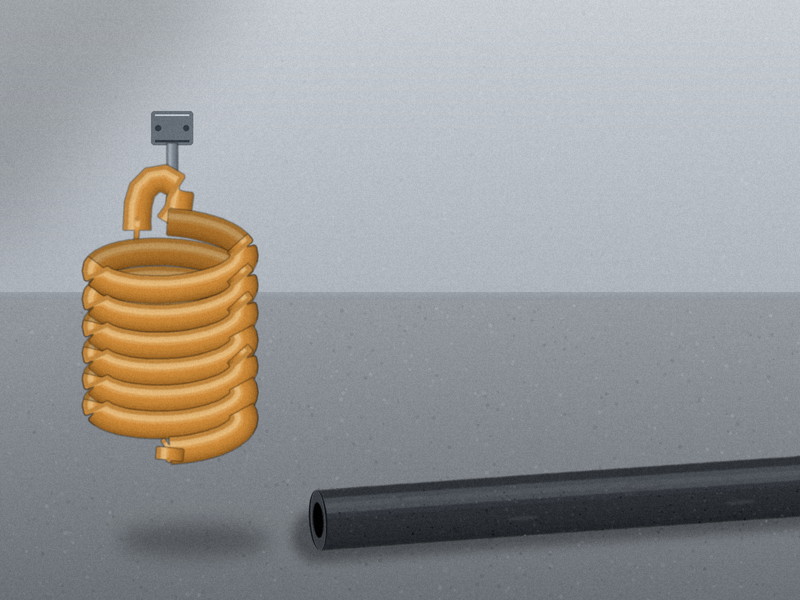
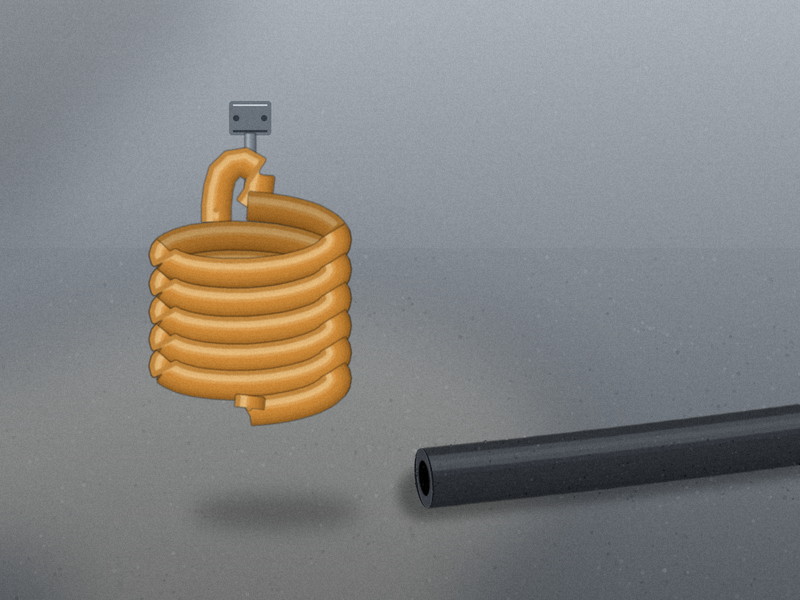
Figure 1. A coiled PU air hose beside a straight 3/8-inch rubber hose. The coil stays off the floor and self-retracts; the straight hose carries more flow and takes the abuse.
The 8 Differences That Matter
1. Stored length vs working length
A straight hose is its own length, whether deployed or hung. A coil has two numbers: its coiled length (typically 1 to 5 feet) and its extended length (typically 10 to 50 feet). Pull it and it extends; let go and it retracts.
The practical gain is that the coil never becomes an obstacle. Nothing to hang, nothing to trip over, no reel to wind. That is the entire reason coils exist.
2. Bore size and airflow
Coils are most commonly 1/4-inch bore. Straight hose is commonly offered in 1/4, 3/8, and 1/2 inch. This is the single most important difference in practice, because bore size governs flow.
A 1/4-inch hose is fine for blow guns, small nailers, and 1/4-inch die grinders. It will starve an impact wrench, a sandblaster, or a spray gun over any real distance. Our air hose size chart and what size air hose do I need guide show where 1/4 inch stops being adequate.
3. Pressure rating
A typical 1/4-inch PU recoil hose is rated about 150 to 200 PSI working pressure. A textile-reinforced straight air hose is commonly rated 200 to 500 PSI. Coils are also limited by their fittings, which are usually small-bore push-fit or barbed ends rather than crimped brass.
If your system runs above roughly 150 PSI, a standard coil is the wrong component. Our working pressure versus burst pressure explainer covers the safety arithmetic behind that limit.
4. Weight and pull force
A 25-foot PU coil weighs roughly 1.5 to 2 lb — far less than a comparable straight hose. But weight is not the whole story: the coil exerts a continuous retraction force on your tool, and that force grows as you extend it toward its full stretch.
At full extension, a stiff coil pulls noticeably on a small tool and can drag a lightweight blow gun off a bench. Nylon coils are worse in this respect than PU. Bore and length trade-offs are set out in our how to measure air hose size guide.
5. Coil memory and recovery
PU holds its coil memory longer than PVC and recovers better after extension. Nylon recovers well but feels stiffer. Cheap PVC coils have the shortest memory life and often hang loose within a season.
6. Temperature behavior
PU coils are typically rated from -40°F to 140°F (-40°C to 60°C) under ISO 5774:2023. Nylon coils stay serviceable in the cold, and PVC coils stiffen below freezing; hot surfaces relax the heat-set memory permanently.
A coil left where the sun reaches it will lose retraction regardless of polymer — that is a storage problem, not a manufacturing complaint.
7. Service life and failure mode
Straight hose usually fails from abrasion or from a cut near the fitting. Coils usually fail from memory loss first — they stop retracting — and only then from cracking at the highest-stress point of the helix.
That changes the cost calculus. A coil can be physically intact and still be useless, which does not happen with a straight hose.
8. Cost and total value
A 25-foot PU coil and a 25-foot 1/4-inch straight hose sit in a similar price band, but they solve different problems. The coil’s value is the reel it replaces and the floor it keeps clear. The straight hose’s value is flow and durability. Neither is a cheaper version of the other.
Straight Air Hose vs Coiled Air Hose: Which for Which Job
Table 1. Application guide for straight versus coiled hose.
| Solicitud | Best choice | Motivo |
|---|---|---|
| Tire inflation bay | Coiled, 1/4 in | Short reach, repetitive, hose must stay off the floor |
| Assembly bench, blow gun | Coiled, 1/4 in | Low air demand at short distance |
| Small die grinder, 1/4 in drive | Coiled, 1/4 in, higher rating | Intermittent use, maneuverability matters |
| Impact wrench, 1/2 in drive | Straight, 3/8 in minimum | High air demand; a 1/4 in coil starves it |
| Spray painting | Straight, 3/8 in | Continuous flow at constant pressure |
| Sandblasting | Straight, 1/2 in | Very high air demand |
| Mobile service van | Straight, 3/8 in hybrid | Long, variable reach; weight matters |
| Fixed production cell, repeated short runs | Coiled, overhead mounted | Self-retracting overhead keeps the cell clear |
| Long outdoor runs | Straight, 1/2 in | Coils are not designed for extended deployment |
| Overhead drop to a bench | Coiled, mounted above | Retracts out of the way between tasks |
Coiled Air Hose Sizes and Working Lengths
Table 2. Common coiled hose configurations. Confirm the bore, not just the working length — bore decides what tools the coil can run.
| Bore (inch / metric) | Common working lengths | Typical working pressure | Fits |
|---|---|---|---|
| 1/4 in / 6 mm | 10 ft, 15 ft, 25 ft | 150–200 PSI | Blow guns, small nailers, 1/4 in grinders |
| 5/16 in / 8 mm | 25 ft, 30 ft | 150–200 PSI | Medium nailers, light impact work at short range |
| 3/8 in / 10 mm | 25 ft, 50 ft | 150–200 PSI | Impact wrenches and spray guns at short range |
| 1/2 in / 13 mm | 25 ft | 150 PSI | High-flow tools; heavy and stiff in coil form |
Note the trade-off row by row: as bore rises, the coil gets heavier, its retraction force rises, and its stored length grows. A 1/2-inch coil is rarely the right answer — at that flow demand a straight hose on a reel is more practical.
Choosing, Using, and Troubleshooting a Coiled Air Hose
- Start with the tool’s air demand, not the coil’s size. Match bore to the tool’s consumption at your working distance.
- Choose a working length about 1.2× your farthest reach. Coils pulled to full extension can permanently stretch and retract weakly afterwards.
- Check the fittings before the hose. Coils come with 1/4-inch NPT male ends, quick-connect plugs, or bare barbs. Match your existing system, or budget for adapters.
- Mount the fixed end high. Overhead mounting lets gravity help the coil retract and keeps the working end free.
- Never use a coil as a permanent run. Coils are working hoses, not plumbing.
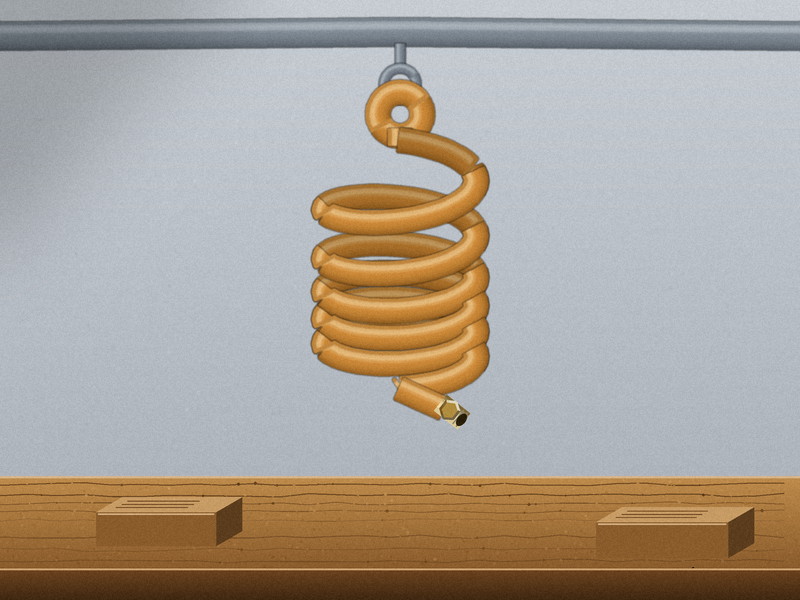
Figure 2. A recoil hose mounted overhead. The fixed end carries the weight, the working end retracts clear of the bench — the configuration coils are designed for.
Five problems account for most coil failures:
- The coil stops retracting. Memory loss from heat exposure or prolonged full extension. Not repairable; the heat-set is gone.
- The tool feels weak. Bore too small for the tool’s demand, not a compressor problem. Measure the coil bore before blaming the air supply.
- Leaks at the swivel or coupling. The most flexed point of the helix. Support the fitting so the hose does not hang from it.
- The coil tangles on itself. Usually a coil stored at full extension rather than relaxed, or a coil with uneven heat-set.
- Cracking at the same point every time. A sharp pull against a fixed edge. Reroute or add a strain relief.
Working Length: How to Size a Coil to the Job
Working length is the number buyers get wrong most often, because it is measured at full extension and the coil is not designed to live there.
Four rules cover most cases:
- Measure your farthest practical reach, then add about 20%. A bench that needs 12 feet of reach calls for a 15-foot coil.
- Expect the coil to run out of retraction near full extension. The last 15% of a coil’s length is where the pull on the tool is strongest and where the helix is most stressed.
- Do not size from the coiled length. A coil that stores in 2 feet does not deliver 2 feet of working reach.
- Confirm which length the supplier quotes. Some list stretched length, others list the extended length. Establish which, in writing, before ordering.
Table 3. Sizing a coiled hose by reach and tool demand.
| Farthest reach needed | Recommended length | Bore for light tools | Bore for medium tools |
|---|---|---|---|
| Up to 8 ft | 10 ft | 1/4 in | 1/4 in |
| Up to 12 ft | 15 ft | 1/4 in | 5/16 in |
| Up to 20 ft | 25 ft | 1/4 in | 3/8 in |
| Up to 40 ft | 50 ft | Not recommended | 3/8 in |
The last row is the boundary case worth remembering. A 50-foot coil stretched to full length is working at the edge of its design, and its retraction will weaken with use. If a job genuinely needs 40 feet of reach with moderate airflow, a straight hose on a reel is usually the better tool.
Storing a Coil So It Keeps Its Retraction
Heat-set memory degrades, and almost all of that degradation comes from storage rather than use — coil memory is a storage property as much as a manufacturing one. Three habits extend a coil’s retraction life substantially:
- Store it relaxed, not stretched. A coil left at full extension, hanging from one end, takes a set and will retract weakly from then on.
- Keep it out of direct sun and away from hot surfaces. Heat is what relaxes a heat-set helix. A coil left on a truck dashboard in summer is being permanently damaged.
- Hang it from the fixed end, not the working end. The fixed end is designed to take the load; the working end carries the coupling.
Table 4. Coil storage habits, what each one protects, and what ignoring it costs.
| Storage habit | What it protects | If you ignore it |
|---|---|---|
| Store the coil relaxed, not stretched | The heat-set that provides retraction | The coil takes a set and retracts weakly from then on |
| Keep it out of direct sun and off hot surfaces | The helix geometry held in the polymer | Retraction relaxes permanently; a dashboard in summer is enough |
| Hang it from the fixed end, not the working end | The coupling at the working end | The working end carries the load and the coupling leaks |
| Do not try to re-set a dead coil | Your time and the coil’s remaining pressure rating | Heat can restore shape but not the rated wall strength |
Two things you cannot fix, and should not try to. A coil that has lost its retraction cannot be re-set with household methods, and one that has cracked at the peak of the helix cannot be repaired back to its rated pressure.
When a Coil Is the Wrong Answer
Four situations where a coil will disappoint and a straight hose will not:
- Long, variable reach. Coils suit a fixed station with a predictable reach. Mobile work across a site needs a straight hose.
- High air demand. A 1/2-inch impact wrench on a 1/4-inch coil will run weak regardless of compressor size.
- Continuous duty with a heavy tool. The constant retraction pull becomes a strain on the wrist and on the tool’s air inlet.
- High ambient temperatures. In a hot working area the heat-set relaxes and the coil hangs loose within a season.
None of those four is a defect in the coil. Each is a case of the wrong hose type for the duty. That is the practical summary of this comparison: the coil is a specialist tool for a fixed station, and the straight hose is the generalist that handles everything else.
Air Hose vs Coiled Air Hose FAQs
What is the difference between an air hose and a coiled air hose?
A straight air hose is a flat-stored flexible line of fixed length. A coiled hose is heat-set into a helix so it self-retracts, stores short, and needs no reel. The coil trades bore size, pressure rating, and a pull force on the tool for self-storage.
Is a coiled air hose as good as a straight air hose?
For short, repetitive, low-demand work it is better, because it stays out of the way, needs no reel, and cannot be run over in the same way. For high-flow tools or long runs it is worse, because 1/4-inch bore and a 150–200 PSI rating limit both airflow and pressure.
What is a coiled air hose made of?
Most commonly a polyurethane air hose, which is light, abrasion-resistant, and holds a helix well. Nylon coils are stiffer, resist higher pressure and heat, and feel heavier in the hand. PVC coils are the cheapest option, and they lose their memory fastest.
Can a coiled air hose run an impact wrench?
A 1/4-inch coil cannot deliver enough air for a 1/2-inch impact wrench over any useful distance, because the bore chokes the flow the tool needs. A 3/8-inch coil can run an impact wrench at short range, where the pressure drop is small. For sustained impact work, use a straight 3/8-inch or 1/2-inch hose.
How long do coiled air hoses last?
PU coils last several years in normal bench use if they are stored relaxed and kept out of direct sun. The first thing to go is retraction, and heat exposure is the usual cause. A coil that still holds pressure but hangs loose has reached the end of its useful life, not a repairable state.
Can a coil hose be shortened or repaired?
A coil can be cut back and refitted with new ends, but only at a workshop: the helix must be re-set or the cut end will not retract evenly. Cutting a coil short also raises its pull force. A coil that has lost its heat-set cannot be repaired at all, so shortening is only worth doing on a coil that still retracts well.
What bore does a coil need for a spray gun?
A 1/4-inch coil is usually too small for a spray gun, which needs steady volume rather than peak pressure. Use 3/8-inch bore at minimum, keep the run short, and check that the coil’s 150–200 PSI rating still covers your regulator setting with margin. For sustained spraying, a straight 3/8-inch hose remains the better choice.
Do coils work in cold weather?
PU coils are typically rated down to -40°F (-40°C) under ISO 5774:2023, so an unheated workshop is usually fine. PVC coils stiffen below freezing and should not be stored coiled in a freezing space, because a cold coil pulled straight can crack at the helix peak.
Are coils suitable for a mobile service van?
Only for short, repetitive jobs at the van itself. The coil’s limited bore and its constant pull suit a fixed station, not variable work across a site, so a straight 3/8-inch hybrid hose is usually the better van choice.
About HENGHUA
HENGHUA manufactures coiled and straight air hoses and reinforced hose assemblies for workshops, distributors, and OEM brands worldwide. Our coiled air hoses are polyurethane, heat-set on controlled mandrels in 1/4, 5/16, 3/8, and 1/2 inch. Working lengths run from 10 to 50 feet, rated 150–200 PSI, fitted with brass or nickel-plated couplings as standard. Straight air hose is available in PVC, hybrid, and rubber from 1/4 to 1/2 inch, rated 200–500 PSI.
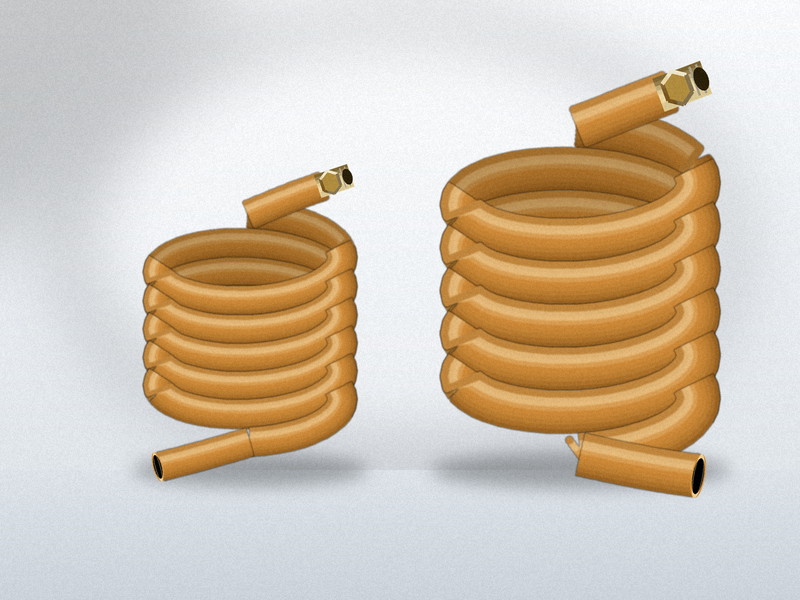
Figure 3. HENGHUA polyurethane coiled air hoses in 1/4-inch and 3/8-inch bore.
Because we heat-set in-house, we can tune retraction force and coil diameter to your market rather than selling one generic spring rate. Custom bores, lengths, colors, fittings, and OEM/ODM branding are available at factory-direct pricing. Tell us your tools, working pressure, and reach, and contact our engineering team for a quote and samples.
Written by the HENGHUA Engineering Team — the engineers who extrude, heat-set, and pressure-test the hoses we manufacture — with input from workshop users across the US and Europe. HENGHUA manufactures coiled and straight air hose assemblies from 1/4 inch to 1/2 inch, rated 150–500 PSI, with custom lengths, fittings, and OEM branding available.






 English
  Spanish
  Portuguese
  French
  German
  Arabic
  Russian
  Indonesian
  Japanese
  Korean