
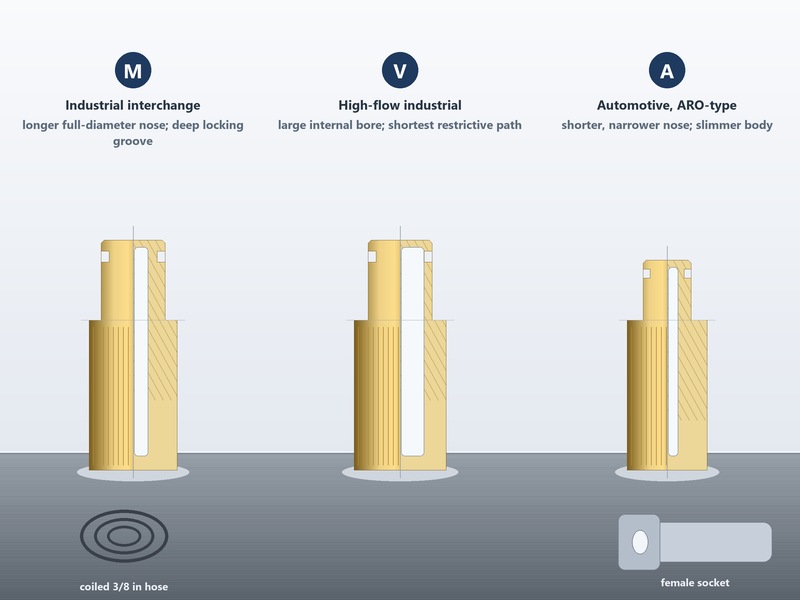
Industrial pneumatic couplers are the quick-disconnect fittings that join a compressed-air hose to a tool, and the style letter on the plug decides what it will lock into. M-style is the North American shop default, V-style is the high-flow option, and A-style is the automotive profile.
Choosing between them is a shop-wide decision, not a one-off purchase. This guide covers the interchange specifications behind the style letters, the measured flow of M, V, and A, the cost of a mixed shop, a four-step standardization plan, and the maintenance rules that keep any coupling sealing.
All flow figures are our bench measurements at 100 PSI inlet and 23 °C ambient; tool demand figures are manufacturer ratings at 90 PSI. About 13 min read.
What Industrial Pneumatic Couplers Actually Standardize
In this category, industrial means the coupling follows a published interchange specification, so a plug from one manufacturer locks into a socket from another. A brand name is a label; the specification is what makes two parts from two factories fit together. The style letters shops use for these profiles come from catalogue practice, and the specification is what governs interchange.
Three documents carry most of the weight in North American and international trade. A-A-59439 is the current commercial item description for quick-disconnect air hose couplings, and it replaced the older military specification. MIL-C-4109 is that earlier military specification, still printed on plenty of packaging and catalog pages. The ISO 6150 series covers cylindrical quick-action couplings and fixes the plug connecting dimensions for each series, which is what allows cross-border interchange within a series.
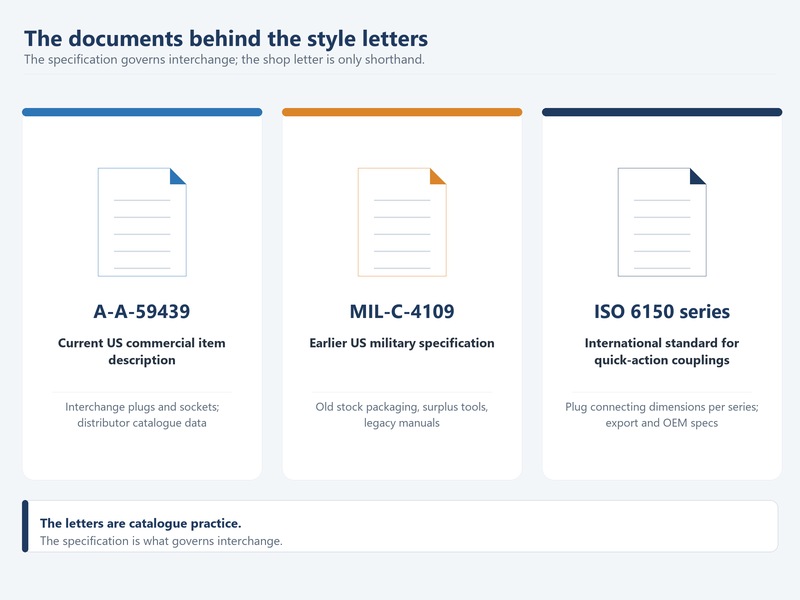
Figure 2. The interchange documents behind the style letters: a US commercial item description, its military predecessor, and the international ISO 6150 series.
Table 1. The interchange specifications behind industrial pneumatic couplers, in plain terms
| Designation | What it covers | Where a shop meets it |
|---|---|---|
| A-A-59439 | Current US commercial item description for quick-disconnect air hose couplings | Distributor catalog data, industrial interchange plugs and sockets |
| MIL-C-4109 | Earlier US military specification for the same coupling family, superseded but still referenced | Old stock packaging, surplus tools, legacy maintenance manuals |
| ISO 6150 series | Pneumatic quick-action couplings: plug connecting dimensions and interchangeability per series | European and export machinery, OEM tool specs, global catalogs |
| ISO 4414 | General rules for pneumatic fluid power systems and their components | System-level design checks, safety documentation |
| ASME B1.20.1 | NPT pipe threads, 60° included angle with a 1/16 taper | The threaded end of every adapter, barb, and coupler stem |
Where the industrial profile differs from the automotive profile
The industrial and automotive families differ in nose diameter, nose length, and the position of the locking groove.
An A-style plug uses the automotive, ARO-type profile. It has a different nose than an industrial M-style plug of the same nominal size, so it will not lock in an M-style socket. The reverse also holds. This is the single most common swap a shop tries to make, and it is the reason the industrial vs automotive air coupler question comes up on almost every counter visit.
The nominal size adds a second layer of confusion. A “1/4 in coupler” describes the hose or thread end, not the plug nose. Two 1/4 in couplers from different families look similar in a parts bin and behave nothing alike at the coupling.
M-Style, V-Style, and A-Style Industrial Pneumatic Couplers Side by Side
The three profiles a shop actually chooses between share one job: mate a hose to a tool without leaking and without slowing the air down. They differ in bore, body length, and where they dominate distribution.
Table 2. M-style, V-style and A-style couplers compared at a 1/4 in nominal size
| Attribute | M-style | V-style | A-style |
|---|---|---|---|
| Profile family | Industrial interchange | High-flow industrial | Automotive, ARO-type |
| Nose and body | Longer, full-diameter nose with a deep locking groove | Large internal bore, shortest restrictive path, reinforced body | Shorter nose, narrower than industrial, slim body |
| Typical flow at 100 PSI inlet and 23 °C, 1/4 in | ≈40 SCFM | Above M at the same nominal size; the hose bore becomes the limit | ≈35 SCFM |
| Best for | General shop air across mixed tool sets | Impact wrenches, sanders, long hose runs, high-cycle lines | Legacy automotive air, blow guns, tire service |
| Where it dominates | North American distribution, the de-facto default | Industrial maintenance and heavy-duty kits | Automotive service channels and older shops |
| Main drawback | Restriction shows up on long runs and hungry tools | Higher cost per unit, larger body envelope | Limited industrial availability at short notice |
M-style earns its default status through inventory rather than performance. Almost every air tool sold into North America arrives with an M-style plug already fitted, and every general distributor stocks the matching sockets. That matters more than a few SCFM when a tool is down and a technician is standing in line.
On our flow bench, a 1/4 in M-style coupler passes about 40 SCFM at 100 PSI inlet. A 1/4 in A-style coupler passes about 35 SCFM under the same conditions, and an E-style coupler sits in the same range as A. The gap between M and A is small enough that few shops notice it on a brad nailer, and large enough to matter on a die grinder running all day.
V-style changes the starting point rather than the finish line. It is built as a high-flow profile, with a larger internal bore for the same nominal size and a shorter restrictive path through the socket. We do not publish a single V figure, because past a certain bore the hose and the tool inlet become the limiting factors. What we measure consistently is that a V-style coupling resists flow loss better than a standard M-style coupling of the same nominal size on the same hose.
A-style remains the right answer in one specific place: a shop whose tools and hoses already carry the automotive profile and whose suppliers still stock it. Converting a healthy A-style fleet to M buys convenience and costs money.
Table 3. What each style is best at, and where it still holds ground
| Shop situation | Sensible style | Why |
|---|---|---|
| General maintenance shop, mixed tool brands | M-style | Tools arrive with M plugs; every distributor stocks donors and spares |
| Heavy repair bay with 1/2 in impact wrenches | V-style | Burst air demand is high; a larger bore protects pressure at the tool |
| Long hose runs over 50 ft | V-style at the tool end | Every restriction compounds with length |
| Legacy automotive service bay | A-style until it wears out | Existing hoses and sockets already match; no forced conversion |
| Mixed shop with no clear majority | M-style plus one adapter drawer | Cheapest common denominator, least new inventory |
What a Mixed Shop Really Costs
A mixed shop rarely fails loudly. It leaks, hesitates, and consumes time in small increments that never appear on a maintenance budget line.
The visible cost is inventory. Every extra profile doubles the number of plug and socket lines a shop carries, and each line needs its own spares and its own reorder trigger. A two-profile shop also carries adapters, because the adapters are what make the two halves of the fleet talk to each other.
The invisible cost is downtime. When a technician cannot find the right adapter, the tool waits, the job waits, and someone improvises. Improvised couplings are how a plug gets forced into the wrong socket and how a slow leak becomes a permanent one.
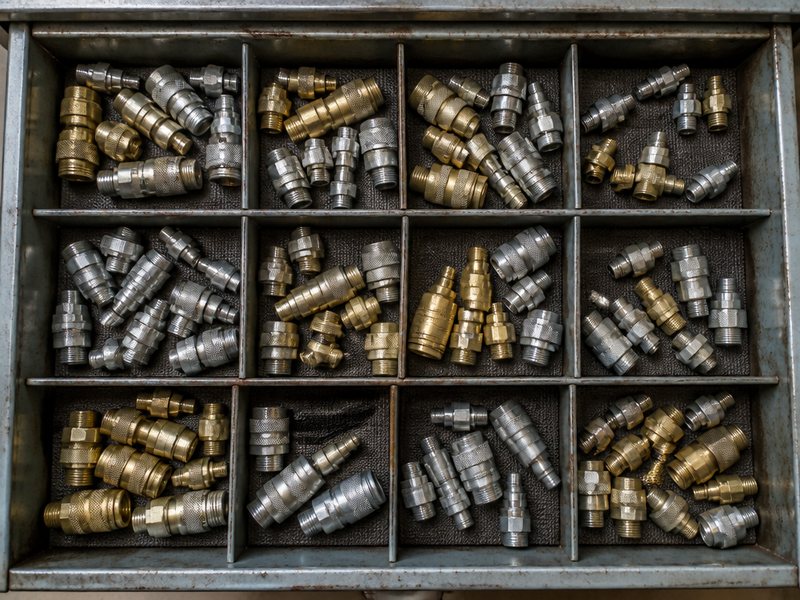
Figure 3. A mixed shop shows up as an adapter drawer: extra inventory lines, extra spares, and a search every time a tool is swapped.
Table 4. The cost of a mixed shop profile, item by item
| Cost item | What it looks like in the shop | Where it lands |
|---|---|---|
| Plugs that half-fit | A plug enters the socket but will not lock, or locks with play | Wasted labor, damaged collars |
| Tools that feel weak | An impact wrench that stalls on a fastener it used to remove | Rework, damaged fasteners, missed flat rate |
| Leaks at the coupling | A steady hiss, an O-ring that wears early, a compressor that cycles more often | Energy cost, seal replacement labor |
| Extra inventory lines | Two of every plug and socket, plus adapters and two sets of O-rings | Working capital, shelf space, obsolescence |
| Adapter hunting | A technician walking the shop for a fitting that is on the other bench | Billable hours lost at the highest labor rate in the building |
None of the five items is large on its own. Together they are the reason a standardization decision pays back faster than almost any other small purchase in a shop.
A Four-Step Standardization Plan for Industrial Pneumatic Couplers
Standardization works when it is decided once, applied in order, and written down, so the next hire inherits the decision instead of re-opening it. Four steps cover the whole job.
Step 1: Audit what you own
Walk the shop and record every plug and socket by profile and nominal size. Count the wall drops, the plugs on the tools, the hose ends, and the adapters in the drawer. Thirty minutes with a clipboard beats a year of guessing. Record what is actually fitted, not what was ordered, because air tool coupler types migrate whenever tools and hoses get swapped between bays.
The audit is really an industrial vs automotive air coupler split, written down. A shop that orders an industrial air hose coupler and an automotive socket in the same week learns the difference the first time a technician tries to couple them. If the team needs a profile map before the count, the quick connect profile chart handles identification; this article is about the decision that follows it.
Step 2: Pick the style
Two inputs decide the answer: what the highest-demand tools already use, and what the distributor can restock quickly.
An M-style coupler at 1/4 in satisfies most general shop air because the tools that draw the most air usually arrive with M-style plugs already fitted. The industrial air hose coupler on the wall drop and the automotive plug on the tool are the pair that most often disagree, and the audit in Step 1 is what exposes them.
Treat the industrial vs automotive air coupler decision as a stock question first and a performance question second. A profile your distributor cannot restock in 48 hours is a profile that will stall a bay. The compatibility and selection checks on our air hose fittings guide cover the mating side of the same decision, and the run-length and bore side is covered in how to choose an air hose.
Step 3: Convert tool plugs first
Plugs cost less than sockets and take seconds to change. Convert in this order: tool plugs, then hose ends, then wall drops, then the fixed compressor outlets.
Converting tool plugs first means the highest-turnover items match earliest, and the remaining mismatches move to the fixed end of the system where they cause the least disruption. Keep the removed plugs in a labeled bin for the first month.
Step 4: Keep one adapter drawer
Every shop needs one escape hatch, and it should be small, labeled, and audited twice a year. A single drawer of adapters is a controlled exception. Adapters scattered across benches and tool bags are the uncontrolled version of the same thing. Once the air tool coupler types in daily use drop to one, the drawer stops growing and starts shrinking.
Table 5. The four standardization steps, what each one costs, and who owns it
| Step | Action | Effort | Typical cost shape |
|---|---|---|---|
| 1 | Audit every plug and socket by profile and size | Half a day, one technician | Labor only |
| 2 | Choose the style from tool majority and distribution support | One decision | None |
| 3 | Convert tool plugs, then hose ends, then wall drops | Staged over two to four weeks | Plugs in bulk, then sockets; planning range only |
| 4 | Keep one labeled adapter drawer with spares and O-rings | Ongoing, audited twice a year | Small, one-off stock value |
Flow Economics: When a High-Flow Coupling Rescues a Starved Impact Wrench
A starved impact wrench usually has less to do with the tool than with the path the air takes to reach it. Every restriction in that path drops pressure, and the tool is rated at 90 PSI at its inlet.
A 1/2 in impact wrench draws roughly 4 to 8 SCFM, and a 3/4 in version reaches 8 to 10 SCFM. Those are averages, and impact wrenches do not draw average air. They gulp in short bursts at the moment of impact, which is exactly when the restriction across a coupling, a swivel, and a long hose shows up as pressure loss.
A V-style coupler earns its price when the air-hungriest tool in the shop is also the furthest from the compressor. A 1/4 in hose passes about 40 SCFM at 100 PSI, a 3/8 in hose about 80 SCFM, and a 1/2 in hose about 140 SCFM on our bench. Those numbers describe the hose alone. The coupling adds its own restriction, and the smaller the coupling bore relative to the hose bore, the more of the hose capacity the coupling gives back.
Swapping the wall drop to a V-style coupler and the plug on the wrench gives the air a wider path at the two points where it changes direction and speed. On a 50 ft run with a 3/8 in hose, that change is often the difference between a fastener that comes out and one that has to be cut off. High-flow V-style couplings for impact tools are sized for exactly that case.
Measure before upgrading every drop in the building. If a drop feeds a brad nailer at 0.3 to 0.5 SCFM, or a framing nailer at 2.0 to 2.5 SCFM, the coupler is not the constraint and the upgrade buys nothing. The air hose size chart shows where each bore stops being adequate, and the matching hose for a V-style conversion is in our air hose collection.
Table 6. Diagnosis: when the coupling is the bottleneck, and when it is not
| Síntoma | Likely bottleneck | Correct fix |
|---|---|---|
| Impact wrench weak only on the longest drop | Restriction compounding with hose length | Larger bore at the tool end and a high-flow coupling |
| Every tool on every drop feels weak | Compressor output, regulator setting, or a leaking header | Check supply pressure and leaks before couplings |
| Tool weak after a coupler was replaced | Wrong profile seated but not fully locked, or a low-flow replacement body | Verify the style and the bore of the replacement part |
| Hissing at the coupling when the tool runs | Worked or dry O-ring, or a scored plug nose | Replace the O-ring, then the plug if the nose is worn |
| Weak only in cold weather | Stiffened hose and cold-hardened seals | Fit a cold-rated hose and fresh seals |
Safety and Maintenance Rules for Industrial Pneumatic Couplers
A coupling that is treated as a permanent fitting becomes a safety item. The habits below cost almost nothing and prevent the failures that stop a shift.
Depressurize before you disconnect. A pressurized hose end can whip when it releases, and the risk is highest on large bore lines. The US Occupational Safety and Health Administration limits cleaning with compressed air to 30 PSI under 29 CFR 1910.242(b), covers tool condition under 1910.242(a), and applies a construction-specific rule at 29 CFR 1926.302(b)(5). Whatever the local rule, the practical version is the same: isolate, bleed, then disconnect.
If a plug will not lock, stop and check two things: the profile and the sleeve. A coupling that will not lock is usually a worn sleeve or a wrong profile. Forcing a wrong profile into place damages the locking collar permanently.
Treat O-rings as consumables with a replacement interval. For a general shop, annual replacement across the fleet is a reasonable planning default. Shorten it in high-cycle bays, hot shops, and any line where the tool is swapped dozens of times a day. Replace immediately on any visible nick, flat spot, or dry, hardened surface.
Replace the coupling when it plays. Locking play, a sleeve that no longer springs back, or a leak that returns after an O-ring change all point at the body. Industrial pneumatic couplers of any profile are wear items with a finite cycle life, and a replacement is cheaper than the air and labor a slow leak consumes.
Keep an industrial air hose coupler matched to its job. A coupler rated 150 to 300 PSI in brass is fine for shop air; heavy-duty steel bodies reach 500 PSI for higher-pressure lines, and burst pressure runs three to four times the working figure.
Temperature is set by the hose and the seal. Rubber is rated -40 to +70 °C under ISO 2398:2024, and PVC or PU -10 to +60 °C under ISO 5774:2023, at a reference condition of 23 °C. Match both limits to the line.
Buying plugs across several air tool coupler types is the habit that quietly rebuilds a mixed standard within a year.
Industrial Pneumatic Couplers FAQs
What is the difference between industrial and automotive air couplers?
The industrial family follows an interchange specification such as A-A-59439, MIL-C-4109, or the ISO 6150 series, and the automotive family uses the ARO-type profile. The two differ in nose diameter, nose length, and locking-groove position, so the plugs will not lock into each other’s sockets. Both are sold in the same nominal sizes, which is what makes the difference easy to miss on a counter.
Is M-style the same thing as industrial interchange?
Yes in practice. M-style is the shop-floor name for the industrial interchange profile that MIL-C-4109 and its A-A-59439 successor describe. Distributors use the letter because it is shorter, and tool catalogs often print the specification instead. When a catalog lists an industrial interchange plug in 1/4 in, it is the same part as an M-style plug of that size.
Will an A-style plug fit an M-style socket?
The A-style plug uses the automotive profile, so it locks only in an A-style socket, and an M-style plug locks only in an M-style socket. The parts may enter partway, which is the trap: a plug that enters but does not lock is a wrong profile, not a worn socket. Check the profile before assuming wear.
Which coupler style should a small shop standardize on?
Most small shops should standardize on M-style, because air tools sold into North America usually arrive with M-style plugs and general distributors stock the sockets. Choose V-style instead when the shop runs large impact tools, and stay with A-style when the existing fleet is already automotive and nothing is failing.
Does a V-style coupler really flow more than an M-style coupler?
Yes, at the same nominal size, because the V-style body has a larger internal bore and a shorter restrictive path. We do not publish a single V figure, since past a certain bore the hose and the tool inlet become the limit. The practical gain is measured at the tool as less pressure drop under burst demand, which is where an impact wrench feels it.
Can I standardize on M-style if my tools already have A-style plugs?
Yes, and it is usually the cheapest route. Plugs are inexpensive and swap in seconds, so converting tool plugs first leaves the wall drops working while the fleet catches up. Keep the removed plugs in a labeled bin for a month in case a tool goes out on a job before the change is complete.
How often should coupler O-rings be replaced?
For a general shop, plan on annual replacement across the fleet as a starting interval. Shorten it in high-cycle bays, in hot areas, and wherever tools are connected and disconnected dozens of times a day. Replace on condition as well: any nick, flat spot, or hardened surface is a leak waiting to happen, regardless of how long the O-ring has been fitted.
Why does my impact wrench feel weak after I added a longer hose?
Because every restriction in the air path compounds with length. A longer hose adds pressure drop, and the coupling, swivel, and fittings add more. The tool still needs 90 PSI at its inlet, and burst demand makes the drop worse at the moment of impact. Check inlet pressure at the tool under load before replacing anything.
Are industrial pneumatic couplers interchangeable between brands?
Within the same interchange profile, yes. That is the entire purpose of the specifications: an M-style plug from one maker locks into an M-style socket from another, and the ISO 6150 series does the same job internationally. Interchange stops at the profile boundary, so brand compatibility never overrides style compatibility.
How much does a mixed coupler inventory cost a shop?
The measurable part is duplicate stock: two lines of plugs, two of sockets, adapters, and two sets of O-rings. The larger part is downtime, because every adapter hunt and every half-fitting plug consumes technician time. A mixed standard also tends to grow, since each new tool purchase can add another profile to the shelf.
Do I need to depressurize before disconnecting a coupler?
Yes. Isolate the line and bleed the pressure before releasing any coupling, especially on large bore hoses where a pressurized end can whip. The compressed-air cleaning limit of 30 PSI under 29 CFR 1910.242(b) shows how seriously the regulator treats stored air energy. A two-second habit prevents the most common coupler injury.
Next Steps: Standardize Deliberately
Industrial pneumatic couplers reward a decision made once. The shop that picks a profile deliberately carries less stock, loses less air, and stops paying a technician to hunt for adapters.
The action list is short. Audit the plugs and sockets you own. Pick the profile your highest-demand tools use or your distributor stocks. Convert tool plugs first, wall drops last. Keep one adapter drawer and one spare O-ring bin. Then re-audit in six months, because new tools arrive with whatever profile the seller chose.
HENGHUA manufactures air hose fittings, quick connect couplers, air hoses, and hose assemblies for distributors, retailers, and OEM brands worldwide. Couplers are machined from brass, zinc-plated steel, or stainless steel, thread-checked against NPT and BSP gauges, and pressure-tested to rated working pressure before shipment. The range covers 1/4, 3/8, and 1/2 in plugs and sockets in M-, A-, and E-style interchange profiles, plus hose barbs, NPT-to-BSP adapters, reducers, complete kits, and spare O-rings for every coupler we sell.
Factory-direct pricing, short lead times on bulk orders, private labeling, custom packaging, and OEM/ODM branding are all available. If you are standardizing a shop, a distribution range, or an OEM program, contact our team for a quote and samples, and we will help you match the style, size, and thread standard to your market.
About the author. This article was prepared by the HENGHUA engineering team, which designs and pressure-tests pneumatic couplers, air hose fittings, and hose assemblies. The team works daily with interchange profiles, thread gauges, and flow bench measurements, and supports customers with style selection, material choice, and application questions.






 English
  Spanish
  Portuguese
  French
  German
  Arabic
  Russian
  Indonesian
  Japanese
  Korean