

A garden hose adapter is a short two-ended fitting that changes one thread standard into another, so two couplings that were never designed to meet can still seal. The five abbreviations in this guide cover almost every connection a hose buyer meets. NST and NH belong to the fire-hose coupling family, NPSH covers straight pipe joints on hose hardware, GHT is the residential spigot thread, and NPT is the tapered pipe thread found on pumps, filters and pressure-washer inlets.
Four variables decide whether any two of them will mate: nominal size, threads per inch, thread form and sealing method. This guide decodes all five standards one by one and puts their published numbers side by side. Work through it once and you can identify both threads on a part, check the fit, and order the right adapter. It then gives you the conversion matrix, shows how to identify an unknown thread with a caliper and a pitch gauge, and closes with the failures that no adapter can repair.
Every adapter decision starts with which of these five you have.
1. What Do NST, NH, NPSH, GHT and NPT Stand For?
Thread abbreviations grew out of three separate trades: firefighting, plumbing and garden watering. That history explains why one thread can carry two or three names, and why two threads that share a name can still be different sizes. Start with the words behind the letters, because half of all ordering mistakes happen when a buyer assumes the letters describe the size.
What Does Each Abbreviation Mean?
Here is the shortest accurate definition of each standard, in the order you are most likely to meet it:
- NST (National Standard Thread) — the North American fire-hose coupling thread, tabulated for sizes from 3/4 inch through 6 inch. Parallel form, gasket seal.
- NH (National Hose) — the current name for the same thread NFPA 1963 describes. NH and NST are two labels for one profile.
- NPSH (National Pipe Straight Hose) — a straight pipe thread that uses the NPT pitch series without the taper. It seals on a gasket, not on thread interference.
- GHT (Garden Hose Thread) — the residential standard, 3/4 inch nominal at 11.5 threads per inch, written as NHR in hose-coupling thread tables.
- NPT (National Pipe Taper) — a tapered pipe thread with a 1:16 taper. It seals when the threads wedge together, assisted by tape or sealant.
Four of those five are parallel threads that need a gasket to seal. Only NPT seals on the thread itself. That single difference decides most of the compatibility questions in the rest of this guide.
Why Does One Thread Carry Two or Three Names?
None of these threads belongs to a single trade, so each trade named it for itself. The NH thread and the NST thread are the same 60-degree parallel form with a flat crest and root. Older specification sheets print NST, current fire-service documents print NH, and some suppliers print NHT, which is only a third spelling of the same thing. The same overlap runs through the pipe family. NPSH is also called IPT or SIPT, and NPT is also called TPT or TIPT on older drawings.
The lesson is practical rather than academic. A label alone never proves compatibility, because the labels were never designed to be exclusive. Only three measurements prove it: male outside diameter, threads per inch and thread form.
Which Threads Mate Directly With Which?
Only identical standards mate reliably, and even then the coupling must be the right size. NH mates with NH, NST with NST, NPSH with NPSH, and NPT with NPT. Everything else needs a dedicated adapter with the correct thread cut on each end.
Two pairings fool people most often, and both involve a shared pitch. A 3/4 inch NPT male and a 3/4 inch straight thread share 14 threads per inch, so they screw together several turns before the taper binds. A 1 inch NPT male and a 1 inch NH male both run at 11.5 threads per inch, but their outside diameters differ by 0.06 inch (calculated).
If you want the full GHT, NPT, BSPP, BSPT and NPSH numbers in one place, the hose thread size chart is the companion reference to this page.
Table 1. The five thread standards in a buyer’s vocabulary
| Estándar | Full name | Form | Seals on | Typical host part |
|---|---|---|---|---|
| NST | National Standard Thread | 60 degree, parallel | Flat gasket in the female coupling | Hydrant outlets, fire-hose couplings |
| NH | National Hose | 60 degree, parallel | Flat gasket in the female coupling | Fire-hose couplings, booster lines |
| NPSH | National Pipe Straight Hose | 60 degree, parallel pipe | Gasket or washer face | Pump suction ports, hose nipples |
| GHT | Garden Hose Thread | 60 degree, parallel | Rubber or fiber washer | Spigots, spray nozzles, timers |
| NPT | National Pipe Taper | 60 degree, 1:16 taper | Thread interference plus sealant | Pumps, filters, valves, pressure-washer inlets |

Two sealing methods: a squeezed gasket face against wedged taper threads.
2. How Does the Fire-Hose Family (NH and NST) Work?
The fire-hose family is the branch most buyers never touch, yet it explains why the words NST and NH keep appearing in search results for a garden hose adapter. Fire hose hardware is built to a coupling standard, not to a hose-size standard. The nominal size tells you which hose the coupling belongs to, and the thread data tells you what it will screw onto.
What Do the NH Thread Numbers Mean?
An NH thread is written as two numbers, nominal size and threads per inch, and the pitch does not follow the pipe series at all. Published hose-coupling thread tables show why. A 1-1/2 inch NH coupling runs at 9 threads per inch, while a 1-1/2 inch NPT fitting runs at 11.5. A 2-1/2 inch NH coupling runs at 7.5 threads per inch against 8 for the same pipe size. The two families were designed by different committees for different loads, so the numbers diverge even where the nominal size matches.
The male outside diameter is the second useful number, and it is always larger than the nominal size. A 2-1/2 inch NH male measures about 3.068 inches across the threads. The extra metal covers the wall thickness of the coupling, which wraps the hose and takes the gasket.
What Does the NST Thread Look Like on a Real Coupling?
An NST thread is a full-form parallel thread cut on a brass, aluminum or stainless coupling. The male end carries a straight thread and a shoulder. The female end carries a matching thread and a recessed gasket, and the two flat faces squeeze that gasket as you tighten by hand. The thread profile is not meant to stop water, so a worn or missing gasket leaks at any pressure.
The gasket design is deliberate. Fire crews connect and disconnect couplings repeatedly, often with gloves on, and they need a joint that seals at hand-tight.
How Is the Fire-Hose Family Different From Your Spigot?
The fire-hose family and the residential family look similar and are not the same. Fire couplings start at 3/4 inch nominal, are built from metal for pumping pressures, and are sealed by a flat gasket. Residential fittings use one common thread size and a rubber or fiber washer. A 3/4 inch label can sit on both, which is the most confusing overlap in the subject.
Table 2. Published NH and NST coupling thread data by nominal size
| Nominal size (in) | Male thread outside diameter (in) | Threads per inch | Typical service |
|---|---|---|---|
| 3/4 | 1.375 | 8 | Booster and forestry hose (1 inch thread) |
| 1 | 1.375 | 8 | Wildland and forestry hose |
| 1-1/2 | 1.990 | 9 | Attack lines, standpipe connections |
| 2 | 2.515 | 8 | Medium-diameter supply hose |
| 2-1/2 | 3.068 | 7.5 | Supply lines, hydrant outlets |
| 3 | 3.623 | 6 | Large-volume supply operations |
| 3-1/2 | 4.243 | 6 | Marine and industrial supply |
| 4 | 5.010 | 4 | High-volume transfer |
| 4-1/2 | 5.760 | 4 | Pump suction hardware |
| 5 | 6.260 | 4 | Large-diameter supply |
| 6 | 7.025 | 4 | Industrial and marine supply |
3. What Is an NPSH Thread and Where Does It Appear?
NPSH is the straight-thread branch of the pipe world. It carries the same pitch as the equivalent NPT size, but the diameter stays constant along the full length of the thread instead of tapering. That one change moves the sealing job from the thread to a gasket, and it changes which fittings can be swapped in the field.
Where Do You Meet This Thread in Practice?
The NPSH thread appears wherever a hose must attach to a port that has to be reconnected often. Common hosts include the suction inlet on pumps, hose nipples that screw into a manifold, and drain or transfer ports on equipment that is assembled and broken down repeatedly. A straight thread survives that duty cycle better than a taper, because the seal does not depend on how far the fitting is driven in.
At 1-1/2 inches, the NPSH male outside diameter is about 1.878 inches with a pitch of 11.5 threads per inch. The matching NPT pipe size measures 1.900 inches at the same pitch. The pitch matches, the diameter does not, which is why tape and hope do not turn one into the other.
How Does NPSH Compare With NPT?
NPT and NPSH are close enough to mislead, so put them side by side. The taper adds about 1/16 inch of diameter for every inch of NPT thread length, while NPSH holds one diameter for the whole thread. A female NPSH port therefore cannot grip a tapered male along its full length, so contact concentrates at the first threads and the joint feels tight while it weeps.
Table 3. NPT against NPSH by nominal size
| Nominal size (in) | NPT pipe outside diameter (in) | NPT threads per inch | NPSH male outside diameter, max (in) | NPSH threads per inch |
|---|---|---|---|---|
| 1/4 | 0.540 | 18 | Not a listed hose-coupling size | — |
| 3/8 | 0.675 | 18 | Not a listed hose-coupling size | — |
| 1/2 | 0.840 | 14 | 0.8248 | 14 |
| 3/4 | 1.050 | 14 | 1.035 | 14 |
| 1 | 1.315 | 11.5 | 1.295 | 11.5 |
| 1-1/4 | 1.660 | 11.5 | 1.6399 | 11.5 |
| 1-1/2 | 1.900 | 11.5 | 1.878 | 11.5 |
| 2 | 2.375 | 11.5 | 2.352 | 11.5 |
| 2-1/2 | 2.875 | 8 | 2.841 | 8 |
| 3 | 3.500 | 8 | 3.470 | 8 |
Is NPSH the Same as NPSM?
No, although they share a pitch family and are often confused. NPSM is the straight mechanical pipe thread used on locknuts, sight glasses and equipment ports, and it usually seals against a face or a soft washer. NPSH is the hose-coupling variant, sized for a male nipple that enters a swivel. Their diameters and truncations differ, so they are not interchangeable in a pressure joint. The NPSM vs NPT thread guide covers the mechanical version in detail.
4. Where Does GHT Sit in the Residential Family?
GHT is the thread most readers own without ever learning its name. It is the straight 60-degree thread on a spigot, a spray nozzle, a timer, a splitter, and the female end of a garden hose. Any of those parts becomes a candidate for a garden hose adapter when the thread on the other side belongs to a different standard.
What Are the GHT Numbers?
Garden hose thread is published as 3/4 inch nominal, 11.5 threads per inch, with a male outside diameter of 1.0625 inch, which is 27.0 mm. The nominal size describes the thread, not the hose. The same thread serves 1/2 inch, 5/8 inch and 3/4 inch hose, so the bore changes while the fitting stays the same. That is why a buyer asking for a “1/2 inch adapter” usually means an adapter for a 1/2 inch hose, not a thread that measures half an inch.
Why Do Published Charts Disagree About 3/4 Inch?
Two widely copied tables give different values for a 3/4 inch fire-hose coupling, and each one is consistent with the family it describes. The first lists a 3/4 inch NST coupling at 1.063 inch outside diameter with 11.5 threads per inch, which is the garden-hose thread at 1.0625 inch rounded to three decimals. The second, drawn from the hose-coupling thread tables, lists a 3/4 inch NH coupling at 1.375 inch with 8 threads per inch. Both rows are accurate, and they describe two different couplings that share one nominal size.
The practical consequence of those two readings matters more than their history. A purchase order reading “3/4 inch NH” is ambiguous, because the garden series at 1.0625 inch and the full-form fire coupling at 1.375 inch will not screw together. Always add outside diameter and threads per inch, or buy from a supplier that states both on the line item. When one chart seems to contradict another, trust the chart that gives the numbers rather than the label.
What Does GHT Share With the Fire-Hose Family?
Less than the shared 60-degree thread angle suggests. Both families use a straight thread with a flat crest, and both seal on a gasket instead of on the threads. They part company on diameter, pitch and duty, because a residential fitting is sized for a household supply while a fire coupling is sized for pumping pressure. Threads that look alike across that boundary are where cross-threading happens.
Table 4. Residential and fire-service threads by nominal size, hose size or thread size
| Nominal size (in) | Garden hose series diameter (in) | Garden hose series threads per inch | Full-form NH diameter (in) | Full-form NH threads per inch |
|---|---|---|---|---|
| 1/2 | 1.0625 | 11.5 | Not a tabulated fire coupling | – |
| 5/8 | 1.0625 | 11.5 | Not a tabulated fire coupling | – |
| 3/4 | 1.0625 | 11.5 | 1.375 | 8 |
| 1 | Not a tabulated garden size | – | 1.375 | 8 |
| 1-1/2 | Not a tabulated garden size | – | 1.990 | 9 |
| 2-1/2 | Not a tabulated garden size | – | 3.068 | 7.5 |
5. Which Threads Does a Garden Hose Adapter Mate?
An adapter is defined by its two ends, and a correct order always names both of them. The end that meets your spigot and the end that meets the appliance are two separate specifications. Compressing either one into “the same size” is how the wrong part arrives and how a return begins.
How Do You Read the Two Ends of a Part Number?
A complete thread callout carries four pieces of information, and a supplier needs all four before cutting metal:
- Nominal thread size, written as a fraction, a decimal or a dash number.
- Thread standard or series, such as GHT, NH, NPSH or NPT.
- Gender, because a male thread and a female thread of the same size are different parts.
- Seat detail, such as a swivel, a gasket seat or a flat washer face.
A callout such as “3/4 inch GHT male to 1/2 inch NPT male” answers all four questions for both ends at once. A callout such as “brass adapter, garden size” answers none of them. Sizes are also not interchangeable across a thread standard, so the same 3/4 inch figure can describe a fitting that measures 1.0625 inch or 1.375 inch across the threads. Measuring is the other half of the job, and the 3/4 inch GHT measurement and compatibility guide shows where to place a caliper on each common residential fitting.
Which Conversions Need an Adapter and Which Do Not?
The matrix below covers the pairings that generate most order questions. Read it as a statement about standards first and sizes second, because a size match inside a standard is normal and a size match across standards is a coincidence.
Table 5. Adapter matrix for the common hose thread pairings
| From | To | Direct mate | What you actually need |
|---|---|---|---|
| NH or NST, same nominal size | NH or NST, same nominal size | Yes | A sound gasket in the female coupling |
| GHT | GHT | Yes | A fresh washer if the joint weeps |
| GHT | 1/2 inch NPT | No | GHT to 1/2 inch NPT adapter or swivel |
| GHT | 3/4 inch NPT | No | GHT to 3/4 inch NPT adapter; the pitches differ at 11.5 and 14 |
| NPT | NPT, same nominal size | Yes | Thread sealant or tape on the taper |
| NPT | NPSH | No | A straight-to-taper adapter rated for the pressure |
| NPSH | NPSH, same nominal size | Yes | A flat gasket or washer face in good condition |
| NH or NST | NPT pipe | No | A fire-hose-to-pipe adapter with both standards stated |
| GHT female | GHT female | No | A double-female adapter or a hose splicer |
| GHT | Pressure-washer inlet | No | A GHT to quick-connect or GHT to M22 adapter |
An NH or NST thread that meets pipe is the pairing that catches people, because hose sizes and pipe sizes are counted differently. A 2-1/2 inch fire coupling and a 2-1/2 inch pipe fitting are both called 2-1/2 inch and share neither diameter nor pitch. The same caution applies to an NPSH thread that meets a tapered male. It also applies to a GHT fitting that meets a 3/4 inch pipe thread, where 11.5 and 14 threads per inch are close enough to start and wrong enough to finish badly.
What Does a Reducer or a Bushing Do That an Adapter Cannot?
A reducer changes nominal size inside one thread standard and leaves that standard unchanged. A bushing does the same job with a male thread outside and a female thread inside. Neither part can bridge two standards, because both ends are cut to one series. A reducer will not rescue a joint between different families, and forcing it damages both threads. A short hex adapter with the correct thread on each end is the only part that converts.
Where Do Quick Connectors Fit Into This Picture?
A quick connector replaces the threaded interface with a push-and-click joint, so the thread question moves to the adapter that carries it. One half stays on the tap, the other stays on the hose or tool, and the two halves must share a series to latch. Quick connectors help where a garden hose meets a pressure washer, because the tool needs a different connection each time you switch accessories. The pressure washer quick connect guide covers the series and the mismatch traps, and any adapter you add to the line has to be matched to the hose rating.
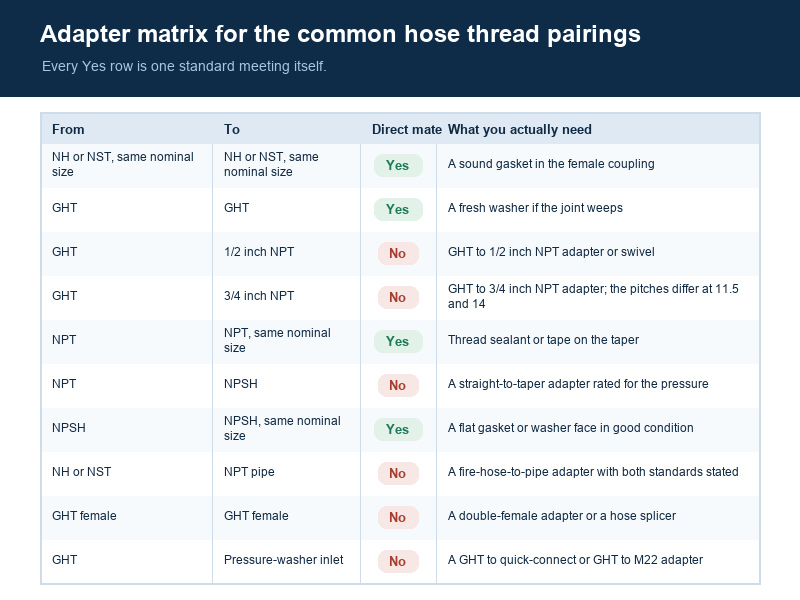
Every Yes row is one standard meeting itself.
6. How Do You Identify an Unknown Thread in Ten Minutes?
Three tools settle the question: a caliper, a thread pitch gauge, and one known male fitting that you trust. A ruler works in place of the pitch gauge if you accept a little less precision. Do the work before you order, because a returned adapter costs more time than the measurement takes.
Measure the Outside Diameter First
Measure across the crests of the male thread with calipers, and take the reading at the first full thread rather than the chamfer. The outside diameter always exceeds the nominal size, so a reading near 1.0625 inch points to the garden-hose series. A reading near 1.375 inch points to a 3/4 inch or 1 inch full-form NH thread.
Count the Threads Per Inch With a Gauge
Lay the pitch gauge across the thread and find the leaf that seats without rocking. If you have no gauge, measure one inch of thread length and count the crests inside it. The count separates the two families quickly, because 11.5 threads per inch belongs to GHT and to 1 inch pipe, while 8 threads per inch belongs to several NH sizes and to 2-1/2 inch pipe.
Confirm the Match With a Known Fitting
Thread a known male part into the unknown female port by hand, and stop at the first resistance. A correct parallel thread runs in by hand until the faces meet. A correct tapered thread runs in by hand for about half its length and then tightens progressively. If the fitting wobbles, turns freely and never seats, the pair is wrong even when the pitch felt right.
Record the Result Before You Order
Write the diameter, the threads per inch and the sealing method in the equipment file, and note the part number you ordered. The record keeps a repeat order from carrying the same error.
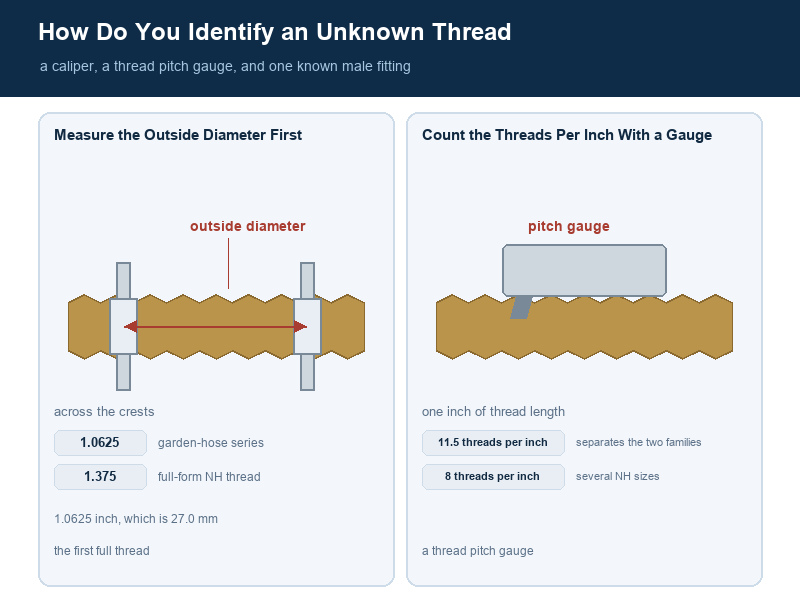
Caliper across the crests and a pitch gauge on the same male thread.
7. How Do You Choose the Right Garden Hose Adapter?
Choosing a garden hose adapter is a four-step check, and each step removes one class of mistake. Match the thread standard on both ends, confirm the size by measurement, decide how the joint will seal, then confirm the material and rating against the pressure and the water quality.
Which Comes First, the Thread or the Size?
The thread standard comes first, because a size match across two standards is worthless. Once the standards match on both ends, then confirm the size, the gender and the seat. This order also tells you when you need a two-part solution, such as a swivel adapter plus a quick connector, instead of a single part that does not exist.
How Much Flow Does an Adapter Cost You?
A reduction in bore costs flow, and the arithmetic is simple to run. Picture a 5/8 inch hose fitted with a 1/2 inch bore adapter. The diameter ratio is 0.8, and area scales with the square of diameter, so the adapter passes about 64 percent of the hose area. The restriction removes roughly 36 percent of the cross section, and that figure is calculated rather than measured. Real flow loss depends on pressure, hose length and fitting friction, so treat the number as a warning rather than a rating.
Which Material Should an Adapter Be?
Three materials cover almost every residential and light industrial case:
- Brass, machined from bar stock, for spigot and appliance connections that stay outdoors.
- Stainless steel, for wash-down, marine and food areas where corrosion resistance matters.
- Engineered polymer, for light duty, quick-connect halves and parts that must not scratch a fixture.
Zinc alloy sits below brass on durability, and a plated part with thin plating loses that plating at the thread crest. If the water is for drinking, ask for a wetted-material declaration, because some jurisdictions limit the lead content of wetted surfaces. The hose and adapter range lists the thread standard and the material on each line item, which is the two pieces of information that decide whether the part will work.
What Should You Check Before You Tighten It?
Check the gasket, the thread start and the number of hand turns. Tighten a gasketed coupling no further than a quarter turn past hand-tight, because more force deforms the gasket seat and makes the next connection worse.
8. What Can a Garden Hose Adapter Not Fix?
An adapter changes a thread and nothing else. It leaves the sealing method, the pressure rating, the hose bore and a damaged part exactly as they were, and knowing those limits prevents the most expensive mistakes. Each of the following cases ends with the same advice: replace the part or the connection, and do not add torque or sealant to bridge the difference.
It Cannot Make a Tapered Thread Seal in a Straight Port
A tapered male carries a diameter that grows along its length, and a straight port holds one diameter from end to end. The first threads bite, the joint feels secure, and the seal depends on a thin band of contact. Wrap the fitting with more tape and the band moves, but it does not become a face seal. The correct part is a straight-thread fitting with a washer or gasket, or an adapter that converts between the two sealing methods on purpose.
It Cannot Repair a Thread That Is Already Damaged
Cross-threading removes metal from the crest, and that metal does not come back. A thread file or a die can clean a burr, and neither restores the profile that carries the load. A male end forced twice into the wrong pitch will hold a correct coupling loosely and leak at the first pressure spike. Replace it when the crests are flattened.
It Cannot Raise the Rating of the Hose or the Fitting
The rating of a hose assembly belongs to its weakest part. A pressure-rated hose with a light-duty adapter on the end is rated by the adapter. A garden hose adapter is generally built for household supply pressure, and it is not a part for a pressure washer pump outlet or a compressed-air line. Install the adapter on the low-pressure side of the equipment, and read the pressure washer hose buying guide before you place hardware in the high-pressure path.
It Cannot Fix a Mismatched Thread System Permanently
An adapter is the right answer for a temporary connection, such as a test port, a guest hook-up or an imported appliance. It is a poor answer for a permanent installation that people who did not buy the adapter will open. A site with one odd thread tends to collect a chain of adapters, and every link adds a surface that can leak. Standardize the permanent connection, and if two thread systems must coexist for years, state the requirement through the contact page so the assembly is built for it.
Preguntas frecuentes
What is a garden hose adapter used for?
A garden hose adapter converts one thread standard into another, so two fittings with different threads can still connect and seal. Typical jobs include joining a garden hose to a kitchen or utility sink faucet, joining a hose to a pressure-washer inlet, replacing a worn male end, and joining two hose sections with female ends. It can also convert a thread size inside one standard, although a reducer or bushing usually does that job.
Is the NH thread the same as NST thread?
Yes. NH and NST describe one thread profile, a 60-degree parallel form with a flat crest that seals on a gasket. Older documents print NST, current fire-service documents print NH, and some suppliers print NHT. Because the names are interchangeable, a purchase order should always carry the outside diameter and the threads per inch as well. That practice removes the last ambiguity when two couplings share a nominal size.
What does the NPSH thread seal against?
An NPSH thread seals against a gasket or a washer face rather than against the thread itself. The thread is straight, so it cannot wedge like a taper, and tightening only presses two faces together. The gasket carries the load, so a hardened, missing or wrongly sized gasket is a leak even when the threads are in perfect condition. Always fit the gasket the coupling was designed around.
What thread size is a standard garden hose?
A standard garden hose uses garden hose thread, 3/4 inch nominal, 11.5 threads per inch, with a male outside diameter of 1.0625 inch. The same thread fits 1/2 inch, 5/8 inch and 3/4 inch hose, so the bore of the hose and the size of the thread are separate specifications. If a fitting measures 1.0625 inch across the threads, it is the garden series.
Can an NPT fitting screw into a garden hose spigot?
It can start, and it should not be used. Garden hose thread runs at 11.5 threads per inch and NPT pipe at 14 threads per inch in the 3/4 inch size, so the two pitches fight after the first turn. The result is a cross-threaded spigot and a joint that weeps. Use a garden-hose-to-NPT adapter, which carries the correct thread on each end and takes the sealing load off the spigot.
How do I tell a 3/4 inch adapter from a 5/8 inch adapter?
Measure the male thread, because the thread does not change with the hose bore. Adapters sold for 1/2 inch, 5/8 inch and 3/4 inch hose often carry the same garden hose thread at 1.0625 inch outside diameter. The difference lies in the tail or barb that enters the hose, not in the thread. Ask the supplier which hose bore the tail fits.
Does an adapter reduce water flow?
It can, and the amount depends on the bore inside the adapter. Hold the adapter against the hose end and compare the two openings; a bore visibly narrower than the hose will cost flow. Pressure, hose length and the number of fittings also influence the flow. Match the adapter bore to the hose, and keep the chain short.
How do I connect a pressure washer to a garden hose?
Fit a garden-hose-to-quick-connect adapter at the supply inlet, and check which quick-connect series the machine uses. Most machines accept a push-on inlet connector on the low-pressure side, and that is where a garden hose belongs. Never place a garden hose adapter in the high-pressure outlet path. If the machine uses a screw inlet, match its thread exactly and use a gasket.
Can I connect a fire hose to a garden hose?
Not directly. Fire couplings use NH or NST threads from 3/4 inch upward, and residential hardware uses garden hose thread. Even where a nominal size appears on both sides, the diameters and pitches differ. A dedicated adapter with NH or NST on one end and garden hose thread on the other makes the connection, and it should carry a pressure rating for the lower of the two systems.
Why does a new adapter leak even though it threads on?
Three causes cover most cases. The gasket may be missing, hardened or the wrong thickness, which matters because parallel threads seal on that gasket alone. The adapter may be the wrong pitch that engaged for one turn, which feels tight and seals poorly. The male end may be damaged from an earlier cross-threading, so a correct female coupling now sits loosely. Check the gasket first, then the thread.
How can I identify a thread without a pitch gauge?
Measure the outside diameter with a caliper, then measure one inch of thread length and count the crests inside it. Compare both numbers with a published table, and remember that the outside diameter always exceeds the nominal size. You can also test with one known fitting, because a parallel thread runs in by hand while a tapered thread tightens progressively. Record the diameter and the count for future orders.
About HENGHUA
HENGHUA is a hose manufacturer serving distributors, retailers, OEM programs and end users from henghuahose.com. The company produces garden hose, water hose and industrial hose under the GLOBHOSE and FLEXMAX brands. It supports OEM work, private label programs and tailored product solutions.
Thread callouts on HENGHUA assemblies are checked against gauges before shipment. Pressure testing is carried out on the finished assembly rather than on the hose alone. Buyers who need a specific thread combination should state both standards, the size of each end and the intended working pressure. Commercial terms such as minimum order quantity, tooling for custom threads, packing and lead time depend on the item, and the sales team confirms them at quotation.






 English
  Spanish
  Portuguese
  French
  German
  Arabic
  Russian
  Indonesian
  Japanese
  Korean