
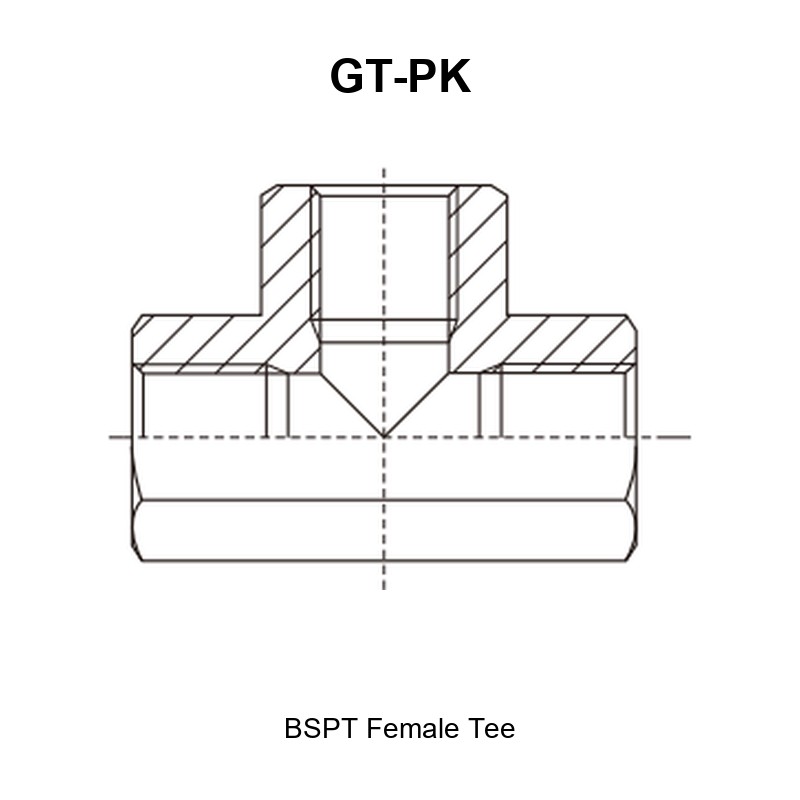
The GT-PK adapter is a BSPT female tee with three female taper ports. All three connections accept male taper-threaded fittings and all three seal on the thread flanks, so a thread sealant is required on every joint. It is the taper-thread counterpart of a parallel seat tee: instead of a metal cone inside each port, the joint depends on the interference between the tapered external and internal threads, and the assembly must be tightened with care. The GT-PK adapter is normally chosen where the surrounding pipework is already taper-threaded, or where a taper joint is preferred because the connection is taken apart and rebuilt often.
A tee with three female ports is compact and easy to build into a pipe run, but it also behaves differently from a stud-end tee. The body has a larger outside envelope, the branch angle affects how the pipework must be bent, and the internal intersection sets the flow behaviour. This page explains the sealing principle, the complete dimension table, installation practice and the questions buyers ask most often.
1. What the GT-PK Adapter Does
A tee is a three-port fitting. In a hydraulic circuit it divides one supply into two consumers, combines two return lines into one, or provides a take-off point for a pressure gauge, a pressure switch or a test point. Because all three ports are female taper ports, the tee joins three externally threaded fittings or pipe ends, and each of those three joints seals in the same way.
The sealing principle is the taper thread itself. A BSPT male thread is slightly conical, and when it is screwed into a BSPT female port the two thread forms interfere progressively along the engagement length. The seal is therefore distributed over the thread flanks rather than concentrated on a single seat, and a thread sealant is needed to fill the helical gap that remains. This is why a taper joint must never be assembled dry, and why it should not be over-tightened: excessive torque expands the female port and can crack a casting.
Because the body carries three female ports, the wall thickness around each port is an important part of the design. A female taper port needs a deeper thread engagement than a male stud end, so the body is heavier than an equivalent stud-end tee. The reward is flexibility: the same tee can accept three different fittings, and each of them can be replaced without disturbing the body.
2. GT-PK Adapter Specifications
2.1 Product Scope and Configuration
The range covers equal tees with three identical female taper ports, from Rc1/8 to Rc2. The body is symmetrical about the branch, so the tee can be installed with either run port facing the supply. Reducing combinations are available on request; for a non-standard combination, send the drawing with the three port sizes and the required centre distances.
2.2 Materials and Surface Treatment
Standard supply is carbon steel with zinc plating for general hydraulic service. For corrosive fluids or aggressive atmospheres, 304 stainless steel or 316 stainless steel is available, and brass is offered for lower-pressure industrial and instrument lines. Plating options include trivalent chromium zinc (Cr3+) and zinc-nickel for a higher corrosion demand. No salt-spray hours and no plating thickness figures are published on this page; request the current test report from the supplier before a specification is frozen.
2.3 Threads, Standards and Sealing Principle
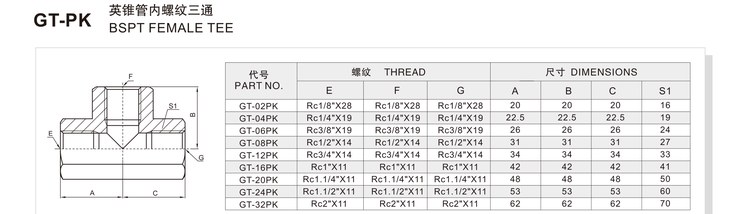
The three thread columns in the table are labelled E, F and G. E and G are the two run ports and F is the branch port. All three are BSPT female taper threads to ISO 7-1, commonly written Rc. A taper joint seals on the thread flanks and needs a sealant such as PTFE tape or a liquid thread sealant applied to the male thread only. Because the seal depends on thread interference, a taper port should not be used with a parallel 60 degree seat stud, which has no cone to seat against inside an Rc port.
2.4 Dimensions and Part Numbers
All dimensions are in millimetres. A and C are the two run-port lengths (ports E and G), B is the branch-port length (port F), and S1 is the across-flats size of the body. The centre distances are measured from the run axis to the end face of each port.
| PART NO. | E THREAD | F THREAD | G THREAD | A | B | C | S1 |
|---|---|---|---|---|---|---|---|
| GT-02PK | Rc1/8″X28 | Rc1/8″X28 | Rc1/8″X28 | 20 | 20 | 20 | 16 |
| GT-04PK | Rc1/4″X19 | Rc1/4″X19 | Rc1/4″X19 | 22.5 | 22.5 | 22.5 | 19 |
| GT-06PK | Rc3/8″X19 | Rc3/8″X19 | Rc3/8″X19 | 26 | 26 | 26 | 24 |
| GT-08PK | Rc1/2″X14 | Rc1/2″X14 | Rc1/2″X14 | 31 | 31 | 31 | 27 |
| GT-12PK | Rc3/4″X14 | Rc3/4″X14 | Rc3/4″X14 | 34 | 34 | 34 | 33 |
| GT-16PK | Rc1″X11 | Rc1″X11 | Rc1″X11 | 42 | 42 | 42 | 41 |
| GT-20PK | Rc1.1/4″X11 | Rc1.1/4″X11 | Rc1.1/4″X11 | 48 | 48 | 48 | 50 |
| GT-24PK | Rc1.1/2″X11 | Rc1.1/2″X11 | Rc1.1/2″X11 | 53 | 53 | 53 | 60 |
| GT-32PK | Rc2″X11 | Rc2″X11 | Rc2″X11 | 62 | 62 | 62 | 70 |
2.5 Working Conditions and Limits
The usable working pressure of a taper-thread tee depends on the thread size, the body material and the quality of the male threads it is matched with, so no single figure covers the whole range. For a specific project, state the fluid, the working pressure, the peak pressure, the temperature range and the vibration environment, and the supplier will confirm the suitable material, plating and assembly torque. Because a taper joint is dismantled less cleanly than a seat joint, systems that are opened frequently are usually built with parallel seat fittings instead.
3. Part Number Decoding
The part number is built from the port sizes, written in the same order as the thread columns E, F and G.
- GT-02PK: all three ports Rc1/8″X28.
- GT-08PK: all three ports Rc1/2″X14.
- GT-16PK: all three ports Rc1″X11.
- GT-32PK: all three ports Rc2″X11.
The PK suffix identifies the taper female tee body. A single size code in the middle of the number means the tee is equal. Where a reducing combination is requested, the drawing number replaces the standard code and the three port sizes are listed separately on the order.
4. Installation and Fitment
A taper joint is made once and made properly. The following sequence keeps it reliable.
- Check that all three mating threads are BSPT male threads. A parallel thread will engage but will not seal.
- Inspect the female threads for burrs, corrosion and debris. A damaged taper port cannot be recovered by extra torque.
- Apply the sealant to the male thread only, leaving the first two threads clean so the sealant is not pushed into the line.
- Screw the fitting in by hand until it is snug, then tighten by a further fraction of a turn. Stop when resistance rises sharply.
- Hold the tee body with a spanner on the flats so the tightening torque is not carried by the other two ports.
- Re-check the joints after the first heat cycle, and never re-tighten a taper joint repeatedly to stop a weep.
When the GT-PK adapter feeds a gauge or a test point, the branch port can be closed with a taper plug so the line can be checked without breaking the run connections.
5. Applications and Industries
Typical applications include:
- Utility and process pipework where taper threads are the site standard.
- Industrial power units: distributing oil to two return lines from one tank port.
- Mobile hydraulics: splitting a supply between two functions on the same machine.
- Test benches: providing a take-off point with a plugged branch.
- Marine and offshore equipment: stainless steel versions for continuous salt exposure.
- Mining and material handling: heavy bodies in high-vibration installations.
- Agricultural machinery: tapered joints where field service must use simple tools.
6. Replacement and Cross-Reference
When replacing an existing tee, work from measurements rather than from a colour code or an old marking. Record the three thread designations, the number of ports, the across-flats size S1, and the port lengths A, B and C. A replacement is equivalent only when the thread family, the port layout and the overall envelope all match. If the original part carries an unfamiliar number, measure the thread with a pitch gauge and send the values with a photograph so the equivalent can be identified.
A taper tee and a parallel seat tee are not interchangeable, even when the nominal sizes look the same. If a system is being converted from taper to parallel seat joints, the mating fittings and the ports must be changed together.
7. Ordering, Packaging and Delivery
To place an order, provide:
- the part number, for example GT-08PK or GT-16PK;
- confirmation that all three ports are BSPT female taper threads;
- the material and the plating option;
- the quantity and the required delivery date.
Parts are supplied individually protected and packed in bulk cartons or in kit bags, with the part number marked on the bag or the label. Minimum order quantities, carton quantities, marking and traceability requirements, and lead times are confirmed at the quotation stage, and special packing or kitting can be arranged for OEM programmes.
8. Frequently Asked Questions
Q1. What is the difference between the GT-PK adapter and a parallel seat tee? The taper version seals on taper threads and needs a thread sealant, while a parallel seat tee seals on a 60 degree metal cone and needs no sealant. The taper version is more tolerant of thread wear and is quicker to assemble on site; the seat version is cleaner to dismantle and can be re-used more often.
Q2. Do I need sealant on all three ports? Yes. Every port is a taper joint and every taper joint needs a sealant on the male thread. PTFE tape and liquid thread sealants are both used; the choice depends on the fluid and the site practice.
Q3. How tight should a taper joint be? Tight enough that the joint is metal to metal along the engagement, and no tighter. Taper threads wedge as they are turned, so a small extra rotation produces a large increase in stress on the female port.
Q4. Can I use a parallel 60 degree seat stud in this tee? No. The GT-PK adapter has three taper female ports and there is no cone inside them for a parallel seat stud to seal against. Use a taper male fitting in each port.
Q5. Why is this tee heavier than a stud-end tee of the same size? A female taper port needs a deeper thread engagement and more wall thickness than a male stud end, so the body must be larger to carry the same load.
Q6. Which material should I choose for a marine application? 316 stainless steel is the usual choice for continuous salt exposure. 304 stainless steel suits many wash-down applications, and carbon steel with zinc-nickel plating is used where the environment is controlled and the cost target is tight.
Q7. Can the tee be re-used after it has been removed? The body normally can be, provided the female threads are undamaged and clean. The male fittings that were removed with it should be inspected and usually replaced, because their threads carry the seal.
Q8. How do I measure an unknown taper tee so I can order a replacement? Measure the outside diameter and the pitch of each female thread, then measure the across-flats size and the three port lengths. Send these values with a photograph and the supplier can identify the equivalent part.
Browse the full Adaptadores hidráulicos range for the complete family, or contact us to request a quote, mill test reports, and samples.


 English
  Spanish
  Portuguese
  French
  German
  Arabic