
1. What a 1T-SP Adapter Does
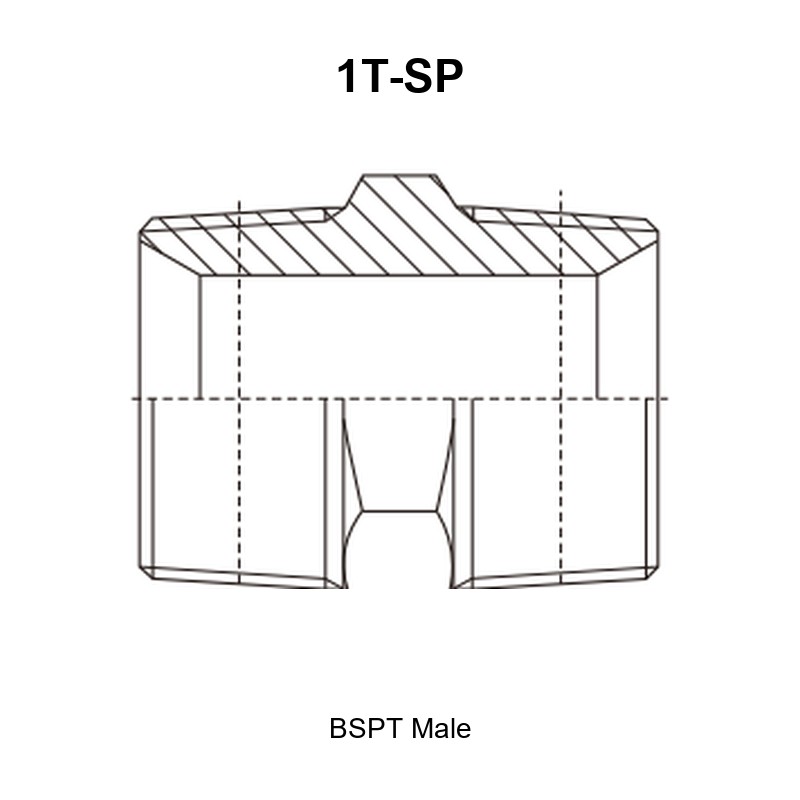
The 1T-SP adapter is a straight hydraulic adapter that joins two BSPT taper ports, one at each end. Both Connection 1 and Connection 2 are BSPT male taper threads to ISO 7-1, the thread family where the pressure-tight joint is made on the thread flanks. The straight body adds length to the run and does not change its direction, so it is used for size conversion on a taper system or to extend a taper port out of a housing.
Both connection ends must match their mating port exactly, because that is the precondition for eliminating leakage at the conversion point. A 1T-SP adapter never bridges a taper thread and a parallel thread: a taper thread cannot seal in a parallel port, and a parallel thread cannot seal in a taper port. Where the run changes standards instead of changing size, the correct part is a conversion series such as the 1BT-SP range rather than a BSPT-to-BSPT thread adapter.
Sealing is by taper on both ends. Each end is a BSPT thread that seals on the thread flanks, so each end requires a thread sealant suited to the fluid and to the system. This differs from BSPP, which is a parallel thread to ISO 228-1 where the sealing is done by a 60° cone seat or by a bonded seal and not by the threads. The two families share a 55° thread angle, but their pitch and taper differ, so a BSPP part and a BSPT part can never be forced into each other’s port. A BSPP adapter belongs to a different family, because it seals on a seat rather than on the threads.
2. 1T-SP Specifications
2.1 Connection 1 — BSPT male taper thread
- Thread standard: ISO 7-1 pipe threads where pressure-tight joints are made on the threads (BSPT, R thread).
- Gender: male taper thread.
- Available thread sizes on Connection 1: R1/8″x28 to R2″x11, covering the Thread E column in the table in section 2.5.
- Sealing method: the taper thread seals on the thread flanks. A thread sealant suited to the fluid and the system is applied before assembly.
- Mating port standard: a taper port machined to ISO 7-1. The port must be a taper port; a parallel port to ISO 228-1 will not seal with this end.
2.2 Connection 2 — BSPT male taper thread
- Thread standard: ISO 7-1 taper pipe thread (BSPT, R thread), matching Connection 1.
- Gender: male taper thread.
- Available thread sizes on Connection 2: R1/8″x28 to R2″x11, covering the Thread F column in the table in section 2.5.
- Sealing method: the taper thread seals on the thread flanks and needs a sealant, exactly as on Connection 1.
- Size combinations: the table includes equal-size rows such as 1T-08SP and reducing rows such as 1T-12-16SP, so a larger taper port can be stepped down to a smaller taper connection.
- Reuse rule: inspect a previously fitted taper end for flattened or galled threads before reuse, because the joint depends on flank contact.
2.3 Construction and Materials
The body is machined from bar stock on CNC lathes. Both taper threads are cut as separate operations, and thread gauges and dimensional checks are applied batch by batch before packing. Every batch of this BSPT adapter is checked against the drawing before packing.
- Body material options: carbon steel, 304 stainless steel, 316 stainless steel, with brass available as an option.
- Plating options for carbon steel: trivalent chromium zinc plating (Cr3+) or zinc-nickel plating. Stainless steel bodies are supplied without plating.
- Seal material options: NBR, FKM (Viton-type) and EPDM, matched to the fluid and the temperature of the application. On a BSPT joint the sealant carries the sealing duty, so the sealant is selected for the fluid as carefully as any elastomer in the circuit.
- Critical surfaces: both taper threads are treated as sealing surfaces during machining, handling and packing.
- Hex feature: one hex across flats (S1) on the body, sized per thread combination as listed in the table.
2.4 Pressure and Temperature
Pressure is governed by the thread size, the wall thickness of the body, the sealing method and the material selected, so it is confirmed per order rather than published as a single figure for the range. Working pressure for these sizes is confirmed per order by HENGHUA engineering, based on the sealing method, thread size and material selected.
Temperature capability follows the sealant and elastomer selection, which is a material fact rather than a rating of the adapter body:
| Seal material | Typical service temperature range | Notas |
|---|---|---|
| NBR | approximately -30°C to +100°C | Mineral hydraulic oil and general industrial service |
| FKM (Viton-type) | approximately -20°C to +200°C | Higher temperature and aggressive media |
| EPDM | approximately -40°C to +120°C | Water, water-glycol and steam-adjacent service |
Carbon steel with zinc plating covers general hydraulic service. Choose 304 or 316 stainless steel for corrosive environments, offshore duty and wash-down areas where the taper threads are exposed.
2.5 Part Number and Dimension Table
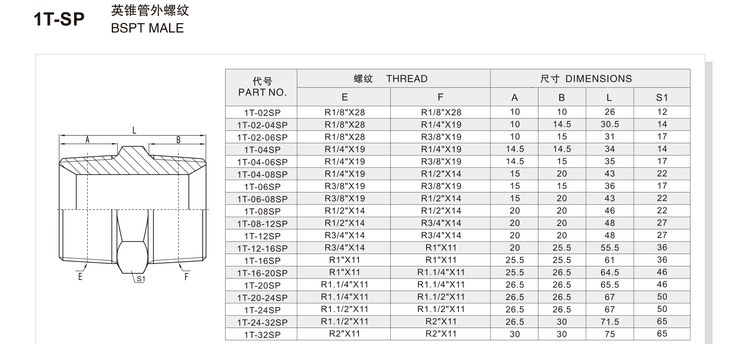
Column key: E is the BSPT (R) male taper thread on Connection 1. F is the BSPT (R) male taper thread on Connection 2. A and B are the two thread lengths measured from the end faces in the order shown on the specification drawing, L is the overall length and S1 is the hex across flats, in millimetres.
| PART NO. | E (BSPT male) | F (BSPT male) | A (mm) | B (mm) | L (mm) | S1 (mm) |
|---|---|---|---|---|---|---|
| 1T-02SP | R1/8″x28 | R1/8″x28 | 10 | 10 | 26 | 12 |
| 1T-02-04SP | R1/8″x28 | R1/4″x19 | 10 | 14.5 | 30.5 | 14 |
| 1T-02-06SP | R1/8″x28 | R3/8″x19 | 10 | 15 | 31 | 17 |
| 1T-04SP | R1/4″x19 | R1/4″x19 | 14.5 | 14.5 | 34 | 14 |
| 1T-04-06SP | R1/4″x19 | R3/8″x19 | 14.5 | 15 | 35 | 17 |
| 1T-04-08SP | R1/4″x19 | R1/2″x14 | 15 | 20 | 43 | 22 |
| 1T-06SP | R3/8″x19 | R3/8″x19 | 15 | 15 | 36 | 17 |
| 1T-06-08SP | R3/8″x19 | R1/2″x14 | 15 | 20 | 43 | 22 |
| 1T-08SP | R1/2″x14 | R1/2″x14 | 20 | 20 | 46 | 22 |
| 1T-08-12SP | R1/2″x14 | R3/4″x14 | 20 | 20 | 48 | 27 |
| 1T-12SP | R3/4″x14 | R3/4″x14 | 20 | 20 | 48 | 27 |
| 1T-12-16SP | R3/4″x14 | R1″x11 | 20 | 25.5 | 55.5 | 36 |
| 1T-16SP | R1″x11 | R1″x11 | 25.5 | 25.5 | 61 | 36 |
| 1T-16-20SP | R1″x11 | R1.1/4″x11 | 25.5 | 26.5 | 64.5 | 46 |
| 1T-20SP | R1.1/4″x11 | R1.1/4″x11 | 26.5 | 26.5 | 65.5 | 46 |
| 1T-20-24SP | R1.1/4″x11 | R1.1/2″x11 | 26.5 | 26.5 | 67 | 50 |
| 1T-24SP | R1.1/2″x11 | R1.1/2″x11 | 26.5 | 26.5 | 67 | 50 |
| 1T-24-32SP | R1.1/2″x11 | R2″x11 | 26.5 | 30 | 71.5 | 65 |
| 1T-32SP | R2″x11 | R2″x11 | 30 | 30 | 75 | 65 |
3. How to Read a 1T-SP Adapter Part Number
Every part number in this series follows the same pattern, so the table can be read without a separate catalogue.
- Prefix
1T-SP: the family code.1marks the male-to-male conversion group,Tmarks the BSPT male taper ends, andSPis the suffix carried by every part number in this series as listed in the specification. There is no angle digit in this prefix because the body is straight. - First size code after the dash: the Thread E size on Connection 1.
- Optional second size code: the Thread F size on Connection 2. When only one size code is present, the two ends are the same size, as in 1T-08SP.
- Two-digit codes repeat the numerator of the thread size, which can be verified from any row: 02 = 1/8″, 04 = 1/4″, 06 = 3/8″, 08 = 1/2″, 12 = 3/4″, 16 = 1″, 20 = 1.1/4″, 24 = 1.1/2″, 32 = 2″.
Worked example, row 1T-12-16SP: 1T-SP is the straight BSPT-to-BSPT male family, 12 is the Thread E code for R3/4″x14, and 16 is the Thread F code for R1″x11. The row then gives A = 20 mm, B = 25.5 mm, L = 55.5 mm and S1 = 36 mm. The same size pair in an elbow body carries 9 in the prefix, which is why the straight and elbow series must not be confused when a replacement is ordered.
4. Installation and Fitment
- Inspect before assembly. Check both taper threads for burrs, galls, flattened flanks and swarf. Because the joint seals on the flanks, surface damage on the threads leaks even when the parts are tightened correctly.
- Apply sealant to both ends. Each BSPT end seals on the thread flanks and needs a sealant suited to the fluid and the system. Leave the first thread clean so that the sealant does not enter the circuit.
- Check the port type before fitting. A BSPT male end can only be used in a taper port. Screwing it into a parallel port by force deforms the threads and destroys the thread form on both parts.
- Align before tightening. Start both ends by hand and confirm the threads run in freely, then tighten to snug contact and apply the additional tightening angle specified for the joint. No tightening angle value appears in the series specification, so work to the value in your assembly instruction or confirm it with HENGHUA engineering.
- Use the hex. Tighten on the S1 hex with a spanner that fits, so the load passes through the body rather than through the taper threads.
- Contamination control. Keep the adapter capped until fitting, work with clean tools and flush the circuit afterwards where sealant debris or swarf could reach a valve.
Common fitment errors and their symptoms:
| Error | Symptom |
|---|---|
| BSPT taper end forced into a BSPP parallel port | Free turning for a few threads then hard binding, thread damage, joint weeps |
| Sealant omitted on either taper end | Weeping along the thread even at low pressure |
| Excessive sealant or tape overhanging the bore | Debris carried into the circuit, sticking valves, blocked orifices |
| Taper end reused after galling | Joint seals when new, then weeps after pressure cycling |
| Correct BSPT ends but no size check | Adapter starts but does not seat, joint stands proud of the port face |
5. Applications and Industries
Application tags: hydraulic systems, water jetting, oil and gas, industrial equipment, construction machinery, agriculture, marine, material handling.
Concrete scenarios where this BSPT-to-BSPT thread adapter is used:
- Cross-standard equipment integration. Machines assembled from components of different origin often present taper ports on cylinders, valves or pipe fittings while the rest of the circuit follows a different port standard. This series extends or steps a taper connection within the same ISO 7-1 family, and a conversion series is used where the standard itself has to change.
- Repair and replacement. A damaged taper nipple or an over-tightened joint is replaced with a straight adapter that restores the connection without re-cutting the pipework.
- Size stepping on older equipment. Legacy machinery frequently uses taper ports in sizes that are no longer standard on new valves, and the reducing rows in the table step the port down or up to the size the new component uses.
- Test benches and gauge lines. Straight adapters are used to bring a taper test point out of a manifold or to connect a gauge line without changing the flow direction.
6. Replacement and Cross-Reference Guide
Identify a replacement by standard, thread and sealing method, never by brand or by the marking on the installed part alone. Where the standards differ at the two ends, a cross standard adapter is required instead of this series.
Measure these three things on the part you are replacing:
- Both thread forms. Measure the outside diameter and count the threads per inch at each end. Both ends of this series taper, so the diameter reduces towards the nose and the thread does not hold a constant gauge along its length. A part whose ends are parallel belongs to a different family.
- The pitch. BSPT is a taper thread to ISO 7-1 and is specified with a pitch count such as 19 threads per inch for 1/4″ and 14 for 1/2″. Confirm the pitch against the table before ordering, because a similar diameter with a different pitch will not seal.
- The length. Measure L and compare it with the table, because a replacement that is longer than the original may not fit the space between the port and the first pipe bend.
Organised by standard rather than by brand:
| What you have | What it adapts to | How to specify it |
|---|---|---|
| BSPT taper port | BSPT taper port, other size | 1T-SP part number, size codes for E and F |
| BSPT taper port on both ends, equal size | Extension of the same size | 1T-SP part number with a single size code |
| BSPT taper port that must change standard | BSPP port with a 60° seat or a flat face | 1BT-SP straight, 1BT4-SP 45° or 1BT9-SP 90° series, because a BSPP adapter is required on that side |
| BSPT taper port that needs a right angle | BSPT port, 90° | 1T9-SP series |
| BSPT taper port that needs a female outlet | BSPT female | 5T-SP, 7T or 7T9-PK series |
7. Ordering, Packaging and Delivery
Send the following with your inquiry so that the quotation is exact: series code and full part number (for example 1T-12-16SP), the thread size on each end, the sealant or elastomer requirement (NBR, FKM or EPDM), body material and plating option, and the annual quantity. Where the old part carries no readable marking, send the measured thread diameter and pitch at both ends instead, and HENGHUA will confirm the match.
- Packaging: single units in sealed bags, bulk quantities in cartons, and palletised cartons for container loads. Marking and labelling can follow distributor shelf needs or direct-to-line OEM needs.
- Sample orders: samples are available for validation before a production order. State the part numbers and seal material you want evaluated.
- Lead time: confirmed per order, based on size, material and quantity. Custom sizes and drawing-based manufacture follow the same route.
- Documentation: quotations and order confirmations state the part number, both thread sizes, material and seal option, so the delivered part can be checked against the paperwork.
8. FAQ
Q1. What is the difference between BSPP and BSPT, and can they be interchanged? BSPP (G thread) is a parallel thread to ISO 228-1 where the pressure-tight joint is not made on the threads: a 60° cone seat or a bonded seal does the sealing. BSPT (R thread) is a taper thread to ISO 7-1 where the joint is made on the thread flanks and needs a sealant. They must never be forced together, because the pitch and the taper differ and forcing one into the other deforms both parts. Both ends of this series are BSPT, so both mating ports must be taper ports.
Q2. What is the difference between a 60° cone seat and a bonded seal, and which should I choose? Neither applies to this series, because both of its ends seal on the taper thread flanks with a sealant rather than on a seat. A 60° cone seat and a bonded seal both belong to BSPP practice: the cone seat seals metal-to-metal against a mating cone inside an ISO 1179 port, and the bonded seal (Dowty-type washer) seals against a flat face. If the mating port is a BSPP port with a cone seat or a flat face, use a conversion series such as 1BT-SP instead of this one.
Q3. How do I identify the correct 1T-SP size? Read the two size codes in the part number. The first code is the Thread E size and the second code is the Thread F size, both BSPT, with 02 = 1/8″, 04 = 1/4″, 06 = 3/8″, 08 = 1/2″, 12 = 3/4″, 16 = 1″, 20 = 1.1/4″, 24 = 1.1/2″ and 32 = 2″. When only one code is present, the two ends are the same size. Confirm diameter and pitch at both ends with a gauge before ordering.
Q4. What seal material should I select for my fluid and temperature? NBR suits general hydraulic oil service at approximately -30°C to +100°C, FKM covers higher temperatures and aggressive media at approximately -20°C to +200°C, and EPDM covers water and water-glycol service at approximately -40°C to +120°C. On a BSPT joint the sealant does the sealing, so the sealant must also be compatible with the fluid and the temperature. Send the fluid and temperature data with your inquiry and HENGHUA will confirm the selection.
Q5. How is the working pressure of this adapter determined? Working pressure depends on the thread size, the wall thickness of the body, the sealing method and the material selected, so the series is not published with a single figure. Working pressure for these sizes is confirmed per order by HENGHUA engineering, based on the sealing method, thread size and material selected. Include the operating pressure and the fluid in your inquiry so the confirmation can be issued with the quotation.
Q6. What is the minimum order quantity and can I get samples? Samples are available for validation before a production order, and smaller quantities can be supplied for trials and maintenance stock. State the part numbers, seal material and quantity in your inquiry so that sample and production lead times can be confirmed together. Minimum order quantity is confirmed per order according to the size, material and plating combination requested.
Q7. Can this adapter be used on a BSPP port with a bonded seal? No. Both ends of this series are BSPT taper threads that seal on the thread flanks, and a taper thread cannot seal in a parallel port or against a flat face. A BSPP port must be matched by a BSPP stud end, which seals on a 60° cone seat or with a bonded seal. Where the two standards meet on a machine, order a conversion series such as 1BT-SP for the straight version or its elbow equivalents.
Browse the full Hydraulic Adapters range for the complete family, or contact us to request a quote, mill test reports, and samples.


 English
  Spanish
  Portuguese
  French
  German