
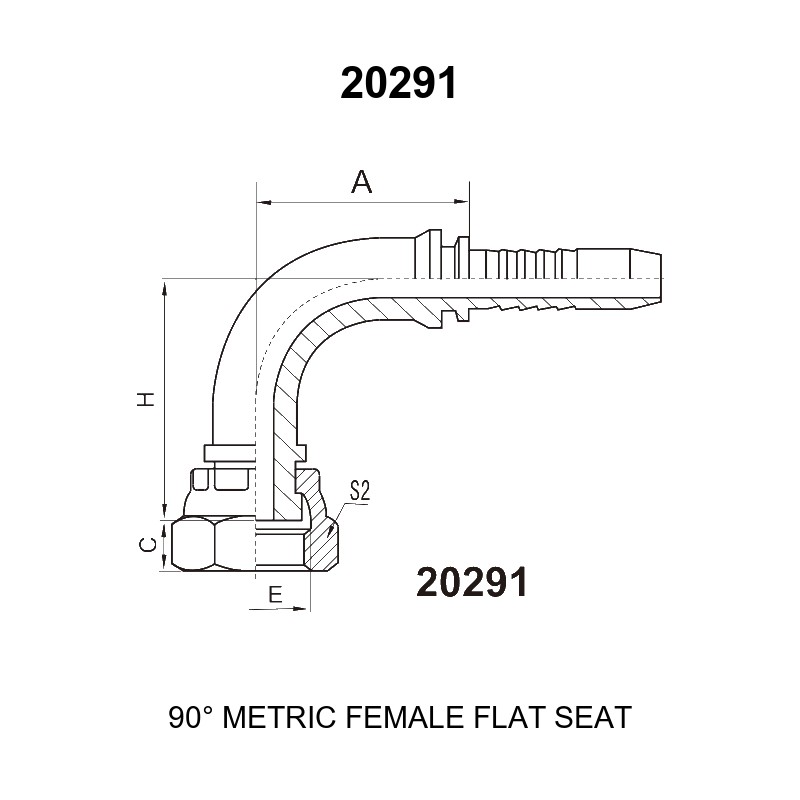

Flat-seat 90-degree hydraulic hose elbow fittings turn the hose 90 degrees at a flat-seal connection, so the direction change happens in the steel elbow instead of in the hose. The 20291 series is the metric female flat-seat version: a 90-degree swept elbow with a swivel nut whose face is machined flat for the flat-seal system, covering 26 part numbers from M12x1.25 (DN4, -02) to M64x2 (DN50, -32) – including the M60x2 (DN45) size – designed for wire-braided hose. If your machine connects hose onto flat-seat male studs and the routing needs a compact right-angle turn, this page covers dimensions, the nut construction variants, part numbers and OEM options.
Why Choose These Flat-Seat Elbow Fittings
- Turn the corner in steel, not in the hose. The 90-degree elbow keeps the hose inside its minimum bend radius at the connection – smaller envelopes and longer hose life.
- Flat-seal system compatibility. The machined flat face connects to flat-seat male studs of the flat-seal system (the male family of the 10311 flat-seal series in this catalog), sealing through the seal element of the joint.
- The largest elbow size coverage on this page set. 26 part numbers from DN4 (-02) to DN50 (-32), including the M60x2 (DN45) size not seen on the other elbow series.
- Swivel nut for orientation. The nut turns freely, so the elbow plane is set toward the routing before the joint is torqued – no twisted hose.
- OEM-ready. Laser marking, custom plating, material test reports and batch traceability.
Standards and traceability. Threads are ISO 724 metric threads. The 90-degree elbow geometry and the flat sealing face are machined per the series drawing, following the flat-seal (flat-face) sealing configuration of the metric flat-seal hose fitting family. (The source sheet prints GB/T 9065.3 as a reference label; the current edition of that standard covers flange-end fittings, so the series is described here by its geometry instead – see the notes section.) Fittings are designed to pair with wire-braided hose built to EN 853 1SN/2SN or SAE 100 R1AT/R2AT performance classes. Dimensional inspection reports and material test certificates are available for OEM gate checks.
What the Flat Seat Means on an Elbow
The port end of this elbow is a female metric thread with a flat, machined sealing face behind it – not a cone, not a spherical seat. It connects over a male stud whose sealing face is also flat, and the joint seals through the seal element of the flat-seal system (an O-ring or bonded seal between the two flat faces, depending on the male stud design). Straight metric threads do not seal by themselves, which is why the flat faces and the seal element do the work – and why tape has no place on this joint.
On an elbow, the flat seat has a practical advantage: because the sealing faces are flat and parallel, the swivel nut can orient the elbow plane freely before torque, and the joint stays sealed at any orientation. A cone seat has the same freedom, but a flat seat is the system many flat-seal machine ports already use.
Which male stud does it connect to? A male stud with a flat sealing face in the flat-seal system – the machine-side equivalent of the 10311 male series in this catalog. If you are replacing an existing elbow, send us a photo of the male stud face and thread: flat face with an O-ring or bonded seal groove tells us the flat-seal system; a cone tells us something else.
What does the T suffix mean on 20291?
Rows ending in T carry the variant shown on the drawing with a slightly different shoulder profile behind the swivel nut. Both constructions use the same thread and the same flat sealing face, and the choice follows the drawing or the old fitting you are replacing. Order the exact part number – with or without T – and we will confirm the construction before dispatch.
Flat-seat elbow vs the multiseal elbow (20291 vs 20191)
The catalog carries two 90-degree metric female elbows. The 20191 series uses the spherical multiseal seat; this 20291 series uses the flat seat. They serve different male studs: match the elbow seal to the male stud system – flat-face male stud, flat-seat elbow; spherical/conical male, multiseal or cone elbow. When in doubt, send a photo of the male stud and we will identify the system.
20291 Series Technical Specifications
Materials and processing
- Body material options: high-strength carbon steel (20#/35#/45# grades, cold-formed or machined) as standard; stainless steel 304 or 316L available for corrosive or wash-down environments.
- Surface treatment: zinc plating as standard; yellow, white or black zinc, zinc-nickel and Dacromet coating available for higher salt-spray requirements.
- Heat treatment: hardness and case depth are controlled per drawing so the elbow body, thread and flat sealing face stay fatigue-resistant; typical surface hardness range HRC 20-28 (confirm the exact code on your drawing or PO).
- Elbow geometry: swept 90-degree bend, machined as one piece with the body; the flat sealing face is machined, not cast.
Full dimension and part number table
All linear dimensions are in millimeters. E = thread, DN = hose bore, A and C = lengths per the supplier drawing, H = overall elbow height per the drawing, S2 = swivel nut hex across flats. Rows ending in T carry the shoulder-profile variant shown on the drawing. Two rows in the source image print the thread with an N prefix (“N12X1.25”, “N52X2”); these are transcribed here as M12X1.25 and M52X2 to match the metric system of the table – confirm against the drawing before ordering.
| Part Number | Thread E | Hose bore DN (mm) | Dash size | A (mm) | C (mm) | H (mm) | S2 nut hex (mm) |
|---|---|---|---|---|---|---|---|
| 20291-12-02 | M12x1.25 | 4 | -02 | 26.5 | 8.0 | 30.5 | 17 |
| 20291-12-04 | M12x1.25 | 6 | -04 | 30.0 | 8.0 | 33.5 | 17 |
| 20291-14-04 | M14x1.5 | 6 | -04 | 30.0 | 8.5 | 34.0 | 19 |
| 20291-14-05 | M14x1.5 | 8 | -05 | 33.0 | 8.5 | 37.0 | 19 |
| 20291-16-04 | M16x1.5 | 6 | -04 | 30.0 | 8.0 | 35.0 | 22 |
| 20291-16-05 | M16x1.5 | 8 | -05 | 34.0 | 8.0 | 38.0 | 22 |
| 20291-16-06 | M16x1.5 | 10 | -06 | 35.3 | 8.0 | 40.3 | 22 |
| 20291-18-05T | M18x1.5 | 8 | -05 | 33.0 | 8.0 | 39.0 | 24 |
| 20291-18-06 | M18x1.5 | 10 | -06 | 35.75 | 8.0 | 41.3 | 24 |
| 20291-22-08 | M22x1.5 | 12 | -08 | 41.0 | 10.0 | 48.0 | 27 |
| 20291-22-10 | M22x1.5 | 16 | -10 | 57.5 | 10.0 | 53.0 | 27 |
| 20291-24-08T | M24x1.5 | 12 | -08 | 41.0 | 11.0 | 45.5 | 30 |
| 20291-27-04T | M27x1.5 | 6 | -04 | 30.0 | 10.0 | 35.5 | 32 |
| 20291-27-08T | M27x1.5 | 12 | -08 | 41.0 | 10.0 | 46.0 | 32 |
| 20291-27-10T | M27x1.5 | 16 | -10 | 56.0 | 10.0 | 51.0 | 32 |
| 20291-30-12 | M30x1.5 | 20 | -12 | 66.2 | 11.0 | 63.5 | 36 |
| 20291-33-14 | M33x2 | 22 | -14 | 71.2 | 13.0 | 65.0 | 41 |
| 20291-36-14T | M36x2 | 22 | -14 | 71.2 | 13.0 | 61.0 | 41 |
| 20291-36-16 | M36x2 | 25 | -16 | 76.7 | 13.0 | 70.0 | 41 |
| 20291-39-16T | M39x2 | 25 | -16 | 76.7 | 13.0 | 67.5 | 46 |
| 20291-42-20 | M42x2 | 32 | -20 | 91.5 | 15.0 | 82.5 | 50 |
| 20291-45-20T | M45x2 | 32 | -20 | 91.5 | 15.0 | 78.5 | 55 |
| 20291-52-20T | M52x2 | 32 | -20 | 91.5 | 17.0 | 78.5 | 60 |
| 20291-52-24T | M52x2 | 40 | -24 | 109.4 | 17.0 | 92.0 | 60 |
| 20291-60-28T | M60x2 | 45 | -28 | 119.9 | 20.0 | 106.5 | 70 |
| 20291-64-32T | M64x2 | 50 | -32 | 130.95 | 23.0 | 113.3 | 75 |
Full dimensioned CAD drawings are available on request so your engineers can verify every length, the elbow height and the flat sealing face before you commit a batch.
Working pressure: the honest answer engineers need
A crimp hose assembly fails at its weakest link, so the rating of a 20291 elbow depends on the hose you pair it with and the crimp quality. Wire-braided hydraulic hose in this size range typically operates between roughly 80 and 400 bar depending on bore size and construction (1SN or 2SN). Send us your hose specification and we will confirm the working pressure, burst margin and the recommended ferrule for your exact hose brand – the check is free and takes one message. For derating at elevated temperature, follow the hose manufacturer’s pressure-temperature curve, because the rubber cover and tube lose capacity above about +100°C.
Which Fitting Series Do You Need: 20291 (Braided) or 20292 (Spiral)?
The part number changes with the hose construction, because the barb geometry and the crimp parameters are different. For spiral-reinforced hose (4SP/4SH style), order the 20292 series as 20292-XX-XX. Check the hose label before ordering: braided hose is marked 1SN, 2SN or R1AT, R2AT; spiral hose is marked 4SP, 4SH or similar.
Part Number Decoder and How to Order
The 20291 part number carries the specification – thread, pitch, bore, construction – so purchasing can copy it straight into a PO:
20291 – 30 – 12
- 20291 = 90-degree metric female flat-seat elbow for braided hose
- 30 = thread nominal size (here M30x1.5)
- 12 = hose dash size (here DN20, 3/4-inch class bore)
- T (where present) = the shoulder-profile variant shown on the drawing
Because one thread size can serve several hose bores, always quote both the thread size and the dash size. If you are replacing an existing elbow, send us a photo of the male stud, the old nut and the elbow body – we will confirm the matching part number, including the correct seal system and construction, the same day.
Assembly Guide: Four Steps with the Flat-Seat Elbow
Step 1 – Cut the hose square. Use a sharp hose cutter or cutoff saw. A square, clean cut lets the ferrule grip the cover evenly. A beveled or ragged cut is the most common cause of pull-out failures.
Step 2 – Prepare the insert depth. Push the elbow tail into the hose until it bottoms firmly against the internal shoulder. The hose end must sit at the full insertion depth, not short, or the crimp zone will be wrong.
Step 3 – Lubricate and insert. Apply a thin film of assembly lubricant to the hose bore and the barb. Push the elbow in with a steady twisting motion until it bottoms out, then wipe away excess lubricant. Keep the flat sealing face and the seal element clean.
Step 4 – Crimp, verify, orient and torque. Crimp the matched ferrule with the hose manufacturer’s crimp specification and measure the crimp outside diameter against the crimp table. Then set the elbow plane to the routing direction and torque the swivel nut onto the flat-seat male stud – the nut turns freely, so the hose is never twisted to aim the elbow.
Warnings: three mistakes that cause leaks and blow-outs
- Never use a flat-seat elbow on a cone or spherical male stud, or a cone elbow on a flat-face male. Match the seal system to the male stud, not to the thread.
- Never put PTFE tape or sealant on the thread of a flat-seal joint. The seal element between the flat faces does the sealing; tape can keep the faces from seating and contaminate the system.
- Never aim the elbow by bending the hose. If the nut cannot reach the correct orientation, re-check the part number or use an adjustable fitting.
Aplicaciones típicas
90-degree flat-seat female elbows serve layouts that combine the flat-seal connection system with a compact right-angle turn:
- Machine tools, presses and injection molding machinery with flat-seal ports
- Agricultural and construction machinery hydraulic bays
- Hydraulic power units and valve stands
- Mobile equipment with compact plumbing
- Replacement service for machines with unreadable or obsolete elbow part numbers
Wherever the male stud is a flat-seal (flat-face) connection and the routing demands a 90-degree turn, the 20291 series is the elbow to specify – from DN4 control lines to DN50 main circuits.
OEM Customization and Quality Traceability
For equipment builders and large maintenance programs, the 20291 series can be adapted to your exact drawing and your traceability rules.
Customization options
- Thread and geometry: special threads, modified lengths, non-standard elbow angles (for example 45 degrees) and configurations machined to your drawing or to a sample.
- Surface treatment: zinc-nickel, Dacromet or other coatings for higher salt-spray grades; we confirm the achieved test hours for the coating you choose instead of quoting a generic number.
- Laser marking: your logo, part number and batch or date code laser-marked on the hex for full field traceability.
- Material: stainless steel 304/316L versions for corrosive media or wash-down duty.
- Nut construction: standard or -T shoulder variant per your drawing.
- Packaging and kitting: custom labels, barcodes, poly-bag or box quantities, and complete hose assembly kitting.
Quality documentation
- Batch number traceability: every order carries a batch code that links back to the production records.
- Material test reports (MTR) available for carbon steel and stainless batches.
- Dimensional inspection reports for OEM gate checks.
- Third-party inspection (BV, SGS or similar) can be arranged before shipment.
Samples and MOQ. Samples for stock sizes ship fast, and we keep low MOQs for standard part numbers so distributors can test the series without tying up capital. OEM programs can move to scheduled deliveries once the drawing is approved.
Packaging and Logistics
Standard export packing: elbows are individually poly-bagged or boxed to protect threads, flat sealing faces and swivel nuts, then packed in export cartons labeled with part number, quantity and batch code. Custom labeling, kitting and barcode requirements are available. Exact carton quantity, gross weight and CBM are confirmed on the packing list for every order.
FAQ
Q: What is a 90-degree metric female flat-seat hydraulic hose elbow? A: It is a crimp-style 90-degree swept elbow whose port end is a female metric thread with a swivel nut and a machined flat sealing face, connecting over flat-seat male studs of the flat-seal system.
Q: Which male stud does it connect to? A: A male stud with a flat sealing face in the flat-seal system – the machine-side equivalent of the 10311 flat-seal male series in this catalog. Send a photo of the male stud for a same-day confirmation.
Q: What is the difference between the flat-seat elbow (20291) and the multiseal elbow (20191)? A: The 20291 seals through the flat-seal system on a machined flat face; the 20191 uses the spherical multiseal seat. Match the elbow seal to the male stud system.
Q: What does the T suffix mean? A: Rows ending in T carry the variant shown on the drawing with a slightly different shoulder profile behind the swivel nut. Both constructions use the same thread and flat sealing face.
Q: Do I need thread tape or sealant? A: No. The seal element between the two flat faces does the sealing. Tape on a straight metric thread adds nothing and can prevent the faces from seating.
Q: Can the elbow be oriented after crimping? A: Yes – the swivel nut turns freely, so the elbow plane is set toward the routing when the nut is torqued, without twisting the hose.
Q: What is the difference between 20291 and 20292 series? A: 20291 is for wire-braided hose (1SN/2SN or R1AT/R2AT) and 20292 is for spiral hose (4SP/4SH style).
Q: What is the working pressure of these elbows? A: The assembly rating depends on the hose, the ferrule and the crimp quality. Send your hose specification and we will confirm the working pressure for your combination.
Q: Can you make custom part numbers with my logo? A: Yes. We offer laser marking, custom plating, stainless versions, special elbow angles and dimensions, with MTR and batch traceability for OEM programs.
Order Today: Flat-Seat Elbows with Confirmed Fit
Every 20291 flat-seat 90-degree hydraulic hose elbow fitting in this range is machined to controlled dimensions, inspected before packing and backed by batch traceability. Send us a photo of the male stud, your hose type and thread size, and you will get a confirmed part number – including the correct seal system and construction – a delivery date and a quote within one working day. Request samples first and trial-fit one on your own layout: the flat seat and the swivel nut make the elbow as easy to aim as it is to route. We make sure the fitting, ferrule and hose work as one leak-free assembly.flat-seat 90-degree hydraulic hose elbow fittings



 English
  Spanish
  Portuguese
  French
  German