
The steam hose vs hot water hose difference is not cosmetic, and it decides whether the line is safe. A hot water hose cannot serve a steam line at any pressure rating, because tube, cover and margin all assume a liquid, not vapor at 210 °C. Substituting one for the other changes the failure mode, not the service life.
This article compares the two builds item by item, then follows the substitution error through the mechanisms that turn a misapplied hose into a burst cover, a contaminated line or a sudden rupture.
Scope: the comparison covers saturated steam hose to ISO 6134 Type 1 and Type 2, published at 6 bar and 164 °C and at 18 bar and 210 °C. The hot water side is EPDM hose, published at a planning figure of about 20 bar and 95 °C. Superheated steam sits above that temperature and loads the same materials harder. The application index and the wider attribute comparison are covered in companion articles.
About a 14-minute read at 250 words per minute; every figure below stays inside published steam-service data and the ISO 6134 duty split.
Steam Hose vs Hot Water Hose: The Six Build Differences
The steam hose vs hot water hose comparison turns on the build, and it starts at the tube because the tube meets the medium. Steam service calls for a heat-resistant EPDM or chlorobutyl tube. A hot water hose uses EPDM or a blend rated for hot water, which is a milder duty even when the polymer family name looks the same.
Six build items separate the two products, and each one is chosen for a different thermal and pressure envelope. Substitution decisions ignore this split, and hose substitution is where the danger starts.
Table 1. The six build differences between a steam hose and a hot water hose.
| Build item | Steam hose | Hot water hose |
|---|---|---|
| Tube compound | Heat-resistant EPDM or chlorobutyl | EPDM or blends rated for hot water |
| Verstärkung | Steel wire braid or spiral | Textile or lighter wire |
| Cover | Perforated and pin-pricked to vent permeating steam | Solid cover, not perforated |
| Wall thickness | Heavier wall for the same bore | Lighter wall for the same bore |
| Design factor | 10:1 to 20:1 published for steam service | A lower margin for liquid duty |
| Rating pair | ISO 6134 Type 1 at 6 bar / 164 °C and Type 2 at 18 bar / 210 °C | Roughly 20 bar / 95 °C band (planning figure) |
Read the table by rows, not by columns. The design-factor row is the first clue that the two products are not interchangeable. A published 10:1 to 20:1 margin sits far above the margin of a liquid-duty hose, as the note on working pressure vs burst pressure explains.
The wall-thickness row carries part of the margin. A heavier wall spreads tube stress and slows the rate at which vapor works through it. A lighter wall saves weight and cost, which is the right trade for hot water and the wrong trade for steam. Confirm the wall on the datasheet before you assume two hoses of equal bore are equivalent.
Steam Hose Construction: Tube, Reinforcement and Cover
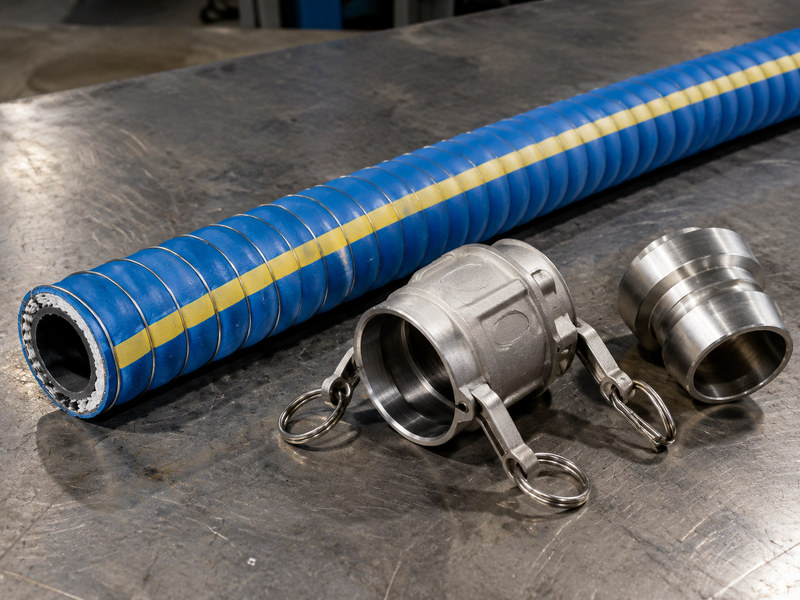
Steam hose construction answers the vapor problem in three layers. The tube holds the medium, the reinforcement holds the pressure, and the cover holds the reinforcement together. The steam cover is the one layer that is vented: perforated and pin-pricked, so vapor leaves the wall in controlled amounts. Each layer carries a different job, and each one leaves a visible clue you can check in the field.
In practice, the two builds differ at every one of those layers. The next table sets out the layer, the material, the function and the recognition clue for both products.
Table 2. Layer, material, function and field recognition for each product.
| Layer | Material | Function | How to recognize it |
|---|---|---|---|
| Steam tube | Heat-resistant EPDM or chlorobutyl | Contains vapor and condensate at high temperature | Dense black rubber, slightly stiff under the thumb |
| Steam reinforcement | Steel wire braid or spiral | Carries the pressure and limits elongation | Rigid wire rings are felt through the wall |
| Steam cover | EPDM, perforated and pin-pricked | Vents steam that permeates the tube wall | Small pin holes and a dull, sprinkled surface |
| Hot water tube | EPDM or a hot-water blend | Contains a liquid at a much lower temperature | Softer and thinner feel than a steam tube |
| Hot water reinforcement | Textile or lighter wire | Holds a lower working pressure | Flexible, bends easily, little wire feedback |
| Hot water cover | Solid EPDM or rubber | Protects the reinforcement from abrasion | Smooth surface with no perforations |
The recognition column matters, because the two products can look alike until you read the surface. Your inner-tube polymer also decides chemical compatibility, so check the medium against a dedicated reference rather than the product name alone, such as the NBR vs EPDM vs FKM inner-tube selection chart.
The site’s EPDM steam hose and saturated steam note covers the material side in more depth.
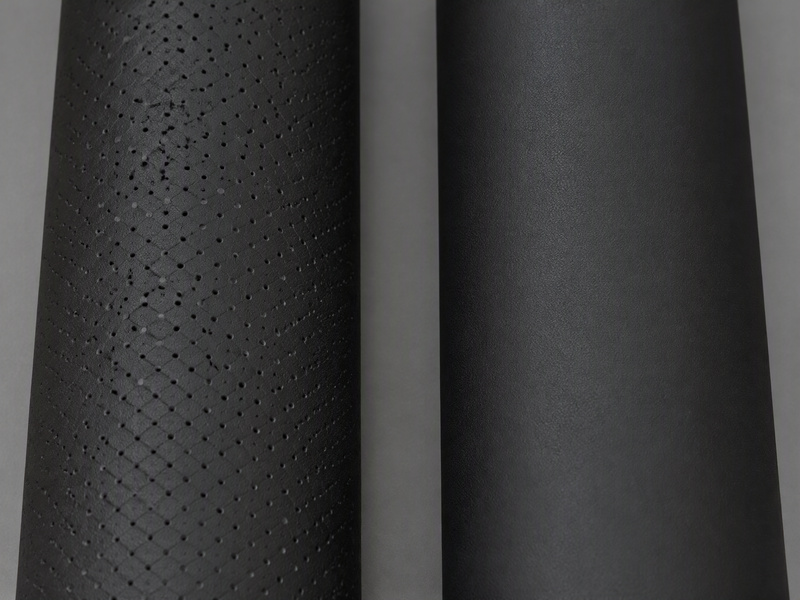
Figure 1. Two covers at the same bore: the vented surface on the left, the sealed surface on the right, both unused.
Why the Rated Ranges Do Not Overlap
The duty envelopes do not overlap, so neither rating covers the other duty. ISO 6134 sets a low-pressure steam hose at Type 1, 6 bar and 164 °C, and a high-pressure steam hose at Type 2, 18 bar and 210 °C. An EPDM hot water hose is usually published at about 20 bar and about 95 °C, and that band is a planning figure rather than a guarantee.
Table 3 sets the three envelopes side by side. The hot water hose rating and the steam ratings sit on different pressure and temperature axes, so a direct numeric swap would be meaningless.
Table 3. Published duty envelopes for steam service and a typical hot water hose rating.
| Product or class | Pressure | Temperature | Typical duty |
|---|---|---|---|
| ISO 6134 Type 1 | 6 bar | 164 °C | Low-pressure steam hose |
| ISO 6134 Type 2 | 18 bar | 210 °C | High-pressure steam hose |
| EPDM hot water hose | About 20 bar | About 95 °C | Hot water service (planning figure) |
ISO 6134 is the standard a steam hose is built and marked against. ISO 1403 covers textile-reinforced rubber water hose in three types, and none of them is a steam class. The two standards describe different products with different reinforcement and different covers. Reading the standard number off a marking is often the fastest way to confirm which side of the split a hose belongs to.
A higher hot water hose rating changes nothing that steam duty depends on. The tube is still a liquid-duty compound, the cover is still solid, and the margin is still sized for a liquid. Those three facts, not the pressure number, decide what happens on a steam line.
Failure Mechanics: Steam Permeation and Cover Blistering
Steam does not stay inside the tube. Molecules of water vapor work through the tube wall over time, and the amount grows with temperature and pressure. A perforated and pin-pricked cover lets vapor escape in small, controlled amounts. A solid cover has no such exit.
The permeation rate is not constant. It climbs as the steam temperature and pressure rise, so a hose that shows nothing at a low-pressure duty can blister before the next inspection at the top of its range. Pin-pricking does not stop permeation; it only gives the vapor somewhere to go. That is why the venting pattern is part of the design, not an afterthought.
When a hot water hose is placed on a steam line, that vapor collects under the solid cover. The trapped vapor lifts the cover away from the reinforcement and forms blisters. Once the bond is broken, water and steam travel along the cover, and the hose can no longer be trusted.
The steam hose vs hot water hose difference in the cover is therefore a vent, not a weakness. Perforations are placed in the steam cover on purpose, so a smooth, solid surface on a steam line is a warning sign rather than an improvement.

Figure 2. Vapor lifts the cover into blisters, and one has already split where the bond gave way, still before any burst or leak.
Condensate, Water Hammer and Popcorning
Steam condenses as it cools, and condensate collects at the low points of a hose run. A slug of condensate driven by the steam behind it can strike a coupling with the force of a hammer blow. Water hammer of this kind is a common cause of coupling pull-off and reinforcement fatigue.
The operating rule is to drain the hose after every use. If a steam hose is left full of condensate, the liquid soaks into the tube and the tube can swell and bubble into a popcorn-like surface. This popcorning failure is a direct result of skipping the drain step, and once it starts, the tube cannot recover.
Line practice reduces the hammer risk before the hose is chosen: traps remove condensate, and a slight slope keeps liquid moving toward the trap. A run that is also drained after use starts each shift empty.
Why Reinforcement Fails Before the Tube Does
Reinforcement is where a substitution defect becomes a safety event. Textile cord and light wire are chosen for a liquid at moderate temperature. At steam temperature the cord loses tensile strength, and the wire layers take a load outside their design. This is the point where hose substitution turns into an accident.
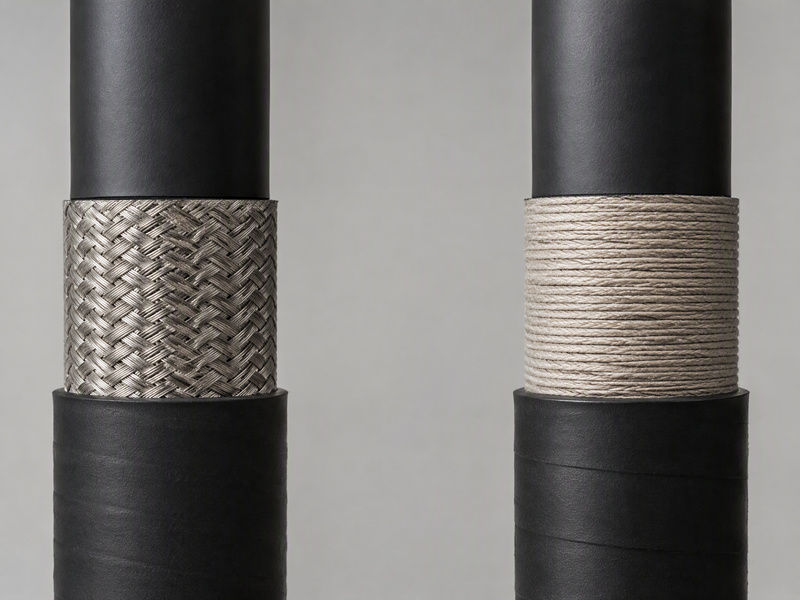
Figure 3. Same bore, different reinforcement: steel wire braid on one side, textile cord on the other, each cut back to show both.
The tube often survives longer than the reinforcement. Heat ages the rubber, but it attacks cord and light wire faster, because their strength depends on a bond and a structure that heat can loosen. By the time the cover looks tired, the load-bearing layer may already be the weakest part of the assembly.
Table 4 maps the failure modes to the mechanism and to the first warning sign an operator can see. Read the four rows above the burst as warnings, because each one usually arrives before it.
Table 4. Failure modes, mechanisms and the first warning sign for each.
| Failure mode | Mechanism | First warning sign |
|---|---|---|
| Cover blistering | Vapor permeates the tube and traps under a solid cover | Soft blisters or bubbles along the cover |
| Cover separation | Trapped vapor breaks the bond between cover and reinforcement | A loose cover that slides over the braid |
| Popcorning | Condensate left in the tube boils and swells the compound | A lumpy, popcorn-like inner surface |
| Reinforcement fatigue | Textile or light wire loses strength at steam temperature | Swelling, kinking or a soft spot in the wall |
| Sudden burst | A degraded reinforcement releases stored pressure at once | No warning, which is why the earlier signs matter |
A hot water hose on a steam line can degrade quietly and then burst suddenly, because the reinforcement, not the tube, is the part that finally gives way. A steam hose carries a very large margin between working pressure and burst pressure, and that margin is sized for steam duty.
A steam release at line temperature is a burn hazard at the point of failure, so the cover check is a safety check rather than a maintenance preference.
The Reverse Error: A Steam Hose on a Hot Water Line
In a steam hose vs hot water hose mix-up, the reverse direction fails at the cover first. A steam hose has a perforated cover by design, so it vents. On a hot water line, that same perforated cover admits dust, wash-down spray and surface water into the reinforcement.
Water entering the reinforcement corrodes steel wire, and in a sanitary line it can travel back into the product. The correct choice for that duty is a solid-cover hose from the water range, so compare the two envelopes before you order (see the industrial water hose range).
Contamination is the quiet cost of the reverse error. Water held against the tube creates a warm, wet layer that supports growth, which in a food, beverage or pharmaceutical line is a sanitation problem rather than only a hose problem.
Table 5. Substitution direction, what fails first and the likely outcome.
| Direction | What fails first | Likely outcome |
|---|---|---|
| Hot water hose on a steam line | Cover, then reinforcement | Blistering, then a sudden burst |
| Steam hose on a hot water line | Cover and reinforcement wire | Contamination and internal corrosion |
Read the table by direction. The steam-line error fails in sequence, cover then reinforcement, and ends in a burst. The water-line error fails in parallel, cover and wire together, and ends in corrosion.
Steam Hose vs Hot Water Hose: A Field Identification Test
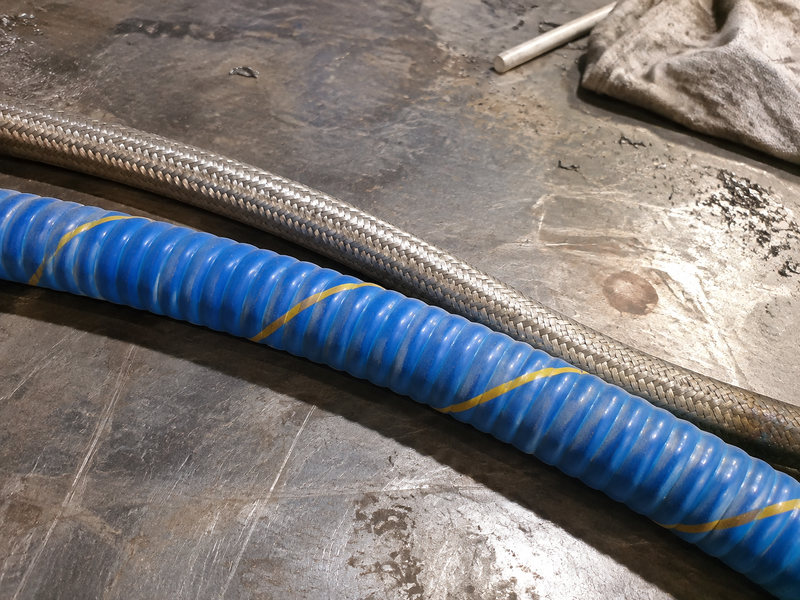
A steam hose vs hot water hose mix-up is usually caught by inspection, not by paperwork. Start with the cover and run your hand along it. A steam cover is perforated and pin-pricked, so it feels rough and shows many tiny holes. A hot water cover is smooth and solid.
Next, read the marking. A steam hose is usually branded with the type, the pressure and temperature pair, the electrical grade mark, and the quarter and year of manufacture, following the ISO 6134 marking convention. If the marking shows only a hot water hose rating, treat it as a hot water product and keep it off a steam header.
Finally, compare weight and stiffness at the same bore. The heavier wall and the steel reinforcement make a steam hose stiffer and denser in the hand. Two hoses of equal bore that differ this much are not interchangeable (hose size selection guide). This test catches the common hose substitution errors before they reach the line.
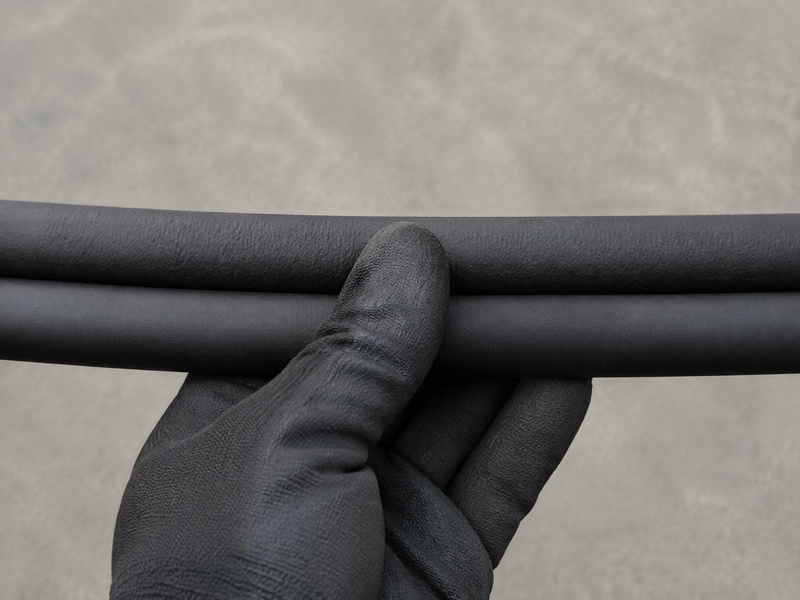
Figure 4. Equal bore and equal color: with no marking in view, only the surface texture and the stiffness separate the two.
The ARPM IP-11-1 guide covers steam hose use, testing and inspection, and the cover check belongs in that routine. Record what you find. A short note on the cover pattern, the marking text and the measured weight per foot builds a reference you can compare against the next delivery. When a hose arrives without a clear marking, treat the vent pattern and the stiffness as the deciding evidence and assign it to water duty only.
Steam Hose vs Hot Water Hose: The Rule
Match the hose to the medium, never to the pipe. The steam hose vs hot water hose decision turns on vapor duty, temperature and design factor, not on whether the thread fits.
The hose rating is not the assembly rating. A coupling attached with clamps or bands can pull the assembly working pressure below the rating printed on the hose, as the NAHAD Industrial Hose Assembly Guidelines note. Specify a steam-rated coupling for steam duty, and treat every clamp-and-band joint as a derated assembly. A universal quick-acting coupling suits air or water duty.
Keep a steam hose on steam duty and a hot water hose on hot water duty, and the vent, the compound and the margin all stay inside their intended envelope. When you need either product, the steam category page is the right starting point: industrial steam hose.
For an attribute-by-attribute view of both products, the planned companion article will list them side by side: comparing hot water and steam hoses, planned URL — publish before linking.
Steam Hose vs Hot Water Hose FAQs
Can a hot water hose be used on a steam line?
No. A hot water hose is a liquid-duty product: solid cover, textile or light wire reinforcement and a margin sized for liquid duty. Its published ceiling sits near 20 bar and 95 °C (planning figure). Steam service needs a heat-resistant tube, steel reinforcement and a perforated cover, with published ratings to 18 bar and 210 °C under ISO 6134. Match the marking to the duty, and order a steam hose whenever the marking shows only a water rating.
Why is the cover perforated on a steam hose?
Steam vapor works through the tube wall in service, and a solid cover would trap it against the reinforcement until the bond lifted. Perforations give it a controlled exit. A correct steam cover shows an even pattern of pin holes over the full length. A cover with holes only near the ends, or none at all, belongs to a water hose or has lost its perforation.
What happens if a steam hose is not drained after use?
Condensate left inside the tube boils on the next start-up and swells the compound into the lumpy surface known as popcorning, and the tube cannot recover once it starts. The fix is a shutdown step, not a repair: blow the line down, then drain the hose with both ends open and the low point down. A hose stored wet starts the next shift with liquid already inside it.
Does a higher pressure rating make a hot water hose steam-safe?
No. Pressure and temperature are separate limits, and a hose has to clear both. A 20 bar water hose still stops near 95 °C, while saturated steam at 18 bar arrives at 210 °C. Select on the temperature the medium actually reaches, then confirm the pressure rating covers the line. A pressure number never raises a temperature limit.
What is steam hose construction built around?
Steam hose construction answers three loads at once: pressure, heat and permeation. Steel reinforcement carries the pressure. The tube uses a heat-resistant EPDM or chlorobutyl compound for the temperature load. A vented cover releases the vapor that crosses the tube wall. A heavier wall and a design factor published at 10:1 to 20:1 add margin for all three.
How do I tell a steam hose from a hot water hose in the field?
Check the cover, the marking and the weight at the same bore. One finding closes the hose substitution question. A smooth cover with no pin holes, a marking with no type or temperature pair, or a weight far below a known steam hose of that bore. Any one of the three keeps that hose on water duty. That is the whole steam hose vs hot water hose test.
Why does textile reinforcement fail on steam duty?
Textile cord loses tensile strength as temperature climbs, and the wire layers then carry a load they were never sized for. The tube usually outlasts them. Squeeze the wall: a soft spot marks cord that has already given up, and that reading comes long before a burst.
What is the risk of putting a steam hose on a hot water line?
A steam hose vents by design, and those vents work in both directions. On a hot water line the cover admits wash-down water into the reinforcement, the steel wire corrodes from the inside, and a sanitary line can carry that water back into the product. For hot water, a solid-cover hose is the right product.
What do ISO 6134 Type 1 and Type 2 mean?
ISO 6134 is the international standard for rubber hose and hose assemblies for saturated steam. Type 1 is the low-pressure class, rated at 6 bar and 164 °C. Type 2 is the high-pressure class, rated at 18 bar and 210 °C. The two types split the market by duty, and each one carries its own pressure and temperature ceiling.
How much design factor does steam service need?
Published design factors for steam service are commonly 10:1 or 20:1, measured from working pressure to burst pressure. The margin absorbs thermal cycling, permeation and condensate, so it is consumed by the duty rather than by age. A hose built to a liquid-duty margin has spent its allowance before the first steam cycle. Confirm the figure against the current datasheet.
Über HENGHUA
HENGHUA manufactures hose and couplings for distributors, retailers and OEM brands worldwide. The steam line uses an EPDM or CR tube with one to two layers of steel wire braid or four to six layers of steel wire spiral, and a perforated, pin-pricked cover. Bore sizes run from 3/8 in to 4 in, covering saturated steam to 210 °C and superheated steam to 230 °C. A separate food-grade hose line serves food and beverage duty.
The factory covers 35,000 m² and runs 95 production lines, exporting to more than 70 countries. Quality systems follow ISO 9001, IATF 16949 and ISO 14001, and an in-house laboratory performs hydrostatic testing to ISO 1402 and impulse testing to ISO 6803. Commercial terms include factory-direct pricing, short bulk lead times and a warranty, with OEM/ODM support, custom lengths at ±1% length tolerance, sheath printing and private labeling.
To discuss a steam or hot water hose project, request a quote and free samples, or read more about HENGHUA.
 English
 Spanish
 Portuguese
 French
 German
 Arabic
 Russian
 Indonesian
 Japanese
 Korean