
Hot water and steam hoses both move hot fluids, but they follow different construction rules. Steam hose carries a vapor that flashes through the wall, so its cover is vented through pin-prick perforations. Hot water hose carries liquid under a lower published ceiling. This reference compares hot water and steam hoses attribute by attribute, then covers field identification and buying.
About a 15-minute read at 250 words per minute; the sections run from duty and materials through ratings, couplings, identification, standards and purchase.
What Hot Water and Steam Hoses Are For: Duty Windows
A duty window is the combination of fluid state, working pressure and continuous temperature that an assembly may see. Steam duty pairs a pressure with its saturation temperature, so raising the pressure raises the temperature as well. Water duty is set by the process rather than by saturation, and general water hose is commonly rated well below steam service.
Because the two duties move independently, a hose comparison has to start with the window instead of a single headline number. A pressure quoted without its fluid state tells you very little about which family belongs on the line. Both duty windows are stocked as separate ranges, the steam hose range and the water hose range, so the split is easy to see in a catalog.
The table below sets out typical service intent before any material is selected. Read it as a short list of questions to answer on site: what fluid, at what pressure, and at what continuous temperature the assembly will actually run.
Table 1. Duty windows and typical service intent for the two hose families.
| Attribute | Steam hose | Hot water hose |
|---|---|---|
| Fluid state | Saturated or superheated vapor | Pressurized liquid |
| Typical service | Live steam transfer, cleaning, thawing and heating | Washdown, rinse, process water and CIP supply |
| Pressure and temperature link | Fixed by saturation, so both halves move together | Two independent process values |
| Primary risk | Cover blistering and tube popcorning | Kinking and permeation at temperature |
The link row is the clearest single difference between the families. Steam duty is specified on a coupled pair, so a pressure on its own is half a specification. Water duty is specified on two values the process sets, which is why the two families of hot water and steam hoses are read from different evidence.

Figure 1. Vented and closed covers side by side; the outer wall, not the shade, differs.
Tube Compound and Reinforcement in Hot Water and Steam Hoses
Both families use rubber tubes, and EPDM is the common base for each of them. Steam hose needs a heat-resistant EPDM or chlorobutyl tube so the inner wall tolerates continuous saturation temperature without hardening. Water hose uses an EPDM tube tuned for liquid service, where the thermal load stays lower for the same pressure.
Reinforcement is where duty shapes the build. Steam hose relies on wire, either braided or spiral, to hold the bore against pressure and heat together. Water hose often uses textile reinforcement at lower pressures and turns to wire only where the rating demands additional strength. The two designs are close cousins at the material level, and then diverge sharply once the wire count and the cover are fixed.
The table shows how the two builds line up row by row, from the wetted tube outward to the cover.
Table 2. Construction compared across tube, reinforcement and cover.
| Layer | Steam hose | Hot water hose |
|---|---|---|
| Tube | Heat-resistant EPDM or chlorobutyl | EPDM for liquid service |
| Verstärkung | Wire braid or wire spiral | Textile, or wire where the rating requires it |
| Cover | EPDM, perforated or pin-pricked | EPDM, closed |
| Purpose of the cover | Vents vapor that crosses the wall | Holds liquid in and contamination out |
Read the tube and cover rows together. A closed cover on steam duty traps vapor, while a perforated cover on a water line is simply unnecessary. Because the two families share so much of the tube chemistry, the cover and the reinforcement are the two places where a buyer can lose the distinction. For a full walkthrough of how the two builds diverge, read steam hose vs hot water hose construction differences (planned URL — publish before linking).
Cover Construction: Venting, Marking and Identification Signals
The cover is not decoration. It is the part of the hose that tells a technician what is in hand, and on steam hose it must vent the vapor that diffuses through the tube and reinforcement. Makers therefore perforate or pin-prick the cover (Figure 2), and that venting is what keeps the outer layer bonded to the carcass over a long service life.
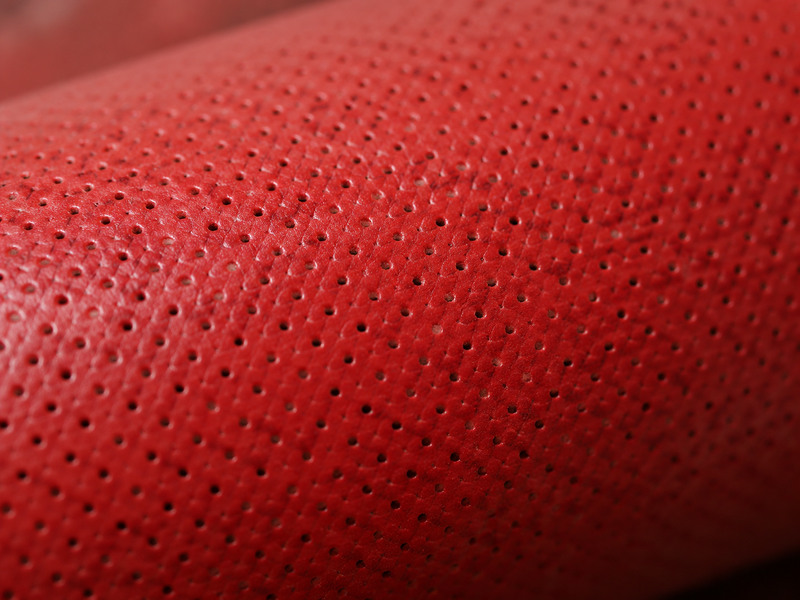
Figure 2. Pin-prick perforations across a red cover, the vents that release vapor through the wall.
A closed cover is correct for water duty. It keeps the reinforcement dry, resists scuffing on concrete and steel, and seals the carcass from splash contamination. That difference in the outer wall is the hinge of the field check, because the cover is the one layer a technician can inspect without cutting the hose.
Because the two covers can look nearly identical in color, identification has to rely on markings and on the small perforations rather than on shade alone. The table lists the data you can actually read on a cover and how to confirm each item.
Table 3. Cover marking and identification data to read in the field.
| Marking element | What it tells you | How to confirm it |
|---|---|---|
| Type code | Pressure class of the build | Compare with the line schedule |
| Pressure and temperature pair | Working limits taken together | Read both halves, never pressure alone |
| Electrical grade | Conductive or non-conductive build | Match the site grounding rule |
| Quarter and year | Manufacturing date | Date the hose before reuse |
| Inner diameter | Bore for flow and couplings | Measure the bore rather than assume it |
The marking table is the fastest field check available. The electrical grade line states whether the build is conductive or non-conductive, and the site grounding rule decides which one the line may accept. If the pressure and temperature pair is missing or unreadable, treat the assembly as of unknown rating and take it out of steam service before the next shift.
Working Pressure and Temperature: Reading the Steam Hose Rating
A steam hose rating is always a pair and never a lone pressure. ISO 6134 sets two classes: Type 1 at 6 bar and 164 °C for low-pressure steam, and Type 2 at 18 bar and 210 °C for high-pressure steam. The saturation link is what makes the two halves inseparable.
Water sits on a different scale. General textile-reinforced rubber water hose falls under ISO 1403, and a commonly published EPDM hot water ceiling is about 20 bar at +95 °C as a planning figure. The hot water temperature limit is therefore a published process figure rather than a saturation value, and it sits well below either steam class. For the saturated steam case in detail, see EPDM steam hose for saturated steam.
The table pairs the published numbers with the test basis behind them, but read the direction: the water planning figure gives the highest working pressure in the table and the lowest temperature.
Table 4. Published pressure and temperature pairs and test basis.
| Parameter | Steam hose | Hot water hose |
|---|---|---|
| Betriebsdruck | Type 1: 6 bar (0.6 MPa); Type 2: 18 bar (261 psi) | About 20 bar published ceiling (planning figure) |
| Temperature | Type 1: 164 °C; Type 2: 210 °C (410 °F) | +95 °C planning figure |
| Design factor | Commonly published at 10:1 or 20:1 | Set by reinforcement, not a fixed figure |
| Burst test | ISO 1402 | ISO 1402 |
| Impulse test | ISO 6803 | Not a standard steam-style test |
Treat every pair as a single, indivisible fact. When a supplier quotes only the pressure half of a steam hose rating, ask for the temperature that goes with it and for the test basis behind both numbers.
Design Factor and Bend-Radius Behavior
Design factor is the ratio of burst pressure to working pressure. Steam hose is commonly published at 10:1 or 20:1, so a 20:1 build carries a far larger margin than a 10:1 build at the same nominal rating. That value is an industry convention that varies by product and size, not a fixed universal number, so it belongs in the purchase questions rather than in an assumption.
Bend radius governs how tightly the assembly can turn before the reinforcement is stressed. Wire-reinforced steam hose generally needs a larger bend radius than textile water hose of the same bore, and a tight turn concentrates load on the inner curve of the wall. The table shows how the two behave at the bend and what to check on site.
Table 5. Bend-radius behavior compared for the two hose families.
| Condition | Steam hose | Hot water hose |
|---|---|---|
| Reinforcement at the bend | Wire braid or wire spiral | Textile or light wire |
| Effect of a tight turn | Load concentrates on the inner curve | Bore tends to flatten |
| Source for the minimum radius | Maker datasheet, per bore | Maker datasheet, per bore |
| Field check | Sight the curve for flattening | Sight the curve for kinking |
| If the radius is ignored | Premature cover cracking | Reduced flow and early kinking |
Choose the bore against both flow and bend radius rather than flow alone. The sizing method, including how to convert between inches and millimeters, is set out in the hose size selection guide.
Couplings, Clamps and Assembly Working Pressure
The hose rating is not the assembly rating. A coupling joined with clamps or bands can reduce the assembly working pressure below the rating printed on the hose, a point the NAHAD Industrial Hose Assembly Guidelines make directly. The attachment has to suit the bore, the pressure and the temperature together, because a clamp that is adequate at one temperature may slip at another.
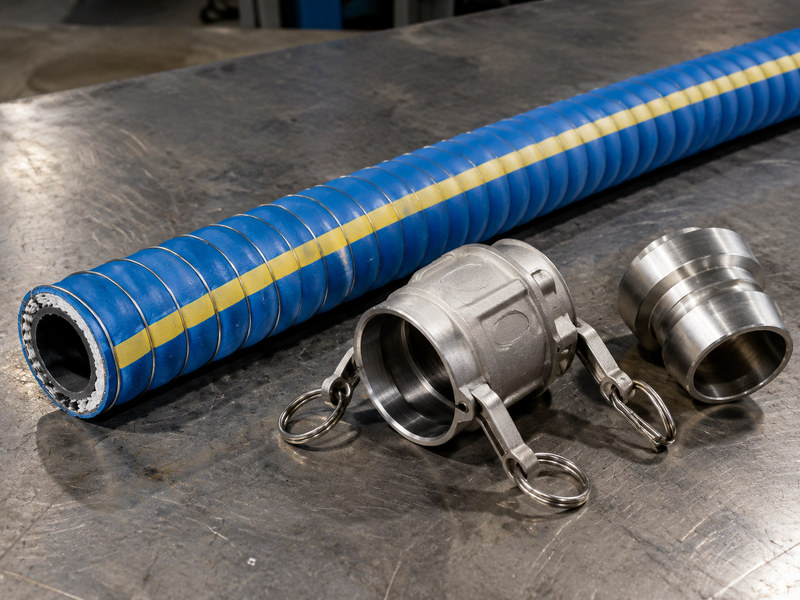
Steam adds one more rule. Universal quick-acting couplings must not be used on steam hose, because a coupling that can be opened under pressure is a hazard when the line holds live vapor. Fixed, rated end connections are the safe choice for steam (Figure 3), while water duty can use a wider range of fittings within its rating.

Figure 3. A fixed rated coupling at a steam line end; no quick-acting fitting belongs here.
The table compares the two cases, including the effect of a band or clamp on the finished assembly.
Table 6. Couplings, clamps and assembly working pressure.
| Item | Steam hose | Hot water hose |
|---|---|---|
| Suitable end connection | Fixed, rated coupling | Cam-lock or clamped fitting within the rating |
| Universal quick-acting coupling | Not permitted on steam | Permitted within the rating |
| Effect of a clamp or band | Lowers the assembly rating below the hose rating | Lowers the assembly rating below the hose rating |
| Check before service | Confirm the assembly rating, not only the hose rating | Confirm the assembly rating, not only the hose rating |
| Test reference | ISO 1402 hydrostatic | ISO 1402 hydrostatic |
A finished assembly therefore carries two numbers: the hose rating and the lower assembly rating. Selection detail for end fittings is covered in the complete guide to hose couplings, and the gap between the two pressure numbers is explained at working pressure vs burst pressure.
Field Identification Sequence
Field identification is a short, fixed sequence. It starts with the cover surface, then the marking, then the bore, then the end connections, and finally the age of the hose. Work the steps in order, and let a failure at any step send the hose for review instead of back into steam service.
Each step yields one fact you can record on a tag. Cover perforations confirm steam construction, and a complete marking gives both the rating pair and the date of manufacture. The table sets out the sequence as a decision path.
Table 7. Field identification sequence for steam and water hose.
| Step | Überprüfen | Decision |
|---|---|---|
| 1 | Cover surface for perforations | Perforated points to steam construction |
| 2 | Cover marking for a readable pair | Unreadable means quarantine the hose |
| 3 | Bore against the line schedule | Confirm the couplings will fit |
| 4 | End connections for a rated fit | Reject any universal quick-acting coupling |
| 5 | Date code against the service window | Retire hoses of unknown age |
Keep the recorded facts with the assembly. When a hose returns from service, the tag tells the next technician what to verify and shortens the decision considerably.
Standards Behind Hot Water and Steam Hoses
Standards tell you which tests a build answers to. Steam hose is commonly specified to ISO 6134, which sets the two pressure classes and their temperatures. Water hose is commonly specified to ISO 1403 for general textile-reinforced rubber water hose. Dimensions and tolerances come from ISO 1307, where a length tolerance of ±1% is commonly published, and testing uses ISO 1402 for hydrostatic and burst work and ISO 6803 for impulse.
Two further references help in practice. The ARPM IP-11-1 guide covers steam hose use, testing and inspection, and BS 5342 is a British steam rubber hose standard. Naming a standard is not a claim that a product holds it; it only states which test basis applies. Confirm the actual basis on the maker’s datasheet before ordering.
The table maps each standard to the family it governs and the property it covers.
Table 8. Standards map for steam and water hose.
| Standard | Applies to | What it covers |
|---|---|---|
| ISO 6134 | Steam hose | Two pressure classes and their temperatures |
| ISO 1403 | Water hose | General textile-reinforced rubber water hose |
| ISO 1307 | Both families | Dimensions and tolerances |
| ISO 1402 | Both families | Hydrostatic and burst testing |
| ISO 6803 | Steam hose | Impulse testing |
Use the standards map as a shopping list of questions: which class, which test, which tolerance, matched to the duty window you wrote down at the start.
Choosing Between Hot Water and Steam Hoses: A Decision Table and Purchase Checklist
Choosing between the two families comes down to the duty window, not the color of the cover. The table below maps a duty to the family and to the attribute you specify first. Read each answer as a starting point, and confirm every number against the maker’s datasheet, because ratings vary by bore and construction.
Table 9. Decision table: if your duty is X, the answer is Y.
| If your duty is | The answer is | Specify first |
|---|---|---|
| Live saturated steam to 6 bar | ISO 6134 Type 1 steam hose | Vented cover and the 164 °C limit |
| Live high-pressure steam to 18 bar | ISO 6134 Type 2 steam hose | The 210 °C pair and wire reinforcement |
| Rinse water near +95 °C | EPDM hot water hose | The +95 °C ceiling and a closed cover |
| Light washdown at low pressure | Textile water hose to ISO 1403 | Bore, flow rate and cover |
| Food-contact hot water | Food-grade hot water hose | A food-contact declaration |
| Steam cleaning outdoors | Steam hose with a drain routine | Drain after use without exception |
Keep the hose comparison anchored to the duty window as you work down the table, and match the hot water temperature to the process set point before you choose the cover. Before you order, confirm five things. First, the duty window and the fluid state. Second, the pressure and temperature pair, both halves of it. Third, the reinforcement and cover type for that duty. Fourth, the assembly rating after the chosen couplings and their attachment. Fifth, the marking and date code you expect to read on the delivered hose.
One rule is common to both families and it decides service life more often than any single specification line: drain the hose after every use. Residual liquid inside a steam hose lets the tube blister, a failure known as popcorning, and leftover water shortens a hot water hose as well. The rule costs nothing to follow and it protects both duty windows (Figure 4).

Figure 4. An open-ended coil hung on a rack so residual liquid drains after the shift.
Hot Water and Steam Hoses FAQs
What is the main difference between hot water and steam hoses?
The fluid state drives everything else. Steam hose carries vapor that flashes through the wall, so its cover is perforated to vent that vapor. Hot water hose carries a pressurized liquid and uses a closed cover. The published limits also differ: the two steam classes run to 164 °C and 210 °C, while an EPDM hot water ceiling is commonly published near +95 °C as a planning figure.
Can I use a hot water hose for steam service?
No. A hot water hose is not built or rated for steam duty. The cover does not vent vapor, the reinforcement is sized for liquid service, and the published ceiling stops well short of steam. Match the hose to the fluid state first and to the pressure second, then confirm both halves of the rating with the maker.
How do I read a steam hose rating?
Read it as a ceiling, not a target. The cover marking gives a maximum working pressure with the saturation temperature that belongs to it, and the class code names the ISO 6134 class that pair defines. Compare both halves with the window you recorded on site. A pressure quoted alone, in bar or in psi, is not a rating.
What does a perforated cover tell me?
A perforated or pin-pricked cover signals steam construction. The small vents let vapor that diffuses through the tube and reinforcement escape to the atmosphere. Without that venting, trapped vapor blisters the cover and then separates it from the carcass. A closed cover instead points to water or multipurpose duty, where there is no vapor to release.
What should a hose comparison check first?
A hose comparison of hot water and steam hoses should begin with the duty window: the fluid state plus the continuous pressure and temperature. That one step separates the two families faster than any single figure can. Once the window is fixed, tube compound, reinforcement, cover, design factor and couplings follow in order, and each choice traces back to the duty.
Why does a clamp reduce the assembly working pressure?
A clamp or band grips by friction, so the finished assembly is only as strong as the attachment allows. The NAHAD Industrial Hose Assembly Guidelines treat that drop as normal rather than as a defect. Put the assembly rating, with the chosen coupling and band, on the purchase order before the first length is cut.
What hot water temperature can an EPDM hose handle?
A commonly published EPDM hot water ceiling is about 20 bar at +95 °C, and that figure is treated as a planning figure rather than a hard field limit. It sits well below steam service. Confirm the hot water temperature range and the pressure with the maker, because grades and reinforcement differ, and check the cover type as well.
Which standards apply to each family?
Three names cover most inquiries: ISO 6134 for the steam classes and their temperatures, ISO 1403 for general water hose, and ISO 1307 for dimensions and tolerances. ISO 1402 and ISO 6803 cover the hydrostatic, burst and impulse tests behind them. Naming a standard states the test basis, not a product approval.
How does bend radius differ between the two?
Wire-reinforced steam hose needs a larger minimum bend radius than textile water hose of the same bore, and the path sets that radius before the purchase does. Measure the tightest turn on site, allow for the fittings at both ends, then compare the figure with the datasheet for the bore you intend to order.
What is the one rule common to both hose types?
Drain it after every use, and put the drain point on the installation drawing rather than in a work instruction. A coil hung open-ended at its low end empties itself; a coil lying flat keeps liquid against the tube. The arrangement, not the reminder, is what keeps the tube dry.
How does design factor affect a purchase decision?
A 20:1 build and a 10:1 build can carry the same nominal rating, so the factor is the one line that shows how much margin sits behind the pressure. Ask for it at the bore you are ordering, because it changes with size and construction. Never compare two suppliers on the pressure number alone.
Über HENGHUA
HENGHUA is a manufacturer of hoses and fittings that supplies distributors, retailers and OEM brands worldwide. The steam line is built with an EPDM or CR tube, 1 to 2 layers of wire braid or 4 to 6 layers of wire spiral, and a perforated (pin-pricked) cover. Bore coverage runs from 3/8 in to 4 in, covering saturated steam duty to 210 °C and superheated steam duty to 230 °C, and a separate food-grade hose series serves food and beverage lines.
The factory runs a 35,000 m² site with 95 production lines and exports to more than 70 countries, operating under ISO 9001, IATF 16949 and ISO 14001 quality systems. An in-house laboratory performs hydrostatic (ISO 1402) and impulse (ISO 6803) testing. Business terms include factory-direct pricing, short lead times for bulk orders and a warranty, with support for OEM/ODM work, custom lengths to a ±1% tolerance, and cover printing and private label.
 English
 Spanish
 Portuguese
 French
 German
 Arabic
 Russian
 Indonesian
 Japanese
 Korean