
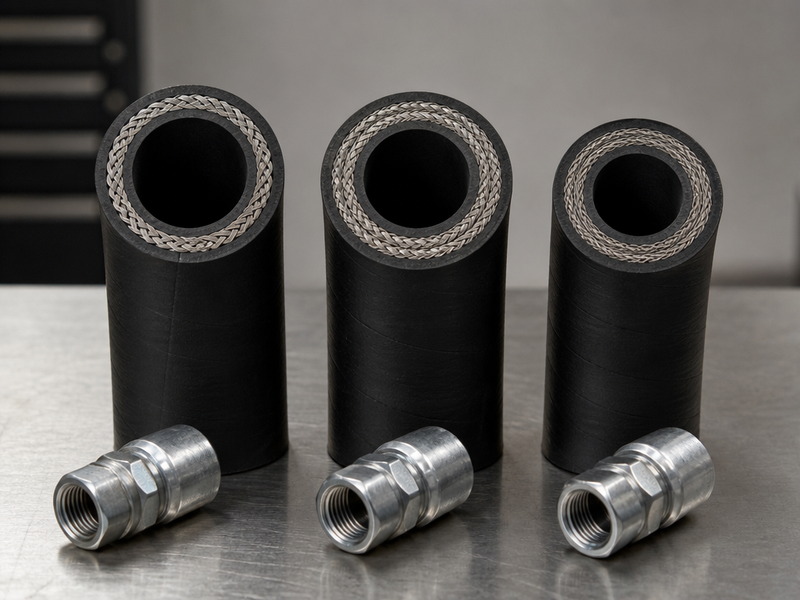
The short answer to 100R1 vs 100R2 vs 100R16 is a size-for-size comparison of pressure and geometry: in 3/8-inch bore, an SAE 100R1 single wire braid hose is rated about 2,280 psi, an SAE 100R2 double wire braid hose about 4,000 psi, and an SAE 100R16 compact double wire braid hose delivers the same or higher pressure class as the 100R2 while bending to roughly half its radius. In practice the 100R1 to 100R2 line sits near 2,000 psi, and the 100R2 vs 100R16 line is decided by the tightest radius the routing allows. Choose between them on the circuit:
- SAE 100R1 for medium-pressure lines where cost and easy routing matter
- SAE 100R2 when the circuit runs at 3,000 to 5,000 psi and the hose has room to bend
- SAE 100R16 when you need 100R2 pressure inside a tight, moving installation that a 100R2 cannot physically reach
This guide compares all three on construction, working pressure by dash size, outside diameter, bend radius, weight, temperature limits, fittings and crimp requirements, then gives a five-step decision path, the identification marks printed on each hose, and the point at which a different specification is the better answer.
Note on terminology: throughout this guide R1, R2 and R16 mean the SAE 100R1, SAE 100R2 and SAE 100R16 hose designations — one braid layer, two braid layers, and a compact two-braid build. They are unrelated to the R1 and R2 bend radius conventions, which describe whether a curve is measured to the inside surface or to the hose centerline.
The Short Answer: One Table for 100R1 vs 100R2 vs 100R16
All three hoses are built to SAE J517 and share the same three-layer architecture, so the differences come down to how many braided steel layers sit over the tube, how tightly the finished hose is built, and therefore where the 100R1 vs 100R2 vs 100R16 line falls for your circuit. The table below is the version most buyers need.
Table 1. 100R1, 100R2 and 100R16 compared at 3/8 inch bore — typical published values
| Especificações | Reforço | Typical working pressure (3/8 in bore) | Minimum bend radius (3/8 in bore) | Choose it when | Main limitation |
|---|---|---|---|---|---|
| SAE 100R1 | One braided steel wire layer | 2,280 psi (15.7 MPa) | 125 mm (4.9 in) | Line runs under about 2,000 psi, or you need the lowest-cost steel-braid hose | Lowest pressure ceiling; the braid fatigues sooner under repeated spikes |
| SAE 100R2 | Two braided steel wire layers | 4,000 psi (27.6 MPa, SAE J517 100R2AT table) | 125 mm (4.9 in) | General mobile and industrial pressure lines, 2,000 to 5,000 psi | Larger outside diameter; will not bend tightly |
| 100R16 (compact, SAE J517) | Two braided steel wire layers, compact build | 4,785 psi (33 MPa, EN 857 2SC table) | 65 mm (2.6 in) | Space is tight, the hose moves, or a 100R2 cannot make the bend | Thin cover; smaller size range; its own ferrule and crimp specification |
A fourth specification, SAE 100R17, is worth knowing before you order: it is a compact hose rated a constant 3,000 psi in every size, which makes it the standard answer for pilot and control lines on mobile equipment. If your line is a return line or a suction line, none of these three is correct — a suction and return hose built to 100R4, or a textile-braid hose (100R3 or 100R6), belongs there instead.
What Each Specification Actually Requires
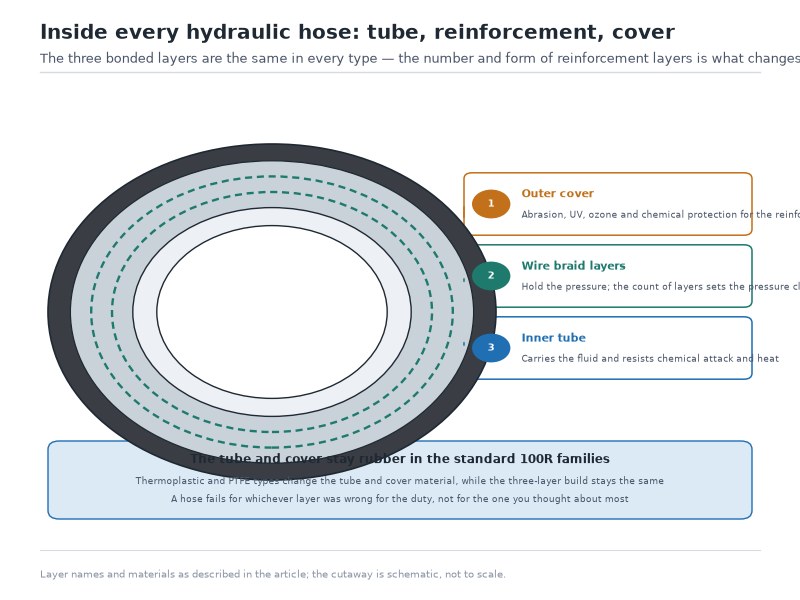
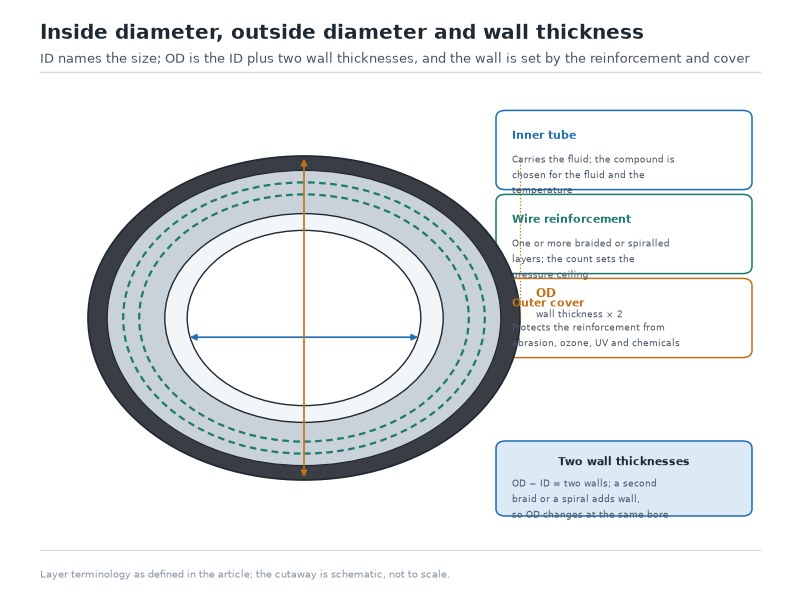
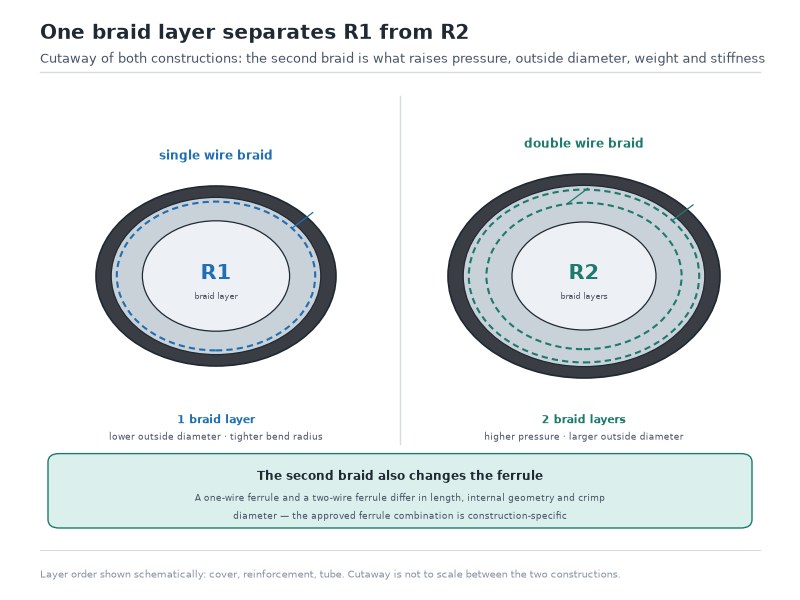
SAE J517 is the document that defines these hose types — our SAE 100R hydraulic hose standards guide covers the full series — and each “100R” number is a separate specification with its own pressure table, dimensional table, and impulse-test requirements. 100R1 describes a hose with one braided steel wire reinforcement layer over an oil-resistant synthetic rubber tube, with a weather-resistant synthetic rubber cover. 100R2 describes the same architecture with two braided steel wire layers. 100R16 describes a compact two-braid hose engineered to fit the outside diameter of a 100R1 while carrying the pressure capability of a 100R2.
The European standards mirror the same three constructions — the mapping across SAE, ISO, EN and DIN is set out in our hydraulic hose standards comparison guide — and they are the reason the same hose often carries two codes on its cover. On a European drawing, the same choice is written as a 2SN vs 2SC question, with the pressure tables expressed in bar rather than psi. 100R1 corresponds to EN 853 1SN and ISO 1436 Type 1SN. 100R2 corresponds to EN 853 2SN and ISO 1436 Type 2SN. 100R16 corresponds to EN 857 Type 2SC and ISO 11237 Type R16.
Table 2. SAE / EN / ISO cross-reference: SAE 100R1 = EN 853 1SN = ISO 1436 1SN; SAE 100R2 = EN 853 2SN = ISO 1436 2SN; SAE 100R16 = EN 857 2SC = ISO 11237 R16; SAE 100R17 = EN 857 1SC = ISO 11237 R17.
| Especificações | SAE standard | European equivalent | ISO equivalent | Typical size range | Cover type |
|---|---|---|---|---|---|
| 100R1 | SAE J517 100R1 | EN 853 1SN | ISO 1436 1SN | 3/16 in to 2 in | Standard or thin (AT) |
| 100R2 | SAE J517 100R2 | EN 853 2SN | ISO 1436 2SN | 3/16 in to 2 in | Standard or thin (AT) |
| 100R16 | SAE J517 100R16 | EN 857 2SC | ISO 11237 R16 | 1/4 in to 1-1/4 in | Thin cover, compact |
| 100R17 | SAE J517 100R17 | EN 857 1SC | ISO 11237 R17 | 1/4 in to 1 in | Thin cover, compact |
When a purchase order carries only one code, a supplier is entitled to deliver against that code, so any 2SN vs 2SC substitution should be confirmed in writing before it reaches a crimping bench.
One caution applies to every row of that table: these are equivalent constructions, not identical published values. The same 3/8 inch bore is published at 15.7 MPa (2,280 psi) on the SAE 100R1AT table and 18 MPa (2,610 psi) on the EN 853 1SN table, because each figure belongs to the specification the hose was tested against. A cross-reference tells you which codes describe the same construction; it does not tell you that the two codes publish the same number.
Because the two-braid construction is what separates 100R2 and 100R16 from 100R1, the pressure step from 100R1 to 100R2 is the largest single jump in the medium-pressure family — about 1.72 to 1.98 times the working pressure up to 3/4 inch, 1.97 times at 1 inch and 2.42 times at 1-1/4 inch, where the two published tables diverge most. It is not a doubling, because the second braid layer also changes how the first layer is loaded. The step is smallest exactly where most mobile machinery is specified, and that is why the 100R2 decision is usually made on the bore and the routing rather than on the pressure alone.
What the “AT” Suffix Means in 100R1AT and 100R2AT
The suffix on a hose marking tells you which assembly method the hose was built for, not what pressure it holds. “AT” indicates a no-skive hose: the cover is thin enough that a crimp ferrule can be pressed directly over it, without machining the cover back to expose the wire braid. The older Type A design required skiving and no-skive fittings to be chosen separately, which is why second-hand literature sometimes quotes different dimensions for “100R1” and “100R1AT” of the same size.
A 100R1AT and a 100R1 Type A hold the same pressure class, but the AT version is lighter and has a smaller outside diameter — and the two are not interchangeable on the same ferrule without checking the crimp specification. A marking of 100R2AT and a table headed SAE J517 100R2AT describe the same construction class: the pressure column you design to is the one published for the exact hose in your hand, while the AT / Type A distinction affects cover, outside diameter and crimp specification rather than the pressure class.
Where 100R16 Sits: The Compact Two-Braid Family
100R16 was written for the problem 100R2 cannot solve: a machine that needs 4,000 psi in a hose run that has no room for a 100R2’s outside diameter or bend radius. The construction is the same two-braid architecture squeezed into a tighter package, and the result is a compact hydraulic hose whose bending radius is close to half that of a 100R2 of the same nominal size. That compression is why the SAE 100R16 pressure rating is published per size rather than as a single figure, and why the compact hydraulic hose is normally specified from the routing drawing rather than from the pressure line on the schematic.
The trade-offs are deliberate: the cover is thinner, the available size range stops around 1 inch to 1-1/4 inch, and the compact build has less cover material to absorb abrasion.
100R17 is its sibling — the single-braid companion to 100R16, a compact one-layer construction rated a flat 3,000 psi in every size rather than from a size-by-size table, published as EN 857 1SC and ISO 11237 R17. A 100R16 vs 100R17 comparison therefore turns on one question: does the circuit need the highest available pressure in a tight space (100R16), or one predictable rating across every size (100R17)? Both are manufactured as standard production lines, and the SAE 100R17 compact hose and the EN 857 2SC compact hose that corresponds to 100R16 share the no-skive assembly approach.
Working Pressure: 100R1 vs 100R2 vs 100R16 by Dash Size
Working pressure is the number of the comparison that decides most jobs, and it is a per-size value, not a property of the specification alone. Read it from a hydraulic hose working pressure chart at your dash size rather than from a family figure, because every specification in this family is published size by size. The table below is that hydraulic hose working pressure chart for the three specifications across the sizes most often specified in mobile and industrial hydraulics: the SAE 100R16 pressure rating at -6 (3/8 inch) is 33 MPa / 4,785 psi, against 27.6 MPa / 4,000 psi for the 100R2AT in the same bore. Values are working pressure, not burst pressure; the minimum burst pressure for all three is specified at four times the maximum working pressure (SAE J517 / EN 853 / EN 857).
SAE J517 100R2AT and EN 853 2SN are the SAE and European codes for the same two-wire braid construction, but the two standards publish different working pressures at some dash sizes: this table follows the SAE J517 100R2AT column, and the EN 853 2SN values for the same dash sizes run higher. Confirm the figure for the exact dash size and standard on the datasheet before ordering, because a hose built to one code is not interchangeable with a hose built to the other at every size.
Table 3. Working pressure by dash size. Columns: SAE J517 100R1AT, SAE J517 100R2AT and EN 857 2SC / SAE 100R16. Minimum burst pressure is specified at four times the maximum working pressure (SAE J517 / EN 853 / EN 857).
| Dash size | Nominal ID | SAE J517 100R1AT | SAE J517 100R2AT | EN 857 2SC / SAE 100R16 |
|---|---|---|---|---|
| -4 | 1/4 in | 19.2 MPa / 2,780 psi | 34.5 MPa / 5,000 psi | 35 MPa / 5,075 psi |
| -6 | 3/8 in | 15.7 MPa / 2,280 psi | 27.6 MPa / 4,000 psi | 33 MPa / 4,785 psi |
| -8 | 1/2 in | 14 MPa / 2,030 psi | 24.1 MPa / 3,500 psi | 27.5 MPa / 3,990 psi |
| -12 | 3/4 in | 8.7 MPa / 1,260 psi | 17.2 MPa / 2,500 psi | 21.5 MPa / 3,120 psi |
| -16 | 1 in | 7 MPa / 1,015 psi | 13.8 MPa / 2,000 psi | 16.5 MPa / 2,390 psi |
| -20 | 1-1/4 in | 4.3 MPa / 620 psi | 10.3 MPa / 1,500 psi | 12.5 MPa / 1,810 psi |
For a first-pass SAE 100R1 vs 100R2 screen, compare the circuit’s maximum pressure with the 100R1 column for the dash size you need — if it does not clear it with margin, the 100R2 column is where the answer is.
Three practical points follow from that table.
First, the 100R1 to 100R2 step is not one number: it is about 1.80 times at 1/4 inch (5,000 psi against 2,780 psi), 1.75 times at 3/8 inch, 1.72 times at 1/2 inch, 1.98 times at 3/4 inch, 1.97 times at 1 inch and 2.42 times at 1-1/4 inch, so the second braid layer buys proportionally more as the bore grows. That widening step is the number to read before you substitute one construction for the other by size alone; the one-braid side of it is worked through in detail in our 100R1 vs 100R2 construction comparison. Second, 100R16 matches or exceeds 100R2 in every size where both exist, and the gap widens in the larger sizes because the compact construction is built to the European 2SC table rather than the 100R2 table. Third, no hose in this family is rated at a single pressure across all sizes unless the specification says so — only 100R17 and 100R18 behave that way. The full hydraulic hose working pressure chart, including proof and minimum burst pressures for every dash size, is published on the SAE 100R1 single wire braid hose and SAE 100R2 double wire braid hose product pages.
Why the 100R1 vs 100R2 Pressure Gap Is Not Exactly Double
Two wire layers raise the working pressure by roughly 1.72 to 1.98 times across the -4 to -12 range, rather than doubling it, because the two layers do not carry identical loads. The inner braid sits close to a tube that expands slightly under pressure, while the outer braid sits on top of the first and sees a different hoop stress pattern. What the second layer mainly buys is resistance to impulse fatigue — repeated pressure spikes — rather than a clean multiple of steady-state pressure. In test benches, a single-braid 100R1 hose that passes a steady pressure test will still degrade faster than a 100R2 on a circuit with frequent spikes, which is why the specification choice for shock-loaded circuits is made on impulse life rather than on the working-pressure number alone.
How Rating Falls as Bore Grows
Working pressure falls steeply as bore grows, but not in proportion to it: on the tables here it drops about 60 percent when the bore quadruples — a 1/4-inch 100R2AT is rated 5,000 psi and a 1-inch 100R2AT 2,000 psi, for four times the bore and sixteen times the flow area at the same fluid velocity. The reason is wall stress: hoop stress rises with diameter for the same pressure and the same reinforcement thickness, so the same construction holds less pressure as it grows — a fall of 60 percent, not the 75 percent that a strictly proportional rule would predict. The practical consequence is that a hose size is never chosen from flow alone. A 1-inch line that needs 3,000 psi is one of the cases where a spiral hose beats a two-wire braid hose, because the braided construction has already run out of pressure at that diameter.
Outside Diameter, Bend Radius and Weight: Where 100R16 Wins
Geometry, not pressure, is the reason 100R16 exists: the 100R2 vs 100R16 decision turns on bend radius and outside diameter (Table 4), not on working pressure (Table 3). In the same dash size, a compact hydraulic hose such as 100R16 is built to a smaller outside diameter, bends to about half the radius, and weighs less than the equivalent 100R2. The figures below are published minimum bend radii and hose weights for the three specifications.
Table 4. Minimum bend radius by dash size. 100R16 values are half the 100R1 / 100R2 values at every size listed (50 / 65 / 90 / 120 / 150 mm), which is why the compact hose is normally specified from the routing drawing rather than from the pressure line.
| Dash size | Nominal ID | 100R1 bend radius | 100R2 bend radius | 100R16 bend radius | 100R16 ÷ 100R2 |
|---|---|---|---|---|---|
| -4 | 1/4 in | 100 mm | 100 mm | 50 mm | 50% |
| -6 | 3/8 in | 125 mm | 125 mm | 65 mm | 52% |
| -8 | 1/2 in | 180 mm | 180 mm | 90 mm | 50% |
| -12 | 3/4 in | 240 mm | 240 mm | 120 mm | 50% |
| -16 | 1 in | 300 mm | 300 mm | 150 mm | 50% |
Table 5. Mass per metre by dash size, with the saving the compact build gives against the standard two-braid hose in the same dash size. Mass values are catalogue figures — confirm against the datasheet for the exact hose.
| Dash size | Nominal ID | 100R1 mass | 100R2 mass | 100R16 mass | 100R16 lighter than 100R2 by |
|---|---|---|---|---|---|
| -4 | 1/4 in | 0.25 kg/m | 0.36 kg/m | 0.30 kg/m | 16.7% |
| -6 | 3/8 in | 0.36 kg/m | 0.54 kg/m | 0.42 kg/m | 22.2% |
| -8 | 1/2 in | 0.45 kg/m | 0.68 kg/m | 0.54 kg/m | 20.6% |
| -12 | 3/4 in | 0.65 kg/m | 0.94 kg/m | 0.80 kg/m | 14.9% |
| -16 | 1 in | 0.91 kg/m | 1.35 kg/m | 1.15 kg/m | 14.8% |
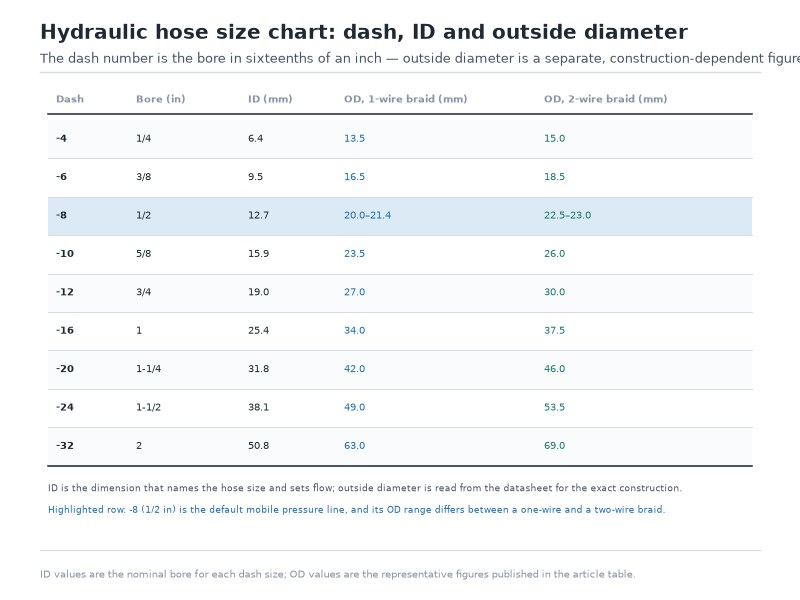
Outside diameter follows the same pattern. In a 3/8-inch size, one major manufacturer’s published catalogue lists the 100R2AT at 0.75 inch outside diameter against 0.68 inch for the 100R16 and 0.68 inch for the 100R1AT — the compact hose gives up nothing in pressure while staying within the 100R1 envelope, and in the last column of Table 5 it is up to about a fifth lighter than the 100R2 it replaces, 0.42 kg/m against 0.54 kg/m. The published outside diameters of the three constructions are recorded in the hydraulic hose size chart guide.
How to Size a 100R16 From the Routing Drawing, Not the Pressure Line
On a machine that is already designed, the routing is fixed before the hose is chosen, so the fastest way into the specification is to start from the tightest radius the drawing allows. Read the radius off the drawing, then read across this table.
Table 6. Largest dash size each construction allows for a given available bend radius, read from Table 4 (100R16 values are half the 100R1 / 100R2 values at every size).
| Tightest radius the routing allows | Largest 100R1 / 100R2 dash size | Largest 100R16 dash size | What it means |
|---|---|---|---|
| 50 mm | None — the smallest 100R1 / 100R2 radius is 100 mm at -4 | -4 (50 mm) | Only the compact construction can be routed here at all |
| 90 mm | None | -8 (90 mm) | A 1/2 inch pressure line is still available, in the compact build |
| 100 mm | -4 (100 mm) | -8 (90 mm) | Both constructions exist, but only in their smallest sizes |
| 150 mm | -6 (125 mm) | -16 (150 mm) | The compact hose now gives two dash sizes of extra bore |
| 180 mm | -8 (180 mm) | -16 (150 mm, the largest size in this table) | The standard hose has caught up on bore |
| 240 mm and above | -12 or larger (240 mm) | -16 (largest size in this table) | Bend radius no longer decides; pressure, flow and abrasion do |
The rule behind the table is the same one the sizing step uses: if the radius the routing allows is tighter than the bend radius published for the standard two-braid hose at the dash size the flow requires, the compact 100R16 is the answer; if it is not, the standard two-braid hose is the cheaper choice in the same bore. Whatever the routing decides, the SAE 100R16 pressure rating at that dash size still has to cover the circuit pressure — which is why the two readings are always taken together.
Why a Tighter Bend Radius Matters More Than It Sounds
Bend radius determines how much hose a machine needs and how long it lasts. A hose that must reach a 125 mm radius on a moving boom needs extra length and extra routing brackets to keep the bend from being forced; the same circuit laid out with a 65 mm minimum radius can take a shorter, straighter path, which reduces hose length, reduces the number of clamps, and lowers the chance of the hose rubbing against a machine member. The flow and service-life effects of that geometry are covered in more detail in our guide to hydraulic hose bend radius. In our own assembly shop, the most common routing correction we make on a supplied drawing is a hose that has been sized for pressure but not for the bend radius at the fitting — the hose fits the port and then kinks 200 mm behind it, and the customer sees a failure six weeks later.
Where a 100R2 Will Not Fit At All
There are installations where the choice is not a preference but a physical constraint: retract cylinders inside a boom, steering lines routed through a mast or a pivot, hydraulic hose in a cab or turret with no clearance, and any line that has to pass through a bulkhead with fixed hole diameters. In those cases an SAE 100R2 cannot be routed without exceeding its minimum bend radius, and forcing the bend is exactly the failure mode the compact specification was written to prevent. This is also the case where a hose is replaced by nominal size only: a 100R2 and a 100R16 of the same dash size look similar on a shelf, but their ferrules and crimp diameters are different.
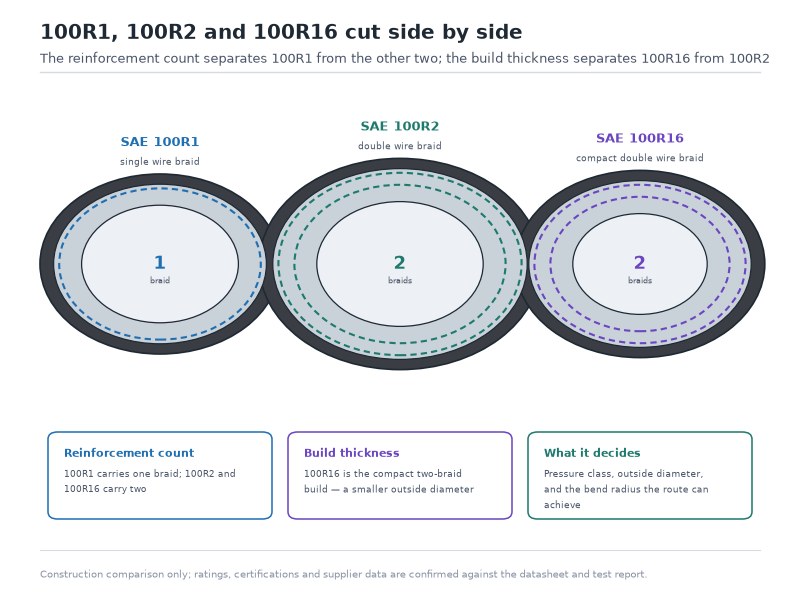
Figure 1. 100R1 (single braid), 100R2 (double braid) and 100R16 (compact double braid) cut side by side. The reinforcement count separates 100R1 from the other two; the build thickness separates 100R16 from 100R2.
Temperature, Fluid and Cover: Small Differences That Decide Replacements
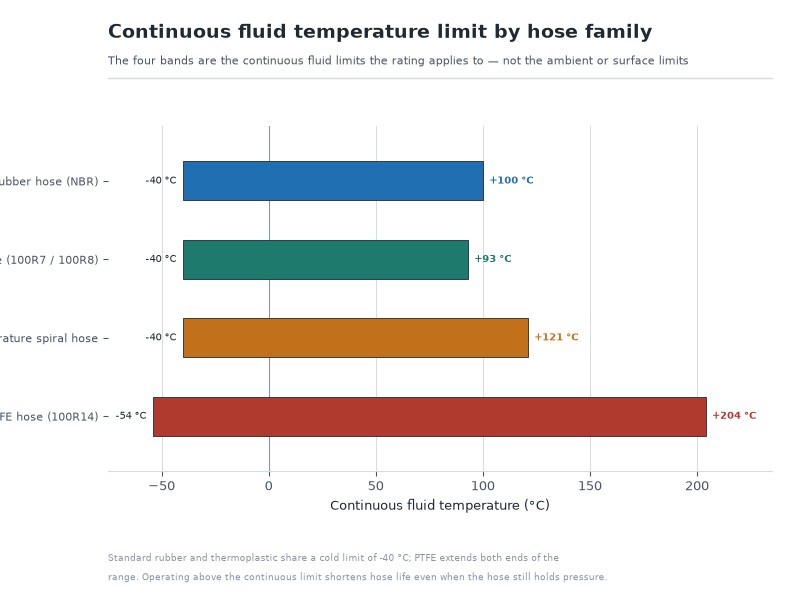
All three hoses share the same nominal working temperature range of -40°C to +100°C (-40°F to +212°F), which is defined by the rubber compounds rather than by the reinforcement. Differences appear at the edges of that range and in what the cover can survive.
Table 7. Temperature, fluid and cover comparison for SAE 100R1, SAE 100R2 and 100R16 (+120 °C intermittent is the published compound figure for these families; the continuous rating is -40 °C to +100 °C on all three).
| Propriedade | SAE 100R1 | SAE 100R2AT | 100R16 (EN 857 2SC) |
|---|---|---|---|
| Working temperature | -40 °C to +100 °C | -40 °C to +100 °C | -40 °C to +100 °C |
| Intermittent peak (petroleum fluids) | Up to about +120 °C | Up to about +120 °C | Up to about +120 °C |
| Water-based fluids | Good, reduced temperature limit | Good, reduced temperature limit | Good, reduced temperature limit |
| Cover thickness | Standard or thin (AT) | Standard or thin (AT) | Thin, compact |
| Abrasion tolerance | Good (AT: moderate) | Good (AT: moderate) | Moderate — protect in wear zones |
| Non-conductive option | Available in some ranges | Available in some ranges | Not a standard option |
Two of those rows cause most of the replacement problems we see. The first is water-based fluid: when a machine runs on a water-glycol fluid, the continuous temperature limit drops well below the rubber’s nominal 100°C — around +70°C in most published tables — and a hose that is fine on mineral oil will age prematurely if it is left at the top of its range on a water-based fluid. The second is cover thickness. The thin AT cover and the compact 100R16 cover both give up material for flexibility, and the place that material is missing is exactly the place a hose rubs against a machine. Where a hose runs through a wear zone, a protective sleeve or guard is cheaper than a specification upgrade.
What 100R16 Does Not Solve
100R16 is often described as a straight upgrade, and that is only true for the problem it was designed for. Four limits matter before you standardize on it.
- Size range. The compact family stops around 1 inch to 1-1/4 inch, which is the same limit that applies to the 2SN vs 2SC equivalents in the European tables. If the line is a 1-1/2 inch or 2 inch pressure line, 100R16 does not exist in your size and 100R2 or a spiral hose is the answer.
- Abrasion exposure. A thinner cover wears through faster on rock, concrete and steel edges. On a mining or demolition machine, the correct combination is often a compact hose plus a protective sleeve, not a compact hose alone.
- Fitting and crimp compatibility. 100R16 needs a ferrule and crimp diameter matched to the compact build. A ferrule sized for 100R2 will not produce a correct crimp on a 100R16, even in the same dash size, and a mismatch shows up as a pull-off or a leak at the crimp rather than as a burst.
- Availability in every size and construction. 100R2 is stocked by virtually every distributor in every dash size. 100R16 is stocked in the sizes that sell, which is usually -4 through -12. If your maintenance plan depends on same-day hose, that stocking difference is a real constraint on a standard-build machine.
Fittings, Ferrules and Crimp Specs Are Not Interchangeable
The common failure we are asked to diagnose is a compact hose assembled with the wrong ferrule. The hose is marked 100R16, the crimper is set to a 100R2 programme of the same dash size, and the assembly passes a visual inspection because the outside diameters are close. The crimp is then either under-compressed — the hose pulls out of the ferrule under load — or over-compressed, which cuts the outer braid and leaves a hose that bursts below its rated pressure. The rule is simple: crimp to the coupling manufacturer’s published specification for that hose type and dash size, and record the crimp diameter. If you are moving a machine from 100R2 to 100R16 to solve a routing problem, the fittings change with the hose, and it is worth confirming the ferrule part number before the first assembly is built.
What a 100R2 Crimp Programme Does to a Compact Hose
The consequence of running a compact hose through a crimp programme written for a standard two-braid hose is not marginal, and it fails in two opposite directions depending on how the crimper was set.
Table 8. What happens when the crimp programme does not match the hose construction.
| Crimp condition | What it does to the assembly | How it shows up in service |
|---|---|---|
| Under-compressed — a 100R2 setting on a compact hose | The ferrule never grips the full circumference of both braid layers | The hose pulls out of the ferrule under load, usually early in service |
| Over-compressed — a compact setting on a standard two-braid hose | The ferrule cuts into the outer braid wires at the compression point | A burst below the rated pressure, close to the fitting |
| Correct for the hose and dash size | The ferrule compresses the cover and both braid layers as the coupling manufacturer published | Holds proof pressure and reaches its rated impulse life |
Because both mistakes pass a visual inspection — the two hoses look close in outside diameter at the same dash size — the crimp diameter belongs on the batch card.
How to Identify 100R1, 100R2 and 100R16 on the Hose You Already Have
You do not need to cut a hose to identify it. Every hose built to these specifications carries a printed layline — the text running along the cover — that states the specification, the size and the manufacturer’s code. Reading it takes a few seconds and prevents the most expensive mistake in hose replacement; the full method for decoding one is in our guide to reading a hydraulic hose layline.
Table 9. Reading the layline for SAE 100R1, SAE 100R2, SAE 100R16 and SAE 100R17: what each field means and what to do about it (the dash number is read in sixteenths of an inch).
| What the layline shows | What it means | What to do |
|---|---|---|
| SAE 100R1AT-6 or EN 853 1SN | Single braid, 3/8 in bore | Replace with the same class; a 100R2 will fit but adds diameter |
| SAE 100R2AT-8 or EN 853 2SN | Double braid, 1/2 in bore | Direct replacement by specification and dash size |
| SAE 100R16-6, EN 857 2SC or ISO 11237 R16 | Compact double braid, 3/8 in bore | Substitute a 100R2 only after confirming the bend radius the routing allows and the ferrule series the assembly shop holds |
| SAE 100R17-6 or EN 857 1SC | Compact single braid, constant 3,000 psi | Replace with the same specification; a 100R1 in the same dash size carries a different published rating |
| A number after the dash, e.g. -8 | Dash size, in sixteenths of an inch | 8/16 inch = 1/2 inch nominal bore |
If the layline has worn off, two measurements identify the hose. Measure the outside diameter with a caliper and compare it with the published OD for the size, then look at the cut end: one visible braid layer is a 100R1 or a compact single braid, two braid layers is a 100R2 or a 100R16, and a wire helix inside or outside the reinforcement means the hose is a suction and return construction rather than a pressure hose. Where the hose is still in service and the marking is unreadable, the safest route is to pull the assembly and let the distributor match it against a specification table rather than to match it on outside diameter alone.
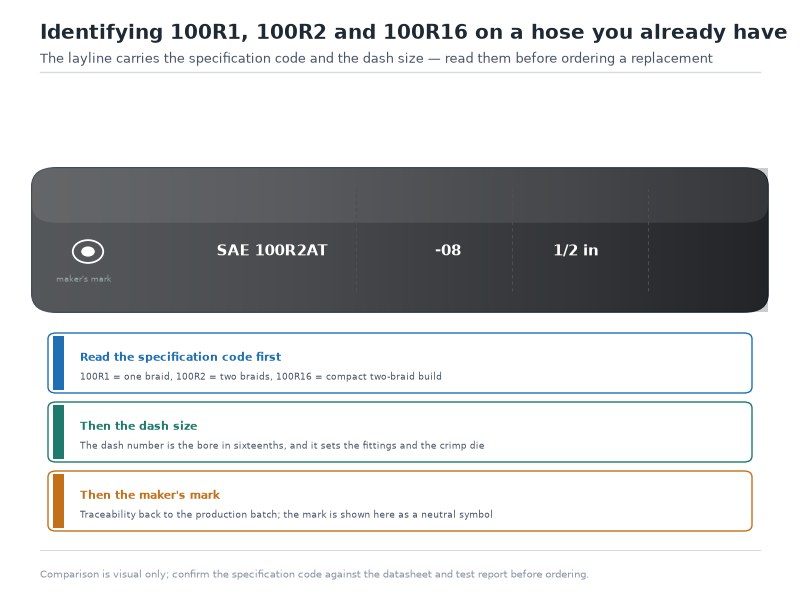
Figure 2. The layline is the fastest identification tool on any hydraulic hose. The specification code, the dash size and the manufacturer’s code are printed continuously along the cover.
Which Reading Fits Your Job
- Specifying a new line: the five-step path below fixes the specification; fill in pressure, bore, available bend radius and the fittings at both ends.
- Replacing a hose at the machine: read the layline first (Table 9) and match by specification and dash size; the two measurements in the identification section are the fallback.
- Stocking for a fleet or a store: hold a two-specification range — a standard two-braid hose for general pressure lines and a compact hose for the tight, moving circuits.
- Working through a repeat failure: map the failure pattern to a cause (Table 12) before changing the specification, and treat a repeated failure in the same position as a routing or fitting signal.
The Five-Step Decision Path: Which Hose Do You Need
Working through these five steps in order takes about five minutes per circuit and settles the 2SN vs 2SC question before you look at a catalogue.
- Establish the real maximum pressure, including spikes. Take the system relief setting and add the surge margin the circuit actually produces. If a line regularly sees spikes above 2,000 psi, do not specify 100R1 on the strength of its steady-state rating. Where the pressure is between 2,000 and 3,000 psi, both 100R1 and 100R2 exist in the size range; the deciding factor is then impulse frequency, not the pressure number.
- Confirm the dash size from flow, not from the old hose. A hose that has been replaced twice in the same size but keeps failing may be undersized for the flow rather than wrong for the pressure. As a working rule in mobile hydraulics, oil velocity above about 20 feet per second in a pressure line generates heat and pressure drop, and the fix is the next dash size up.
- Measure the space and the bend. This is the step that decides the 100R2 vs 100R16 question. Measure the tightest radius the routing allows, add the fitting and crimp length at both ends, and compare against the published minimum bend radius. If the radius the routing allows is tighter than the bend radius published for the standard two-braid hose at that dash size (Table 4), the compact 100R16 is the answer (Table 6).
- Check fluid and temperature at the hose, not at the reservoir. Measure the temperature where the hose runs, not at the reservoir: on a mobile machine the hose side of the circuit is normally well above the tank reading, and it is the hose figure that the compound has to survive. Water-based fluid lowers the ceiling further. Where the requirement exceeds the rubber range, the answer is a different material family rather than a different braid count.
- Match the fittings and the crimp spec. Confirm the ferrule series for the chosen hose type, the crimp diameter, and that the assembly shop holds the specification. A correct hose with an out-of-spec crimp fails like a wrong hose.
Fast Decision Table
Table 10. Fast decision table: which specification fits the duty
| Situation | First choice | Acceptable alternative | Why |
|---|---|---|---|
| 3/8 in line at 1,500 psi, easy routing | 100R1 | 100R2 if surge is frequent | Lowest cost per metre for the duty |
| 3/8 in line at 3,500 psi, room to bend | 100R2 | 100R16 if space is tight | 100R2 is the best-cost hose at this pressure |
| 1/2 in line at 3,500 psi inside a retract cylinder | 100R16 | 100R2 only if the bend allows | Radius is the constraint, not pressure |
| 3/4 in line at 5,000 psi | 100R12 spiral | 100R2 is out of its range | Braided construction has run out of pressure at this size |
| Pilot or control line, 3,000 psi | 100R17 | 100R16 | A 100R16 vs 100R17 choice settles on the constant rating, which simplifies stock |
| Return line, below 500 psi | 100R3 or 100R6 | 100R1 if abrasion is severe | Textile braid is the correct low-pressure hose |
| Suction line, vacuum duty | 100R4 | 100R4 with a wire helix | The hose must not collapse under vacuum |
Send us the dash size and the tightest radius the routing allows, and we will tell you whether a 100R2 or a 100R16 fits that envelope.
Application Map: Which Hose on Which Line
The same machine usually carries more than one of these specifications, and matching each circuit to the right one is how a maintenance plan keeps hose costs down without creating failures. Where a machine carries both compact specifications, the 100R16 vs 100R17 split follows the circuit: high-pressure moving lines take 100R16, constant-pressure control lines take 100R17.
Table 11. Application map by circuit for mobile and industrial hydraulics
| Circuit | Typical pressure | Recommended specification | Note |
|---|---|---|---|
| Boom and bucket cylinders | 3,000 to 5,000 psi | 100R2 or 100R16 | 100R16 where the hose moves within a tight envelope |
| Main pressure line, general mobile equipment | 2,000 to 4,000 psi | 100R2 | The default pressure line on most machines |
| Steering and pilot lines | 1,500 to 3,000 psi | 100R17 compact | Smaller diameter keeps the bundle tidy |
| Return and drain lines | Below 500 psi | 100R3 or 100R6 | Textile-braid hose is the default here, sized for flow rather than pressure |
| Suction lines | Vacuum | 100R4 | Requires the helical wire for collapse resistance |
| Tool circuits and quick-connect drop legs | 2,000 to 4,000 psi | 100R2 or 100R16 | Compact hose reduces strain on the operator side |
| High-pressure injection and press lines | Above 5,000 psi | 100R12 or 100R13 | Spiral construction is the correct answer above this pressure |
Send us four items — working pressure including spikes; bore or dash size; minimum bend radius the routing allows; fittings at both ends — and our engineers will name the construction that fits, including the compact option where the routing rather than the pressure is the constraint.
Cost, Stock and Replacement Economics
Price follows construction, and the price difference between these three is smaller than the cost of getting the choice wrong. The 100R1 vs 100R2 price step is roughly 20 to 30 percent per metre of the same size; a 100R1 is the least expensive of the three per metre, while a 100R2 costs that premium over it; and a 100R16 carries a further premium over the 100R2 — typically 15 to 40 percent depending on size and cover — because the compact construction requires tighter braiding tolerance and a thinner, more demanding cover extrusion.
That premium is often repaid before the first year is out, because the compact hose changes the assembly rather than just the hose: a shorter routing, fewer clamps, less abrasion contact and a lighter assembly on a moving boom all reduce the failure rate that caused the replacement in the first place. The premium is not repaid when the compact hose is used in a wear zone with no protection, or when it is fitted with a ferrule that was specified for a 100R2. Both of those turn a routing improvement into a repeat failure.
For buyers managing stock, the practical rule is to standardize on two specifications rather than three: 100R2 for general pressure lines and general service, plus 100R16 for the tight and moving circuits that generate most emergency callouts. Holding 100R1 as well is only economic where a fleet genuinely runs a large volume of low-pressure pressure lines, and even then the saving per metre is small relative to the inventory cost of a third specification, a third set of ferrules and a third crimp programme.
If you are working out which two specifications to stock, send us those same four items — working pressure including spikes; bore or dash size; minimum bend radius the routing allows; fittings at both ends — together with the circuits you run most, and we will confirm which two constructions cover the fleet with the fewest SKUs and quote both.
How Each Hose Fails, and What to Inspect
Each specification fails in a characteristic way, and the failure pattern tells you whether the hose was the wrong choice or the right hose installed badly. In practice the SAE 100R1 vs 100R2 decision shows up more often in the failure log than in the specification sheet, because a single-braid hose under a shock-loaded circuit meets its pressure rating while running out of impulse life.
Table 12. Characteristic failure modes by specification and what each one indicates
| Failure seen | Specification most often involved | What it usually means |
|---|---|---|
| Wire braid fatigue and a pinhole leak near a fitting | 100R1 | Line is seeing more impulse than a single braid can absorb |
| Cover cracked and braid exposed on the outside of a bend | 100R2 or 100R16 | Routing below the minimum bend radius, or abrasion without protection |
| Hose pulls out of the ferrule | 100R16 | Ferrule and crimp diameter specified for 100R2 |
| Burst in a straight run, well below rated pressure | Any | Pressure spikes above the rating, or an incorrect crimp reducing the assembly’s capacity |
| Tube swollen and closing, flow falling | Any | Fluid incompatibility — check the tube compound against the fluid |
| Kink at the fitting rather than a clean bend | 100R16 used where 100R1 was expected, or vice versa | Assembly length or orientation not matched to the minimum bend radius |
Inspection is the same on all three: look at the cover for cracks and exposed braid, feel along the length at the fitting for soft spots, check the crimp area for seepage, and confirm the layline is readable so the replacement can be matched. The ten failure causes we see most often, with the corrective action for each, are collected in our hydraulic hose failure troubleshooting guide. A hose that has been in continuous service for five years should be replaced on schedule even if it passes a visual check, because the failure mode that follows a long service life — internal tube hardening and braid fatigue — is not visible from the outside.
Frequently Asked Questions
Is 100R16 a direct replacement for 100R2?
It is a functional replacement, not a dimensional one. A 100R16 carries the same or higher working pressure in the same dash size and bends to about half the radius, but its outside diameter, ferrule and crimp specification differ, which is why the 100R2 vs 100R16 decision is usually made on routing rather than on pressure. If the hose runs through a fixed guide, a clamp or a pulley sized for a 100R2, check the clearance before installing the compact hose.
Is 100R2 twice as strong as 100R1?
Not exactly, which is the detail most often missed in a 100R1 vs 100R2 summary. In the same bore, a 100R2 is rated about 1.80 times the working pressure of a 100R1 at 1/4 inch (5,000 psi against 2,780 psi), 1.75 times at 3/8 inch, 1.72 times at 1/2 inch, and up to 2.42 times at 1-1/4 inch. The bigger practical difference is impulse life: the second braid layer absorbs repeated pressure spikes far better, which is why shock-loaded circuits specify 100R2 even where the steady pressure would allow a 100R1.
What is the 100R2 vs 100R16 pressure rating at 3/4 inch?
On the tables used here, the -12 published working pressures are 17.2 MPa (2,500 psi) for SAE 100R2AT and 21.5 MPa (3,120 psi) for 100R16 (EN 857 2SC), so the compact hose is rated about 25 percent higher at that size. The gap widens as the bore grows, because the compact construction is published to the EN 857 2SC table while 100R2 is published to its own. Read the figure from a hydraulic hose working pressure chart at the exact dash size you are ordering: both specifications fall with bore, and they do not fall at the same rate.
What is the difference between 100R2 and 100R2AT?
The AT suffix describes the cover and the assembly method, not the pressure class. 100R2AT is a no-skive hose with a thinner cover, so the ferrule is crimped directly over the cover; the standard 100R2 has a thicker cover and more abrasion margin. Both hold the same pressure class, and the AT version is lighter with a smaller outside diameter.
Is 100R1 cheaper than 100R2 and 100R16?
Yes, per metre: the 100R1 to 100R2 step is roughly 20 to 30 percent and the 100R2 to 100R16 step a further 15 to 40 percent, depending on size and cover — a market range rather than a published figure. Where that saving is usually not worth taking is stock rather than hose. A third specification needs its own ferrules, its own crimp programme and its own shelf space, so on a machine that runs only a few low-pressure pressure lines the inventory cost of adding 100R1 exceeds the per-metre saving, and the answer is to keep 100R1 out of the stores list altogether.
Is 100R16 the same as 2SC?
They are the same construction class published by two standards bodies. 100R16 corresponds to EN 857 Type 2SC and ISO 11237 Type R16, and a single hose often carries both markings on the cover. In other words, the 2SN vs 2SC question on a European machine is the same decision as 100R2 vs 100R16 on a North American one. Pressure tables are close but not always identical between editions, so confirm the actual figure on the datasheet for the size you are ordering.
Which hose should I stock as a distributor?
Two specifications rather than three: 100R2 in every dash size the fleet uses, plus 100R16 in the -4 to -12 range that the tight and moving circuits call for. 100R1 earns shelf space only where a customer base genuinely consumes a large volume of low-pressure pressure lines, because the per-metre saving is small against the cost of a third ferrule series and a third crimp programme. Add 100R4 for suction lines and 100R3 or 100R6 for return lines where those circuits are serviced, and keep the layline string of every stocked hose in the parts record so replacements are matched by specification rather than by sight.
What pressure is a 1/2 inch 100R16 rated for?
On the EN 857 2SC table used here, a -8 (1/2 inch) 100R16 is published at 27.5 MPa (3,990 psi) working pressure, with minimum burst pressure specified at four times that figure. Ratings fall as bore increases, so confirm the value for the exact size rather than assuming the 1/2 inch figure applies to the whole range, and read the psi or bar column from the same published table rather than from a second source.
Can a 100R2 hose be crimped with a 100R16 ferrule?
No — it depends on the ferrule, not on the dash size. A ferrule published for a 100R2 hose is matched to a standard two-braid build, while a 100R16 needs the ferrule and crimp diameter published for the compact build, even when the two hoses carry the same dash size. The two look close enough on the bench that an under-compressed or over-compressed crimp passes a visual check, which is why the crimp diameter belongs on the batch card and the ferrule part number should be confirmed by series rather than assumed to carry across.
What does 100R16-6 mean on a layline?
It is a compact two-braid hose in 3/8 inch nominal bore. 100R16 is the SAE J517 specification number, and -6 is the dash size, read in sixteenths of an inch — 6/16 inch is 3/8 inch. A fully marked hose also carries the manufacturer’s code and the working pressure, and often the equivalent European code EN 857 2SC or ISO 11237 R16, so the same hose can be identified from either side of the standard. The -6 on its own tells you the bore; the specification code in front of it is what tells you the construction.
What is the 100R16 temperature range in cold weather?
The rubber grades behind 100R16 are rated -40 °C to +100 °C continuously, with short excursions to about +120 °C — the same envelope as SAE 100R1 and SAE 100R2, and the thinner compact cover does not change the low-temperature limit. What does change the limit is the fluid: on water-glycol fluid the continuous ceiling falls to around +70 °C in most published tables, whatever the hose type. Cold-weather failures on all three hoses are more often caused by routing that forces a bend while the hose is still stiff than by the compound itself, so leave the straight lead-in behind the fitting intact in winter.
Do 100R1, 100R2 and 100R16 have the same impulse life?
They are tested to the same impulse procedure — EN ISO 6803, at 133 percent of working pressure, at +100 °C, for a minimum of 200,000 cycles — but they do not survive it equally. The second braid layer shares the load across twice the wire, so a two-braid hose lasts longer under the same pulse profile, and the compact 100R16 has less cover material to shed heat from. On a circuit that pulses hard and often, ask the supplier for the impulse report at your dash size rather than comparing working-pressure numbers, because the pulse profile and not the steady rating is what decides the replacement interval.
Final Verdict: Match the Rating, Then Verify the Supplier
The choice in a 100R1 vs 100R2 vs 100R16 decision is settled by three numbers in this order: the maximum pressure the circuit actually sees, the minimum bend radius the routing allows, and the temperature and fluid at the hose. If the pressure is under about 2,000 psi and there is room to route, 100R1 is the economical answer. If the pressure is between 2,000 and 5,000 psi, 100R2 is the general-purpose answer and remains the hose most machines are built around. If the bend radius is the constraint — which is the case on most modern mobile equipment — the compact hydraulic hose delivers the same pressure class in roughly half the space, provided the fittings and crimp specification change with it.
Where the pressure rises above about 5,000 psi at 3/4 inch and larger, none of these three is correct and the line needs a spiral hose.
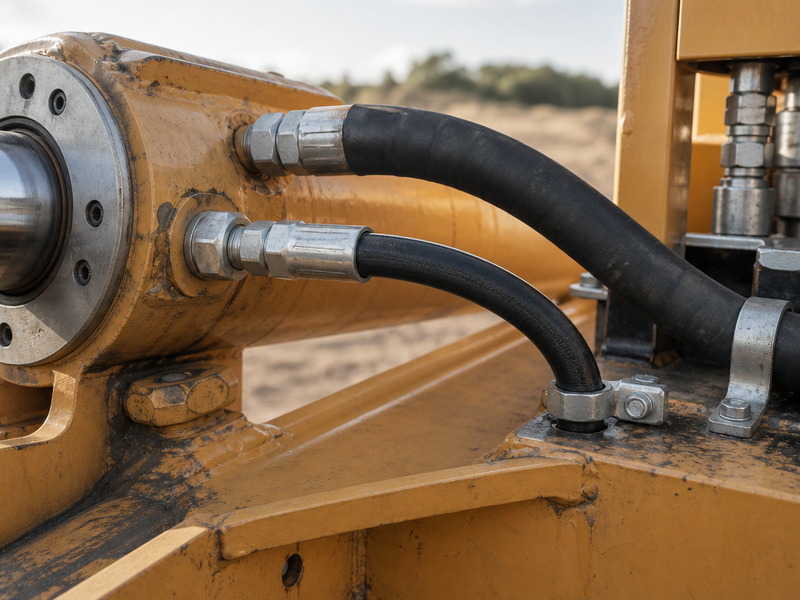
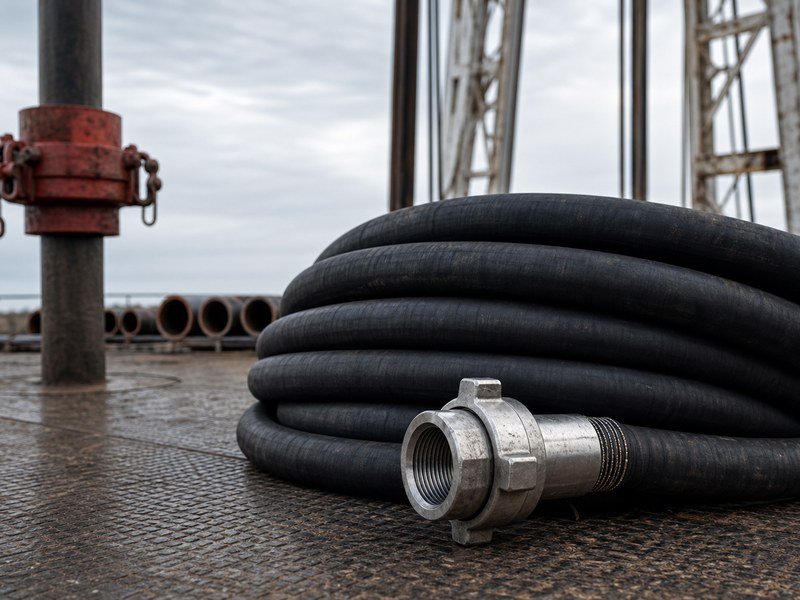
Figure 3. The compact build of 100R16 is what allows a pressure line to bend tightly behind the fitting without kinking — the routing that most often forces a specification change.
Manufacturing Notes: How These Three Hoses Are Made at HENGHUA
HENGHUA manufactures the three specifications compared in this guide — SAE 100R1AT, SAE 100R2AT and SAE 100R16 compact hose, together with the constant-pressure SAE 100R17 companion — in inside diameters from 6 mm to 51 mm, alongside the spiral (100R12, 100R13, 100R15) and textile-braid (100R3, 100R6) families that the decision tables above point to when a line leaves the medium-pressure range. Production runs in an 18,000 m² facility with in-house rubber mixing, so tube compound, wire braid and cover are controlled in one plant rather than assembled from bought-in components, and the braiding lines hold tension to ±0.05 mm.
Three details of that process are relevant to the comparison in this article. Pressure and dimensional data are published per dash size rather than quoted as a family range, so the working pressure, proof pressure, minimum bend radius and weight of the exact size you order can be checked before anything is crimped. Braided hoses are impulse-tested beyond 400,000 cycles, and finished assemblies are 100% proof-tested with the crimp record retained for the batch. And because the same plant mixes, braids, extrudes, crimps and tests, matching the ferrule to the hose type — the failure mode covered under “Fittings, Ferrules and Crimp Specs Are Not Interchangeable” — is a production control rather than something left to the customer to discover in the field.
Certification and approvals held across the range include ISO 9001, ISO 18752, MSHA, CE, CCS, ABS and DNV, with RoHS and California Proposition 65 compliance on the relevant lines. HENGHUA supplies distributors, OEM programmes and maintenance operations in more than 70 countries, with 48-hour custom sampling, seven-day turnaround on standard bulk orders, fittings in metric, BSP, JIC, NPT and ORFS styles, and test reports supplied with the shipment.
If you are working through a specification decision and want it confirmed against real data, send us four items and our engineering team will confirm whether 100R1, 100R2 or 100R16 is the right construction for that line, together with the correct crimp specification and a quotation:
- working pressure including spikes
- bore or dash size
- minimum bend radius the routing allows
- fittings at both ends
 English
  Spanish
  Portuguese
  French
  German
  Arabic
  Russian