
1. What an 8B Adapter Does
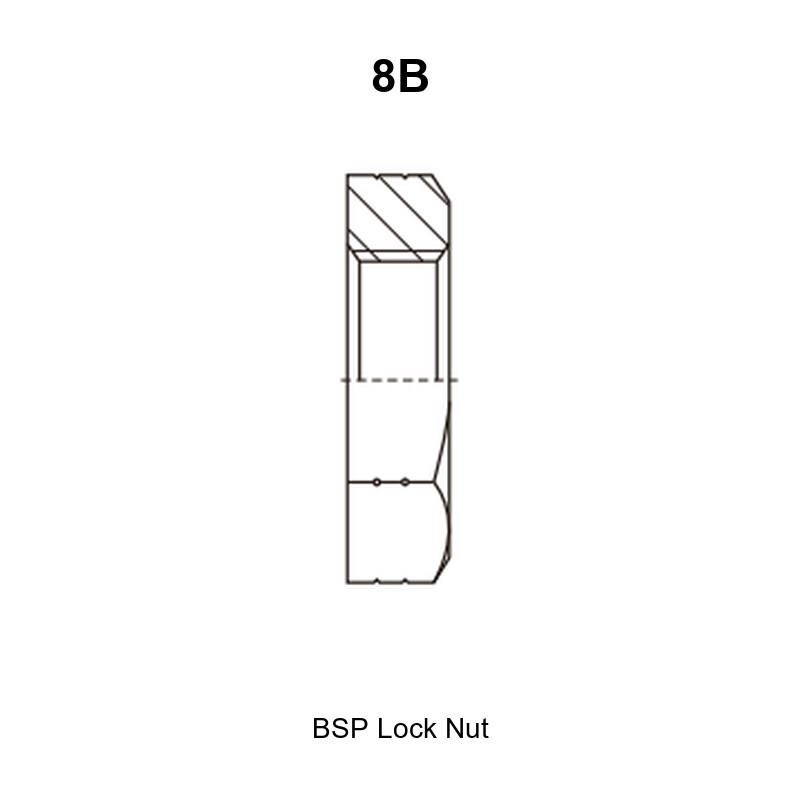
The 8B adapter is a BSP lock nut: a hexagonal steel nut with an ISO 228-1 G parallel pipe thread and no sealing feature of its own. It is the retaining element of the British Adapters range, and its job is to clamp or jam a threaded component – normally a bulkhead adapter, a straight stud end or a swivel elbow – so that the component stays in the position the assembly drawing requires.
Core value: the lock nut has to match the thread it runs on exactly. Thread size, pitch and class decide whether the nut pulls down onto a panel or jams hard against a mating shoulder, and a mismatched nut either will not start or will not hold.
Sealing principle: this part does not seal. This part carries no 60 degree cone, no bonded seal and no O-ring, so it never forms the pressure boundary itself. It transmits clamping load on its thread flanks and on its two flat faces; sealing always happens in the adapter or stud end that the nut locks into position.
2. 8B Specifications
The blocks below present the thread end and the mechanical features of the 8B adapter in the same order as the drawing, so a buyer can read off which panel or shoulder the nut works against.
2.1 Connection — BSP parallel thread, ISO 228-1
- Thread standard: ISO 228-1, pipe threads where pressure-tight joints are not made on the threads.
- Thread family: British Standard Pipe Parallel (BSPP / G).
- Gender: internal (female) thread, running the full height of the nut.
- Size range: G1/8″x28 up to G2″x11.
- Sealing method: none; the nut is a mechanical retainer, not a seal.
- Mating component: any male BSPP stud end, bulkhead adapter or swivel body with the same ISO 228-1 thread size.
2.2 Panel and Bulkhead Function
This is the part that makes a bulkhead or panel installation hold. The threaded body of the adapter passes through the panel hole, one lock nut is run down on each side, and the two nuts clamp the panel between them. Tightening the pair locks the adapter against rotation and against vibration, so the fluid connection itself does not have to resist the torque.
A single nut works as a jam nut where the mating component already has a shoulder to pull against, and as a lock nut where a previously set position has to be held. In both roles the load path is the nut thread into the adapter thread, and the nut face onto the panel or shoulder.
2.3 Construction and Materials
The nut is machined from bar stock on CNC lathes, then tapped and gauged, so the thread runs square to the hex faces. Body material options are carbon steel, 304 stainless steel, 316 stainless steel and brass. Carbon steel nuts are supplied with trivalent chromium zinc plating (Cr3+) or zinc-nickel plating, and stainless steel nuts are supplied bare.
The hex section is turned on the same setup as the thread, so the spanner flats are concentric with the thread axis and the nut face runs true against a panel. There is no elastomer in this part and no seal material to select; where the assembly includes a bonded seal or O-ring, that seal belongs to the adapter or stud end, and its material is chosen for the fluid and temperature of the system.
2.4 Pressure and Temperature
The 8B adapter has no pressure rating of its own, because it is not part of the pressure boundary. Working pressure of an assembly that uses this nut is confirmed per order by HENGHUA engineering, based on the sealing method, thread size and material selected for the adapter or stud end that the nut retains.
The nut itself is a steel or brass component, so its service limit follows the body material: carbon steel with zinc plating for general hydraulic service, and 304 or 316 stainless steel for corrosive and offshore service. Where a bonded seal or O-ring is present in the same assembly, these material limits apply:
| Seal material | Temperature range |
|---|---|
| NBR bonded seal | approximately -30°C to +100°C |
| FKM (Viton-type) | approximately -20°C to +200°C |
| EPDM | approximately -40°C to +120°C |
2.5 Part Number and Dimension Table
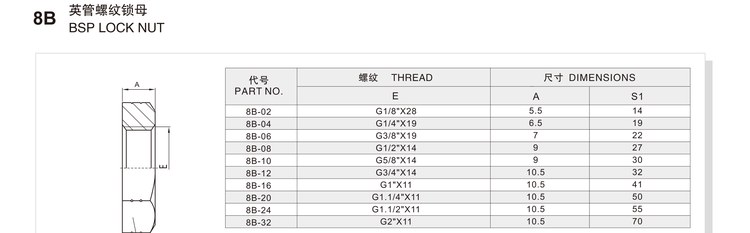
E is the internal thread callout of the nut. A is the nut height (thickness) and S1 is the hex across flats, both in millimetres and both taken from the drawing above. Thread callouts follow the drawing notation, where G1.1/4″ means G1-1/4″ and G1.1/2″ means G1-1/2″.
| N.º DA PEÇA. | THREAD E | A | S1 |
|---|---|---|---|
| 8B-02 | G1/8″x28 | 5.5 | 14 |
| 8B-04 | G1/4″x19 | 6.5 | 19 |
| 8B-06 | G3/8″x19 | 7 | 22 |
| 8B-08 | G1/2″x14 | 9 | 27 |
| 8B-10 | G5/8″x14 | 9 | 30 |
| 8B-12 | G3/4″x14 | 10.5 | 32 |
| 8B-16 | G1″x11 | 10.5 | 41 |
| 8B-20 | G1.1/4″x11 | 10.5 | 50 |
| 8B-24 | G1.1/2″x11 | 10.5 | 55 |
| 8B-32 | G2″x11 | 10.5 | 70 |
3. How to Read an 8B Adapter Part Number
The prefix 8B identifies the series: BSP lock nut, hex body, ISO 228-1 G parallel internal thread, no sealing feature. It is followed by a single size code, because a lock nut has one thread only and there is no second connection to code.
The size code is the BSP size step of the thread: 02 is G1/8, 04 is G1/4, 06 is G3/8, 08 is G1/2, 10 is G5/8, 12 is G3/4, 16 is G1, 20 is G1-1/4, 24 is G1-1/2 and 32 is G2. The code tracks the nominal bore step, not the thread outside diameter, which is why the hex size jumps between 8B-12 and 8B-16.
Worked example from the table: 8B-08 is a lock nut with G1/2″x14 internal thread, A 9 mm nut height and S1 27 mm hex across flats. Order that part number for a G1/2″ bulkhead adapter or stud end. This series carries no dash suffix; where a customer needs a non-standard hex or a thinner nut, it is quoted as a drawing-based special rather than as a different 8B code.
4. Installation and Fitment
Run the nut on by hand first. A lock nut should turn freely down the full length of the thread it is matched to; if it binds before it reaches the panel, stop and check the thread form, because forcing it will gall the thread on both parts.
For a bulkhead or panel installation, fit the first nut on the outside of the panel, pass the adapter body through, then fit the second nut on the inside. Bring the two nuts up snug, check that the adapter is square to the panel and that the port faces the correct direction, then tighten the pair against each other to the torque specified for the thread size and material.
Common fitment errors and their symptoms: using a BSPT nut or tapping a BSPT body into an ISO 228-1 thread produces a loose, wobbling joint; a single nut used where the mating part has no shoulder cannot hold position under vibration, because there is nothing to clamp against; a nut tightened before the adapter is aligned pulls the body out of square and loads the cone seat at the far end; and a nut re-used after it has been run loose shows flattened thread crests and will not hold its setting.
5. Applications and Industries
Application tags for the 8B adapter are hydraulic systems, industrial equipment, construction machinery, agriculture, marine, material handling and oil and gas equipment. It is a small part that decides whether a panel-mounted connection stays where the drawing puts it.
Concrete scenarios: a bulkhead adapter through a control panel or reservoir wall, locked by one nut on each side so that a hose can be connected and disconnected without the adapter turning; a swivel elbow on a machine frame, where a lock nut holds the set angle against vibration; a repair or retrofit job where an existing stud end has lost its retaining nut and the assembly has to be returned to its original layout; and an OEM assembly line where nuts are supplied in the same thread size as the adapters on the bill of materials, so the two are fitted together in one operation.
6. Replacement and Cross-Reference Guide
Identify a replacement by standard and thread, never by brand. The 8B is a plain BSPP lock nut with ISO 228-1 G internal thread, so the specification to match is the thread size and pitch, the hex across flats and the nut height.
Measure these three things before ordering: first, the thread outside diameter of the male body the nut must run on, and its threads per inch, to confirm an ISO 228-1 G thread at 28, 19, 14 or 11 threads per inch; second, the hex across flats needed to clear the panel boss and to accept the spanner in the space available; third, the nut height, since a deeper nut spreads the clamping load but may not clear a recess in the panel.
| Mating component | Thread standard | Function of the nut | Fits |
|---|---|---|---|
| BSPP bulkhead adapter | ISO 228-1 | Panel clamp, one nut each side | Yes |
| BSPP straight stud end with shoulder | ISO 228-1 | Jam nut against the shoulder | Yes |
| BSPP swivel elbow | ISO 228-1 | Holds the set angle | Yes |
| BSPT male body (R thread) | ISO 7-1 | Taper thread, not compatible | Não |
| JIC male end, 37 degree flare | SAE J514 | Thread form not compatible | Não |
| Metric stud end with O-ring | ISO 6149-3 | Thread form not compatible | Não |
| NPT male body | Not applicable | Thread form not compatible | Não |
7. Ordering, Packaging and Delivery
To order, give the series code with the full part number, the thread size, the body material, the plating and the quantity. For example: series 8B, part number 8B-08, G1/2″x14, carbon steel with trivalent chromium zinc plating, 1000 pieces. Where the nut is wanted as part of a bulkhead kit, list the bulkhead adapter and the two matching nuts on the same inquiry.
Packaging is arranged for distributor shelves and for direct-to-line delivery, with thread protection in transit and labels carrying the part number and thread size. Lock nuts are small, high-count items, so they are normally supplied in quantity boxes or bags by size. Samples are available for validation, and lead time is confirmed per order once thread sizes, material and quantity are fixed.
8. FAQ
Q1. What is the difference between BSPP and BSPT, and can they be interchanged? BSPP is the parallel pipe thread defined in ISO 228-1, which is the thread on this lock nut. BSPT is the taper thread defined in ISO 7-1, which seals on the thread flanks and needs a sealant. They are not interchangeable, and a BSPT body screwed into an ISO 228-1 nut will wobble and cannot be locked properly.
Q2. What is the difference between a 60 degree cone seat and a bonded seal, and which should I choose? A 60 degree cone seat seals metal-to-metal between two cones and carries no elastomer, so it suits high temperature work. A bonded seal is a metal washer with a bonded elastomer ring that seals on a flat face. Neither is part of this lock nut: this nut only clamps, and the sealing method is chosen in the adapter or stud end that the nut retains.
Q3. How do I identify the correct 8B size? Read the thread callout of the male body the nut has to run on, and match the same G size and threads per inch. The size code follows the BSP size step, so 8B-08 is G1/2″x14 and 8B-16 is G1″x11. Then check the hex across flats and the nut height against the space on the panel.
Q4. What seal material should I select for my fluid and temperature? No seal material is needed for this part, because the nut has no elastomer and does not seal. Select the body material instead: carbon steel with trivalent chromium zinc plating for general hydraulic service, or 304 or 316 stainless steel for corrosive and offshore service. Where a bonded seal or O-ring is used in the same assembly, NBR covers approximately -30°C to +100°C, FKM approximately -20°C to +200°C, and EPDM approximately -40°C to +120°C.
Q5. How is the working pressure of this adapter determined? The 8B adapter has no working pressure of its own, because it is a mechanical lock nut outside the pressure boundary. The pressure rating belongs to the adapter or stud end it retains, and is confirmed per order by HENGHUA engineering based on the sealing method, thread size and material selected for that part. Send the full assembly with the inquiry so the confirmation covers the right component.
Q6. Does one lock nut seal the joint? No. A lock nut clamps, it does not seal, and the fluid path is closed by the cone seat, bonded seal or O-ring inside the adapter or stud end. If an assembly leaks after the nuts are tightened, the cause is at the sealing end, not at the nut, so inspect the cone or the seal before adding torque.
Q7. Do I need one lock nut or two for a bulkhead panel installation? A bulkhead or panel installation normally uses two nuts, one on each side of the panel, so the panel is clamped between them. A single nut is enough where the adapter already has a shoulder to pull against, and then the nut acts as a jam nut.
Q8. What is the minimum order quantity and can I get samples? Minimum order quantity depends on the size, the material and the plating, and is confirmed with the quotation. Because lock nuts are small high-count items, orders are normally placed by size and quantity rather than as single pieces. Samples are available for validation so thread fit and hex clearance can be confirmed before a production order, and lead time is confirmed per order.
Browse the full Hydraulic Adapters range for the complete family, or contact us to request a quote, mill test reports, and samples.

 English
  Spanish
  Portuguese
  French
  German
  Arabic