
Why This ISO 6149-3 Adapter Passes the Compliance Gate
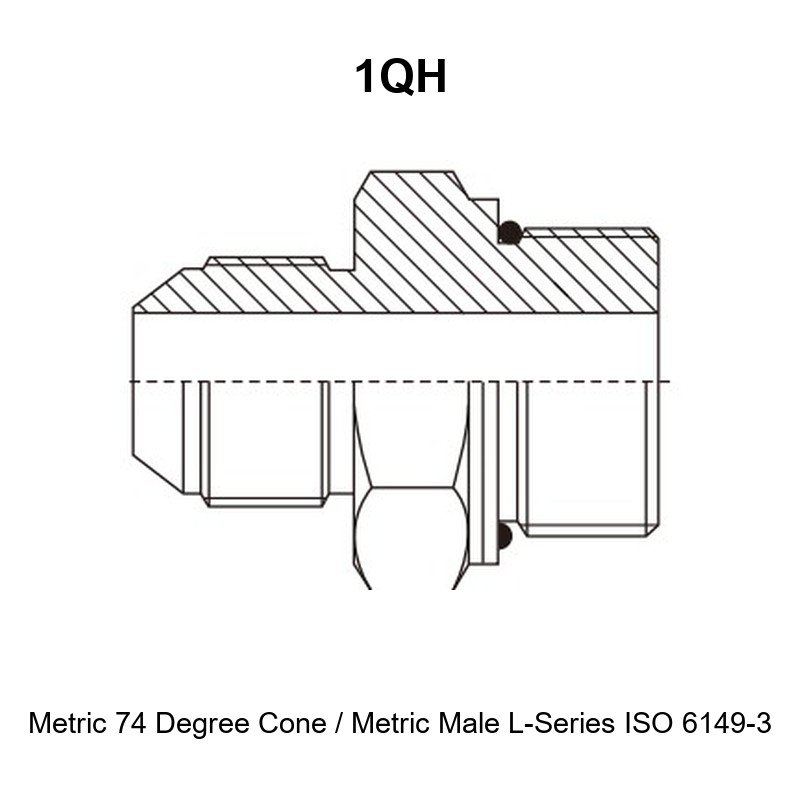
Two different sealing principles meet inside this part: a wide 74° metal cone on one side and an O-ring stud end on the other. Get either one wrong and the joint behaves differently from the other three joints on the same manifold. Every 1QH ISO 6149-3 adapter is produced with the cone cut in the same setup as its thread, the stud-end groove turned to the ISO 6149-3 groove dimensions and measured on a profile projector, the stud thread gauged 6g go / no-go, and the O-ring checked against its batch certificate for compound, hardness and dimensions. The part is then dimensionally inspected end to end against the drawing so the installed length matches what your manifold was designed around.
The adapter converts a metric male 74° cone connection into a metric male L-series stud end per ISO 6149-3, i.e. ISO 6149-3 connects a 74° cone tube end to a metric port with O-ring sealing, light-duty class. The catalogue also lists the /RN version supplied complete with cutting ring and nut.
Core Advantages
- Two systems, one part. Brings a 74° cone tube run directly onto a metric O-ring port without an intermediate nipple and a second joint.
- O-ring sealing at the port. The stud end seals on an O-ring against the port chamfer, so assembly torque is low and manifold distortion is minimal.
- Correct L-series groove. The groove and O-ring are made to the light-duty L-series dimensions, which is what most 74° cone tube runs in Chinese and Japanese machinery actually need.
- Metal-to-metal 74° cone on the tube side. No elastomer in the cone joint, so the tube side tolerates temperature and contamination.
- Complete-set option. The /RN variant adds the sleeve (NB500-Q) and nut (NB200-Q) for a one-line order.
Technical Specifications
What Is a 74° Cone to ISO 6149-3 Adapter?
It is a straight adapter with a metric male 74° cone end on one side and a metric male stud end with an O-ring groove to ISO 6149-3 on the other. The 74° end seals on a wide metal cone face; the stud end screws into a straight-thread metric port and seals on the O-ring at the base of the stud. It is the standard link between a 74° cone tube connection and a modern metric O-ring ported manifold, pump, valve or cylinder.
Understanding L Series and S Series — DIN 2353 and ISO 6149-3
Two standards use the L / S convention and they use it the same way, which is why the two are so often confused:
| Padrão | Light series | Heavy series | What changes for the same tube OD |
|---|---|---|---|
| DIN 2353 / ISO 8434-1 (24° cone) | L | S | The S series uses one thread size larger than the L series |
| ISO 6149 (metric port, O-ring seal) | ISO 6149-3 (L, light duty) | ISO 6149-2 (S, heavy duty) | The S series uses a larger port thread and a larger O-ring |
The logic in both cases is the same: for a given tube outside diameter the heavy series carries a thicker tube wall, so it needs a bigger thread and a bigger sealing diameter to pass the same flow at a higher pressure. Take 6 mm tube as the classic example: DIN 2353 light series uses M12×1.5 and the heavy series uses M14×1.5 for the same tube. ISO 6149 behaves identically at the port — the light-duty and heavy-duty port for the same nominal size are not the same thread, and a stud end built for one will not seal correctly in the other.
This family is an ISO 6149-3 (L, light-duty) adapter. If the customer’s port is ISO 6149-2 (S, heavy-duty) or a DIN 2353 S-series port, the port thread for the same tube will be larger and the correct part number is different. Always confirm which series the port is before ordering — the letters “L” and “S” appear in both standards and mean the same thing, but the thread in the hole is what matters.
Cone Geometry — 74°, 60° and 37° Are Not Interchangeable
The tube end here is a metric 74° cone. It does not interchange with:
- 60° cone (DIN 3861 / ISO 1179) — seals on a 60° cone face with a BSP parallel thread.
- 37° flare (JIC) — SAE J514 / ISO 8434-2, seals on a 37° flare with a UNF thread.
- 24° cone (DIN 2353 / ISO 8434-1) — the narrow metric cone used with the L and S series above.
Each has a different included angle, a different contact diameter and a different axial seat position. Mixing them produces edge or line contact instead of full face contact: the joint can pass a cold static test and weep when the circuit reaches working temperature. Check both halves of every joint.
Dimensional Data
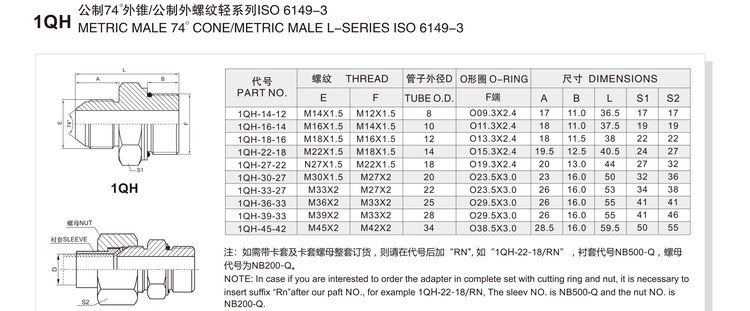
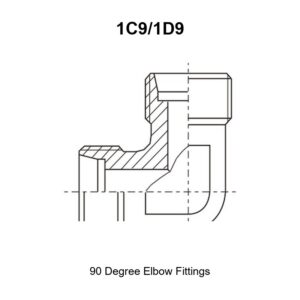
In the drawing, E is the thread of the 74° cone end, F the thread of the ISO 6149-3 stud end, D1, D2 the tube outside diameter, A the length of the 74° cone end from the centre hex to its end face, B the length of the stud end from the hex to its end face, L the overall length, and S1, S2 the across-flats hexes. The O-ring column gives the compound size fitted at the F end — for example O09.3×2.4 is 9.3 mm inside diameter with a 2.4 mm section.
B is the dimension that decides whether the stud end will seat: it must be long enough to let the O-ring reach the port chamfer before the hex bottoms out, and short enough for the thread to engage fully. Where the port is counterbored or the manifold face is machined, check B and L against the drawing rather than against the old part.
Full Dimension Table (Part Number Matrix)
Values as published in the HENGHUA catalogue drawing. Dimensions in millimetres.
| PART NO. | E — 74° cone end | F — ISO 6149-3 stud end | TUBE O.D. | O-RING (F end) | A | B | L | S1 | S2 |
|---|---|---|---|---|---|---|---|---|---|
| 1QH-14-12 | M14×1.5 | M12×1.5 | 8 | O09.3×2.4 | 17 | 11.0 | 36.5 | 17 | 17 |
| 1QH-16-14 | M16×1.5 | M14×1.5 | 10 | O11.3×2.4 | 18 | 11.0 | 37.5 | 19 | 19 |
| 1QH-18-16 | M18×1.5 | M16×1.5 | 12 | O13.3×2.4 | 18 | 11.5 | 38 | 22 | 22 |
| 1QH-22-18 | M22×1.5 | M18×1.5 | 14 | O15.3×2.4 | 19.5 | 12.5 | 40.5 | 24 | 27 |
| 1QH-27-22 | M27×1.5 | M22×1.5 | 18 | O19.3×2.4 | 20 | 13.0 | 44 | 27 | 32 |
| 1QH-30-27 | M30×1.5 | M27×2 | 20 | O23.5×3.0 | 23 | 16.0 | 50 | 32 | 36 |
| 1QH-33-27 | M33×2 | M27×2 | 22 | O23.5×3.0 | 26 | 16.0 | 53 | 34 | 38 |
| 1QH-36-33 | M36×2 | M33×2 | 25 | O29.5×3.0 | 26 | 16.0 | 55 | 41 | 41 |
| 1QH-39-33 | M39×2 | M33×2 | 28 | O29.5×3.0 | 26 | 16.0 | 55 | 41 | 46 |
| 1QH-45-42 | M45×2 | M42×2 | 34 | O38.5×3.0 | 28.5 | 16.0 | 59.5 | 50 | 55 |
Catalogue note: to order the adapter as a complete set with cutting ring and nut, add the suffix “RN” after the part number — for example 1QH-22-18/RN. The sleeve is NB500-Q and the nut is NB200-Q.
Thread Size and Dash Chart
| Tube O.D. | 74° cone end (E) | ISO 6149-3 L-series stud end (F) | O-ring (F end) |
|---|---|---|---|
| 8 mm | M14×1.5 | M12×1.5 | O09.3×2.4 |
| 10 mm | M16×1.5 | M14×1.5 | O11.3×2.4 |
| 12 mm | M18×1.5 | M16×1.5 | O13.3×2.4 |
| 14 mm | M22×1.5 | M18×1.5 | O15.3×2.4 |
| 18 mm | M27×1.5 | M22×1.5 | O19.3×2.4 |
| 20 mm | M30×1.5 | M27×2 | O23.5×3.0 |
| 22 mm | M33×2 | M27×2 | O23.5×3.0 |
| 25 mm | M36×2 | M33×2 | O29.5×3.0 |
| 28 mm | M39×2 | M33×2 | O29.5×3.0 |
| 34 mm | M45×2 | M42×2 | O38.5×3.0 |
Note that one port size can serve two adjacent tube sizes — M27×2 appears against both 20 mm and 22 mm tube, and M33×2 against both 25 mm and 28 mm — which is exactly the light-duty logic of ISO 6149-3 at work.
Material and Heat Treatment
Carbon steel bodies, machined from bar or forged, hardened according to pressure class and plated in trivalent chromium or zinc-nickel. Stainless 304 / 316L is available to order. Standard O-rings are NBR 90 Shore A; FKM is supplied for high-temperature or aggressive fluid service.
Working Pressure and Operating Envelope
The rating of a stud-end joint is set by the port standard, the O-ring and the tube wall. The 74° cone end is rated with its sleeve and nut assembly. In practice the lower of the two ends governs, and the port boss in the housing sets a third limit — a light-duty port in a thin casting is often the real ceiling. A 4:1 burst ratio is typical of the steel body.
Temperature Range
NBR O-rings: −40 °C to +120 °C. FKM O-rings: −20 °C to +200 °C. Because the port end seals on an elastomer, the O-ring material — not the steel — usually sets the high-temperature limit of the joint.
How to Read the Part Number Matrix
1QH-22-18 reads: family 1QH (metric 74° cone to metric male ISO 6149-3 L-series), size 22 = the 74° cone end for 14 mm tube / M22×1.5, and 18 = the ISO 6149-3 stud end M18×1.5. The first number follows the 74° cone side, the second the port side — the two are different ladders and cannot be interchanged. Add /RN to receive the set with cutting ring and nut.
Selection and Ordering
Selection Checklist / Decision Table
| Requirement | Choose |
|---|---|
| 74° cone tube run into a metric O-ring port | This family |
| Port is ISO 6149-3 light duty (L series) | This family |
| Port is ISO 6149-2 heavy duty (S series) | Different part number — larger port thread |
| Port is BSP parallel with 60° cone | 60° cone family |
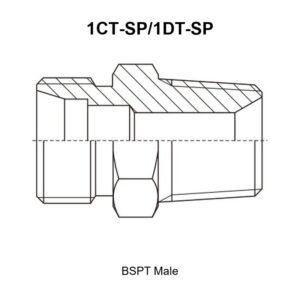
| Port is BSPT tapered | 1QT-SP family |
| Port is UN/UNF O-ring boss | ISO 11926 / SAE J1926 family |
| Complete set with sleeve and nut required | Add suffix /RN |
Cross Reference Service
Send the OEM number, the tube OD, the port thread and the port standard, or a photograph of the port. We identify whether the port is ISO 6149-3 or ISO 6149-2, confirm the O-ring size and return a mapped part number with A, B and L filled in.
Packaging and Logistics
O-ring fitted and protected, thread protectors on both ends, plastic bag, carton and pallet; certificates and the O-ring batch referenced to the heat number. Air, sea and express shipping available.
Installation and Fitment Guide
Step-by-Step Assembly
- Confirm the port is a straight-thread metric O-ring port to ISO 6149-3 (L series), and that the stud thread size matches F.
- Inspect the port chamfer and clean the O-ring groove. A nicked chamfer cuts the O-ring on assembly — that leak is visible before the system is pressurised.
- Fit the O-ring dry or with a light film of system fluid. Never roll or stretch it into the groove.
- Confirm the 74° side is a 74° cone, not 60° or 37°.
- Screw the stud end into the port by hand until the O-ring contacts the chamfer, then tighten to the specified stud-end torque with a wrench on the S1 hex.
- Assemble the 74° cone side to its sleeve and nut, holding the body with the S2 hex so the port joint is not disturbed.
- Re-check both joints, and the O-ring, after the first thermal cycle.
Torque and Sealing Notes
The two ends behave differently and are torqued separately. The stud end needs only enough torque to compress the O-ring and resist vibration; excessive torque stretches the stud and distorts the port. No thread sealant is used on the stud end — the thread does not seal, the O-ring does. The 74° cone end is a metal-to-metal joint; here also, no tape and no compound. One part, two different sealing principles, two different torque values.
Installation Warnings
- Never fit an L-series stud into an S-series port, or the reverse; the O-ring will not seat on the chamfer.
- Do not reuse an O-ring that has been through a thermal cycle or has been removed from the groove.
- Do not mix 74°, 60°, 37° and 24° cone components.
- Do not use thread sealant on either end of this adapter.
- Do not hold the adapter by the 74° cone when tightening the stud end.
Applications and Industries
These adapters are common wherever 74° cone tube runs meet modern metric O-ring ported components: machine tools, presses, injection-moulding machines, construction and agricultural machinery, hydraulic power units, shipboard hydraulics and test benches. The metric 74° cone to ISO 6149-3 adapter is the standard interface between a 74° cone system and an ISO 6149 light-duty port.
OEM Customization and Quality Traceability
Reducing versions (different 74° cone and port sizes), non-standard lengths, special hex, alternative materials, other O-ring compounds and customer plating are produced to drawing. Incoming material verification, first-article inspection, thread gauging, groove and cone measurement, O-ring batch verification, proof pressure testing on sample lots and final inspection are recorded against the order, with EN 10204 3.1 certificates on request.
FAQ
What is ISO 6149-3? The light-duty (L series) metric port with O-ring sealing. ISO 6149-2 is the heavy-duty (S series) version.
How do L and S series differ? For the same tube or nominal size, the S series uses a larger thread and a larger O-ring to carry heavier wall tube and higher pressure. The same logic applies in DIN 2353 and in ISO 6149.
Will this fit an ISO 6149-2 port? No. The port thread and O-ring size are different; the O-ring will not seal correctly.
Is the cone side a 74° cone? Yes. It does not interchange with 60° cone or 37° flare.
Does the stud end need sealant? No. The O-ring seals; the thread only provides the clamping load.
What is /RN? The complete set: adapter plus cutting ring (NB500-Q) and nut (NB200-Q).
Solicitar um orçamento
Send the part number, the tube OD, the port standard and thread, the O-ring material, the quantity and the working pressure. We will confirm the L-series port size, the O-ring and the installed length, and quote with the inspection documentation included.
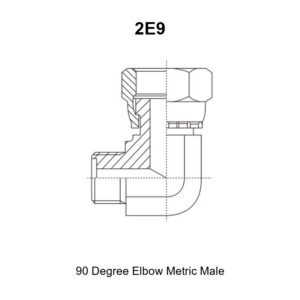
Related products in this range: metric male 74° cone adapter 1Q · metric male 74° cone adapter with bonded seal 1QL · metric male 74° cone to BSPT male adapter 1QT-SP · metric male 74° cone plug adapter 4Q · metric male 74° cone bulkhead adapter 6Q.
Browse the full Hydraulic Adapters range for the complete family, or contact us to request a quote, mill test reports, and samples.

 English
  Spanish
  Portuguese
  French
  German