
1. What a 1BN9 Adapter Does
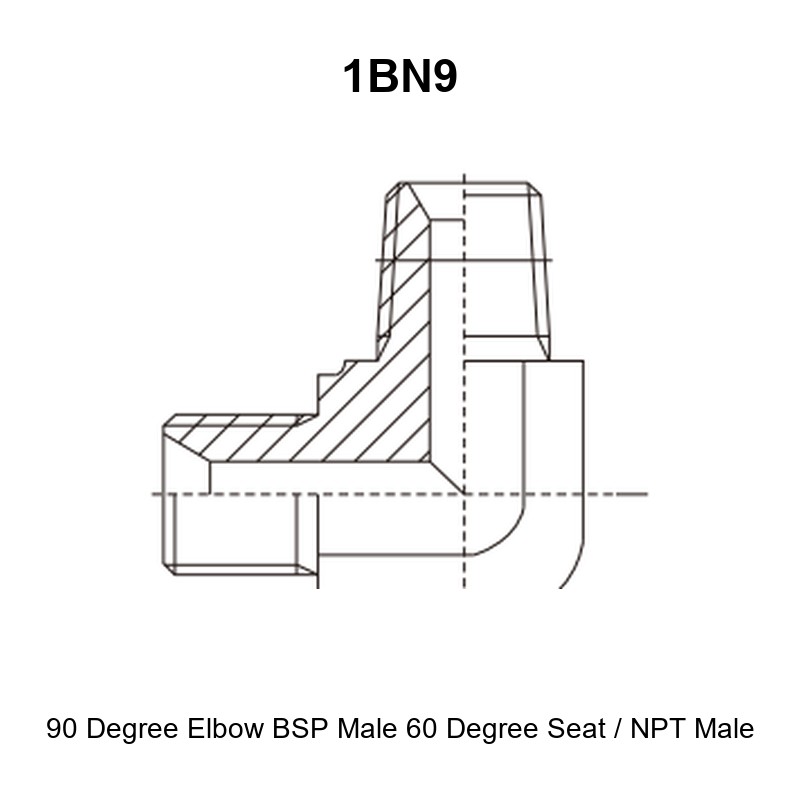
The 1BN9 adapter is a 90° elbow hydraulic conversion adapter that joins a BSPP port to an NPT port. Connection 1 is a BSPP male stud end with a 60° cone seat, produced to ISO 228-1 thread form and used against an ISO 1179 port. Connection 2 is an NPT male taper thread. The 90° body turns the flow through a right angle, so a hose or tube run can leave a manifold or pump face without a large bend radius.
Both connection ends must match their mating port exactly, because that is the precondition for eliminating leakage at the conversion point. A 1BN9 adapter does not bridge a parallel thread and a taper thread by force; it carries one correctly machined end for each port, so neither port has to be modified.
Sealing is deliberately asymmetric. The BSPP end seals on a 60° cone seat against the mating cone, or on a bonded seal when the port face is flat. The NPT end is a taper thread that seals on the thread flanks and requires a sealant. This difference is the reason the two ends can never be interchanged, and it is the first point to check when a leak appears on a conversion joint.
2. 1BN9 Specifications
2.1 Connection 1 — BSPP (G) male stud end, 60° cone seat
- Thread standard: ISO 228-1 parallel pipe thread (BSPP, G thread), the thread form used for the stud end.
- Mating port standard: ISO 1179, ports and stud ends with ISO 228-1 threads, 60° cone seat configuration.
- Gender: male stud end.
- Available thread sizes on Connection 1: G1/4″x19 to G1″x11, covering the size range listed in the table in section 2.5.
- Sealing method: 60° cone seat against the mating cone; a bonded seal (Dowty-type washer) is used instead when the adapter is applied to a flat face.
- Seat rule: a pressure-tight joint is not made on the BSPP threads themselves. The threads position the stud end; the 60° cone or the bonded seal does the sealing.
- Hex: the body is machined with a hex (S1) so the stud end can be tightened with a spanner on the adapter body rather than on the pipework.
2.2 Connection 2 — NPT male taper thread
- Thread standard: NPT taper pipe thread, shown in the series specification as the Z thread designation.
- Gender: male taper thread.
- Available thread sizes on Connection 2: Z1/8″x27 to Z1″x11.5, covering the size range listed in the table in section 2.5.
- Sealing method: the taper thread seals on the thread flanks. A thread sealant appropriate to the fluid and to the system is applied to the taper end.
- Reuse rule: a taper thread that has already been deformed by a previous installation should be inspected before it is used again, because taper joints rely on flank contact.
- Cross-standard note: a BSPP adapter seals on the seat or on a bonded seal while an NPT adapter seals on the thread flanks, so an NPT taper male end must never be screwed into a BSPP parallel port and a BSPP stud end must never be forced into an NPT port. The two thread families are both 60° threads but differ in pitch, angle and taper, so forcing them damages both components.
2.3 Construction and Materials
The body is machined from bar stock on CNC lathes, with the 60° seat and the taper thread cut as separate operations and checked with thread gauges and dimensional checks batch by batch before packing.
- Body material options: carbon steel, 304 stainless steel, 316 stainless steel, with brass available as an option.
- Plating options for carbon steel: trivalent chromium zinc plating (Cr3+) or zinc-nickel plating. Stainless steel bodies are supplied without plating.
- Seal material options: NBR, FKM (Viton-type) and EPDM bonded seals or O-rings, matched to the fluid and the temperature of the application.
- Surface and thread finish: the 60° cone seat is machined as a sealing face, so it is handled and packed as a critical surface.
- Hex feature: a single hex across flats (S1) on the elbow body, sized per thread combination as listed in the table.
2.4 Pressure and Temperature
Pressure is governed by the thread size, the wall thickness of the body, the sealing method and the material selected, so it is confirmed per order rather than published as one blanket figure. Working pressure for these sizes is confirmed per order by HENGHUA engineering, based on the sealing method, thread size and material selected.
Temperature capability follows the seal material, which is a material fact rather than a rating of the adapter body:
| Seal material | Typical service temperature range | Notes |
|---|---|---|
| NBR | approximately -30°C to +100°C | Mineral hydraulic oil and general industrial service |
| FKM (Viton-type) | approximately -20°C to +200°C | Higher temperature and aggressive media |
| EPDM | approximately -40°C to +120°C | Water, water-glycol and steam-adjacent service |
Carbon steel with zinc plating covers general hydraulic service. Choose 304 or 316 stainless steel for corrosive environments, offshore duty and wash-down areas.
2.5 Part Number and Dimension Table
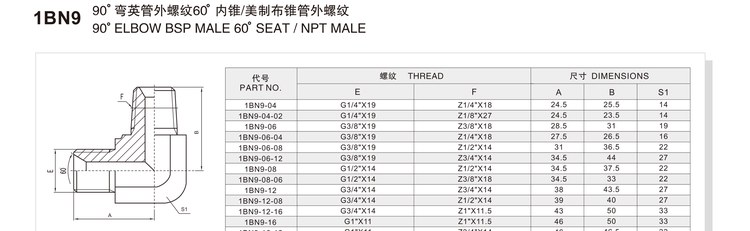
Column key: E is the BSPP (G) male stud end on Connection 1. F is the NPT male taper end on Connection 2, shown in the specification with the Z thread designation. A is the height of the BSPP leg from the seat face, B is the height of the NPT leg, and S1 is the hex across flats, in millimetres.
| PART NO. | E (BSPP male, 60° seat) | F (NPT male) | A (mm) | B (mm) | S1 (mm) |
|---|---|---|---|---|---|
| 1BN9-04 | G1/4″x19 | Z1/4″x18 | 24.5 | 25.5 | 14 |
| 1BN9-04-02 | G1/4″x19 | Z1/8″x27 | 24.5 | 23.5 | 14 |
| 1BN9-06 | G3/8″x19 | Z3/8″x18 | 28.5 | 31 | 19 |
| 1BN9-06-04 | G3/8″x19 | Z1/4″x18 | 27.5 | 26.5 | 16 |
| 1BN9-06-08 | G3/8″x19 | Z1/2″x14 | 31 | 36.5 | 22 |
| 1BN9-06-12 | G3/8″x19 | Z3/4″x14 | 34.5 | 44 | 27 |
| 1BN9-08 | G1/2″x14 | Z1/2″x14 | 34.5 | 37.5 | 22 |
| 1BN9-08-06 | G1/2″x14 | Z3/8″x18 | 34.5 | 33 | 22 |
| 1BN9-12 | G3/4″x14 | Z3/4″x14 | 38 | 43.5 | 27 |
| 1BN9-12-08 | G3/4″x14 | Z1/2″x14 | 39 | 40 | 27 |
| 1BN9-12-16 | G3/4″x14 | Z1″x11.5 | 43 | 50 | 33 |
| 1BN9-16 | G1″x11 | Z1″x11.5 | 46 | 50 | 33 |
| 1BN9-[VERIFY WITH SUPPLIER] | [VERIFY WITH SUPPLIER] | [VERIFY WITH SUPPLIER] | [VERIFY WITH SUPPLIER] | [VERIFY WITH SUPPLIER] | [VERIFY WITH SUPPLIER] |
Note: the last line of the specification image is cropped at the bottom edge. A further table row is partially visible but its part number and dimensions cannot be read reliably, so it is marked for verification rather than reproduced from assumption. Confirm the final row with HENGHUA before ordering the largest size.
3. How to Read a 1BN9 Adapter Part Number
A part number in this series follows the same construction across the whole range, so once the pattern is clear the table can be read at a glance.
- Prefix
1BN9: the family code.1marks the male-to-male conversion group,Bmarks the BSPP end with a 60° seat,Nmarks the NPT male end, and9marks the 90° elbow body. - First size code after the dash: the Thread E size on the BSPP end.
- Optional second size code: the Thread F size on the NPT end. If only one size code is present, E and F are the same nominal size.
Size code mapping, read directly from the size column: 02 = 1/8″, 04 = 1/4″, 06 = 3/8″, 08 = 1/2″, 12 = 3/4″, 16 = 1″. The code repeats the numerator of the thread size, so the mapping can be verified from any row of the table.
Worked example, row 1BN9-12-08: 1BN9 is the 90° elbow BSPP-to-NPT male family, 12 is the Thread E code for G3/4″x14 on the BSPP end, and 08 is the Thread F code for Z1/2″x14 on the NPT end. The row then gives A = 39 mm, B = 40 mm and S1 = 27 mm. The part number therefore states the series, both thread standards and both thread sizes without any further reference.
4. Installation and Fitment
- Inspect before assembly. Check that the 60° cone seat is free of burrs, scores and swarf, and that the taper thread is clean and undamaged. A damaged seat cannot be recovered by extra tightening.
- Apply sealant only where the sealing method requires it. The NPT taper end seals on the thread flanks and needs a sealant suited to the fluid. The BSPP 60° cone end seals on the seat and does not need sealant on the threads when a cone seat is used.
- Fit the bonded seal where the port face is flat. The bonded seal (Dowty-type washer) seals against a flat face. Fit a new washer for each assembly; bonded seals are single-use parts.
- Align before tightening. Start both ends by hand and confirm that the threads run in freely. Tighten to snug contact, then apply the additional tightening angle specified for the joint. Because no tightening angle value appears in the series specification, work to the torque value in your assembly instruction or confirm it with HENGHUA engineering.
- Do not force a parallel thread into a taper port. A BSPP stud end will enter a taper port by a few turns and then bind. Continue and the thread flanks of both parts are deformed.
- Contamination control. Cap or plug the adapter before installation, keep it in its packaging until the moment of fitting and flush the circuit afterwards where swarf ingress is possible.
Common fitment errors and their symptoms:
| Error | Symptom |
|---|---|
| BSPP stud end forced into a taper port | Few turns then increasing resistance, thread damage on both parts, weeping joint |
| Missing bonded seal on a flat face port | Leak at the joint face even at low pressure, no visible thread damage |
| Sealant applied to the 60° cone seat | Seat contamination, intermittent weeping, sealant debris in the circuit |
| Over-tightening the elbow to stop a leak | Distorted hex or cracked seat, leak continues |
| Re-used taper end with flattened flanks | Joint seals initially, then weeps as pressure cycles |
5. Applications and Industries
Application tags for this series: hydraulic systems, water jetting, oil and gas, industrial equipment, construction machinery, agriculture, marine, material handling.
Typical scenarios where a cross standard adapter is the practical answer:
- Cross-standard equipment integration. A machine arrives with an NPT port on a pump or valve block while the rest of the circuit uses BSPP adapters and ISO 1179 stud ends. This series gives the NPT port a BSPP 60° seat face at 90°, so the existing hose assemblies stay unchanged.
- Repair and replacement. A damaged elbow on a machine built to a mixed specification is replaced without re-cutting the pipework, because the 90° body absorbs the change of direction as well as the change of thread standard.
- High-pressure test benches. Test stands often combine NPT manifolds with BSPP instrumentation ports. A 90° elbow keeps gauge and hose runs close to the manifold face and reduces the bending load on the connection.
- OEM assembly lines. Builders of compact power units use the 90° body to keep the installation envelope small, and order the series by part number so that the BSPP and NPT ends are fixed before the line is set up.
6. Replacement and Cross-Reference Guide
Identify a replacement by standard, thread and sealing method, never by brand or by the part number of an installed fitting alone. This is a cross standard adapter, so both thread standards must be identified before a replacement is ordered. A BSPP adapter and an NPT adapter belong to different thread systems, so the standard and the sealing method decide which part fits, not the brand.
Measure these three things on the part you are replacing:
- The two thread forms. Measure the outside diameter and count the threads per inch on each end. A BSPP thread is parallel; an NPT thread tapers, so the diameter changes along the length. Compare the result with the E and F columns of the table.
- The sealing method on the BSPP end. Check whether the end has a 60° cone seat that meets a mating cone, or a flat face that takes a bonded seal. The two configurations are not interchangeable.
- The sealing method on the NPT end. A taper thread sealed by the flanks needs a sealant, and it also tells you that the port is an NPT port and not a BSPP port. An NPT adapter therefore carries a taper, while a BSPP adapter carries a seat.
Organised by standard rather than by brand:
| What you have | What it adapts to | How to specify it |
|---|---|---|
| BSPP port with a 60° cone seat (ISO 1179) | NPT port, 90° elbow | 1BN9 part number, size code for E and F |
| BSPP port with a flat face | NPT port, 90° elbow with a bonded seal | 1BN9 part number plus bonded seal, NBR / FKM / EPDM |
| NPT port only | BSPP stud end on the circuit side | 1BN9 part number, verify F thread against the NPT port pitch |
| BSPP port, no elbow needed | NPT port, straight | Straight BSPP-to-NPT series in the same range |
7. Ordering, Packaging and Delivery
Send the following with your inquiry so that the quotation is exact: series code and full part number (for example 1BN9-12-08), the thread size on each end, seal material (NBR, FKM or EPDM), body material and plating option, and the annual quantity. If you are replacing a part without a readable number, include the measured thread sizes and the seat type instead.
- Packaging: single units in sealed bags, bulk quantities in cartons, and palletised cartons for container loads. Marking and labelling can follow distributor shelf requirements or direct-to-line OEM requirements.
- Sample orders: samples are available for validation before a production order. State the part numbers and seal material you want evaluated.
- Lead time: confirmed per order, based on the size, material and quantity requested. Custom sizes and drawing-based manufacture follow the same route.
- Documentation: quotations and order confirmations state the part number, thread size, material and seal option, so the delivered part can be checked against the paperwork.
8. FAQ
Q1. What is the difference between BSPP and BSPT, and can they be interchanged? BSPP (G thread) is a parallel thread to ISO 228-1, and a pressure-tight joint is not made on the threads: the 60° cone seat or a bonded seal does the sealing. BSPT (R, Rc, Rp) is a taper thread to ISO 7-1 that seals on the thread flanks and needs a sealant. They must never be forced together, because the pitch and the taper are different and forcing one into the other deforms both parts. Use a conversion adapter such as the 1BN9 series so that each port receives the thread form it was made for.
Q2. What is the difference between a 60° cone seat and a bonded seal, and which should I choose? The 60° cone seat seals metal-to-metal against the mating cone inside an ISO 1179 port, so no separate sealing part is needed. A bonded seal (Dowty-type washer) seals against a flat face and is used when the port has no cone. Choose the cone seat where the mating port is a cone seat port, and a bonded seal where the port face is flat. If in doubt, measure the port: a visible internal cone means a cone seat, and a machined flat face means a bonded seal.
Q3. How do I identify the correct 1BN9 size? Read the two size codes in the part number. The first code is the BSPP (G) thread size on the elbow end, the second code is the NPT thread size, and 02 = 1/8″, 04 = 1/4″, 06 = 3/8″, 08 = 1/2″, 12 = 3/4″ and 16 = 1″. If only one code is present, both ends are the same nominal size. Confirm the thread against the port with a thread gauge or by measuring diameter and pitch before ordering.
Q4. What seal material should I select for my fluid and temperature? NBR covers general hydraulic oil service at approximately -30°C to +100°C, FKM covers higher temperatures and aggressive media at approximately -20°C to +200°C, and EPDM covers water, water-glycol and similar service at approximately -40°C to +120°C. Select the material from the fluid and the highest temperature the seal will see, not from the ambient temperature. Send the fluid and temperature data with your inquiry and HENGHUA will confirm the selection.
Q5. How is the working pressure of this adapter determined? Working pressure depends on the thread size, the wall thickness of the body, the sealing method and the material selected, so it is not published as one figure for the whole range. Working pressure for these sizes is confirmed per order by HENGHUA engineering, based on the sealing method, thread size and material selected. Give the operating pressure and the fluid in your inquiry and the confirmation is issued with the quotation.
Q6. What is the minimum order quantity and can I get samples? Samples are available for validation before a production order, and smaller quantities can be supplied for trial and for maintenance stock. State the part numbers, seal material and quantity in your inquiry so that both the sample and the production lead time can be confirmed together. Minimum order quantity is confirmed per order according to the size, material and plating combination requested.
Q7. Can I fit the 1BN9 elbow against a port with a scratched cone seat? No. The 60° cone seat is the sealing surface, so a scratched or deformed cone leaks regardless of how much torque is applied, and additional tightening usually damages the mating port as well. Inspect the seat before assembly, keep the adapter capped until fitting, and replace the adapter if the seat is damaged. A flat face port is a different case: there the bonded seal does the sealing and it must be renewed at each assembly.
Browse the full Hydraulic Adapters range for the complete family, or contact us to request a quote, mill test reports, and samples.


 English
  Spanish
  Portuguese
  French
  German