
1. What a 4TN Adapter Does
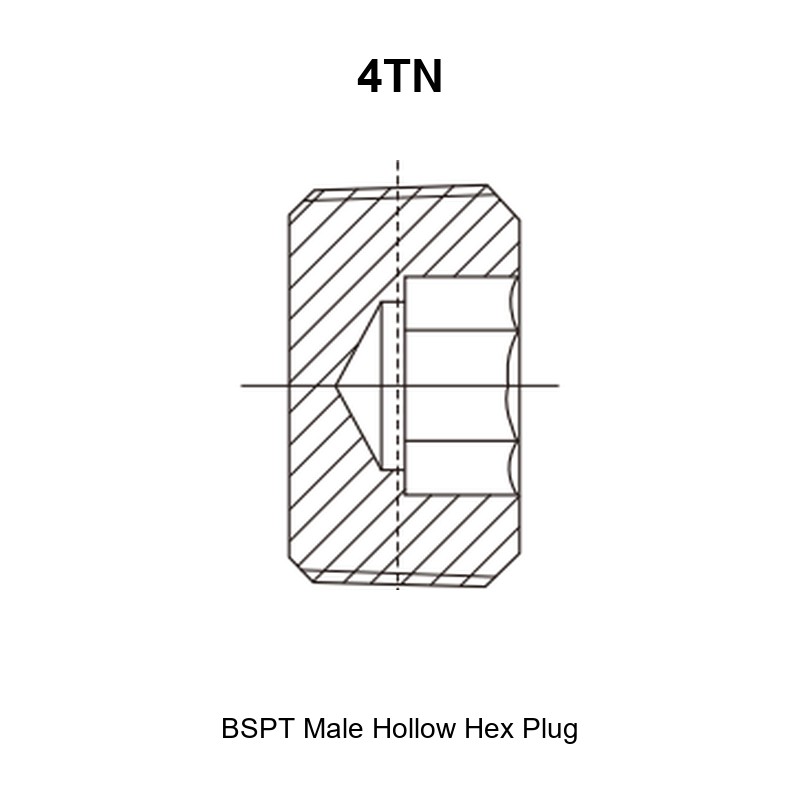
The 4TN adapter is a single-ended BSPT male hollow hex plug that closes a hydraulic port which is not in use. Its stud end carries an R (BSPT) taper pipe thread to ISO 7-1 and screws into a BSPT port on a manifold, valve block, pump, cylinder, filter head or pipe fitting. The drive is an internal hex recess, so the plug is turned with a hex key instead of a wrench on an external hex.
A plug has one interface only, so that interface decides whether the port stays dry. On a taper thread the seal is made on the thread flanks themselves, which means the thread form, the thread size and the thread preparation must all be correct, because there is no separate seal ring to fall back on.
The hollow hex feature is what separates this plug from the standard taper plug. The outside of the plug stays close to the thread diameter, so it can be fitted in a recessed port, next to a casting wall or between other fittings where no wrench can reach. The internal hex is smaller than the external hex of the equivalent standard plug, and it drives the same thread to the same engagement depth.
2. 4TN Specifications
2.1 Connection 1 — BSPT male stud end (into the port)
- Thread standard: ISO 7-1 taper pipe thread, R series, where the pressure-tight joint is made on the threads.
- Gender: male.
- Size range: R1/8″x28 up to R1.1/4″x11, seven sizes in the published table. Larger sizes are confirmed with the supplier before ordering, because they are not listed in the published chart.
- Sealing: metal-to-metal contact between the thread flanks, with a thread sealant applied at assembly.
- Mating port: a BSPT (Rc or Rp) threaded port to ISO 7-1.
2.2 Connection 2 — hollow hex head (no line connection)
- Function: the head closes the stud end and carries the internal hex that drives the plug.
- Drive: internal hex, dimension S1 in the table, turned with a hex key.
- Face: a solid blank head; no washer is fitted, because sealing takes place on the taper thread.
- Mating part: none. The head connects to no hose, tube or fitting.
2.3 Construction and Materials
The body is machined from bar stock on CNC lathes, with the internal hex machined to the size shown in the table and the taper thread cut and gauged for correct engagement. Standard material is carbon steel with trivalent chromium zinc plating (Cr3+) for general hydraulic service. Zinc-nickel plating, 304 stainless steel, 316 stainless steel and brass are available for corrosive and marine duties. Because the joint seals on the threads, no separate elastomer is fitted in the standard configuration; a thread sealant suitable for the fluid is applied at assembly.
2.4 Pressure and Temperature
Pressure is not fixed by the part number alone. It is governed by the thread size, the wall thickness of the plug, the sealing method used at the port and the body material, so working pressure for these sizes is confirmed per order by HENGHUA engineering, based on the sealing method, thread size and material selected. Where an elastomer is used in an alternative configuration, its material limits apply as material facts: NBR approximately -30°C to +100°C, FKM approximately -20°C to +200°C, EPDM approximately -40°C to +120°C.
2.5 Part Number and Dimension Table
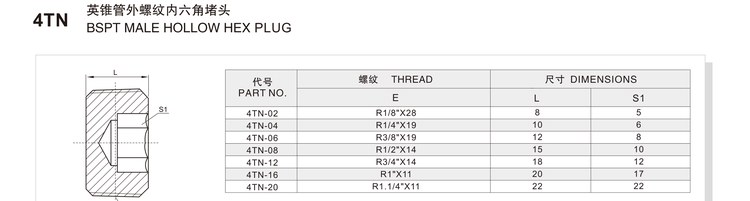
Every value below is taken from the published series chart. All dimensions are in millimetres. E is the thread designation of the stud end, L is the overall length of the plug, and S1 is the hex across flats of the internal hex drive.
| PART NO. | THREAD E | L | S1 |
|---|---|---|---|
| 4TN-02 | R1/8″x28 | 8 | 5 |
| 4TN-04 | R1/4″x19 | 10 | 6 |
| 4TN-06 | R3/8″x19 | 12 | 8 |
| 4TN-08 | R1/2″x14 | 15 | 10 |
| 4TN-12 | R3/4″x14 | 18 | 12 |
| 4TN-16 | R1″x11 | 20 | 17 |
| 4TN-20 | R1.1/4″x11 | 22 | 22 |
Sizes larger than R1.1/4″x11 are not listed in the published chart for this series; [VERIFY WITH SUPPLIER] before ordering a larger size, and send the port dimensions so that the size and the internal hex can be confirmed.
Note on thread notation: a designation such as R1.1/4″x11 means a 1 1/4 inch BSPT taper thread with 11 threads per inch. The number after the x is the thread pitch in threads per inch.
3. How to Read a 4TN Adapter Part Number
A 4TN part number has a fixed structure: series prefix and size code.
- 4T identifies the BSPT male plug family, the taper thread plug of the British Adapters range.
- N marks the hollow hex version. The N plug has the same thread as the standard taper plug of the same size, but it is driven by an internal hex instead of an external hex.
- The two digits are the size code, expressed as the nominal bore in sixteenths of an inch. 02 is 2/16 inch, or 1/8 inch; 04 is 4/16, or 1/4 inch; 06 is 6/16, or 3/8 inch; 08 is 8/16, or 1/2 inch; 12 is 12/16, or 3/4 inch; 16 is 16/16, or 1 inch; 20 is 20/16, or 1 1/4 inch.
Worked example from the table: 4TN-08. The prefix 4T shows a taper thread plug and N shows the hollow hex drive. The code 08 gives a 1/2 inch nominal bore, so the thread is R1/2″x14. The overall length L is 15 mm and the internal hex S1 is 10 mm, so a 10 mm hex key drives the plug and the plug sits down inside the port.
4. Installation and Fitment
Clean the port threads and remove old sealant, then apply a thread sealant suitable for the fluid and the operating temperature. Start the plug by hand and turn it in until it seats by hand; a taper thread engages progressively, so resistance increases as the plug enters. Finish with a hex key in the internal recess, tightening until the plug is firm in the port. Do not drive a taper plug to a hard stop, because the joint is made on the thread flanks and excessive torque splits bosses, seizes threads and rounds the internal hex.
Use a hex key that fills the recess properly. An undersized or worn key loads only the corners of the internal hex and rounds them, which makes the plug difficult to remove later. Keep the key square to the axis of the plug while tightening.
Never fit a bonded seal washer or an O-ring to make a taper thread seal. A taper thread seals on the flanks, and a washer under the head changes the engagement depth without improving the joint. Do not mix thread families: an R thread must go into an Rc or Rp port, and a G thread must go into a parallel port.
Common fitment errors and their symptoms:
- Fitting a taper plug without sealant. Symptom: a weep along the thread that grows with pressure.
- Using a hex key that is too small or worn. Symptom: the key slips and the internal hex corners are rounded.
- Fitting a taper plug into a parallel port. Symptom: the plug enters a few turns and then binds with no sealing contact.
- Fitting the plug where the counterbore is too shallow. Symptom: the plug bottoms out before the thread is properly engaged.
- Over-tightening into a casting. Symptom: a cracked or bulged port boss.
Inspect the thread for stretching, galling and flattened crests, and check the internal hex for rounding, before reusing a plug after service.
5. Applications and Industries
Typical applications and industries for this plug include hydraulic systems, water jetting equipment, oil and gas service equipment, industrial machinery, construction machinery, agriculture, marine hydraulics and material handling equipment.
Four concrete uses:
- Capping a spare port in restricted space. A port set into a recess, close to a casting wall or surrounded by other fittings leaves no room for a wrench. This hollow hex plug closes that port with a hex key instead.
- Isolating an unused branch. When a circuit branch is removed during a rebuild, its port stays open. The hollow hex plug isolates that port from the rest of the system without needing access around the port.
- Capping a line during commissioning. On a test bench or on site, sub-circuits are pressurised one at a time while the remaining ports stay closed, which allows part of a machine to be commissioned without dismantling the rest.
- Protecting a port during transport. Pumps, cylinders, blocks and pipe spools ship with their ports closed to keep out moisture, dust and insects, and the low profile of the hollow hex plug keeps the protection inside the handling envelope of the machine.
6. Replacement and Cross-Reference Guide
Identify a replacement by standard and sealing method, not by the source of the original part. BSPT threads are defined by ISO 7-1, and a plug that matches the thread size and form performs the same duty. Separate the thread families first: BSPT (taper, R) to ISO 7-1, BSPP (parallel, G) to ISO 228-1, JIS gas thread to JIS B 0203, and the metric and SAE families to their own standards.
Measure these three things before ordering:
- The thread. Measure the outside diameter of the male port thread near the port face and again toward the end. A taper thread is larger at the port face and smaller at the tip; a parallel thread measures the same along its whole length. Confirm the pitch with a thread gauge.
- The sealing method. A taper port seals on the threads and needs a sealant. A flat face with a spot face takes a bonded seal washer, and a machined 60° internal cone takes a cone seat plug. Match the replacement to the sealing method, not to the appearance of the old part.
- The drive and the clearance. Check that a hex key can reach the port and that the key is available in the size S1 shown in the table. Where an external hex plug fits and a wrench is available, the standard taper plug does the same job with the same thread.
7. Ordering, Packaging and Delivery
To place an order or request a quotation, send the series code, the full part number, the thread size, the material or plating, and the quantity. Example: 4TN-08, R1/2″x14, carbon steel with trivalent chromium zinc plating, 500 pieces. State whether the plugs will be used with a thread sealant or in a dry assembly, and confirm the hex key size available in your workshop if the recess size matters for your application. Sizes outside the published table are quoted as specials from a drawing or from the mating port dimensions.
Plugs are packed in sealed polyethylene bags inside cartons, with the part number, thread size, material and quantity printed on the label. Bulk cartons and labelled shelf packs are available for distributor stock. Sample orders are accepted so that the taper engagement and the recess clearance can be validated before a production order. Lead time is confirmed per order, since it depends on the size, the material grade and the order quantity.
8. FAQ
Q1. What is the difference between BSPP and BSPT, and can they be interchanged? BSPP is a parallel pipe thread to ISO 228-1, where the pressure-tight joint is not made on the threads; sealing comes from a 60° cone seat or a bonded seal washer. BSPT is a taper pipe thread to ISO 7-1, where the joint is made on the threads and a sealant is required. The two are not interchangeable: a taper plug in a parallel port binds and leaks, and a parallel plug in a taper port never seats.
Q2. What is the difference between a 60° cone seat and a bonded seal, and which should I choose? A 60° cone seat seals metal to metal between a cone on the stud end and a cone in the port, as defined for BSPP stud ends in ISO 1179. A bonded seal washer seals on a flat face, with the elastomer bonded to a metal backing ring. Neither applies to a taper thread joint, which seals on the thread flanks; choose the taper plug when the port thread is BSPT.
Q3. What is the difference between a solid hex plug and a hollow hex plug? A solid hex plug has an external hex and is turned with a wrench, so it needs clear space around the port. A hollow hex plug such as this series has an internal hex recess and is turned with a hex key, so the outside of the plug stays close to the thread diameter and the plug can sit in a recess or beside a casting wall. Both use the same thread and the same sealing method for a given size.
Q4. How do I identify the correct 4TN adapter size? Measure the outside diameter of the male port thread and match it to the size code table; the two-digit code is the nominal bore in sixteenths of an inch, so 08 is 1/2 inch and the thread is R1/2″x14 with a 10 mm internal hex. Check that the thread tapers toward the tip, which confirms BSPT rather than BSPP, and confirm the pitch with a thread gauge.
Q5. Does a 4TN plug need a sealant or a washer? It needs a thread sealant, because a BSPT joint seals on the thread flanks. A washer under the head does not seal a taper joint and can reduce the engagement depth of the thread. Choose a sealant compatible with the fluid and with the operating temperature, and apply it to the thread rather than to the head face.
Q6. How is the working pressure of this adapter determined? Working pressure is governed by the thread size, the wall thickness of the plug, the sealing method at the port and the body material, so it is not one figure for the whole series. Working pressure for these sizes is confirmed per order by HENGHUA engineering, based on the sealing method, thread size and material selected.
Q7. What seal material should I select for my fluid and temperature? For a taper plug the primary choice is the thread sealant, not the elastomer. Where an elastomer is used, NBR suits mineral hydraulic oil at approximately -30°C to +100°C, FKM suits higher temperatures and aggressive fluids at approximately -20°C to +200°C, and EPDM suits water and water-glycol service at approximately -40°C to +120°C. Match the sealant and the elastomer to the fluid first and to the temperature second.
Q8. What is the minimum order quantity and can I get samples? Sample orders are accepted so that the taper engagement and the hex key access can be checked in the actual port before a production order. Minimum order quantity depends on the size, the material grade and the finish, and is confirmed with the quotation.
Browse the full Hydraulic Adapters range for the complete family, or contact us to request a quote, mill test reports, and samples.


 English
  Spanish
  Portuguese
  French
  German
  Arabic