
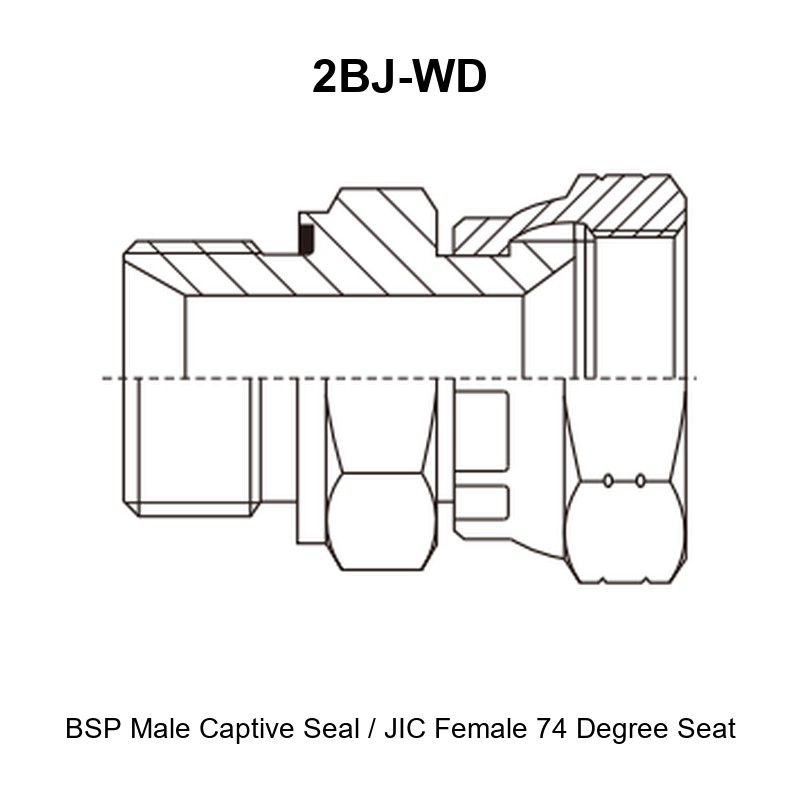
Series 2BJ-WD | straight adapter | BSP male stud end with captive bonded seal washer to JIC female swivel end
1. What a 2BJ-WD Adapter Does
A 2BJ-WD adapter is a straight conversion adapter that joins a BSP male stud end to a JIC female swivel port with a 74° seat. The BSP end carries a parallel pipe thread to ISO 228-1 in the bonded seal configuration described for BSPP ports in ISO 1179. The JIC end is a female swivel machined to SAE J514.
The letters WD mark the captive seal. The bonded seal washer sits on the stud end and is held there by a captive feature machined into the body, so the washer stays with the adapter while it is stored, carried, fitted and removed. A loose washer that drops out during site work can fall into an open port, and a missing washer turns a ten-minute job into a shutdown; the captive design removes both risks.
The three technical facts that define this series are therefore: a BSP male adapter end for a flat face port that takes a bonded seal, a JIC female 74° seat end to SAE J514, and a washer that cannot be separated from the adapter in normal handling.
2. 2BJ-WD Adapter Specifications
2.1 Connection 1 – BSP male stud end with captive bonded seal
- Thread family: BSPP parallel pipe thread, G series, to ISO 228-1.
- Size range in this series: G1/8″x28 through G1.1/2″x12.
- Gender: male stud end with hex flats for wrench engagement.
- Sealing method: bonded seal washer compressed between the flat port face and the shoulder of the stud end.
- Mating port standard: ISO 1179 BSPP flat face port for bonded seal.
- Captive feature: the washer is retained on the stud end and is supplied fitted to the adapter.
As a BSP male adapter end it is machined with a parallel thread, so pressure tightness is never obtained on the thread flanks. The thread only supplies the clamping load; sealing happens at the washer. The stud end also keeps the 60° seat geometry of the standard series, so the same body can serve a cone seat port when the washer is removed, but the captive washer version is normally ordered for flat face ports where the washer must not be lost.
2.2 Connection 2 – JIC female swivel, 74° seat
- Thread family: SAE J514 straight thread, UNF series.
- Size range in this series: 7/16″x20 through 1.7/8″x12.
- Gender: female swivel nut with a 74° internal seat.
- Sealing method: 74° seat (inverted flare) metal-to-metal contact with the mating cone nose.
- Mating port standard: SAE J514 74° seat / inverted flare stud end.
The JIC end follows SAE J514, and within that family a buyer has to keep two sealing forms apart. A 37° flare joint seals on a shallower external cone, spreading the contact load over a longer cone surface. A 74° seat, also called an inverted flare, uses a steeper internal cone of 74° included angle inside the swivel nut and seals against the matching cone nose of the stud end it is screwed onto.
The two forms do not interchange. A 37° flare nose will not seat correctly in a 74° seat nut, and a 74° seat nut will not seal on a 37° flare nose: the threads may engage and the joint may still leak, because the contact lines are at different angles. Confirm that the equipment port is a 74° seat port before ordering any JIC adapter for this position.
2.3 Construction and Materials
Bodies are machined from bar stock on CNC lathes, with the thread, the seat face and the captive washer groove cut so that the seal face runs true to the thread axis.
- Body material options: carbon steel, 304 stainless steel, 316 stainless steel, brass.
- Plating options for carbon steel bodies: trivalent chromium zinc plating (Cr3+), zinc-nickel plating.
- Seal material options for the captive bonded seal: NBR, FKM (Viton-type), EPDM.
- Hex features: S1 across flats on the main body, S2 across flats on the JIC swivel nut, per the dimension table in 2.5.
- Identification: series and size code marked on the body where the size allows.
2.4 Pressure and Temperature
Temperature limits follow the washer material that is selected, not the body:
| Seal material | Typical service temperature range |
|---|---|
| NBR | -30°C to +100°C |
| FKM (Viton-type) | -20°C to +200°C |
| EPDM | -40°C to +120°C |
Working pressure is not one fixed figure for the whole series. It depends on the thread size, the wall thickness of the body at that size, the sealing method and the material grade, and it is confirmed per order by HENGHUA engineering against the drawing. On the JIC side, capability also follows the mating SAE J514 stud end. State the system working pressure and the peak pressure with the inquiry so that size and grade can be confirmed for the duty.
2.5 Part Number and Dimension Table
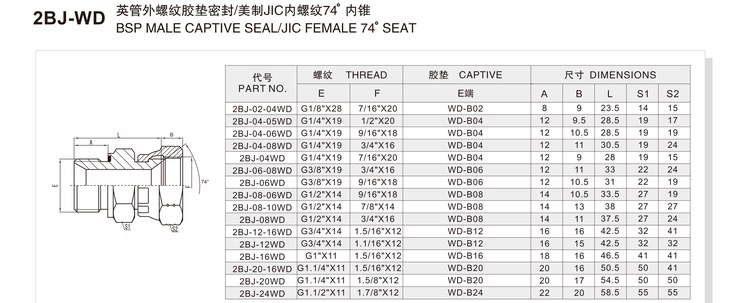
| PART NO. | E THREAD (BSP male stud) | F THREAD (JIC female 74° seat) | CAPTIVE SEAL | A | B | L | S1 | S2 |
|---|---|---|---|---|---|---|---|---|
| 2BJ-02-04WD | G1/8″x28 | 7/16″x20 | WD-B02 | 8 | 9 | 23.5 | 14 | 15 |
| 2BJ-04-05WD | G1/4″x19 | 1/2″x20 | WD-B04 | 12 | 9.5 | 28.5 | 19 | 17 |
| 2BJ-04-06WD | G1/4″x19 | 9/16″x18 | WD-B04 | 12 | 10.5 | 28.5 | 19 | 19 |
| 2BJ-04-08WD | G1/4″x19 | 3/4″x16 | WD-B04 | 12 | 11 | 30.5 | 19 | 24 |
| 2BJ-04WD | G1/4″x19 | 7/16″x20 | WD-B04 | 12 | 9 | 28 | 19 | 15 |
| 2BJ-06-08WD | G3/8″x19 | 3/4″x16 | WD-B06 | 12 | 11 | 33 | 22 | 24 |
| 2BJ-06-08WD (v) | G3/8″x19 | 9/16″x18 | WD-B06 | 12 | 10.5 | 31 | 22 | 19 |
| 2BJ-08-06WD | G1/2″x14 | 9/16″x18 | WD-B08 | 14 | 10.5 | 33.5 | 27 | 19 |
| 2BJ-08-10WD | G1/2″x14 | 7/8″x14 | WD-B08 | 14 | 13 | 38 | 27 | 27 |
| 2BJ-08WD | G1/2″x14 | 3/4″x16 | WD-B08 | 14 | 11 | 37.5 | 27 | 24 |
| 2BJ-12-16WD | G3/4″x14 | 1.5/16″x12 | WD-B12 | 16 | 16 | 42.5 | 32 | 41 |
| 2BJ-12WD | G3/4″x14 | 1.1/16″x12 | WD-B12 | 16 | 15 | 42.5 | 32 | 32 |
| 2BJ-16WD | G1″x11 | 1.5/16″x12 | WD-B16 | 18 | 16 | 46.5 | 41 | 41 |
| 2BJ-20-16WD | G1.1/4″x11 | 1.5/16″x12 | WD-B20 | 20 | 16 | 50.5 | 50 | 41 |
| 2BJ-20WD | G1.1/4″x11 | 1.5/8″x12 | WD-B20 | 20 | 17 | 54.5 | 50 | 50 |
| 2BJ-24WD | G1.1/2″x12 | 1.7/8″x12 | WD-B24 | 22 | 20 | 58.5 | 55 | 55 |
Column notes: E is the BSP male stud end thread, F is the JIC female swivel thread with its 74° seat, and CAPTIVE SEAL is the code of the captive bonded seal washer that is supplied fitted on the stud end, sized by the BSP thread. A is the length of the E-end section as shown on the series drawing, B is the length of the F-end section, L is the overall length, S1 is the across-flats of the body hex and S2 is the across-flats of the JIC swivel nut. Dimensions are in millimetres.
(v) [VERIFY WITH SUPPLIER]: the chart shows this G3/8″x19 to 9/16″x18 row under the same part number as the row above it, and shows the G1.1/2″ E thread with a x12 pitch callout. Both cells are to be confirmed against the current drawing before the number is used in an order.
3. How to Read a 2BJ-WD Adapter Part Number
The part number carries the series, the BSP-end size, the JIC-end size and the captive seal marker.
- 2BJ-WD: series prefix, a straight adapter with a BSP male stud end that carries a captive bonded seal washer and a JIC female 74° seat end.
- First size code (BSP end): 02 = G1/8″x28, 04 = G1/4″x19, 06 = G3/8″x19, 08 = G1/2″x14, 10 = G5/8″x14, 12 = G3/4″x14, 16 = G1″x11, 20 = G1.1/4″x11, 24 = G1.1/2″.
- Second size code (JIC end): 04 = 7/16″x20, 05 = 1/2″x20, 06 = 9/16″x18, 08 = 3/4″x16, 10 = 7/8″x14, 16 = 1.5/16″x12, 20 = 1.5/8″x12, 24 = 1.7/8″x12.
- WD suffix: captive bonded seal version, washer retained on the stud end.
Worked example: 2BJ-08-10WD. The prefix 2BJ-WD fixes the series. The first code 08 sets the BSP stud end at G1/2″x14 to ISO 228-1 for an ISO 1179 flat face port. The second code 10 sets the JIC end at 7/8″x14 with a 74° seat to SAE J514. Reading the table, the adapter takes captive washer WD-B08, and measures A 14 mm, B 13 mm, L 38 mm, S1 27 mm and S2 27 mm. Quote 2BJ-08-10WD plus the washer material to place the line.
4. Installation and Fitment
Installation of this adapter starts with the port, not with the wrench. Confirm that the port has a flat face wide enough for the bonded seal washer, and check that the washer is still correctly seated in its captive position after transport: it should move slightly but must not come free.
- Bring the adapter in by hand until the washer touches the flat face.
- Hold the body hex S1 with one wrench and tighten the JIC swivel nut S2 with a second wrench. Never let the body turn while the swivel nut is tightened, because that loads the body thread instead of the seat.
- Torque practice is snug contact first and then a controlled tightening angle to reach the seating load the joint needs. The figure depends on thread size, material and washer type, so it is confirmed per order rather than quoted as one number for all sizes.
- Keep the sealing face of the washer clean. A single chip trapped under the washer produces a leak path that no amount of extra tightening will close.
- Replace the captive washer when the adapter is opened for service. Because the washer is retained by the body, replacing it means fitting the correct WD code washer for that stud size, or replacing the adapter.
- Support the hose run so that vibration is not carried into the stud thread, and re-check the joint after the machine reaches working temperature.
Common fitment errors and their symptoms: a washer from the wrong WD code is thicker or thinner than the port face expects, so the joint either bottoms early on the body shoulder or leaves the washer under-compressed and weeping. Fitting a captive seal adapter to a recessed 60° cone seat port gives a joint with no flat land for the washer and an immediate leak at the body face. Starting the JIC swivel nut by wrench instead of by hand cross-threads the nut, which shows as heavy drag and a nut that will not seat.
5. Applications and Industries
Application tags: hydraulic systems, water jetting, oil and gas, marine, industrial equipment, construction machinery, agriculture, material handling.
- Site work where washers get lost. Offshore platforms, mobile plant and field service trucks are the classic captive seal environment. A retained washer cannot drop into an open reservoir, be blown away by wind or be lost in a gravel yard, and the fitter does not need a stock of loose washers on the vehicle.
- Flat face port manifolds and valve blocks. Where a manifold face is machined flat for a bonded seal, the captive version keeps the seal correctly centred on the port during assembly, which reduces the risk of a washer sitting off centre and leaking.
- Repair and replacement. When a leaking bonded seal joint is opened on imported machinery, the replacement part has to match a BSP flat face port at one end and a JIC 74° seat line at the other. Reading the two thread callouts off the old adapter and matching them in the table identifies the correct line.
- OEM assembly lines. On a production line the captive washer removes one handling step and one class of assembly error, because the seal arrives with the part and cannot be omitted. The 74° seat end gives a repeatable metal-to-metal joint at the equipment interface.
6. Replacement and Cross-Reference Guide
Cross-reference any BSP adapter by standard and sealing method, never by another maker’s catalogue number. Three things identify the correct replacement: the thread, the seat angle and the seal type.
- Thread. Measure the outside diameter of the BSP stud end and identify the threads per inch. A G1/2″x14 stud end measures about 20.9 mm across the thread with 14 threads per inch; a taper thread at the same diameter identifies a BSPT end instead. On the JIC side, measure the swivel nut thread: 7/16″x20, 9/16″x18, 3/4″x16, 7/8″x14, 1.1/16″x12 and 1.5/16″x12 are UNF sizes.
- Seat angle. Look at the internal cone inside the swivel nut. A 74° seat is visibly steeper than a 37° flare seat, and the two must not be mated to each other. A JIC adapter ordered for a 37° flare port will not seal in this position.
- Seal type. If the washer is held on the stud end by the body, the part is a captive seal adapter and this series is the correct match. If the washer is loose, the standard series 2BJ is the equivalent part, and if there is no washer at all, the part works on a 60° cone seat port.
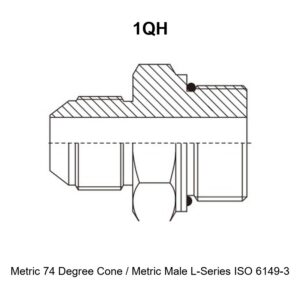
Related families in the same HENGHUA British Adapters range, by function: 2BJ is the same connection with a loose bonded seal washer; 1BJ covers a BSP stud end to a JIC male 74° cone; 5B and 7B stay inside ISO 1179 with BSP male to BSP female connections; 4B-WD and 4BN-WD are the captive seal plug equivalents for closing a BSP port.
7. Ordering, Packaging and Delivery
To place a quotation request for this BSP adapter, send these six items: series code, full part number, the thread size of each end, the washer material, the plating or material grade, and the annual or first-order quantity.
Example of a complete inquiry line: series 2BJ-WD, part number 2BJ-08-10WD, BSP end G1/2″x14 to ISO 228-1, JIC end 7/8″x14 with 74° seat to SAE J514, captive bonded seal washer WD-B08 in NBR, carbon steel body with trivalent chromium zinc plating, 500 pieces.
- Packaging. Parts are bagged and cartoned in quantities suited to distributor shelf handling, with larger sizes cartoned loose in single size groups. Carton labels carry the series code, the part number and the quantity.
- Labelling. Neutral labelling is available for distributors who re-label under their own brand, and customer label artwork can be applied where supplied.
- Samples. Single pieces or small sample sets can be supplied for fit validation. Sampling a new size on the actual port is the fastest way to confirm the washer code and the across-flats clearance in a tight installation.
- Lead time. Lead time depends on the size mix, the material grade and the plating selected, and is confirmed at quotation per order.
- Inspection. Each carton is checked against the drawing with thread gauges and dimensional checks before packing, and the batch is identified by the part number on the label.
8. FAQ
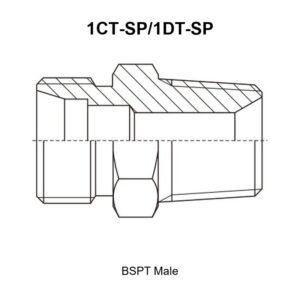
Q1. What is the difference between BSPP and BSPT, and can they be interchanged? BSPP is a parallel pipe thread to ISO 228-1, where pressure tightness is made on the seat or on a washer rather than on the thread. BSPT is a taper pipe thread to ISO 7-1, where pressure tightness is made on the thread flanks and a sealant is required. They must not be interchanged: a BSPT male end in a BSPP port engages only a few turns and damages the parallel thread, and a BSPP male end in a BSPT port bottoms without sealing. Series codes ending in -SP in this range are the taper thread parts.
Q2. What is the difference between a 60° cone seat and a bonded seal, and which should I choose? The 60° cone seat seals where a machined cone on the stud end meets the matching cone in the port, so it needs a port with that internal cone. A bonded seal adapter seals where a washer with a bonded elastomer ring is compressed against a flat port face. Choose the cone seat for a machined cone seat port, and the bonded seal for a flat face port. The 2BJ-WD stud end keeps the cone geometry and adds the captive washer, so it serves the flat face port without any loose part.
Q3. How do I identify the correct 2BJ-WD adapter size? Read two threads: the BSP stud end and the JIC swivel end. Measure the outside diameter and the pitch of the BSP thread to get the G size, then measure the swivel nut thread to get the UNF size such as 7/16″x20 or 9/16″x18. Match that pair in the table and read off the WD washer code at the same time. Confirm that the JIC end is a 74° seat and not a 37° flare before ordering.
Q4. What seal material should I select for my fluid and temperature? NBR covers general hydraulic oil service from about -30°C to +100°C and is the usual first choice. FKM (Viton-type) runs from about -20°C to +200°C and suits higher temperatures and many aggressive fluids. EPDM runs from about -40°C to +120°C and suits water and water-glycol service, but it is not suitable for mineral oil. Send the fluid and working temperature with the inquiry and the washer selection will be confirmed against them.
Q5. How is the working pressure determined? Working pressure is not one figure for the whole series. It depends on the thread size, the wall thickness of the body at that size, the sealing method and the material grade, and it is confirmed per order by HENGHUA engineering. On the JIC side, capability also follows the mating SAE J514 stud end. State the system and peak pressures with the inquiry so the size and grade can be confirmed for the duty.
Q6. Can the captive washer be replaced, or must the whole adapter be replaced? The washer is retained on the stud end, so it is replaced by fitting the correct WD code washer for that stud size, or by replacing the adapter when the seat face is damaged. Order spare captive washers with the adapters so that service work does not stall on a missing seal. A washer that has been run at temperature and then opened should not be reused.
Q7. What is the minimum order quantity and can I get samples? Sample quantities can be supplied for fit validation before a production order. The minimum order quantity depends on the size, the material grade and the plating selected and is confirmed in the quotation. Send the part numbers, washer material and expected annual quantity in one inquiry so that the sample set and the production release can be quoted together.
Browse the full Hydraulic Adapters range for the complete family, or contact us to request a quote, mill test reports, and samples.


 English
  Spanish
  Portuguese
  French
  German