
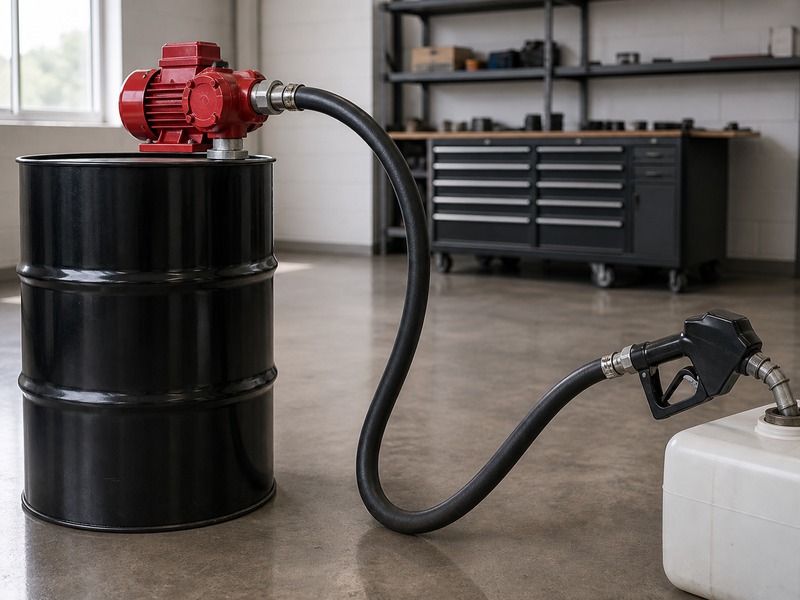
Choosing a discharge hose for your oil transfer pump? Quick answer: the outlet-side line on a 12 V battery or AC (mains-powered) transfer pump is a flexible, static-dissipating assembly that carries oil or fuel to the receiving tank. For most light pumps, the right oil transfer pump hose is a 3/4-inch (19 mm) or 1-inch (25 mm) bore assembly with a nitrile (NBR) tube, a working pressure rating of at least 150 PSI (10 bar), and fittings that match the pump port and the tank or nozzle connection.
Most buyers land on this page in one of three situations: replacing a worn hose on an existing 12 V or AC transfer pump, matching a discharge hose to a pump they just bought, or checking whether their current fuel line is safe. The guide answers the five decisions in order — suction versus discharge, bore size, pressure and temperature rating, tube material and static-safety construction, and end fittings — with a size and flow chart, an inspection checklist, the standards printed on a compliant cover, and a 2026 view of what actually drives discharge hose pricing — because on rubber goods, the only number that stays current is the factory’s quote for your specification.
Key Discharge Hose Specifications at a Glance
Typical specifications for a light oil and fuel pump discharge hose (always confirm against the printed datasheet):
| Specification | Typical value for light transfer pumps |
|---|---|
| Inner diameter (ID) | 3/4 in (19 mm) or 1 in (25 mm) |
| Common lengths | 12 ft, 14 ft, or 20 ft (3.7–6.1 m) |
| Working pressure | 150–300 PSI (10–20 bar) |
| Temperature range | -40°C to +100°C (-40°F to 212°F) |
| Tube material | Conductive nitrile (NBR) |
| Static protection | Conductive tube plus internal ground wire |
| End fittings | 3/4 in NPT male or female, hose barb, or nozzle |
1. What Is a Discharge Hose for an Oil Transfer Pump?
A discharge hose is the line on the outlet (pressure) side of a pump. It pushes oil, diesel, kerosene, or lubricant from the pump into a drum, tank, machine, or vehicle, and it sees positive pressure only; vacuum (suction) service belongs to the hose on the inlet side. In product catalogs and parts listings this line appears under several names — oil discharge hose, delivery hose, or simply discharge pump hose — all describing the same assembly for the outlet (pressure) side of a transfer pump, to separate it from the suction hose on the inlet side.
A purpose-built oil discharge hose is a three-layer assembly:
- Tube: conductive nitrile (NBR) rubber that resists swelling in petroleum products and drains static charge from the flowing fluid.
- Reinforcement: one or more textile plies that carry the pressure and stop the hose from bursting or kinking.
- Cover: an oil-, abrasion-, and weather-resistant rubber outer layer, usually chloroprene (CR) or an NBR blend.
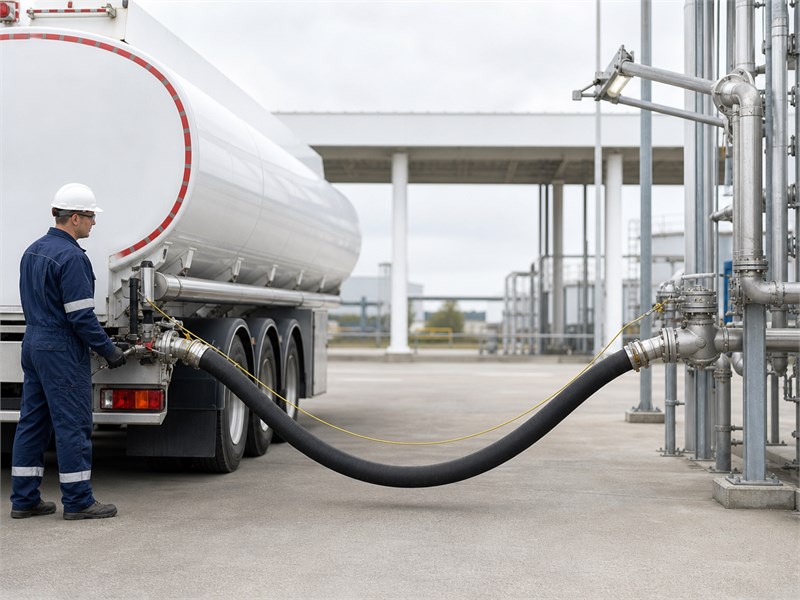
Many packaged discharge hoses also include an internal ground wire bonded between the end fittings. Fuel flowing through a hose generates static charge; the wire and the conductive tube give that charge a path to ground, which is why distributors and pump brands fit them as standard on transfer duty.
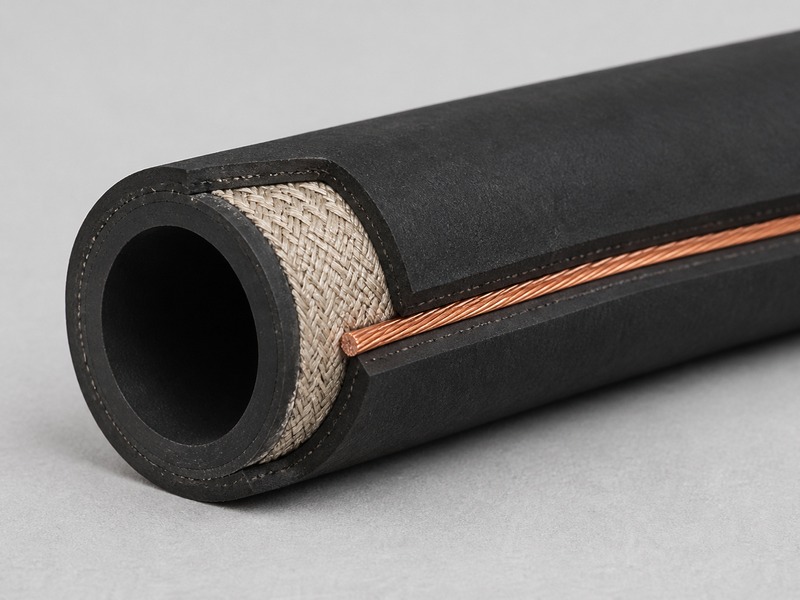
Figure 1. A discharge hose is a tube-reinforcement-cover assembly; the internal ground wire is the static-safety feature that matters on fuel transfer duty.
2. Suction Hose vs Discharge Hose: Which Side of the Pump Needs Which?
A transfer pump needs two different hoses: a suction hose on the inlet and a discharge hose on the outlet. They are built differently because they face different forces.
- The suction hose must hold its shape under vacuum. When the pump pulls fluid from a drum or tank, atmospheric pressure pushes on the hose wall; without a steel helix wire inside the wall, the hose collapses flat and starves the pump.
- The discharge hose only pushes, so it can be lighter, more flexible, and less expensive. It carries no vacuum rating.
| Feature | Suction hose (pump inlet) | Discharge hose (pump outlet) | Oil suction and discharge (OS&D) hose |
|---|---|---|---|
| Pressure it sees | Vacuum (negative) | Positive pressure | Both |
| Vacuum rating | Full vacuum (about 0.9 bar / 13 PSI below atmospheric) | None | Full vacuum |
| Reinforcement | Textile plies + steel helix | Textile plies | Textile plies + steel helix |
| Typical bore | 3/4–4 in | 3/4–1 in (light pumps) | 3/4–4 in and up |
| Main job | Pull from tank or drum | Push into tank or machine | Loading and unloading, both duties |
The mistake we see most often in the field is a discharge hose fitted to the inlet of a pump. On suction duty it collapses, and the pump cavitates or runs dry. If your line may pull as well as push — for example, emptying an underground tank with the same hose you fill from — choose an oil suction and discharge (OS&D) hose that is rated for both. Our separate oil suction and discharge hose guide covers that heavier class of hose, and the suction hose vs delivery hose comparison explains the construction difference in more detail.
3. What Size Oil Transfer Pump Hose Do I Need?
Size the bore from the pump flow. The pump port is machined to the pump’s own internals and is not a reliable guide to the hose bore that must carry that flow at an acceptable velocity. An undersized hose raises fluid velocity, which increases pressure drop and can heat the oil; an oversized hose costs more and is harder to handle.
The planning rule is to keep velocity at or below about 5 ft/s (1.5 m/s) on suction lines and 10–15 ft/s (3–4.5 m/s) on discharge lines. The quick formula for discharge flow is Q (US gpm) = 2.448 × bore² (inches) × velocity (ft/s). At those velocities, the table below gives the practical flow capacity of each common bore.
| Hose bore (ID) | Flow at 10 ft/s (gpm) | Flow at 15 ft/s (gpm) | Typical pump match |
|---|---|---|---|
| 1/2 in (13 mm) | 6 | 9 | Siphon kits, small 12 V pumps |
| 3/4 in (19 mm) | 14 | 21 | Most 12 V and AC transfer pumps (10–16 gpm) |
| 1 in (25 mm) | 24 | 36 | High-flow AC pumps, long hose runs |
| 1-1/4 in (32 mm) | 38 | 57 | Bulk transfer, 50 gpm-class pumps |
Most battery and 12 V transfer pumps are rated around 10–16 gpm, which is why a 3/4-inch bore is the standard choice on their packaged hoses. A 1-inch fuel transfer hose suits AC pumps above roughly 20 gpm, and at the same flow rate it cuts the friction pressure drop of a 3/4-inch line to about a quarter per unit length (calculated at 14 gpm over 100 ft for diesel at typical ambient temperature: about 26 PSI on a 3/4-inch line versus about 7 PSI on a 1-inch line), which makes it a sensible upgrade when the pump sits far from the tank. The same steps size every oil transfer pump hose, from a 1/2-inch siphon line to a 1-1/4-inch bulk line: confirm the pump flow in gpm, read across to the bore that keeps velocity inside the range, then check that both end fittings accept that bore.
Quick capacity check: at the 14 gpm capacity of a 3/4-inch line (10 ft/s), a 55-US-gallon drum empties in about 4 minutes (55 ÷ 14 ≈ 3.9 min); at a typical small 12 V pump’s real-world 10 gpm, allow about 5.5 minutes. The rule is simple: fill time (minutes) = gallons ÷ actual pump flow — and actual flow falls as suction lift, filter clogging, and hose length increase.
Not sure of your pump’s rated flow or which bore to order? Send your pump model and rated flow (gpm) to HENGHUA — our engineers confirm the correct bore, length, and fittings, usually within one business day. Get a sizing confirmation.
Hose size always refers to the inner diameter (ID). To identify an unmarked hose, measure the bore across the cut end with a caliper — do not rely on the outer diameter, which varies with the reinforcement and cover thickness: two hoses with the same ID can have different ODs.
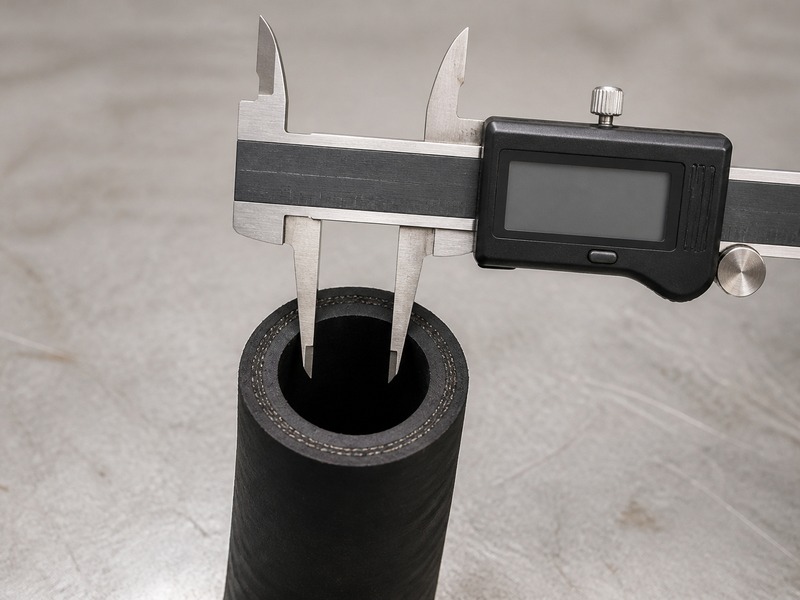
Figure 2. Measure the bore of the cut end with a caliper; hose size always refers to the inner diameter.
4. Working Pressure, Burst Pressure, and Temperature: What Ratings Matter?
Three numbers appear on every hose datasheet, and each has a different job:
- Working pressure is the continuous operating rating — the number you select against.
- Burst pressure is the destruction-test value, typically about 4 times the working pressure on this class of hose.
- Temperature range defines the fluid and ambient temperatures the hose survives in service.
What working pressure rating does a transfer pump hose need? Most 12 V and AC fuel and oil transfer pumps discharge at well under 100 PSI in normal service, so a hose rated 150 PSI (10 bar) working pressure leaves a large margin; the 300 PSI (20 bar) class covers nearly every pump-based line, including 1/2-inch NBR constructions sold for gasoline service. If your oil transfer pump hose is rated lower than the pump relief setting, upgrade the hose rather than relying on the valve.
Why does burst pressure matter on a transfer line? Because every pump start and stop sends a pressure surge through the hose that can briefly exceed the steady reading, and cold, thick oil raises pressure on long runs. A 150 PSI-rated hose with a 4:1 safety factor is built to burst near 600 PSI, which absorbs those transients. Our oil hose working pressure vs burst pressure guide explains the rating difference and the safety-factor logic in detail.
What temperature range does a discharge hose survive? A standard NBR oil and fuel hose operates from about -40°C to +100°C (-40°F to 212°F), covering outdoor winter transfer and warm diesel. For hotter fluid — hot lube oil circulation, for example — confirm the continuous fluid temperature against the datasheet and ask for a heat-stabilized construction instead of derating a standard hose.
Cold-weather handling: at -40°C a standard NBR hose stays flexible but stiffens noticeably, so follow four steps for a winter transfer: (1) keep stored reels indoors or above freezing before the job; (2) uncoil the hose fully and let it warm for several minutes before starting flow; (3) start the pump and ramp up slowly, keeping cold oil velocity below the 10 ft/s planning value until the oil warms — thick cold oil raises discharge pressure; (4) after the job, drain the hose completely so residual oil does not thicken and clog it in storage.
One more rating is worth naming: vacuum. A discharge-only hose is for the outlet (pressure) side of the pump only. For the inlet (suction) side — or for one hose that must both pull and push — choose a full-vacuum suction-and-discharge construction rated for about 0.9 bar (≈13 PSI below atmospheric).
5. Tube Material: What Makes a Pump Hose Oil- and Fuel-Safe?
Oil resistance is a measured property, not a phrase printed on a cover. The standard test, ASTM D471, immerses rubber samples in reference oils and records the volume change; a compound that swells less resists oil better. In our factory test records, the NBR compounds used in oil and fuel hoses show roughly +5% to +20% volume change in IRM 903 (the reference oil specified in ASTM D471 for petroleum-product testing) after 70 hours at 100°C, while EPDM shows +50% to +150% — which is why EPDM water hose fails quickly on diesel or oil lines.
For pump discharge duty, the tube should be conductive nitrile (NBR). NBR resists mineral oil, diesel, kerosene, and gasoline; the conductive formulation drains the static charge that flowing fuel generates. Chloroprene (CR) is the usual cover compound because it survives oil splash, weather, and abrasion.
Three quick checks before you buy:
1. Ask for the tube compound in writing — NBR is the standard answer for petroleum products; EPDM on an oil line is a red flag. 2. Check the marking on the cover — oil suction and discharge hose is usually marked to EN 1765, DIN 20023, or ISO 1823, while light fuel hose is commonly built to the SAE J30 family; the marking tells you what the hose was tested against. 3. Ask for the immersion-test (volume change) number in the datasheet rather than accepting the word “oil resistant” — a number can be checked, a phrase cannot.
The material picture across all oil hose types — NBR versus neoprene versus FKM, and how each behaves in immersion testing — is covered in our oil resistant hose guide.
6. Which Fittings Fit an Oil Transfer Pump Discharge Hose? NPT, Barb, Nozzle, Camlock, and Spline
The hose is only as good as its ends. Match the fitting family to the pump port, and use the same thread family at both ends of the line — a mixed NPT/BSP pair leaks immediately.
The most common configurations on pump discharge lines are:
| Fitting type | Typical pump match | Best for / notes |
|---|---|---|
| NPT threads | 3/4-inch NPT male or female outlets on North American transfer pumps | Semi-permanent hookups and ready-made assemblies — the default when the pump outlet is threaded |
| Hose barb + clamps | Field-installed ends on low-pressure lines | Quick replacement: slide the barb in, fit two clamps over the reinforcement, torque evenly |
| Automatic shut-off nozzle | Vehicle and equipment tank fills | Stops the fill automatically so the operator does not have to watch the tank |
| Camlock couplings | Setups that switch between drums or tanks | Tool-free connect and disconnect for frequent changes |
| Spline friction end | Battery-powered pumps with a splined outlet | Needs the matching friction-fit end for that brand and spline size — see the spline FAQ below before ordering |
When you buy an oil transfer pump hose as a complete assembly, confirm two details: that the crimped or clamped ends were applied to the manufacturer’s specification (a loose swage weeps under pressure, an overtight one crushes the tube), and that the end fittings clear the pump body when the hose is connected. Thread family guidance for pipe connections appears in our NPT vs BSP thread guide.
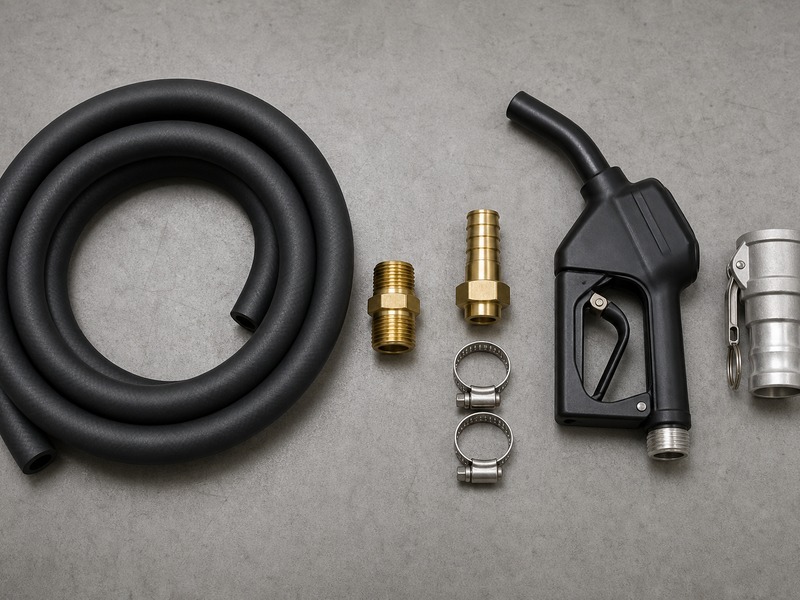
Figure 3. NPT threads, barb and clamp, nozzle, and camlock cover nearly every transfer pump connection.
7. What Length Discharge Hose Do You Need? Bend Radius and Routing Rules
Ready-made transfer pump hoses are sold in set lengths — the 20 ft fuel transfer hose covers most pump-to-tank runs, while 12 ft and 14 ft suit tight bays and short fills. To choose the right length, measure the straight-line distance from the pump outlet to the tank opening, add 10% for routing bends and fitting allowance, and order the next standard length up. A hose that is exactly tight is a hose already under stress.
Respect the minimum bend radius printed on the cover. Bending tighter than that rating kinks the reinforcement, restricts flow, and starts a fatigue crack at the bend point. Two routing rules prevent most damage:
- Keep the hose clear of sharp edges, hot exhaust surfaces, and vehicle traffic.
- Support long horizontal runs so the hose does not sag and chafe; on hose reels, leave enough hose to keep the bend at the reel above the minimum radius.
For workshop setups where the pump is fixed and the hose is pulled out for each job, an oil transfer hose reel with a swivel keeps the line organized and out of the way of spills. Storage matters as much as routing: drain the hose after use, cap the ends, and keep it out of direct sunlight — UV is the main aging killer of rubber covers. The sizing and length rules in our oil transfer hose selection guide apply to larger bores and bulk transfer lines as well.
8. How Long Does an Oil Transfer Pump Hose Last?
A well-maintained oil discharge hose on light transfer duty typically lasts about five years; heavy daily use, hot fluid, or constant UV exposure shortens that to two to three years. Age alone is not the deciding factor — condition is. Inspect the hose monthly in regular service and before every use in daily service, and retire it when any of these signs appear:
- Cracks, hardening, or swelling on the cover, or oil weeping through the rubber.
- Soft or bulging spots that indicate the reinforcement has failed.
- Kinks, crushing, or cuts deeper than the cover.
- A continuity check that fails — the ground wire is broken or corroded at a fitting.
- Fittings that are loose, corroded, or visibly damaged at the crimp.
Replace, do not repair. A pressure line carries burst and fluid-injection risk after patching; the replacement cost of a short hose is small next to the cost of a diesel spill or an injury. Replace the hose and the clamps together, and record the date on the new assembly so the next inspection has a reference. When a hose reaches five years or fails an inspection, order the replacement from the oil hose product range with the same fittings, or ask for a quote on a made-to-length assembly.
9. Static Safety: Why a Grounded Hose Matters on Fuel Duty
Flowing petroleum generates static charge, and low-conductivity fuels such as diesel and kerosene hold that charge instead of draining it. Every transfer is a controlled static event: the pump, the hose, and the receiving tank must be bonded and grounded so the charge drains safely instead of sparking near fuel vapor.
That is why a proper discharge hose has a conductive NBR tube and an internal ground wire connecting the end fittings, and why a grounded oil transfer pump hose with an intact continuity wire is the minimum standard for fuel duty. The hose is one link in a chain that also includes the pump’s own grounding:
1. Bond the receiving tank and the pump (or the vehicle chassis) together before connecting anything. 2. Verify the hose continuity with a multimeter between the two end fittings — the reading should be near zero ohms. 3. Keep flow moderate; high velocity multiplies static generation. 4. Lift the nozzle clear of the tank opening and cap the hose as soon as a fill finishes.
The multimeter continuity check verifies the hose link only — it does not replace bonding the pump and the receiving tank, which must be done separately before every transfer.
In our field checks, a failed continuity reading almost always traces back to a crushed or corroded wire at the fitting, not to the tube itself — which is why the multimeter check belongs in every monthly inspection.
10. How Much Does an Oil Transfer Pump Hose Cost?
Five variables move the price, which is why a single per-meter figure only means something for one specific specification:
1. Bore — a 3/4-inch fuel transfer hose quotes higher per meter than a 1/2-inch fuel hose at the same order quantity. 2. Construction — a ready-made 20 ft assembly with NPT fittings and a nozzle costs several times the raw hose, because fittings and assembly labor are included. 3. End fittings — nozzle and camlock ends add more than plain NPT or barb. 4. Order size — per-meter price falls as order quantity and minimum order size rise. 5. Lead time and branding — OEM printing and short lead times carry a premium.
Rubber prices move with oil prices, so treat any benchmark as a starting point and ask for today’s factory price for your specification.
Wherever you buy, apply the same four supplier checks:
1. Ask for the datasheet first — tube compound, working pressure, temperature range, and the standard marking (EN 1765, DIN 20023, ISO 1823, or SAE J30 family). 2. Request the test report — proof testing and burst testing per batch; a marking without a report is just paint. 3. Confirm commercial terms — minimum order quantity, lead time, warranty, and whether samples ship with test data. 4. Check the continuity — measure the ground path on the sample before you order in volume.
Factory-direct manufacturers typically undercut distributor pricing on identical standard constructions because they skip the middle layers. HENGHUA supplies oil and fuel transfer hoses from 3/4-inch to larger bores, in custom lengths with NPT, barb, camlock, or nozzle ends, OEM branding, and test reports with every bulk order. See the oil hose product range or send your size list for a same-day quote.

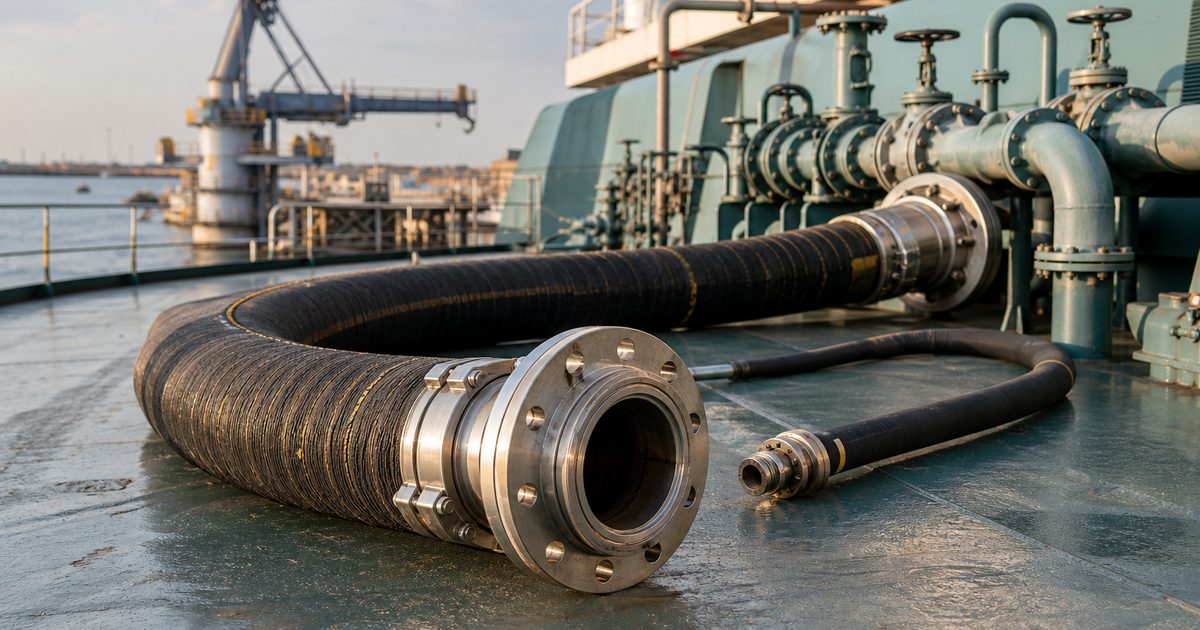
Figure 4. A factory-made discharge hose assembly ships proof-tested, with the compound and rating printed on the cover.
Transfer Pump Hose FAQ
My pump is rated 30 gpm — is a 3/4-inch hose too small?
Yes — at 30 gpm a 3/4-inch line runs at roughly 22 ft/s, above the 15 ft/s practical ceiling for discharge lines, which raises pressure drop and heats the oil. Use a 1-inch hose: it carries 30 gpm at about 12 ft/s (Q = 2.448 × bore² × velocity), inside the recommended 10–15 ft/s range. Choose the bore from the flow table, not from the pump port.
Can I use a water hose or air hose for diesel or oil?
No. Water and air hose tubes are usually EPDM, PVC, or natural rubber, which swell and soften in petroleum products until the reinforcement wets out and the hose fails. Use a hose with a conductive nitrile (NBR) tube marked for oil or fuel service — and for fuel duty, confirm the assembly carries a static ground path (conductive tube plus ground wire), because a non-conductive rubber hose still lets static charge build up on diesel or gasoline transfer.
Is a fuel transfer hose safe for diesel and motor oil?
A fuel-rated hose passes stricter immersion tests than an oil-only hose and handles gasoline, diesel, kerosene, and motor oil. The reverse is not true — an oil-only hose is not safe on gasoline of any blend. When in doubt, match the marking to the fluid; ethanol-blend limits (E10/E15) are covered in the ethanol question below.
Can an oil transfer pump hose handle ethanol-blended gasoline?
A hose marked to the SAE J30 family for gasoline service is compounded for E10, the common North American pump blend. For E15 or higher ethanol content, confirm the maker’s ethanol compatibility statement before use — not every fuel hose is rated above E10. An oil-only (non-fuel-rated) hose is not ethanol-safe at any blend.
Does the discharge hose really need a ground wire?
Yes, on any fuel duty. Flowing fuel generates static charge, and the conductive tube plus internal ground wire drain it to ground through the bonded system. Verify continuity between the end fittings with a multimeter at every inspection.
My battery-powered transfer pump has a splined outlet — what hose end do I need?
A splined outlet accepts only the matching friction-fit hose end for that pump brand and spline size — a standard 3/4-inch NPT hose will not thread onto it. Check the pump manual for the spline size and order the maker’s hose end, or fit a spline-to-NPT adapter if the pump supports one and use a regular 3/4-inch NPT discharge hose. Outlet types vary by brand and generation, so confirm the outlet on your specific model before ordering.
How often should I inspect a transfer pump hose?
Monthly in regular service, before every use in daily service. Look for cracks, hardening, swelling, oil weeping through the cover, kinks, and loose fittings, and run the continuity check each time.
Should I use rigid pipe or flexible hose on the pump discharge?
For portable transfer pumps, flexible hose is the practical choice: it absorbs pump vibration, survives being dragged and coiled, and connects without pipe threading. Rigid pipe suits only permanently installed lines where nothing moves and the run is straight. Whatever you choose, the rating rule is the same — the line must be rated for the fluid and for at least the pump’s maximum discharge pressure. Do not run an oil-rated rubber hose where a fixed metal line is required by local fuel-storage rules.
What comes in a transfer pump hose kit, and is a kit better than buying separately?
A typical kit bundles the suction hose, the discharge hose, clamps, and often a strainer or nozzle, matched to one pump model. Kits remove the guesswork of matching ends and are a good first buy. Buying separately makes sense when you need a custom length, a different fitting, or a higher pressure rating than the kit provides — and it is usually cheaper per meter at factory-direct prices. Either way, confirm both hoses are rated for the fluid, not just for water.
Can I repair a leaking discharge hose?
No — and the risk is worse than a leak. A pinhole or weeper on a pressure line can fail as a fluid-injection injury: the jet through a pinhole can penetrate skin and needs immediate medical treatment, so tape, clamps, and patch kits are never repairs on transfer duty. Order a replacement with the same bore, working pressure, and end fittings, and follow the swap and record-the-date steps in Section 8.
How do I set up an oil transfer pump and its discharge hose for the first time?
Set up in seven steps: (1) confirm the discharge hose tube is nitrile (NBR) and rated for the fluid you are moving; (2) bond the receiving tank and the pump (or the vehicle chassis) together before connecting anything; (3) fit the suction line with a strainer to the pump inlet; (4) connect the discharge hose to the pump outlet, matching the thread family (NPT to NPT, BSP to BSP — never mix); (5) verify hose continuity between the two end fittings with a multimeter (near zero ohms); (6) open the tank vent and the pump outlet valve, then start the pump and keep the flow moderate; (7) after the job, shut off the pump, drain the hose, cap the ends, and store it out of direct sunlight.
How do I clean a discharge hose on an oil transfer pump before storing it?
Drain the hose completely, then purge it with low-pressure air until no oil drips from either end. Wipe the fittings and check the cover for cracks, soft spots, or oil weeping. Coil the hose loosely — no kinks — and store it indoors, away from direct sunlight, heat sources, and ozone-generating equipment such as electric motors. Write the service date on the hose so the next inspection has a reference.
The Bottom Line
Choosing an oil transfer pump hose comes down to four checks: bore sized to flow, a working pressure rating above the pump’s output (150 PSI covers nearly all light pumps), a conductive NBR tube with a ground path, and end fittings that match the pump and the tank. Confirm the printed standard and ask for the immersion and proof test data, and the hose will outlast the pump it serves.
For a factory-direct quote on discharge hoses for your oil transfer pumps — raw hose, cut lengths, or complete assemblies with NPT, barb, camlock, or nozzle ends — send your pump model, flow rate, and line length to HENGHUA. Our engineers confirm the correct size and construction within one business day, and every sample ships with its test report. Quotes on standard constructions go out the same day.
What to send us for a fast, accurate quote — (1) pump model or a photo of the pump outlet; (2) rated flow in gpm, usually printed on the pump label; (3) hose length and end fittings you need (NPT, barb, camlock, or nozzle). No drawing needed.
Reviewed by the HENGHUA Engineering Team — rubber hose manufacturer for oil transfer, fuel, hydraulic, and industrial service. *Last updated: September 2026.*
About HENGHUA
HENGHUA is a professional manufacturer of rubber hoses for oil transfer, fuel, hydraulic, and industrial service, supplying distributors, workshops, and OEM brands worldwide. Every HENGHUA oil and fuel hose is built with an NBR or CR compound verified by ASTM D471 immersion testing, proof-tested at 1.5 times working pressure before shipment, and burst-tested per production batch — the compound and ratings printed on every cover are measured values, not marketing numbers.
We manufacture oil suction and discharge hose to EN 1765 and DIN 20023 in the 10 and 20 bar classes, fuel and oil transfer hose from 3/4-inch bore up, and complete discharge hose assemblies with NPT, barb, camlock, or nozzle ends, in custom lengths, colors, and OEM/ODM branding. Because we control everything from compound mixing to final pressure testing, we deliver documented quality at factory-direct pricing, with short lead times, batch traceability, and a clear warranty on every reel.
Contact our team for a quote and samples — we will send the test report with the sample. Email henghua@hhgpipe.com or use the contact page.


 English
  Spanish
  Portuguese
  French
  German