

The STEAM 250 Series is a high-pressure rubber steam hose family rated at 250 psi (17 bar) working pressure, which in saturated steam corresponds to about 406 °F, against a 2,500 psi (170 bar) burst figure. It covers bores from 3/8 in to 4 in in one construction, with an EPDM tube, high-tensile steel wire reinforcement and an evenly pin-pricked cover. This page sets out the published steam hose specifications size by size, then the application notes that decide which bore and which end connection a duty needs.
The published steam hose specifications are the part buyers come back for, so they come first. The application notes follow, covering bore selection by duty, the cover and marking options, the listed steam hose sizes against standard lengths, sizing for pressure drop, and the cases that fall outside the family.
About a 15-minute read at 250 words per minute; the size matrix is built for a quick scan.
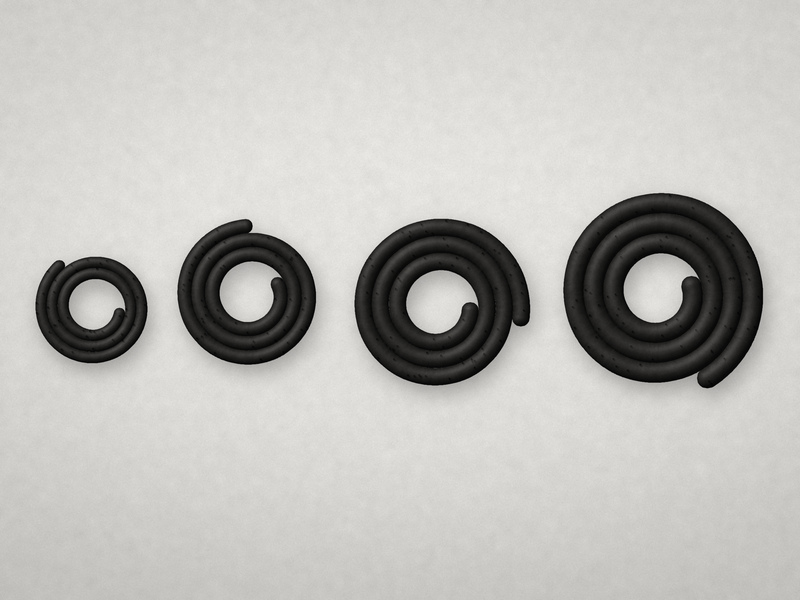
Figure 1. One construction covers the whole bore range. Outside diameter and coil size rise with the bore, while the pressure rating stays the same.
What Does the STEAM 250 Series Cover?
The STEAM 250 Series answers one requirement: continuous saturated steam duty up to 250 psi at the temperature that pressure carries. One construction is built across the whole bore range, so a plant can standardize on a single product for utility stations, process connections and large-bore transfer lines.
The published working pressure is constant across the range. Outside diameter, bend radius and standard length are not, because they follow from the bore and from what the hose has to resist.
What the Series Name Tells You and What It Does Not
The 250 in the series name is the working pressure in psi, and it is the same figure that appears on the cover marking. It is not a temperature, and it is not a burst figure. Because the working pressure is paired with a temperature, the steam hose specifications for this family are read as a pressure and a temperature together.
The name also says nothing about the end connection. A series specification covers the hose. The assembly that goes into service adds a coupling, a clamp or a ferrule, and those are chosen separately.
What Is Fixed Across the Range and What Changes
Four properties stay the same from the smallest bore to the largest. The tube compound is the same EPDM formulation, the reinforcement is the same high-tensile steel wire, the cover is perforated to the same rule, and the pressure rating is identical.
Table 1. What stays constant across the series bore range, and what changes.
| Property | Behavior across the range | Why it matters |
|---|---|---|
| Tube compound | Constant EPDM formulation | One material answer for every duty in the family |
| Reinforcement type | Constant high-tensile steel wire | Same pressure capability and burst ratio at every bore |
| Betriebsdruck | Constant at 250 psi (17 bar) | Selection depends on bore and length, not on pressure |
| Außendurchmesser | Rises with bore | Sets clearance, clamp size and support spacing |
| Mindestbiegeradius | Rises with bore | Sets how tightly the run can be routed |
| Standard length | Two tiers: 100 m / 50 m to 1 in, then 40 m / 20 m above | Keeps a filled hose to a weight a crew can handle |
STEAM 250 Series Size Matrix
The table below is the published specification for the family, given bore by bore. It is the reference to quote against, and every figure in it belongs to the same construction. Burst pressure is the 10:1 multiple of working pressure throughout the matrix.
Table 2. Steam hose specifications by nominal bore: outside diameter, ratings, bend radius and standard length.
| Nominal bore | Außendurchmesser | Betriebsdruck | Burst pressure | Mindestbiegeradius | Standard length |
|---|---|---|---|---|---|
| 3/8 in (10 mm) | 21 mm | 17 bar (250 psi) | 170 bar (2,500 psi) | 50 mm | 100 m / 50 m |
| 1/2 in (12 mm) | 25 mm | 17 bar (250 psi) | 170 bar (2,500 psi) | 60 mm | 100 m / 50 m |
| 5/8 in (16 mm) | 28 mm | 17 bar (250 psi) | 170 bar (2,500 psi) | 70 mm | 100 m / 50 m |
| 3/4 in (19 mm) | 32 mm | 17 bar (250 psi) | 170 bar (2,500 psi) | 80 mm | 100 m / 50 m |
| 1 in (25 mm) | 39 mm | 17 bar (250 psi) | 170 bar (2,500 psi) | 110 mm | 100 m / 50 m |
| 1-1/4 in (32 mm) | 46 mm | 17 bar (250 psi) | 170 bar (2,500 psi) | 150 mm | 40 m / 20 m |
| 1-1/2 in (38 mm) | 54 mm | 17 bar (250 psi) | 170 bar (2,500 psi) | 180 mm | 40 m / 20 m |
| 2 in (51 mm) | 67 mm | 17 bar (250 psi) | 170 bar (2,500 psi) | 245 mm | 40 m / 20 m |
| 2-1/2 in (64 mm) | 83 mm | 17 bar (250 psi) | 170 bar (2,500 psi) | 300 mm | 40 m / 20 m |
| 3 in (76 mm) | 95 mm | 17 bar (250 psi) | 170 bar (2,500 psi) | 400 mm | 40 m / 20 m |
| 3-1/2 in (89 mm) | 110 mm | 17 bar (250 psi) | 170 bar (2,500 psi) | 500 mm | 40 m / 20 m |
| 4 in (102 mm) | 124 mm | 17 bar (250 psi) | 170 bar (2,500 psi) | 600 mm | 40 m / 20 m |
Outside diameters are rounded to the nearest millimeter, and wall thickness is not derived by subtracting the nominal bore from them.
Table 3. Which column to read for the input you already have.
| Input you have | Column to read |
|---|---|
| Pressure and steam condition | Betriebsdruck |
| Flow and pressure drop | Nominal bore |
| Space at the bend | Mindestbiegeradius |
| Route length and crew size | Standard length |
| Clearance and supports | Außendurchmesser |
Why the Ratings Do Not Change With Bore
Every row carries the same pressure rating, which is unusual in industrial hose and worth explaining. In a family with one construction, the wall is set by the largest bore. A smaller bore carries that specification over a smaller internal area, so its hoop stress at a given pressure is lower rather than higher. The limiting component is the wall.
The practical consequence is convenient. A plant does not need a different product for a 1/2 in lance hose and a 3 in transfer hose. It needs the same product in two sizes, with the same rating and the same tube compound.
Why Bend Radius Grows Faster Than the Bore
Minimum bend radius does not scale in proportion to bore. It climbs from 50 mm at 3/8 in to 600 mm at 4 in, a twelve-fold increase for a bore that grows roughly ten-fold, because the wire reinforcement makes the larger sizes stiffer as well as wider.
Routing follows from that. On a small bore the hose can be coiled at the tool and handled freely. On a large bore the run needs planned bends, and bending past the published figure loads the lining and the wire at one point.

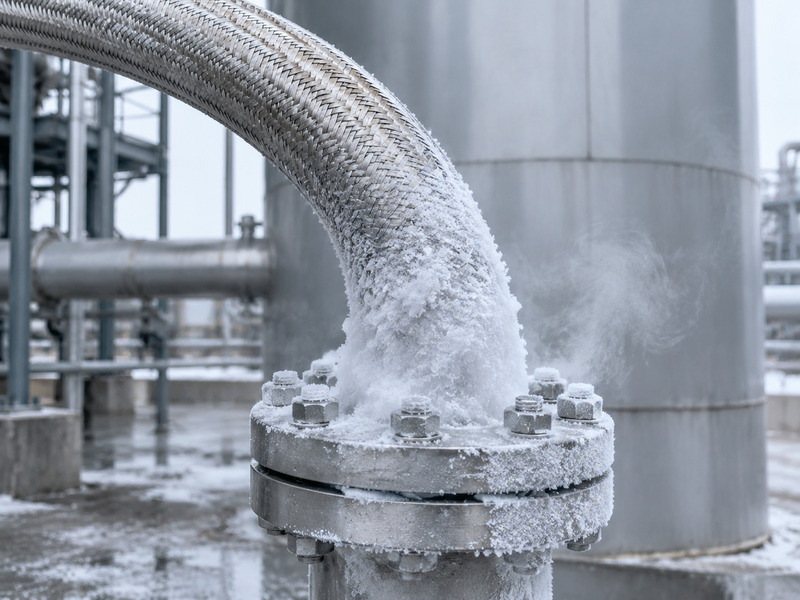
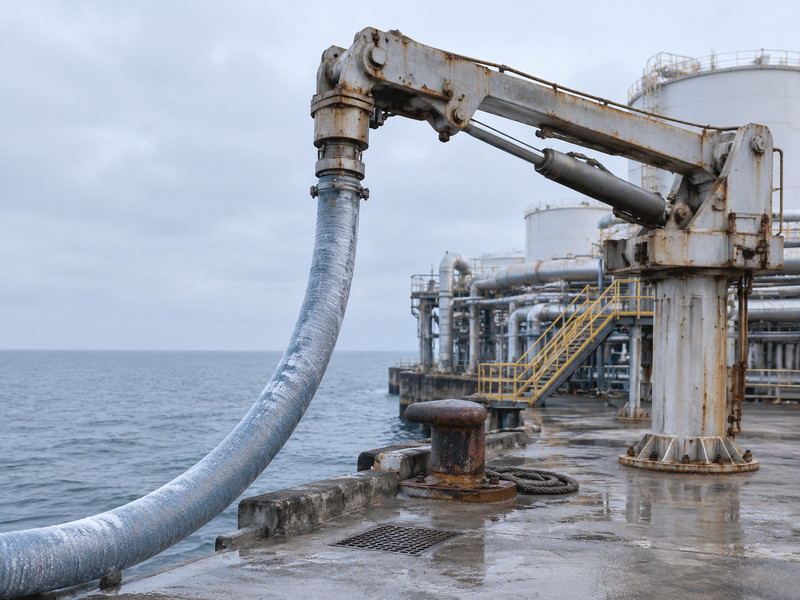
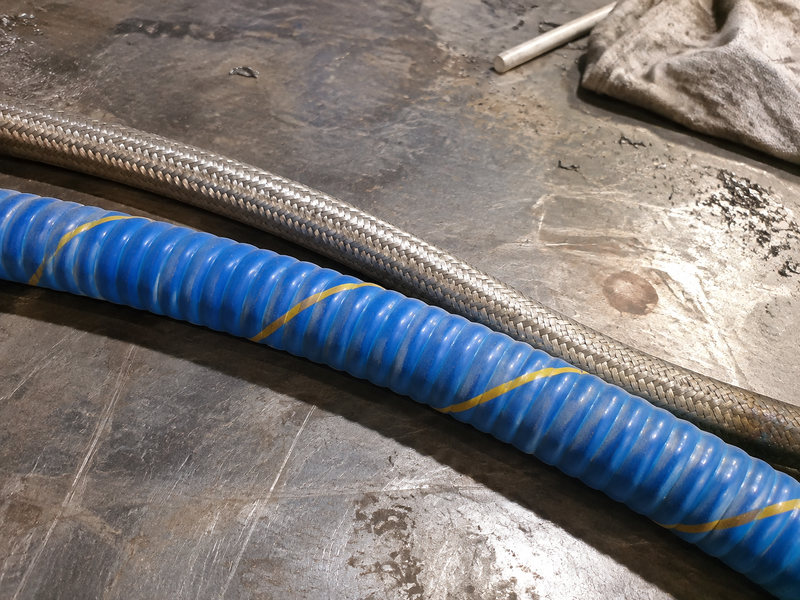
Figure 2. A bend formed at the published radius, beside a straight section of the same hose. The radius belongs in the routing plan, before the hose is installed.
STEAM 250 Series Application Notes by Duty
The steam hose sizes in the matrix suit different parts of a plant. Matching the bore to the duty keeps pressure drop, weight and handling effort inside sensible limits, and it also decides how the run is supported. A maintenance replacement usually needs one bore and one length. A new-build project needs the bend radius and the support spacing before the pipe route is fixed.
Table 4. Application notes by bore band for the series.
| Bore band | Typical duty | What to watch |
|---|---|---|
| 3/8 in to 1/2 in | Steam lances, cleaning guns, small cure blankets | Handling weight and tight bends at the tool |
| 5/8 in to 1 in | Utility stations, hose reels, longer lance runs | Reel diameter against the published bend radius |
| 1-1/4 in to 2 in | Process connections, tank and vessel heating | Condensate pockets at low points in the run |
| 2-1/2 in to 4 in | Large-bore transfer and fixed connections | Support spacing and the static load on the ends |
Choosing Bore for Flow Rather Than for Habit
Bore is chosen from the installation, not from the size of the pipe it connects to. Three inputs decide it: the flow rate and allowable pressure drop, the condensate volume the line has to pass, and the operating pressure available at the point of use.
The condensate figure is the one that gets missed. A saturated steam line always carries some moisture and always makes condensate while it warms through, so the bore has to pass a two-phase flow. A size that is only just adequate for dry steam is not adequate for a start-up slug.
Why Large Bores Ship in Shorter Lengths
Standard lengths step down at 1-1/4 in, from 100 m and 50 m to 40 m and 20 m. That is a practical decision rather than a manufacturing limit. A 4 in hose full of condensate is heavy, and handling a long length of it puts the crew and the end connections under avoidable load.
The same reasoning applies to installation. A large-bore run is supported on saddles so the end connections are not carrying the weight of the hose, and it falls toward a drain point.
STEAM 250 Series Cover, Marking and End Options
The cover is part of the specification rather than a finish, and the marking is how a hose is identified in service after the paperwork has gone missing.
Why the Cover Is Perforated
The cover on a steam hose vents gas that has crossed the tube wall. The perforation only works when it is uniform: holes applied evenly around the circumference and along the length give the gas a short path out at every point. A cover that vents in one area only leaves the rest of the length unprotected, and an unperforated cover is not a variant of this product.
Reading the Marking on the Cover
A compliant hose carries the information that lets a user verify it rather than assume it. The marking identifies the product, the bore and the pressure rating, and it carries a date code so the age of the hose can be established from manufacture rather than from installation.
Marking matters most at replacement. A hose whose marking cannot be read is treated as unspecified, which means it is withdrawn rather than re-used.

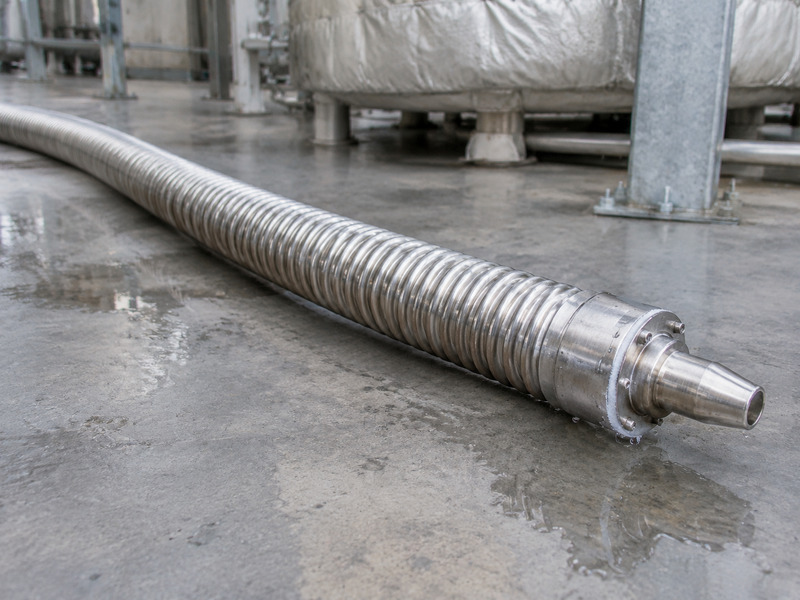
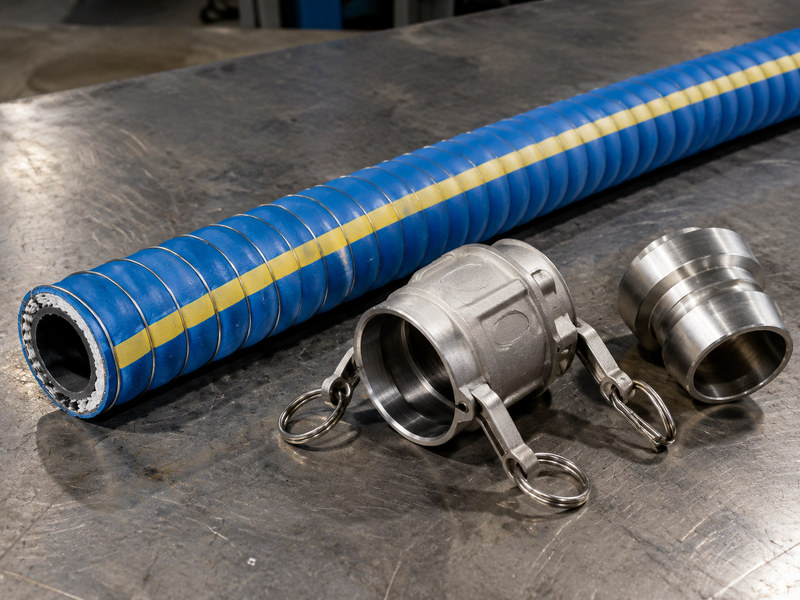
Figure 3. The perforations and the printed marking are both part of the specification, and both are visible on a finished length.
Bore Sizing and Pressure Drop in a Steam Line
Sizing is usually treated as a flow question, and on steam it is a two-phase question. Dry steam is only part of what the bore has to pass, because moisture travels with the steam and condensate forms whenever the line loses heat.
Pressure drop is the other half of the calculation. A bore that is too small costs pressure at the point of use, so the tool runs below its design condition. A bore that is too large costs weight and clamp load, and it holds more condensate at a low point.
Table 5. How bore choice trades pressure drop against handling weight in a steam run.
| Sizing choice | What improves | What gets worse |
|---|---|---|
| Smaller bore | Lower weight, tighter bends, easier handling | Higher pressure drop, less margin for a start-up slug |
| Larger bore | Lower pressure drop, more condensate capacity | More weight, wider bends, heavier end connection load |
| Longer run at fixed bore | Reach, with no change to the fittings | More pressure lost to friction along the hose |
| Shorter run at fixed bore | Better pressure at the point of use | Less reach, so more joints and more connections to check |
Reading the Pressure Available at the Tool
The pressure the tool sees is the header pressure less everything lost along the way, and the hose is usually the largest single contributor. That is why a short, larger bore line can outperform a long, smaller one even though both are rated at 250 psi.
The working pressure rating does not change the pressure drop calculation. The rating says what the hose can hold. The bore and the length decide what arrives at the far end.
Why the Run Should Drain Itself
A run that falls toward a drain point lets condensate leave instead of collecting in the lowest part of the hose. Where the layout permits it, the fall is built in rather than added afterwards.
A low point that holds water has two effects. It reduces the effective bore for steam during start-up, and it keeps the wall in contact with hot condensate between shifts. That standing contact is what a self-draining layout is designed to remove.
Support, Handling and Storage of the Hose
A steam hose run is supported rather than hung, and the reason is load. A large-bore hose filled with condensate is heavy, and hanging it from its own end connections puts that weight into the clamps or the ferrules continuously.
The rules that matter are short. Route the run with slack so thermal expansion does not load the ends. Keep a straight tangent behind each coupling so the highest-stress zone stays unbent. Support long runs on saddles at a spacing that keeps the filled hose off the floor between them, and never use the assembly to pull two fixed points together.
Handling matters over the life of the hose rather than on the day of installation. Dragging a hose across a rough floor abrades the cover, and lifting it by the couplings rather than by the body stresses the shank.
Table 6. Handling and storage points for the series, and the failure each one prevents.
| Practice | What to do | What it prevents |
|---|---|---|
| Supporting a run | Rest the hose on saddles instead of hanging it from the couplings | Continuous load on clamps and ferrules |
| Storing a coil | Coil to no tighter than the published bend radius and never hang it on a hook | A kink that damages the wire layer |
| Storing a location | Keep the store cool, dark, dry and off the floor | Ozone, heat and light aging the compound |
| After every use | Drain the hose and leave one end open while it is not in service | Corrosion of the wire and condensate damage in the wall |
Recording the Batch Date on Receipt
Age counts from the date of manufacture rather than the date of installation, so the batch date is recorded when the hose arrives rather than when it goes into service. Oldest stock is issued first, and a coil that has sat in a hot store for years is treated as unknown rather than new.
Tagging an Assembly After It Is Built
An assembly carries a tag with its installation date, its duty and its next scheduled inspection. Without a tag the assembly has no service history, which makes a planned replacement interval impossible to run and turns condition into the only trigger.
What the STEAM 250 Series Does Not Cover
A family specification is defined as much by its exclusions as by its range, and three of them come up in most enquiries.
Steam Conditions Above the Published Envelope
The rating is a point on the saturation curve, not a general temperature ceiling. ISO 6134:2024 Type 2 sets the wire-reinforced envelope at 18 bar (261 psi) and 210 °C (410 °F); a duty above that pairing belongs to a different product family.
The honest answer to a duty above that point is a different hose rather than a higher-rated version of this one. Rubber compound capability and the standard’s envelope are not the same thing, and a superheated duty should be reviewed as one from the start.
Quick-Release Couplings
Where a steam connection is clamped, the clamp has to be re-tightened as the rubber takes compression set, which is why the series specification never includes a quick-release coupling. The exclusion follows from that requirement rather than from a preference.
That exclusion applies to every bore in the range, including the small ones. A 1/2 in steam lance is still steam service.
Bending Tighter Than the Published Radius
The bend radius is listed for each bore because it is a limit. A hose installed below its published figure has a stress concentration at the tight point, and that point is where it will fail.
Where a layout cannot meet the figure, the answer is a different routing or a longer hose rather than a tighter bend.
STEAM 250 Series FAQs
What pressure and temperature does the series carry?
The published rating is 250 psi (17 bar in round figures) working pressure against a 2,500 psi (170 bar) burst figure. For the saturation lookup, 250 psi is 17.2 bar and corresponds to about 406 °F, so the temperature is set by the pressure rather than chosen separately. The family is intended for duties inside the high-pressure rubber envelope.
How many steam hose sizes are in the range?
Twelve nominal bores are published, from 3/8 in (10 mm) to 4 in (102 mm). Outside diameters run from 21 mm to 124 mm. Bend radii run from 50 mm to 600 mm. Standard lengths are 100 m and 50 m up to 1 in, and 40 m and 20 m from 1-1/4 in upward.
Does the pressure rating change with the bore?
No. Every bore in the family carries the same 250 psi (17 bar) working pressure and the same 2,500 psi (170 bar) burst figure. Because every size is built to the same pressure specification, and a smaller bore carries lower hoop stress at the same pressure, the rating is set by the wall rather than by the diameter.
Why is the bend radius so much larger on the big bores?
Because the steel wire reinforcement makes a large bore stiff as well as wide. The figure climbs from 50 mm at 3/8 in to 600 mm at 4 in, which is a faster increase than the bore itself. Planning the bends at the design stage is far cheaper than re-routing a run after installation.
Can the series be used for superheated steam?
Not above the ISO 6134:2024 Type 2 envelope, which tops out at 18 bar (261 psi) and 210 °C (410 °F). A superheated duty is a different condition from the saturated pairing the rating describes, and it should be specified as a separate duty with its own temperature and pressure data.
Are crimped end connections available for this family?
Assemblies can be supplied crimped or built with clamps and matching tails, and the choice belongs to the application rather than to the hose. What is fixed is that an assembly is rated by its lowest-rated component, the NAHAD assembly rule, and that quick-release couplings are excluded from steam duty.
What bore should I choose for a steam lance?
Most lance and cleaning work in this range uses 3/8 in or 1/2 in, because the hose is handled continuously and weight matters more than pressure drop. Where the run is longer and the flow higher, 5/8 in or 3/4 in is common. The deciding inputs are flow, allowable pressure drop and acceptable handling weight.
Why do the standard lengths get shorter as the bore increases?
Because a large-bore hose full of condensate is heavy. Shipping 40 m or 20 m in the bigger sizes keeps a filled length within what a crew can handle, and within what a support layout can carry without loading the end connections. Longer runs are made up from supported lengths.
About HENGHUA and Steam Hose Supply
HENGHUA manufactures steam hose, industrial hose and hydraulic hose for plants, distributors and equipment builders worldwide. The steam range uses an EPDM tube and a high-tensile steel wire reinforcement, with an evenly pin-pricked cover that vents along the whole length.
On the fittings side we supply the ground joint family and bolted safety clamps. Custom lengths, cover printing, private label and OEM work are available, and every length is proof-tested hydrostatically before dispatch. We quote the assembly rating rather than repeating the hose figure, because an assembly is only as good as its weakest part.
If you have the duty, send us the maximum pressure the system can deliver, the steam condition at the point of use, and the bore and length you need. We will confirm the product for the STEAM 250 Series, and we will say so when the duty belongs to another family instead. Please get a quote and free samples, or review the steam hose category and the EPDM steam hose 170 °C product page.
For how the rating on this family is read in service, the steam hose 250 psi guide works through the pressure and temperature pairing. The saturated steam hose guide covers the material and standard side, and the steam hose inspection checklist sets out the checks that keep an assembly inside its rating.
About the author: Written by the HENGHUA Engineering Team, hose application engineers and assembly specialists supporting hose selection, end connections and pressure testing for industrial, marine, food processing and mobile equipment customers. The steam limits here reflect our production and field service experience with both steam hose constructions, together with the pressure testing and batch traceability records held for every shipment.
 English
 Spanish
 Portuguese
 French
 German
 Arabic
 Russian
 Indonesian
 Japanese
 Korean