
Schlauchpressmaschinen
Schlauchpressmaschinen
A hose crimping machine supplier is only useful if the machine matches the hose you actually build. We supply eleven hydraulic hose crimping machines with bores from 6 mm to 12 inch and crimping forces from 1,600 kN to 5,400 kN, so the selection is made on hose construction and ferrule size rather than on the largest tonnage you can afford.
The range at a glance
| Model | Maximum opening | Working range | Crimping force | Built for |
|---|---|---|---|---|
| HH110 | 110 mm | 6–19 mm bore | 1,600 kN | Brake, fuel, gauge and small air-conditioning line |
| HH120 | 120 mm | 6–38 mm bore | 2,600 kN | Two-wire hydraulic hose to 1-1/2 inch |
| HH145F | 145 mm | 1/4–2 inch 4SP (2-1/2 inch 2SN) | 3,000 kN | Four-spiral hose |
| HH145 | 150 mm | 1/4–2 inch 6SP (2-1/2 inch 2SN) | 3,000 kN | Six-spiral hose |
| HH165 | 190 mm | 6–76 mm bore | 3,600 kN | 3 inch industrial hose |
| HH190 | 210 mm | 6–76 mm bore | 3,600 kN | 3 inch hose; 4 inch industrial hose with long ferrules |
| HH195 | 195 mm | 6–64 mm bore | 3,000 kN | 4 inch industrial tube |
| HH250-K | 60 mm | 6–38 mm bore | 260 t | Air-conditioning line and multi-elbow fittings, side opening |
| HH300 | 300 mm | 6–102 mm bore | 4,500 kN | 4 inch hydraulic hose |
| HH800 | 560 mm | 2–12 inch | 5,400 kN | Large diameter pipe |
| HH-J-170 | 230 mm | 125–175 mm sleeve diameter | 3,550 kN | Air spring, axial closure |
All eleven use the same control logic: buckle size, opening amount, error compensation and holding time are set on a 7-inch touch screen, and each machine stores 200 programs. The difference between them is structural, not cosmetic. One exception to the bore column: the HH-J-170 is an axial-closure machine for air springs, so its 125–175 mm figure is sleeve diameter, not hose bore.
Alle 11 Ergebnisse werden angezeigt
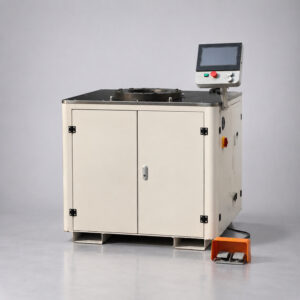


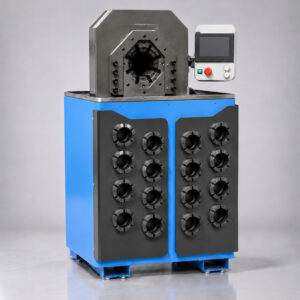


Three numbers that decide the machine
Buyers usually compare tonnage first when they shortlist a hose crimper. In practice three other numbers eliminate most of the range before force matters at all.
Opening. The maximum opening is the clear diameter of the head with the die set removed. A 4 inch ferrule with a heavy sleeve can need more opening than a 4 inch hose with a standard ferrule, which is why the HH190 at 210 mm and the HH195 at 195 mm both exist.
Bore range. The crimping range is quoted as hose bore, not as outside diameter. A 76 mm figure means a 3 inch bore, not a 3 inch outside diameter, and the same figure appears on both the HH165 and the HH190 because they share a bore envelope and differ in head size.
Spiral layer. Two-wire braid, four-spiral and six-spiral hose of the same bore need different crimping force and different die geometry. The HH120 covers two-wire to 1-1/2 inch; the moment a four-spiral construction enters the order, the machine becomes the HH145F, and six-spiral becomes the HH145.
Where the range stops
The boundaries are explicit, because a machine that is sold as universal ends up being wrong at both ends, and a hose crimping machine supplier who blurs them sells the wrong frame twice — once on the way in, once on the return.
The HH110 crimps 6–19 mm bore on standard dies. Four-spiral hose is not catalogued on that frame — it starts at the HH145F — and a 1/8 inch brake line below 6 mm is confirmed per ferrule drawing rather than assumed.
The HH120 covers two-wire hose to 38 mm bore. That is 1-1/2 inch, not 2 inch; a 2 inch two-wire assembly needs the HH145F or larger.
The HH800 is the only frame in the range that takes 12 inch pipe, and it is also the only one with a 560 mm opening, so it is specified for large diameter work rather than bought as a reserve capacity machine.
Where the work is industrial hose rather than hydraulic hose, the industrial hose crimping machine in this range is the HH165 or the HH190, both on a 76 mm bore envelope with 3,600 kN behind them. The difference between those two is head size, not force.
Dies, changeover and what is supplied
Each machine uses a segmented die set — eight segments on the standard frames. Die shape and inner diameter can be made to a ferrule drawing; standard dies are hardened in a vacuum furnace. On the frames with a quick-change die ring, changing size is a one-second operation, which is why the die rack sits on the front of the frame rather than in a cupboard.
A hose crimping machine supplier needs three things before a price means anything: the hose construction and bore, the ferrule part number or drawing, and the annual volume per size. Without the ferrule drawing the die set cannot be specified, and without volume the spare die configuration cannot be proposed.
Applications across the range
The same frame family covers brake and fuel line, power steering, air-conditioning, hydraulic hose assembly, industrial hose, large diameter pipe and air spring. What changes between applications is the die set and the ferrule, not the control system, which is why a workshop running several hose families usually ends up with two frames rather than five.
For buyers assembling hose as well as crimping it, the crimp ferrules and hose assemblies are specified on the same drawings as the dies, so the ferrule, the die and the machine are confirmed as one set.
Frequently asked questions
Which machine do I need for 4 inch hose? The HH300, with a 300 mm opening and a 6–102 mm bore range. The HH195 is the 4 inch industrial tube machine and is not interchangeable with it.
Can one hose crimper handle both two-wire and four-spiral hose? Mechanically the HH145F can, but the die geometry and force differ by construction, so the die set is specified per hose type. If both families run in volume, two dedicated frames are cheaper than one frame with two die sets.
Is the crimping range the hose bore or the outside diameter? Bore. A 76 mm range means 3 inch bore. Ferrule outside diameter decides whether the die fits the opening, and that is checked against the drawing.
What is the largest hose the range covers? The HH800 takes 2–12 inch and a 560 mm opening. Above that, pipe crimping is a different conversation.
Do you supply dies with the machine? Die sets are quoted with the machine against the ferrule drawing, because a universal die set does not exist for spiral hose. Send the ferrule part number with the enquiry.
How do I get a price? Send hose construction and bore, ferrule drawing or part number, and annual volume per size. A hose crimping machine supplier cannot publish one list price for this range, because the die set and the head size change with the ferrule; price and lead time are therefore quoted per configuration.
Choosing between eleven frames is easier once the ferrule drawing is on the table. Send the hose construction, the ferrule part number and the annual volume, and the shortlist comes back with the model, the die set and the spare configuration rather than a single model number. If you are comparing quotations from more than one hose crimping machine supplier, send each of them the same three inputs — a quote built on a different ferrule cannot be compared with one built on yours.
- Hydraulikschlauch2323 Produkte
- Hydraulikschlauch mit Stahldrahtspirale66 Produkte
- Hydraulikschlauch mit Stahldrahtgeflecht1010 Produkte
- Textilverstärkter Hydraulikschlauch33 Produkte
- Thermoplastischer Hydraulikschlauch33 Produkte
- Industrieschlauch7575 Produkte
- Luftschlauch99 Produkte
- Wasserschlauch1111 Produkte
- Ölschlauch1616 Produkte
- Chemikalienschlauch66 Produkte
- Verbundschlauch1616 Produkte
- Chemikalienbeständiger Verbundschlauch33 Produkte
- Verbundschlauch für den Schifffahrtsbereich55 Produkte
- Verbundschlauch für Erdölprodukte55 Produkte
- Hochtemperatur-Verbundschlauch11 Produkt
- PTFE-Verbundschlauch11 Produkt
- Kryogener Verbundschlauch11 Produkt
- Dampfschlauch33 Produkte
- Mehrzweckschlauch22 Produkte
- Schläuche für Lebensmittel und Getränke44 Produkte
- Betonschlauch44 Produkte
- Zementschlauch22 Produkte
- Schlauch für den Materialtransport1111 Produkte
- Baggerschlauch44 Produkte
- Hydraulikarmaturen166166 Produkte
- Wiederverwendbare Schlauchanschlüsse66 Produkte
- Schlauchanschlüsse ohne Überwurfmutter88 Produkte
- JIC-Hydraulikarmaturen1616 Produkte
- Metrische Hydraulikverschraubungen4141 Produkte
- NPT-Hydraulikverschraubungen66 Produkte
- BSP-Hydraulikverschraubungen2626 Produkte
- SAE-Hydraulikverschraubungen3030 Produkte
- Banjo-Hydraulikverschraubungen44 Produkte
- ORFS-Hydraulikverschraubungen1111 Produkte
- Hülse1111 Produkte
- Flanschverbindungen2626 Produkte
- Einteilige Armaturen2424 Produkte
- Hydraulikadapter149149 Produkte
- Industrielle Schlauchkupplungen4747 Produkte
- Camlock-Kupplungen1010 Produkte
- Camlock-Dichtungen und -Griffe22 Produkte
- Verbundschlaucharmaturen33 Produkte
- Europäische Kupplungen55 Produkte
- Klemmhülsen und Schlauchanschlüsse33 Produkte
- Feuerwehrschlauchkupplungen77 Produkte
- Schlauchschellen und Rückschlagventile33 Produkte
- Schnellkupplungen44 Produkte
- Armaturen für Tanks, Schüttgutbehälter und Spezialanwendungen1010 Produkte
- Schlauchpressmaschinen1111 Produkte
Send a Mail
henghua@hhgpipe.com
Make a Call
+15822925523
86-22-83859963
Mon - Sun: 09:00 am - 22:00 pm
Main Office
Tianjin, China
Hezhong Building, Youyi North Road
 English
 Spanish
 Portuguese
 French
 German
 Arabic
 Russian
 Indonesian
 Japanese
 Korean