
A composite hose vs ptfe hose choice is not a choice between good and better. Both use fluoropolymer where chemistry demands it, and both can carry the same solvent. The difference is where the PTFE sits: a composite build uses a thin PTFE film inside a multilayer wall with a wire helix, while a smooth-bore PTFE hose uses an extruded tube inside a braid.
That difference decides flexibility, permeation, pressure capability and price. This guide compares the two on the properties that show up in service, and gives the duty table we use when a terminal is choosing between them.
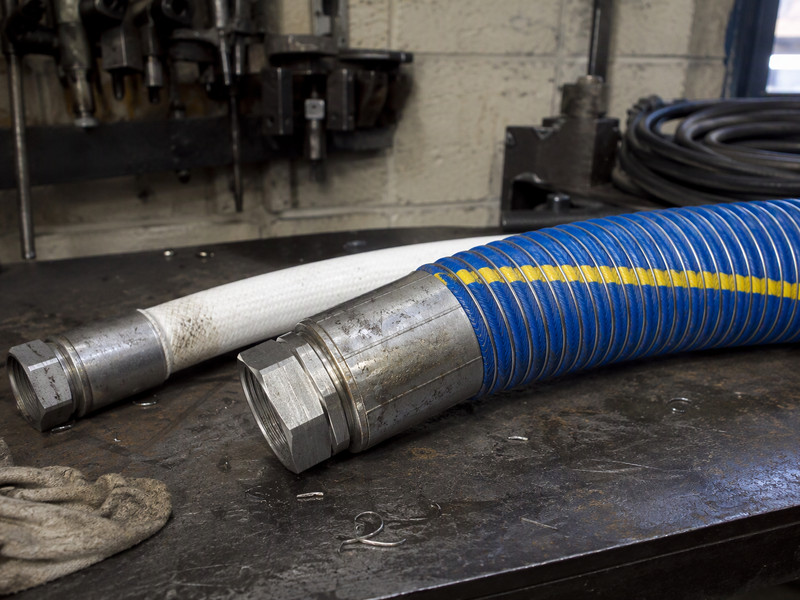
Figure 1. A white PTFE hose and a multilayer composite hose side by side on a bench. The two covers differ; the wetted surface is inside each one.
How Do the Two Constructions Differ?
A composite hose is built from plies: an inner thermoplastic film, fabric reinforcement, further film, and a steel helix inside and out, with a coated cover outside. The PTFE version simply uses a PTFE film for the innermost ply. The wall is supported at every point by the fabric and the helix.
A smooth-bore PTFE hose is an extruded PTFE tube, sometimes with a static-dissipative liner, covered by a stainless braid that carries the pressure. There is no helix, so the tube relies on its own stiffness and the braid to hold shape.
For a buyer weighing ptfe hose vs composite, the practical consequences run in both directions. The composite wall is lighter and more flexible at large bore, and it tolerates bending without kinking because the helix holds the bore open. The smooth-bore tube has a lower permeation path, a smoother surface and a higher pressure capability for its size, and it is stiffer.
What Does the Comparison Look Like Side by Side?
| Property | Composite with PTFE film | Smooth-bore PTFE with braid |
|---|---|---|
| Wall build | Film, fabric, helix, cover | Extruded tube plus braid |
| Flexibility at 2 inch and above | High | Low to moderate |
| Mindestbiegeradius | Tight, helix supported | Larger, tube limits |
| Permeation | Higher, thin film | Lower, thick wall |
| Pressure capability | Governed by helix and fabric | Governed by braid |
| Vacuum resistance | Good with internal helix | Depends on tube and braid |
| Gewicht pro Meter | Lower | Higher |
| Relative cost | Lower at equal bore | Higher |
Table 1. Composite hose vs ptfe hose on the properties that decide service life. Values are directional; confirm each against the datasheet.
The table explains a pattern buyers notice early: at small bore the two are close, and at large bore they diverge fast. A 1-inch smooth-bore PTFE hose is a practical component. A 4-inch one is stiff, heavy and expensive, which is why dock and tanker duty gravitates to composite builds.
Which One Handles More Chemicals?
Both, in principle, because both present PTFE to the product. The chemical question is answered by the fluoropolymer, not by the architecture.
Where they differ is the temperature the assembly can sustain and the concentration the adhesive can tolerate. In a composite build the film is bonded to fabric, and the bond is the weak link at high temperature or with certain solvents. In a smooth-bore build there is no bond in the wetted path.
That is why a solvent that attacks nothing in either liner can still delaminate a composite hose at 120 °C. The film survives; the layer behind it does not.
Scope: below 80 °C both constructions serve the same chemical duty. Above 80 °C the bond system is the deciding field, and the liner alone no longer answers the question.
Does Permeation Favour the Smooth-Bore Design?
Yes, generally. Permeation scales with wall thickness and with the number of material interfaces, and a thick extruded tube has more PTFE in the path than a thin film.
Permeation loss shows up as odour, as worker exposure and as product unaccounted for on a high-value stream. It matters less for aqueous chemicals, where both builds permeate little.
A composite hose ptfe liner can be made thicker, and some suppliers do, but the gain is limited by the fabric bond and by flexibility. A ptfe lined composite hose is still a bonded wall, which is why permeation data for the finished article beats a figure quoted for the film. If permeation is the governing requirement, the smooth-bore construction is the more direct answer.

Figure 2. Two cut ends side by side. One wall is a single tube; the other is a stack of film, fabric and wire.
Where Does Flexibility Decide the Job?
Flexibility decides handling, and handling decides whether a hose is used correctly.
A composite hose with a PTFE liner stays flexible at 4 inch and above, which is why it can be routed around a loading arm, coiled for storage and lifted by two people. The helix also resists kinking when the hose is pulled around a corner.
A smooth-bore PTFE hose at the same bore is stiffer, has a larger bend radius and holds a set. Operators compensate by adding length, which adds weight and creates a coil that traps product.
Where the run is fixed, short and supported, stiffness costs nothing, and the bend radius data tells you whether the route fits. Where the hose is handled every shift, it costs a lot.
How Do the Costs Compare?
Three cost lines matter, and only the first is visible in the quotation, which is why a landed cost view usually reverses the ranking.
The purchase price favours the composite build at large bore and is close at small bore. The smooth-bore hose carries more PTFE per metre and a braid that has to be manufactured around the tube.
The installation cost favours the composite build wherever the hose is handled, because weight and bend radius set how many people and what support is needed.
The replacement cost depends on the failure mode. A smooth-bore hose tends to fail at the braid or the end fitting after fatigue; a composite hose tends to fail at the film or the bond. Whichever arrives first in your duty decides the lifecycle figure.
Which Duty Suits Which Build?
| Duty | Sensible choice | Reason |
|---|---|---|
| Dock and tanker transfer, 4 inch and above | Composite with PTFE film | Flexibility and weight |
| Solvent transfer at high temperature | Smooth-bore PTFE | No bond in the wetted path |
| Steam and hot oil | Smooth-bore PTFE or metal | Temperature beyond film bonds |
| Food and pharma, low permeation needed | Smooth-bore PTFE | Smooth wall, low extractables |
| Multi-product terminal, mixed bores | Composite with PTFE film | One build across the range |
| Small bore chemical dosing | Either, on price and fittings | Difference is marginal |
Table 2. Duty shortlist. Both constructions present PTFE to the product; the choice is about the wall around it.
How Do You Specify Either One?
Write the chemistry, the temperature, the pressure and the handling. Then name the construction you want and why.
A specification that says only PTFE lined leaves the supplier free to offer either architecture, and the offer will follow the price. Adding the construction, the bore, the bend radius and the permeation requirement closes that gap.
Two further fields are worth adding, and one record is worth starting. The bond system is the first field, for composite builds above 80 °C. The end fitting attachment method is the second, because a braided hose and a helix-supported hose fail differently at the coupling. Keep the retirement cause on file: a retired hose with a written cause is a specification input, and a retired hose with no record is a purchase.
What About Static and Fire Performance?
Both constructions can be made conductive, and both can be supplied with a fire-resistant cover or a flame-retardant braid variant. Neither is inherently safer, and neither settles a composite hose vs ptfe hose argument on its own.
The difference is how the static path is built, and that detail is usually settled by the terminal electrical engineer rather than by purchasing. In a composite hose the helix can serve as the conductive path when it is bonded to the fittings. In a braided hose the braid usually does that job. Either way, the resistance measurement and the earthing arrangement belong in the specification.
Fire performance is a separate question, usually a project requirement rather than a product feature, and it rarely decides a composite hose vs ptfe hose choice on its own. A cover that passed a test in one configuration does not certify the assembly in another. Ask for the test the cover passed, not for the word flame-retardant.
What Should the Datasheet Tell You?
A datasheet for either construction should answer the same six questions. Our datasheet checklist sets them out field by field, and those answers are what make a composite hose vs ptfe hose decision possible without a sample in hand.
The wetted material and its grade, stated as a polymer rather than a trade name. The published pressure at the stated temperature, with the derating curve behind it. The vacuum rating, if the line can be drained by suction. The minimum bend radius at the bore you are buying. The permeation figure, or an honest statement that none is available. And the end fitting attachment, stated as swaged, crimped or reusable, because the repair policy follows from it.
For a ptfe hose vs composite comparison, one further field separates the offers: whether the pressure rating applies to the hose or to the assembly. A hose rated at 16 bar with fittings rated at 10 bar is a 10 bar assembly, and that single line explains most of the price gaps buyers see. It also explains why two apparently identical offers can differ by a third in price and neither is wrong.
If a datasheet cannot answer the bend radius question, treat the offer as incomplete. Bend radius is measurable, verifiable and decisive on any handled line, which makes it the cheapest test of whether a supplier knows the product.
How Does the Choice Change Over the Life of the Line?
The two constructions age differently, and that difference usually decides the second purchase rather than the first.
A composite hose ages from the inside out. The film thins at the point of maximum flex, the bond softens under heat, and the first symptom is often a bulge or a blister rather than a leak. Retirement is a visual decision, which is an advantage on a terminal where the hose is inspected daily.
A smooth-bore hose ages from the outside in. The braid frets, the tube takes a set at the bend, and the failure arrives as a pinhole or a braid rupture. Retirement is often reactive, because the damage is hidden under the braid.
That asymmetry matters for maintenance planning, and it is why the inspection programme should name the failure mode it is looking for. Where inspection is thorough, the composite build gives warning. Where the line is rarely looked at, the smooth-bore build’s hidden degradation is a risk that has to be managed with scheduled replacement rather than condition monitoring.
A ptfe lined composite hose also holds its shape better in storage, which matters for spares that sit on a shelf for a year between installations.
Which Questions Settle It Fastest?
Four questions close most composite hose vs ptfe hose debates in a single meeting. What is the bore, what is the temperature, is the line handled, and is permeation a complaint or a cost?
A 4 inch line that is handled daily and runs at 40 °C points to the composite build without further analysis. A 1 inch line at 140 °C points to the smooth-bore tube. The middle cases need the permeation answer.
A decision made on price alone usually lands on the composite build, and sometimes that is right. The risk is a high-temperature or low-permeation duty where the cheaper wall is the wrong wall, and the saving is spent twice inside a year.
One habit makes the choice easier next time, and it costs nothing to start. Record why the current hose was retired, with the failure mode and the hours. A composite hose ptfe liner retired for a bond failure tells you something the datasheet did not, and that record is worth more than any comparison table.
Häufig gestellte Fragen
Which is cheaper, a ptfe hose vs composite build at 4 inch?
The composite build, usually by a wide margin. A ptfe lined composite hose carries a thin film over a fabric and helix wall, while a smooth-bore tube at that bore needs a thick extrusion and a heavy braid.
Which is better for high pressure?
The smooth-bore PTFE hose, generally, because the braid carries the load directly. Composite builds achieve high ratings with heavier helix and more fabric, at a cost in weight.
Can a PTFE-lined composite hose handle vacuum?
Yes, where it has an internal helix. The helix resists collapse, and the vacuum rating should be stated on the datasheet rather than assumed.
Why does a smooth-bore hose cost more at large bore?
Because the tube is extruded in one piece and the braid is applied around it. Both scale badly with diameter, and the finished hose is heavy.
Does a composite hose ptfe liner permeate more?
Usually yes, because the film is thinner. Whether that matters depends on the product value and the ventilation around the line.
Can either hose be repaired?
End fittings can be replaced on reusable designs; the wall cannot be repaired. A damaged liner means a new hose in both cases.
Which one lasts longer?
Neither, universally. The duty decides: fatigue favours composite, high temperature favours smooth bore, and both fail at the coupling when the installation is wrong.
Über HENGHUA
HENGHUA builds composite hose with PTFE liners for chemical, dock and tanker duty, and can advise on where a smooth-bore PTFE hose is the better answer even though we do not make it. The PTFE build is available from small bore to large dock sizes, with flanged, camlock or API ends.
Send the product, temperature and handling, and we will tell you whether the composite architecture is the right one for the duty and where another construction wins.

 English
 Spanish
 Portuguese
 French
 German
 Arabic
 Russian
 Indonesian
 Japanese
 Korean