goodheart786@gmail.com

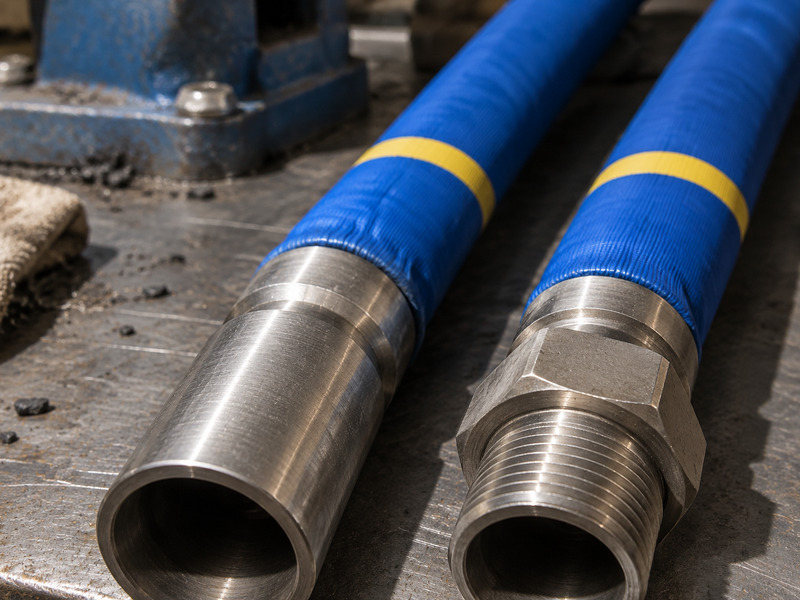
Two composite hose ends on a bench, one crimped ferrule and one reusable fitting

Composite Hose Assembly: Crimped vs Reusable vs Helical Shank Ends

A composite hose assembly carries its end load through the inner helix, not through the film. That single fact explains why the ends are the most engineered part of the product and why three different attachment methods exist. A crimped end is made once at the factory; a reusable end can be assembled in a

Composite Hose Assembly: Crimped vs Reusable vs Helical Shank Ends Weiterlesen »
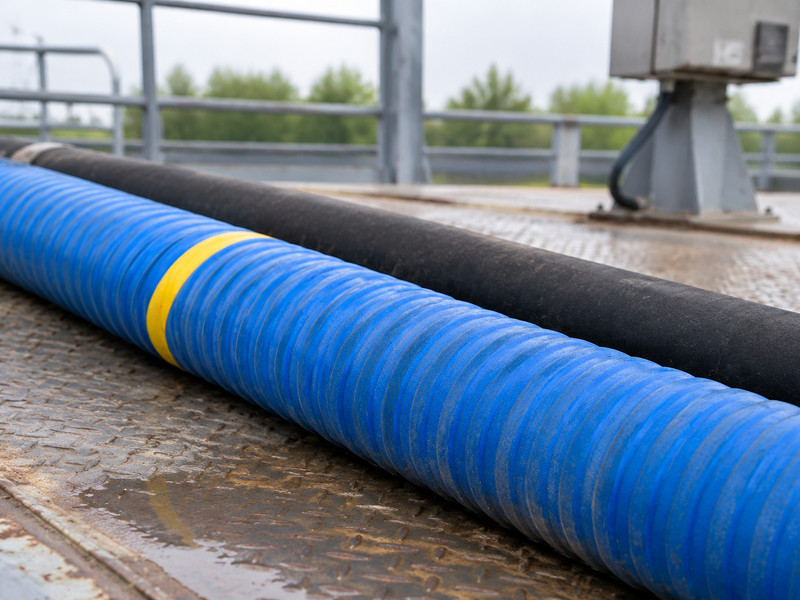
A blue composite hose and a black rubber hose of equal bore lying on an industrial weighbridge, display turned away

Thermoplastic vs Thermoset Hose: Why Composite Wins on Weight

A thermoplastic hose is built from polymers that soften when heated and can be reprocessed. A thermoset is built from polymers that have been cross-linked, usually by vulcanisation, so the wall becomes one irreversible network. Composite hose belongs to the first family, and that single fact explains most of its advantages and most of its

Thermoplastic vs Thermoset Hose: Why Composite Wins on Weight Weiterlesen »

A gloved hand pointing at a blister on the cover of a blue composite hose

Hose Permeation: Which Lining Polymer Leaks Least?

Hose permeation is the movement of a chemical through the wall rather than along it. Molecules absorb into the inner surface, diffuse through the polymer and desorb from the outside, driven by a concentration gradient. The rate depends on the polymer, the temperature, the chemical and the wall thickness, which is why a bare claim

Hose Permeation: Which Lining Polymer Leaks Least? Weiterlesen »

CPE lined rubber hose beside a multilayer composite hose on a workshop bench

Composite Hose vs CPE Hose: Which Lining Lasts Longer?

A cpe hose and a composite hose answer different questions. Chlorinated polyethylene is a rubber-family lining chosen for acids, oxidisers and abrasion, usually inside a vulcanised hose. A composite build uses a thermoplastic film inside a fabric and helix wall, chosen for solvent range, low weight and flexibility at large bore. Neither is better in

Composite Hose vs CPE Hose: Which Lining Lasts Longer? Weiterlesen »

Vapour recovery hose alongside a liquid loading hose on a tanker loading gantry

Vapour Recovery Hose vs Liquid Transfer Hose: What Changes

A vapour recovery hose carries displaced vapour, not product, and that single fact changes almost every part of the specification. The bore is smaller, the pressure is lower, the permeation requirement is stricter and the static control is non-negotiable. Copying the liquid line is the most common and most expensive mistake in vapour service. This

Vapour Recovery Hose vs Liquid Transfer Hose: What Changes Weiterlesen »

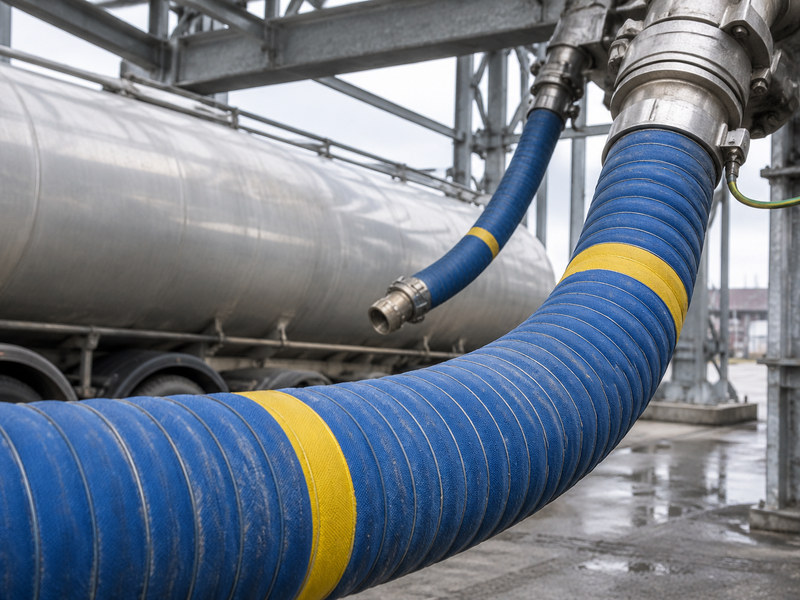
Composite hose coupled at a biodiesel loading gantry with a tanker in the background

Biodiesel Hose and Ethanol Hose for B100 and E100 Blends

A biodiesel hose has to do what a diesel hose does, plus survive a solvent. Fatty acid methyl esters and ethanol are not mineral hydrocarbons: they carry oxygen, they hold water, and they attack polymers that handle diesel without complaint. A hose approved for B7 is not automatically approved for B100, and the difference is

Biodiesel Hose and Ethanol Hose for B100 and E100 Blends Weiterlesen »

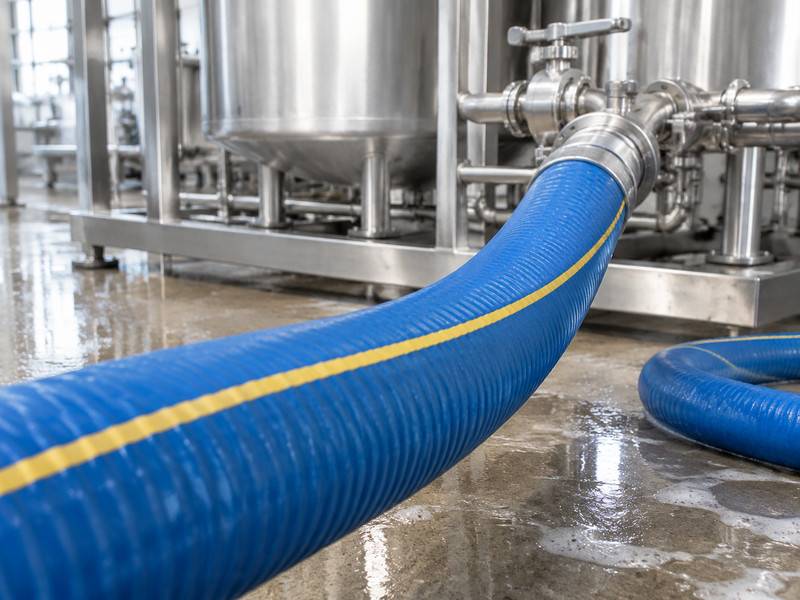
Composite hose coupled to a stainless fermenter outlet in a brewery cellar

Composite Hose for Brewery, Dairy and Beverage Transfer

A brewery hose, like a dairy hose or a beverage transfer hose, spends its life moving liquids that are sensitive to oxygen and temperature. The vessels it connects are cleaned on a fixed cycle, and that cycle shapes the specification. The specification is therefore driven by cleaning and by flavour, not by pressure. Most brewery

Composite Hose for Brewery, Dairy and Beverage Transfer Weiterlesen »

Composite hose coupled to a stainless CIP skid in a food plant with a wet floor

CIP and SIP Compatibility of Composite Hose Linings

Cleaning in place (CIP) and sterilisation in place (SIP) ask two different things of a lining. Cleaning in place asks it to survive hot caustic, acid and detergent in sequence, repeatedly, without swelling or crazing. Sterilisation in place asks it to survive saturated steam above 120 °C without softening, delaminating or releasing anything into the

CIP and SIP Compatibility of Composite Hose Linings Weiterlesen »

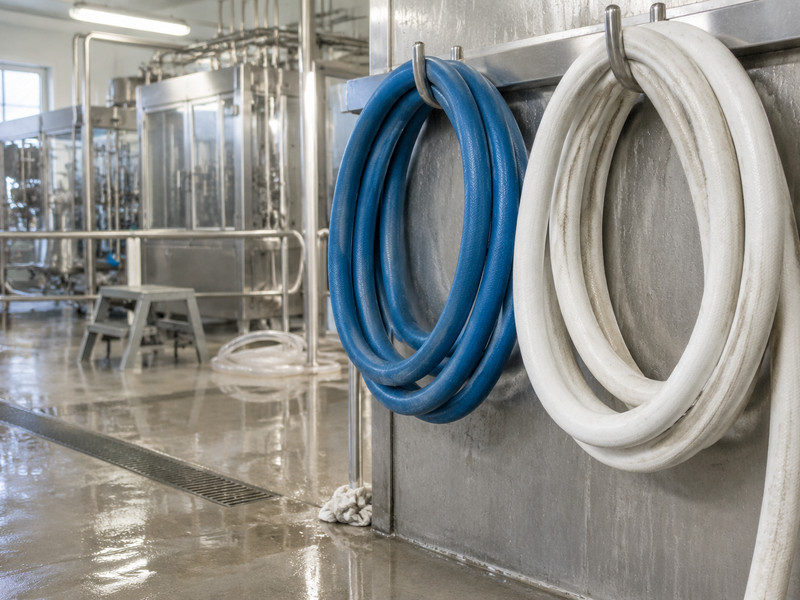
White and blue food grade composite hoses coiled on a stainless rack in a dairy plant

White Food Grade Hose and Blue Food Grade Hose: Colour Rules in Audits

A white food grade hose is the default on dairy, ready-to-eat and pharmaceutical lines, and blue is the default almost everywhere else in a food plant. The colour does not make either hose compliant. It makes the hose identifiable, which is what an auditor is really testing: whether the plant can show that the hose

White Food Grade Hose and Blue Food Grade Hose: Colour Rules in Audits Weiterlesen »