
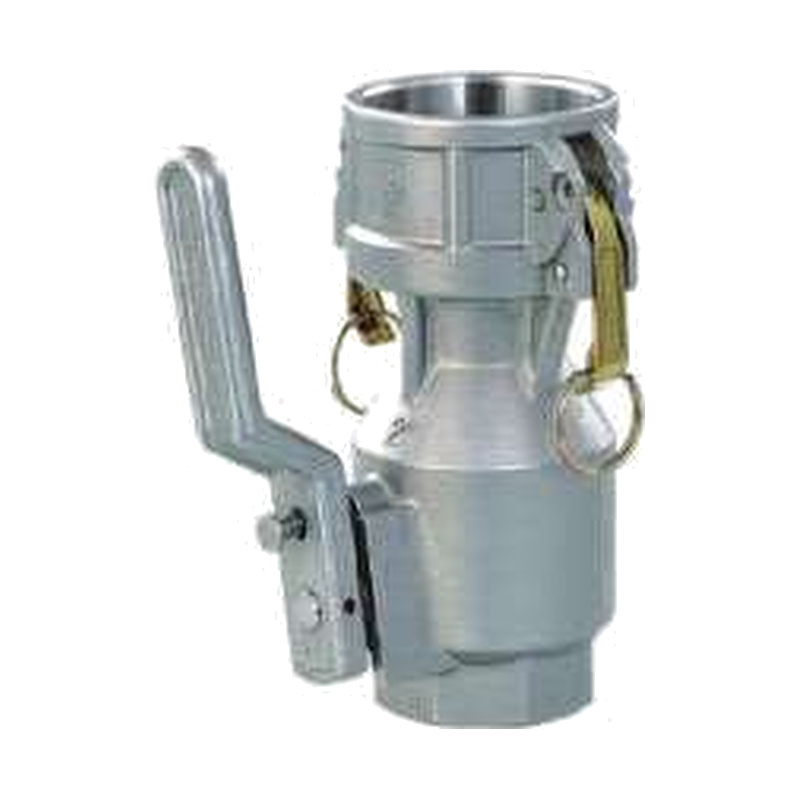


Dry disconnect couplings open and close a liquid line without spilling the contents of the hose: a poppet in each half closes before the halves separate, so the residual product stays inside the coupling. This range covers couplers and adapters from 1 in to 4 in in aluminium and SS316, to the NATO STANAG 3756 interface, with EPDM, NBR or Viton seals. They are used on chemical, solvent and fuel transfer where a spill at the connection is unacceptable.
|
|
|
Dry disconnect couplings: couplers and adapters
| Size | Coupler, aluminium | Coupler, SS316 | Adapter, aluminium | Adapter, SS316 |
|---|---|---|---|---|
| 1 in | Ask | DDC100-SS | Ask | DDA100-SS |
| 2 in | DDC200-AL | DDC200-SS | DDA200-AL | DDA200-SS |
| 3 in | DDC300-AL | DDC300-SS | DDA300-AL | DDA300-SS |
| 4 in | DDC400-AL | DDC400-SS | DDA400-AL | DDA400-SS |
The coupler and the adapter are separate parts and both are needed for a joint. DDC is the coupler, which carries the operating handle; DDA is the adapter, which mounts on the tank, the pump or the hose end. The 1 in aluminium cells read Ask because that combination is quoted on request rather than listed.
What “dry” actually means
Each half carries a spring-loaded poppet that is held open only while the two halves are locked together. When the coupler is opened, both poppets close before the bodies separate, so the volume that spills is the film inside the coupling rather than the contents of the hose. That is the difference between a dry disconnect and a ball valve with a quick coupling on the end: the valve holds the line, but the coupling itself still drains when it is opened.
The seal arrangement matters to that claim. The main seal is in the coupler and the poppet seals are behind it, so a worn main seal shows as a weep at the joint while a worn poppet seal shows as a drip on disconnect. The two fail differently, and only the second one is a spill.
Materials and seals
Aluminium is the light body for hose ends and for fuel, where weight at the end of a hose matters and the medium is not aggressive. SS316 is for chemical and solvent duty and for washdown, and it is the body that also survives being left full. Seals are EPDM for water and many aqueous chemicals, NBR for petroleum and oils, and Viton for solvents and aromatics.
Getting the seal wrong is the usual reason a dry disconnect stops being dry: a swollen seal holds the poppet off its seat, and the coupling spills on every disconnect while looking perfectly normal from outside.
The interface
The coupling follows the NATO STANAG 3756 interface, which is what allows a hose from one supplier to connect to a tanker or a loading arm built to that standard. It is not a camlock and not a hammer union: those are different joints, and an adapter between them is a separate part rather than a way of using the same coupling.
Before the first disconnect
Dry disconnect couplings are tested on water before they go into product service, and the joint is then opened once with the line empty to confirm both poppets close. A coupling that passes that check and spills later has a seal problem, not a mechanism problem.
Ordering information
- Size in inches
- Coupler or adapter
- Material: aluminium or SS316
- Seal compound: EPDM, NBR or Viton
- End connection on the adapter: hose tail, flange or thread
- Quantity per part number
Frequently asked questions
Are dry disconnect couplings the same as quick couplings?
No. A quick coupling connects fast but drains on disconnect; a dry disconnect closes both halves before they separate, so the product stays in the line.
Do I need both the coupler and the adapter?
Yes. DDC is the coupler with the handle, DDA the adapter that mounts on the equipment. A joint needs one of each.
Which seal for solvents?
Viton. NBR swells in aromatic and chlorinated solvents, and a swollen seal is what makes the coupling spill.
What pressure do they hold?
No figure is published for this range, so it is confirmed against the size, the medium and the mating equipment.
What is the minimum order, and can I get samples?
MOQ, samples and lead time are confirmed per line with the price, because each size and material is a separate run.
Related reading
- Tank, bulk and specialty
- Hammer union fittings
- IBC fittings
- Industrial hose couplings
Dry disconnect couplings are quoted by size, coupler or adapter, material and seal compound.
Send the six fields and we come back with the price.


 English
 Spanish
 Portuguese
 French
 German
 Arabic
 Russian
 Indonesian
 Japanese
 Korean