

A steam hose working pressure of 20 bar is a high-pressure tier rather than a routine one. In saturated steam, 20 bar g corresponds to about 214.9 °C, which is above the ISO 6134 Type 2 ceiling of 18 bar and 210 °C. That tier therefore demands a higher grade of construction and stricter service conditions.
This guide answers the three questions a 20 bar reading raises: what the working pressure figure actually covers, where the tier sits against the ISO 6134 ceiling, and what construction the number assumes. Three readers get the same decision sequence. A plant engineer checks whether an existing line can run at 20 bar. A distributor quotes the tier, and a buyer weighs a catalog figure against a line gauge.
About a 14-minute read at 250 words per minute; a construction-led walkthrough of the 20 bar steam hose tier.
What a Steam Hose Working Pressure Rating Actually States
A steam hose working pressure is not one abstract number lifted from a catalog. It is a pressure the hose may carry only under a defined set of conditions, and the most important of those conditions is temperature. Every published figure is tied to a reference temperature, and the industry convention for that reference is a moderate ambient value, often given as 70 °F or 21 °C.
That convention matters because rubber softens and reinforcement relaxes as heat rises. Above the reference temperature the allowable pressure falls, and the correction depends on construction. A rubber hose is corrected from its tube and reinforcement; a metal braided assembly is corrected from its braid alloy. That is why a single headline figure never travels intact across a whole catalog.
Keep the two pressure terms apart. The rated working pressure is the ceiling the hose may safely meet in normal service. Burst pressure is the point of mechanical failure, measured under a hydrostatic test. The gap between them is a deliberate design margin, not spare capacity to spend. For the full relationship, read working pressure vs burst pressure.
There is also a difference between the hose body and the finished assembly. A catalog figure describes the body, while the coupling, its material, and the attachment method can lower the safe pressure at temperature. A buyer who compares numbers without asking which one is being quoted is comparing two different things. The next sections separate those things clearly.
How to Read a Steam Hose Working Pressure Rating Table
A steam hose working pressure table rewards slow reading, because each column carries an assumption. The pressure rating table below shows the columns a competent catalog uses and the question each column answers.
Table 1. What each rating column states, and what a buyer should check.
| Column | Was darin steht | Buyer check |
|---|---|---|
| Nominal bore | The internal diameter the rating was set for | Match the bore to the steam line, never the outside diameter |
| Betriebsdruck | The maximum service pressure at the reference temperature | Confirm the rating is stated at a reference temperature, not at steam temperature |
| Temperature basis | The maximum steam temperature the rating assumes | Convert your line pressure into saturation temperature before comparing |
| Verstärkung | Textile for low-pressure service, steel wire for high-pressure service | Expect steel wire for anything in the 20 bar class |
| Cover finish | Whether the cover is pin-pricked for steam service | Confirm the vents so trapped steam can escape the wall |
| End connection | The coupling class the assembly was tested with | Never swap a dedicated coupling for a band or ordinary clamp |
Read the table from top to bottom rather than left to right, because the rows build on each other. A pressure figure only means something once you know the bore it was set for and the temperature it assumes. A listing that omits the temperature basis is incomplete, however confident the headline number looks.
For the pressure-and-temperature pairing that governs steam, the saturated steam reference is the column that decides everything else. Readers who skip it tend to compare a catalog figure with a gauge reading, which is exactly the comparison that misleads. The two numbers are not interchangeable, and the standard behind them is not a formality.
Why 20 Bar Sits Above the ISO 6134 Type 2 Ceiling
ISO 6134 is the standard that governs rubber hoses and hose assemblies for saturated steam. It splits steam hose into two types and caps each one.
Type 1 is the low-pressure type, with a maximum working pressure of 0.6 MPa, which equals 6 bar, and a corresponding temperature of 164 °C. Type 2 is the high-pressure type, capped at 1.8 MPa, which equals 18 bar, and 210 °C. Reinforcement follows the type: textile for the low-pressure class, steel wire for the high-pressure class.
Now read 20 bar against that ceiling. On the saturated steam table, 20 bar g equals 21.01 bar absolute and a saturation temperature of 214.9 °C. That is above the 210 °C cap, so the steam hose 20 bar tier cannot simply be read as an extension of the standard envelope. The tier sits outside the two ISO 6134 types, and the gap is small but real.
Table 2. The steam hose 20 bar tier next to the two ISO 6134 types.
| Service tier | Source | Maximaler Betriebsdruck | Saturation temperature |
|---|---|---|---|
| Type 1 low-pressure steam hose | ISO 6134 | 0.6 MPa (6 bar) | 164 °C |
| Type 2 high-pressure steam hose | ISO 6134 | 1.8 MPa (18 bar) | 210 °C |
| 20 bar tier | Saturated steam table | 20 bar g | 214.9 °C |

Figure 1. Steam pressure tiers and the construction class each tier requires.
The lesson is not that 20 bar is impossible. The lesson is that the number moves you into a class that needs a higher grade of construction and a documented service condition. Where the ceiling and the actual construction meet is the whole story, and a richer treatment of that meeting point is in hose pressure at elevated temperature.
Two related test standards support that reading. Steam hose test methods are covered by ISO 4023 and its related procedures. The electrical behavior that matters when steam generates static is covered by ISO 8031, while adhesion between the layers is checked under ISO 8033 and bending under ISO 10619-1. None of these replace the pressure ceiling, because they support the construction that meets it.
Construction That Supports a Steam Hose Working Pressure of 20 Bar
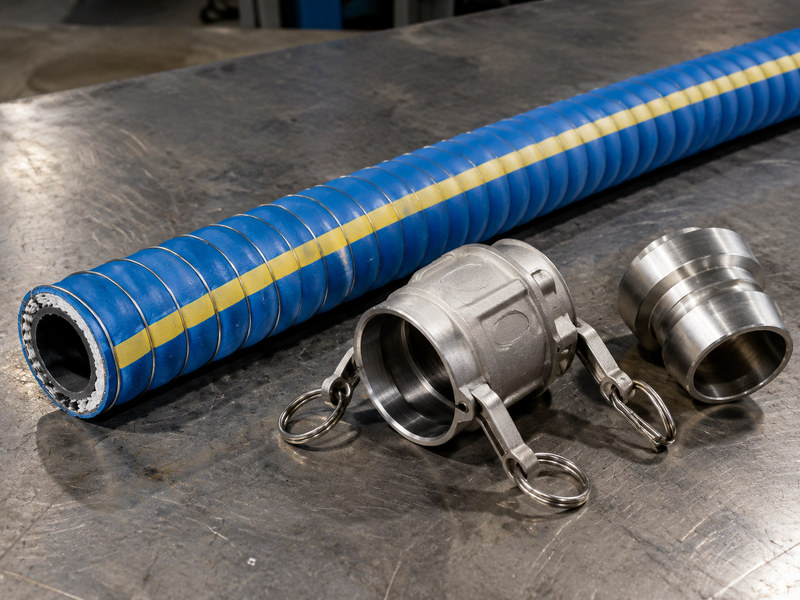
At this tier the reinforcement stops being a supporting detail and becomes the defining feature. The high-pressure class relies on steel wire, as ISO 6134 requires, because a textile carcass alone cannot hold the hoop load. Wire construction resists both the internal pressure and the crushing that comes from bending a hot, pressurized line.
The order of the layers matters as much as their materials. Steam contacts an EPDM tube first, because EPDM resists saturated steam well. Wire reinforcement sits outside that tube and takes the load. A pin-pricked cover then wraps the assembly, so steam that permeates the tube wall can vent instead of lifting the cover.
Table 3. Construction features and the reason each one matters at the 20 bar tier.
| Feature | At low pressure | At the 20 bar tier |
|---|---|---|
| Inner tube | EPDM steam tube | EPDM steam tube, selected for continuous hot service |
| Verstärkung | Textile | Steel wire |
| Cover | Cover, sometimes smooth | Pin-pricked cover that vents permeated steam |
| End connection | Coupling rated for the pressure | Dedicated steam coupling rated for pressure and temperature |

Figure 2. Layer order in a high-pressure steam hose, from the EPDM tube outward to the pin-pricked cover.
A higher grade of construction is not optional decoration at this tier. It is the physical reason the number can be printed at all. When a distributor specifies a steam hose working pressure of 20 bar, the steel wire reinforcement, the EPDM tube, and the pin-pricked cover are the three commitments that make the figure credible. Remove one and the claim loses its basis.
A route that kinks the line pinches the wire carcass, and a pinched carcass cannot hold the pressure the rating table states. That is why the route is quoted with the tier rather than left to the installer.
Static charge is worth a word at this tier, because fast steam flow can build a charge along a long line. A conductive path from the metal wire out through the couplings helps dissipate it, and ISO 8031 covers the electrical test. This is a construction point rather than a pressure point, but it belongs in the same specification.
End Connections and Drainage at 20 Bar
Pressure is only half of what a steam hose working pressure of 20 bar must deliver on site; the ends and the service routine carry the rest. A steam hose must not use a band or an ordinary clamp in place of a dedicated coupling, because that kind of compression lowers the rating of the completed assembly. Bolted safety clamps are the common steam choice.
For a steam hose 20 bar assembly, the ends decide as much as the wall. The rating that matters on site belongs to the finished assembly, not to the hose body it was built from. A distributor who quotes a hose figure for a finished assembly has skipped the step that matters most.

Figure 3. Why a dedicated steam coupling, not a band or ordinary clamp, is required at the 20 bar tier.
Drainage is the quiet requirement. Condensate collects in a steam line whenever it cools, and a trapped slug of water can move at speed and load the assembly. Draining the hose after each use is standard steam practice, and it protects both the tube and the couplings.
Service conditions beyond pressure complete the picture. Steam that is only hot water does not stress the hose the same way that true steam does, and a line that cycles between hot and cold adds its own wear. Confirming the real duty, not only the gauge number, keeps the assembly inside the conditions its rating assumes.
Saturated Steam Pairs Behind a 20 Bar Figure
Because steam temperature and pressure are locked together, the pairs below are the ones that decide the 20 bar tier. You read the pressure, look up the saturation temperature, and compare that temperature with the hose limit. The full pressure, temperature and volume reference sits in the saturated steam chart page (planned URL — publish before linking).
Table 4. Saturated steam pairs that frame the 20 bar tier.
| Pressure (bar g) | Absolute pressure (bar a) | Saturation temperature (°C) |
|---|---|---|
| 6 | 7.01 | 165.0 |
| 10 | 11.01 | 184.1 |
| 14 | 15.01 | 198.3 |
| 18 | 19.01 | 209.8 |
| 20 | 21.01 | 214.9 |
| 25 | 26.01 | 226.1 |
Two reading habits keep this chart honest. First, the pressure column is gauge pressure unless the table says otherwise, so absolute pressure is gauge pressure plus about one bar. Second, the temperature column is the point, not the pressure. A line that reads 20 bar g is a 214.9 °C line, and that is the number a hose must tolerate continuously.
A third habit keeps the two sources from being read as a conflict. The 164 °C figure is the ISO 6134 type limit, and the 165.0 °C row is the saturated steam table value for the same 6 bar g duty; each is quoted from its own source.
A steam hose 20 bar reading is therefore a temperature reading. Applicability: this tier applies where the line duty reaches 214.9 °C, and the construction temperature limit must cover that figure. A buyer who holds only the pressure number still has half the information needed to choose a hose.
Use the chart for the place the duty actually sits, not for the highest figure you might reach on a good day. A line that peaks above 20 bar g crosses into a hotter tier, and the hose limit has to cover that peak. Reading the peak on the chart, rather than the average, is the safe habit when a steam system cycles.
How to Verify a 20 Bar Working Pressure Claim
A claim is worth what its evidence is worth, so the verification is a short, concrete sequence. Ask for the pressure rating table, the standard reference, the construction declaration, and the assembly test record. The table below lists the steps and the evidence each one needs.
Table 5. Verification steps before accepting a 20 bar claim.
| Überprüfen | What to confirm | Evidence |
|---|---|---|
| Pressure basis | The rating states its reference temperature | The catalog rating table |
| Standard reference | The hose is declared to ISO 6134 Type 2 or a higher-graded steam construction | The product declaration |
| Verstärkung | Steel wire is declared for the high-pressure class | The construction description |
| Proof test | The assembly passed a hydrostatic proof test | The test certificate |
| End connection | Couplings are dedicated steam couplings, not band or clamp compression | The assembly drawing |
A credible rated working pressure is traceable to a proof test, not to a marketing sheet. The proof test itself follows ISO 1402, the hydrostatic test standard, and the broader hydrostatic and impulse test methods show how such evidence is produced and recorded. Ozone aging of the cover is checked under ISO 7326, which matters on a hot outdoor line where the rubber ages fast.
Verification also includes a physical check on receipt. Confirm the print on the hose, the coupling type, and the test record match the documents. A mismatch is a signal to stop and ask questions before the assembly enters service, because the cost of a wrong assembly is far higher than the cost of a delayed order.
Keep the documents with the assembly for its whole service life. A test record that cannot be found later is the same as no test record at all, and steam service rewards traceability. If a record is missing, treat the assembly as unverified until the paperwork is restored.
Choosing the Steam Hose Working Pressure Tier You Need
Match the tier to the duty rather than to the largest number on a shelf. If your saturated steam line runs near 20 bar, treat it as a 214.9 °C duty and specify a higher-graded steam construction with steel wire reinforcement, a pin-pricked cover, and dedicated end connections. Confirm the steam hose working pressure figure against a pressure rating table, then confirm the construction behind it.
For the full line, see the steam hose category and the high-temperature steam hose product. For the wire construction this tier depends on, read steel wire reinforced steam hose.
20 Bar Steam Hose FAQs
Does 20 bar in saturated steam always mean about 215 °C?
Yes. In saturated steam, pressure and temperature are locked together, so 20 bar g always corresponds to a saturation temperature of about 214.9 °C. You cannot hold 20 bar of saturated steam at a lower temperature. The only way to separate the two figures is to move to superheated steam, where temperature rises above the saturation value at the same pressure.
Is a 20 bar steam hose covered by ISO 6134?
Not directly. ISO 6134 caps its Type 2 high-pressure steam hose at 18 bar and 210 °C, so a 20 bar, 214.9 °C duty sits above that envelope. The standard still supplies the vocabulary and the test methods, and it tells you the ceiling of the type. A 20 bar product therefore has to be specified as a higher-graded steam construction.
What reinforcement does the 20 bar tier require?
The high-pressure class of ISO 6134 uses steel wire reinforcement, and the 20 bar tier needs that grade because a textile carcass alone cannot carry the hoop load. The wire layer sits outside the EPDM tube and takes the pressure. A pin-pricked cover is added so permeated steam can vent rather than lift the cover.
Why does a rating table give pressure instead of steam temperature?
A rating table gives pressure because that is what a gauge shows and what the numbers in a catalog are built around. But under saturated steam the pressure implies the temperature, so the two columns are never independent. Reading only the pressure and ignoring the implied saturation temperature is the most common error in steam hose selection.
Can a band clamp be used to attach a fitting on a 20 bar steam hose?
No. For a 20 bar steam assembly, the specification is a dedicated steam coupling with a bolted safety clamp attachment. A band or an ordinary clamp changes the rating of the finished assembly, so the coupling class belongs on the assembly drawing rather than being assumed at the counter. Match the end connection to the pressure and temperature the line will actually see, and keep the coupling class with the test certificate.
What is the difference between working pressure and burst pressure?
The rated working pressure is the figure a buyer specifies and a catalog publishes. Burst pressure is a test result: the assembly is taken to failure under hydrostatic pressure, which makes it a bench outcome rather than a service allowance. Keep the two in separate columns when you compare offers, and treat a burst figure as evidence of construction quality rather than as headroom for the steam line.
Does the end connection change the assembly rating?
Yes, and often downward. The coupling type, its material, and the way it attaches each limit the pressure the completed assembly may safely carry at temperature. A catalog figure describes the hose body, not necessarily the finished assembly. Distributors should quote the assembly rating, not the hose rating, when a customer buys a finished length.
Why should a steam hose be drained after every use?
Steam gives up heat as it travels, so part of the flow returns to water and settles at the low points of the line. That water is dense and moves in bursts when it is pushed, which loads the ends of the assembly far harder than steady steam does. Draining after each use clears it before the next start-up, and it keeps the tube wall from sitting wet between shifts.
Can a textile-reinforced hose reach the 20 bar tier?
No. Textile reinforcement belongs to the low-pressure class of ISO 6134, capped at 6 bar and 164 °C. The 20 bar tier needs the steel wire class and a higher grade of construction overall. If a supplier offers a textile hose at that pressure, treat the claim as needing documentary proof before purchase.
What reference temperature is a catalog rating based on?
Catalog working pressures are stated at a moderate reference temperature, commonly given as 70 °F or 21 °C. The figure falls as the service temperature rises, and the correction depends on the tube and the reinforcement. For saturated steam, though, the reading changes: you look up the saturation temperature instead and compare that with the hose limit.
Über HENGHUA
HENGHUA is a professional hose and coupling manufacturer serving distributors, retailers, and OEM brands worldwide. The steam hose line is built around an EPDM inner tube, with textile or steel wire reinforcement, and a cover that is pin-pricked for steam service. Products include an EPDM steam hose rated to 170 °C and an EPDM high-temperature steam hose rated to 230 °C.
End connections can include clamp-type safety couplings, flanges, and threaded options, and the factory can supply assembled lengths, custom lengths, branding, private label, and OEM or ODM work. Commercial terms are factory-direct pricing, short batch lead times, and warranty. For pricing and samples, reach us through the contact page.
 English
 Spanish
 Portuguese
 French
 German
 Arabic
 Russian
 Indonesian
 Japanese
 Korean