
The main types of hydraulic hose fall into six construction families — single-wire braid, double-wire braid, spiral-wound, textile braid, thermoplastic, and PTFE — and which one belongs on a given line is decided by four numbers: working pressure, bore size, fluid temperature, and bend radius. This guide gives you the chart and the checklist together: a side-by-side comparison chart of every type of hydraulic hose with its standard family and pressure rating, the five-step selection sequence that picks the right hose the first time, and the printed markings that tell you which type you already have. For most mobile equipment, a two-wire-braid hose rated at 4,000 PSI in 3/8-inch bore is the workhorse starting point; single-wire braid covers the lower pressures, and spiral-wound constructions take over above about 4,000 PSI. Whether you are replacing a blown line on an excavator, standardizing hoses for an OEM build, or stocking sizes for a distribution territory, the decision path below applies.
The Short Answer: Three Ways to Sort Hydraulic Hose Types
Hydraulic hose is classified three different ways, and a complete specification uses all three at once: by construction (how it is reinforced), by standard family (the SAE or EN code printed on the cover), and by the job the line does (pressure, return, or suction). Construction tells you what the hose can physically handle. The standard family tells you which published rating table applies. The line function tells you which construction is even eligible.
Table 1. Three ways to classify hydraulic hose types — construction, standard family, and line function
| Classification method | What it tells you | Example |
|---|---|---|
| By construction | Reinforcement type and pressure capability | Single wire braid, double wire braid, four-spiral, textile braid, thermoplastic, PTFE |
| By standard family | The published rating and test standard behind the hose | SAE 100R1, 100R2, 100R12, EN 853 2SN, EN 856 4SH, ISO 18752 |
| By line function | The duty the hose must survive | High-pressure supply line, return line, suction line, pilot/control line |
Any comparison of the types of hydraulic hose is, at bottom, a comparison of reinforcement patterns. Most ordering mistakes come from mixing these up — choosing a type because of its construction while ignoring the standard family, or fitting a pressure-line hose onto a return line where a cheaper construction would have done the job with more flexibility.
Terminology used in this guide. SAE 100R1 and SAE 100R2 are the American construction designations for single- and double-wire-braid hose; EN 853 1SN and 2SN are the European equivalents — equivalent constructions, not identical published ratings, so always read the value for the standard family printed on the hose you are buying. Where this guide shortens 100R1 or 100R2 to R1 or R2, it means those two standard families and nothing else: it is not the R1/R2 radius convention (inner-surface radius and centreline radius) used when measuring a bend, and not an end-fitting angle. Where a supplier writes “R1” or “R2” alone, ask which standard family is meant.
What Is a Hydraulic Hose, and What Are Its Three Layers?
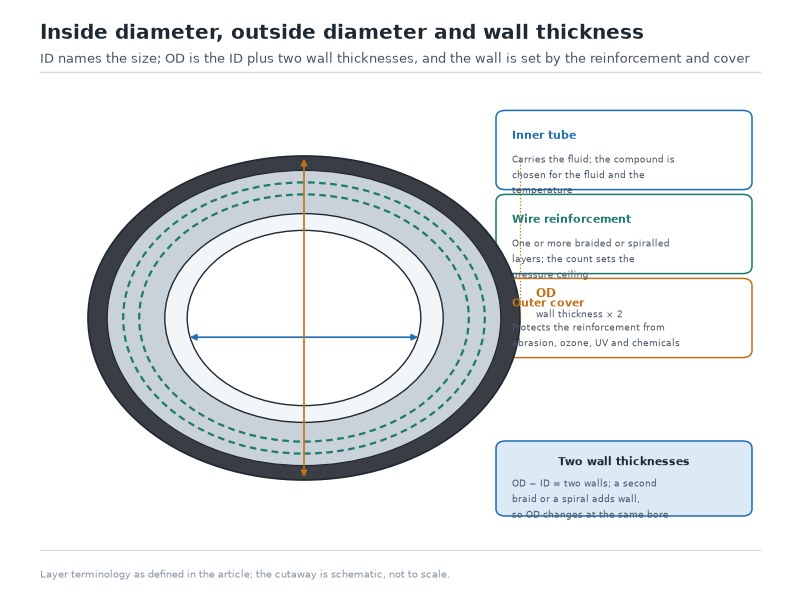
A hydraulic hose is a flexible pressure vessel made of three bonded layers: an oil-resistant inner tube that carries the fluid, one or more reinforcement layers that hold the pressure, and an outer cover that protects the reinforcement from the working environment. The tube and cover are rubber in the standard 100R families and thermoplastic in the 100R7 and 100R8 families. The reinforcement is steel wire braid, spiral-wound steel wire, or high-tenacity textile fiber, depending on how much pressure the hose must contain.
The hose is the flexible link between rigid components — pump, valve, cylinder, motor — and it exists because a machine’s parts move relative to each other. That movement is also the reason a hose is more likely to fail than a steel tube: flexing, bending, impulse, and abrasion all attack the same three layers, and the layer that fails first determines how the hose fails.
Inside the Hydraulic Hose Construction: Tube, Reinforcement, and Cover
Each layer has one job, and a specification error in any of them produces a different failure mode. Understanding what each layer does is the fastest way to read a hose datasheet — read the three layers and you can place any of the types of hydraulic hose within a minute.
Table 2. What each hydraulic hose layer does, and what fails when it is mismatched
| Layer | Function | Typical material | Failure if mismatched |
|---|---|---|---|
| Inner tube | Carries the fluid, resists chemical attack and heat | Synthetic rubber (NBR), polyamide, or PTFE | Swelling, hardening, or cracking — contamination and internal leakage |
| Reinforcement | Contains pressure, resists impulse fatigue | Steel wire braid, spiral-wound steel wire, textile fiber | Burst, wire fatigue, or hose elongation under pressure |
| Cover | Protects the reinforcement from abrasion, UV, ozone, chemicals | Abrasion-resistant rubber or thermoplastic compound | Exposed wire braid, corrosion, then premature burst |
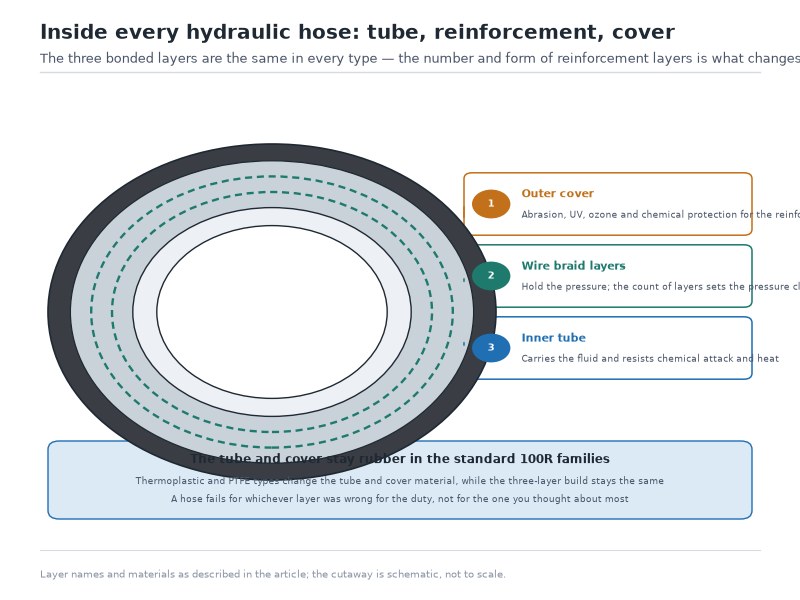
Figure 1. Every hydraulic hose type is a variation on the same three-layer build: tube, reinforcement, and cover. The number and form of the reinforcement layers is what separates one type from another.
Types of Hydraulic Hose by Construction: The Six Main Families
In practice, six hydraulic hose construction families cover almost every hydraulic line in service — the six pressure and return families grouped by reinforcement, with suction and return hose (SAE 100R4) as a seventh group and the specialty designations listed at the end of this section. The reinforcement pattern decides pressure capability and flexibility, and it is the single most useful way to compare hydraulic hose types at a glance.
Single Wire Braid Hydraulic Hose (SAE 100R1, EN 853 1SN)
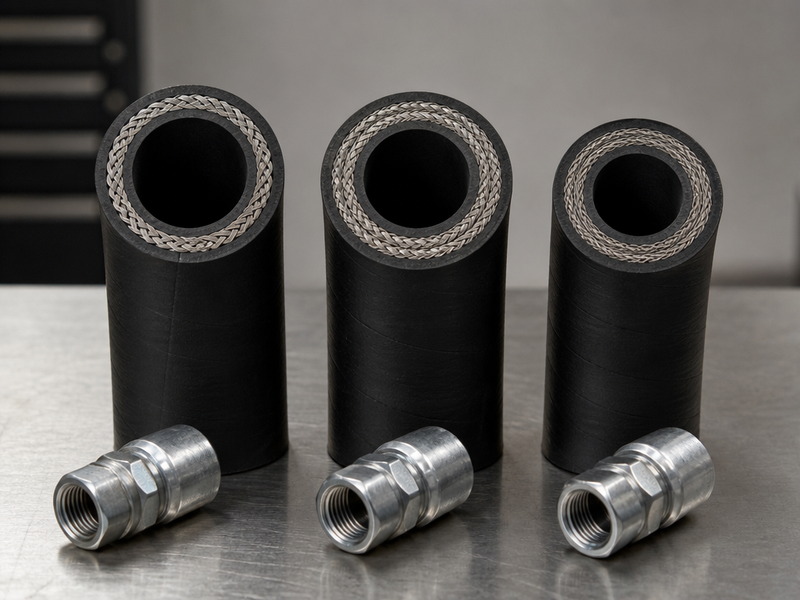
Single wire braid hose has one braided steel wire layer over the tube — the general-purpose entry point of the pressure-hose family. In 3/8-inch bore it is rated 2,280 PSI (15.7 MPa) working pressure on the SAE J517 100R1AT table — the same figure the layline and the standard tables carry for this size and family — and SAE J517 and EN 853 specify a minimum burst pressure of four times that working pressure. It bends easily, crimps reliably, and costs the least of the steel-reinforced types, which is why it appears on low- and medium-pressure circuits: return lines that still see pressure, pilot lines, lubrication lines, and light-duty mobile equipment.
The trade-off is impulse life. One braid layer distributes stress over fewer wires, so where pressure spikes repeatedly — a log splitter, a compaction ram, a boom that stalls under load — the braid fatigues sooner than a two-wire or spiral construction. Use 100R1 below about 2,000 PSI in steady duty, and step up as soon as the circuit sees shock.
Double Wire Braid Hydraulic Hose (SAE 100R2, EN 853 2SN)
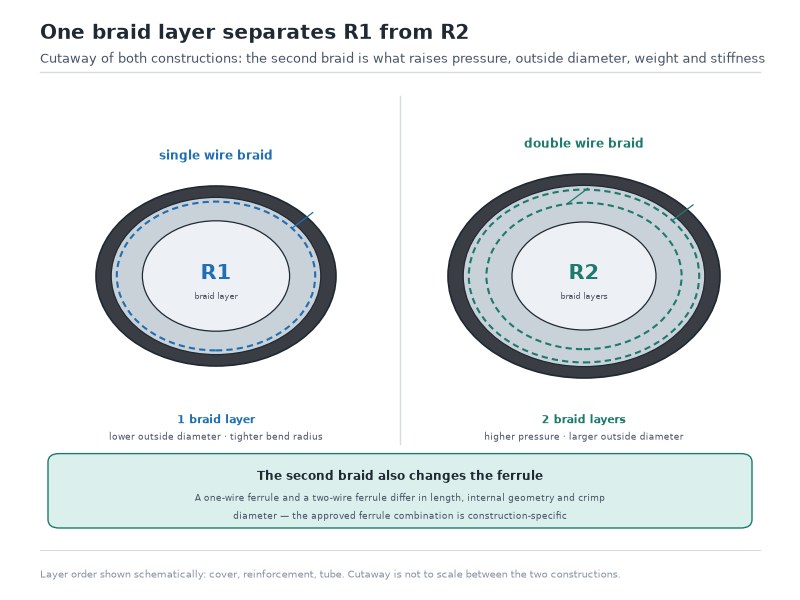
Double wire braid hose adds a second braided steel layer, which is the reason it is the default hose on most mobile machinery. In 3/8-inch bore, SAE J517 100R2AT is rated 4,000 PSI working pressure — about 76 percent more than the single-braid equivalent in the same size (2,280 PSI in the same SAE J517 table), which is the same 1.75 times ratio stated another way — while staying flexible enough to route by hand. A 1/2-inch 100R2AT is rated 3,500 PSI and a 1-inch 100R2AT 2,000 PSI on that same SAE J517 table, because rating falls as bore grows. The EN 853 2SN equivalent is a different published set for the same dash sizes — always read the family printed on the hose.
The same construction is the standard choice on excavator, loader, and tractor lines, where our hydraulic hose assemblies ship with crimped ends in every dash size. Compared with a single-braid hose of the same size, a 100R2 costs roughly 20 to 30 percent more and handles about 1.75 times the pressure. That ratio is why hydraulic hose selection for mobile equipment usually starts at 100R2 and only moves down for low-pressure lines or up for high-impulse circuits.
Spiral-Wound Hydraulic Hose (SAE 100R12, 100R13, 100R15, EN 856 4SP and 4SH)
Spiral hose wraps four or six layers of steel wire in alternating directions instead of braiding them, which spreads impulse load across more wires per layer and limits how much the hose expands under pressure. The published pressure rating of spiral constructions runs from roughly 4,000 PSI to 6,000 PSI depending on family and bore — 100R12 as the four-spiral workhorse, 100R13 and 100R15 as the six-spiral high-impulse grades.
The costs of that strength are stiffness, weight, and price: a spiral hose is noticeably harder to bend and typically costs two to four times a comparable two-wire braid per foot. Specify spiral when the system runs above roughly 4,000 PSI, when surge pressures are frequent, or when the circuit must hold pressure without hose elongation — boom cylinders, rock drills, presses, and offshore equipment. Below those conditions, spiral is money spent without benefit.
Textile-Braid Hydraulic Hose (SAE 100R3, SAE 100R6)
Textile-braid hose replaces steel with one or more layers of high-tenacity synthetic fiber. It is the lightest and most flexible of the low-pressure types, generally rated around 1,000 to 1,500 PSI in small bores and lower as bore increases. Textile-braid hose trades burst strength and impulse life for three advantages: low weight, excellent flexibility at tight bend radii, and the lowest cost of the low-pressure types.
Scope: textile-braid hose suits return, pilot, and in-plant low-pressure lines up to about 1,000 PSI continuous, and small-diameter lines routed around tight machine geometry. Above that figure, specify a wire-braid or spiral construction, because fiber reinforcement carries a lower impulse rating than steel.
Thermoplastic Hydraulic Hose (SAE 100R7, SAE 100R8)
Thermoplastic hose uses a polyamide or similar polymer tube and cover with a fiber or wire reinforcement, giving a non-conductive, low-expansion hose rated roughly 1,000 to 5,000 PSI depending on family and size. 100R7 is the general thermoplastic grade; 100R8 is the higher-pressure version with a tighter construction. Both are lighter than rubber equivalents, resist a wide range of fluids, and hold their shape where a rubber hose would kink.
Their main applications are hydraulic tools, lubrication systems, agricultural and utility equipment, and any circuit running near electrical hazards, where the non-conductive tube matters. Scope: standard thermoplastic grades are published to 93 °C (200 °F) continuous, and they are more vulnerable than rubber to sharp edges and hot surface contact, so route them away from both.
PTFE Hydraulic Hose (SAE 100R14)
PTFE hose uses a smooth, chemically inert polytetrafluoroethylene core with a stainless steel wire braid, and it exists for two problems that no rubber compound solves at the same time: aggressive fluids and extreme temperature. A PTFE core handles hydraulic fluids, phosphate esters, solvents, and many chemicals, and the stainless braid gives it a working range that commonly spans -54 °C to +204 °C (-65 °F to +400 °F), with high-temperature grades published to about +260 °C.
It is the most expensive type per foot, and its service life is shorter where the hose flexes constantly — the static routing is where PTFE pays. Use it for high-temperature circuits, chemical processing equipment, food and pharmaceutical environments, and any line whose fluid would degrade an NBR tube.
Suction and Return Hose (SAE 100R4): Built for Vacuum, Not Pressure
Suction and return hose is built to survive vacuum and external force rather than internal pressure: textile braid or fabric reinforcement plus a helical wire that keeps the bore from collapsing when the pump draws. SAE 100R4 is the standard suction/return family, and it is normally rated only in the low hundreds of PSI. A spiral-wound hose with a wire helix added is sometimes used for return lines on heavy equipment — that is a different product from a pressure-rated spiral hose, even though the cover looks similar.
Specialty Types by Name: SAE 100R5, 100R16, 100R17, and 100R18
Beyond the six families, the specialty types worth knowing by name are the compact and textile-covered designations:
- SAE 100R5 — wire braid with a textile cover, long used for truck and oil-transfer lines
- SAE 100R16 and SAE 100R17 — compact two-wire constructions that deliver the pressure of a larger hose in a smaller outside diameter
- SAE 100R18 — compact single-wire braid for utility and low-temperature duty
The compact families are the ones ISO 18752 describes by pressure class and flexibility grade (AC, BC, CC and DC, where CC is the lightest class and DC the heaviest). If a supplier’s catalogue lists a “type” you have not seen before, the reliable question is which SAE or EN family it actually meets.
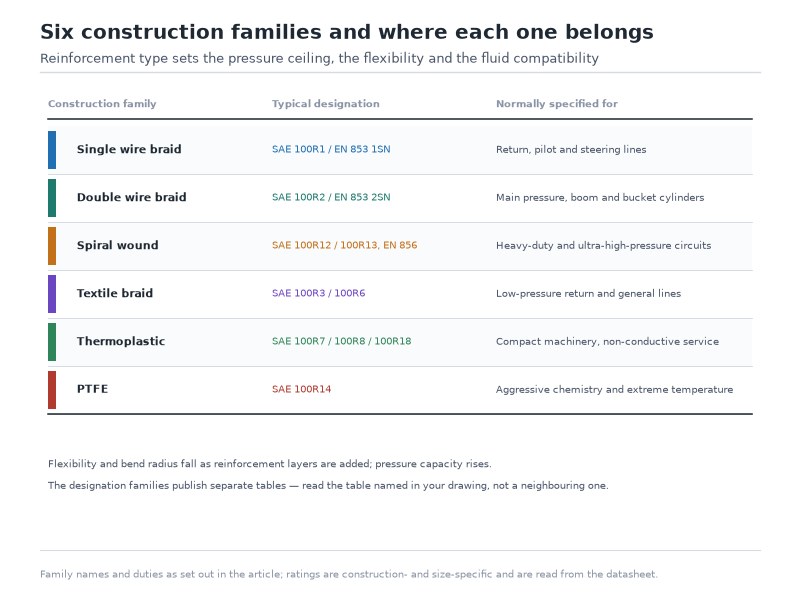
Figure 2. The six construction families side by side. Pressure capability rises from textile braid through thermoplastic and single and double wire braid to spiral-wound and PTFE constructions, while flexibility and price move in the opposite direction.
Table 3. Hydraulic hose types chart — construction, reinforcement, typical working pressure range, flexibility and duty (typical industry values; confirm against the manufacturer’s datasheet for the exact size)
| Type (construction) | Reinforcement | Typical working pressure range | Flexibility | Typical duty |
|---|---|---|---|---|
| Single wire braid (SAE 100R1, EN 853 1SN) | 1 steel wire braid | 500-3,000 PSI | Very good | Medium-pressure supply, pilot, lubrication lines |
| Double wire braid (SAE 100R2, EN 853 2SN) | 2 steel wire braids | 1,000-5,000 PSI | Good | General mobile and industrial pressure lines |
| Spiral-wound (SAE 100R12, 100R13, 100R15, EN 856 4SP, 4SH) | 4 or 6 spiral steel layers | 2,500-6,000 PSI | Moderate to low | High-pressure, high-impulse circuits |
| Textile braid (SAE 100R3, 100R6) | Textile fiber braid | 400-1,500 PSI | Excellent | Low-pressure return and pilot lines |
| Thermoplastic (SAE 100R7, 100R8) | Fiber or wire over polymer tube | 1,000-5,000 PSI | Excellent, non-conductive | Hydraulic tools, utility equipment, tight routing |
| PTFE (SAE 100R14) | Stainless steel wire braid | 1,500-3,000 PSI | Moderate, limited flex life | High temperature, aggressive fluids, chemical duty |
| Suction and return (SAE 100R4) | Textile plus wire helix | 100-300 PSI | Moderate | Pump inlet and return-to-tank lines under vacuum |
How SAE Standard Families Map to Hydraulic Hose Types
Each hydraulic hose construction is published under a standard family code, and that code is the only part of a specification you can verify independently. SAE J517 is the document that defines the 100R series; the code printed along the cover — a stripe such as “SAE 100R2 AT 3/8 – 4000 PSI W.P.” — tells you which construction you are holding and what its tested rating is.
European and international equivalents are widely cross-referenced: EN 853 1SN and 2SN correspond to single- and double-wire-braid rubber hose, EN 856 4SP and 4SH cover four- and six-spiral constructions, and ISO 18752 classifies the same products by pressure class (CC through DC) and flexibility grade. In marine service, SAE J1942 governs similar hoses for shipboard use. When a supplier quotes “two-wire braid” without a standard family, ask for the family code — it is the difference between a verifiable rating and an adjective — and our SAE 100R hydraulic hose guide covers the series family by family. Bore and dash-size conversions for every one of those families are the subject of the size cluster, which carries the full dash-to-ID and dash-to-millimetre conversion table; this guide uses the dash numbers only to place each construction.
Table 4. Hydraulic hose standard families and what each one covers (typical industry values; equivalent construction does not mean an identical published rating)
| Standard family | Bauwesen | Typical duty | Common EN / ISO equivalent |
|---|---|---|---|
| SAE 100R1 | Single steel wire braid | Medium-pressure supply lines | EN 853 1SN |
| SAE 100R2 | Double steel wire braid | General mobile and industrial pressure lines | EN 853 2SN |
| SAE 100R3, 100R6 | Textile braid | Low-pressure return and pilot lines | EN 854 1TE, 2TE |
| SAE 100R4 | Textile plus wire helix | Suction and return lines under vacuum | ISO 6807 |
| SAE 100R7, 100R8 | Thermoplastic, fiber or wire reinforced | Hydraulic tools, utility equipment, non-conductive duty | EN 855 R7 / R8, ISO 3949 |
| SAE 100R12, 100R13 | Four- and six-spiral steel wire | High-pressure and high-impulse hydraulic circuits | EN 856 4SP (100R12), 4SH (100R13) |
| SAE 100R14 | PTFE core with stainless steel braid | High temperature and chemical-resistant duty | — |
| SAE 100R15 | Six-spiral steel wire | Severe high-pressure duty, mining and offshore | ISO 18752 DC |
| SAE 100R16, 100R17 | Compact wire braid, reduced outside diameter | Retrofit and space-constrained routing | ISO 18752 AC, BC |
| SAE 100R18 | Compact single wire braid | Utility and low-temperature mobile duty | ISO 18752 CC |
Hydraulic Hose Pressure Rating: What Each Type Can Hold
Every hydraulic hose pressure rating in the industry is written in two parts, and confusing them is the most common specification error we see in incoming inquiries. Working pressure is the continuous operating rating that belongs in your selection calculation. Burst pressure is a destruction-test value: SAE J517, EN 853, and EN 857 specify a minimum burst pressure of four times the maximum working pressure, and that four-times figure is a qualification requirement that absorbs surge, fatigue, and aging — it is not a usable operating range.
Impulse life is the second half of the rating story. Families intended for high-impulse duty are qualified under SAE J343 and EN ISO 6803 by cycling the hose at 133 percent of its working pressure at a fluid temperature of +100 °C, at 0.5–1.25 Hz, for a minimum of 200,000 cycles in the published requirement. Longer runs — 500,000 or 1,000,000 cycles — are common purchasing program levels rather than a fixed standard figure, so ask which figure a supplier’s claim was tested to and under which standard. The 200,000-cycle figure is the published minimum, not a typical result: 500,000 and 1,000,000 cycles are programme levels a supplier may quote on top of it.
Table 5. Hydraulic hose psi rating chart by type — working and burst pressure reference values at a common bore (3/8 in for the single- and double-braid families; the spiral families are published only from larger bores, so their figures are for the smallest size in each table). The burst ratio column is the ratio of minimum burst pressure to maximum working pressure as published against the standard, not a permissible operating multiple. Ratings vary with size and must be confirmed on the hose cover or datasheet.
| Type (family) | Typical working pressure | Min burst ratio (published) | Typical burst pressure (3/8 in) |
|---|---|---|---|
| Single wire braid (SAE 100R1) | 2,280 PSI | 4:1 | About 9,100 PSI |
| Double wire braid (SAE 100R2) | 4,000 PSI | 4:1 | About 16,000 PSI |
| Four-spiral (SAE 100R12) | 4,000-4,500 PSI | 4:1 | About 16,000-18,000 PSI |
| Six-spiral (SAE 100R13) | 5,075 PSI (35 MPa) | 4:1 | About 20,000 PSI |
| Six-spiral (SAE 100R15) | About 6,000 PSI | 4:1 | About 24,000 PSI |
| Textile braid (SAE 100R3) | About 1,500 PSI | 4:1 | About 6,000 PSI |
| Textile braid (SAE 100R6) | About 1,000 PSI | 4:1 | About 4,000 PSI |
| Thermoplastic (SAE 100R7, 100R8) | 1,000-5,000 PSI | 4:1 | 4,000-20,000 PSI |
| PTFE (SAE 100R14) | 1,500-3,000 PSI | 4:1 | 6,000-12,000 PSI |
| Suction and return (SAE 100R4) | 100-300 PSI | 4:1 | 400-1,200 PSI |
One property of every hydraulic hose pressure rating matters more than the table itself: rating falls as bore size rises. The same 100R2AT construction that holds 4,000 PSI at 3/8-inch holds 3,500 PSI at 1/2-inch and 2,000 PSI at 1-inch on the SAE J517 table; the EN 853 2SN equivalent publishes 2,250 PSI at 1-inch, which is a different standard basis rather than a contradiction. Set the pressure figure from the line that matches the bore you intend to order, and from the standard family printed on the hose. Every published pressure rating carries a burst and proof figure behind it, and a supplier should be able to name all three: the working pressure versus burst pressure comparison sets out how the three values are defined and tested.
How to Select the Right Type of Hydraulic Hose: Five Numbers in Order
A practical hydraulic hose selection sequence starts with five numbers, and the construction family and standard family follow directly from them: working pressure, bore size, fluid and temperature, bend radius, and the fittings at both ends. Read them off the machine in that order. The fluid side of the same decision, for machines that do not run mineral oil, is covered in our guide to selecting the right hydraulic oil hose.
Step 1: Start From the Working Pressure at the Relief Valve
Hydraulic hose selection starts from the maximum pressure the system can produce — normally the relief valve setting — and then applies a surge factor of about 1.25 to that figure for circuits that see shock loads such as boom cylinders, presses, and splitter rams. A 3,000 PSI relief setting therefore becomes a 3,750 PSI specification, and a spool shifting in a valve adds a further transient on top of that figure. The 1.25 factor is an industry practice rather than a fixed standard requirement; what matters is that the comparison is made against the working pressure of the candidate type, never against its burst pressure.
Step 2: Size the Bore From Flow Using a Hydraulic Hose Size Chart
Bore size is set by flow and velocity, not by the size of the port. Industry design practice plans four velocity bands, one per line function:
- long pressure runs at roughly 15 to 20 ft/s (4.6 to 6.1 m/s)
- short straight pressure lines at up to about 26 ft/s
- return lines at 10 to 15 ft/s
- suction lines at 3 to 5 ft/s
The hydraulic hose size chart below converts a 20 ft/s reference velocity into a flow figure for each dash size — the lower edge of the practical band for pressure-line service — and the band column then carries that flow up to about 26 ft/s. Choosing a bore against those figures keeps pressure drop low and prevents internal erosion. Undersizing wastes pump power as heat; oversizing slows the fluid, lets air settle out, and adds cost without benefit.
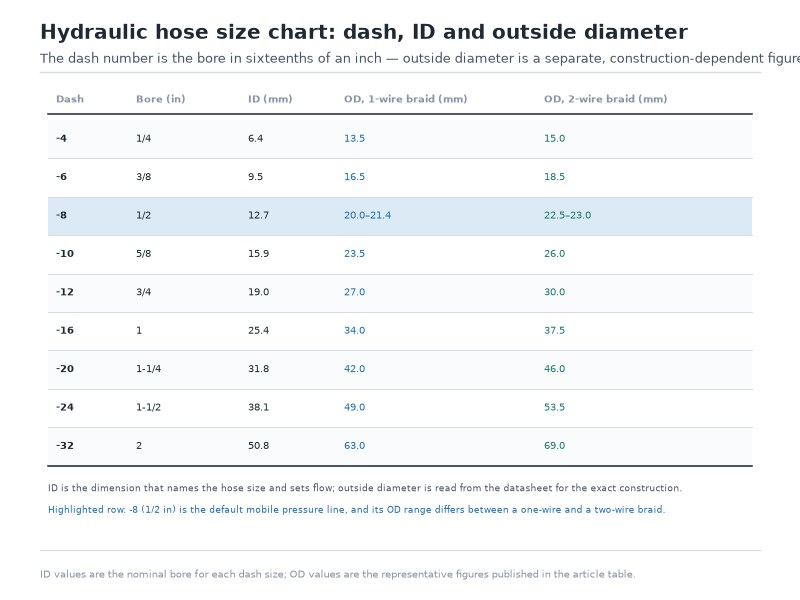
Table 6. Hydraulic hose size chart — dash size, inner diameter, the flow each bore carries at exactly 20 ft/s, and the practical flow band for pressure-line service (planning values; the band is the flow range commonly quoted for pressure-line service at that bore, spanning roughly 20–26 ft/s at the top of its range, while 15–20 ft/s is the figure used for long pressure runs; the 20 ft/s column is rounded to the nearest whole gpm, so a band opens at or within one gpm of the column value. Flow figures are computed as Q (gpm) = V (ft/s) × A (in²) × 3.117, where A is π/4 × ID² — equivalently v (ft/s) = 0.4085 × Q (gpm) ÷ d² (in), the same relationship written with a different constant.)
| Strichstärke | Inner diameter (inch) | Inner diameter (mm) | Flow at 20 ft/s (US gpm) | Practical band (US gpm) |
|---|---|---|---|---|
| -4 | 1/4 | 6.4 | 3 | 3-5 |
| -6 | 3/8 | 9.5 | 7 | 7-10 |
| -8 | 1/2 | 12.7 | 12 | 12-16 |
| -10 | 5/8 | 15.9 | 19 | 19-25 |
| -12 | 3/4 | 19.0 | 28 | 28-35 |
| -16 | 1 | 25.4 | 49 | 49-60 |
| -20 | 1-1/4 | 31.8 | 77 | 75-95 |
| -24 | 1-1/2 | 38.1 | 110 | 110-130 |
| -32 | 2 | 50.8 | 196 | 196-215 |
The flow figures come from one formula: Q (gpm) = V (ft/s) × A (in²) × 3.117, where A is π/4 × ID². Where the practical band and the velocity column disagree on a borderline line, size on velocity: the band is the planning default, and the arithmetic is the check — which is why the 20 ft/s column, not the band, is the column to compute from when a line sits close to the limit.
Step 3: Match the Tube Compound to the Fluid and the Temperature
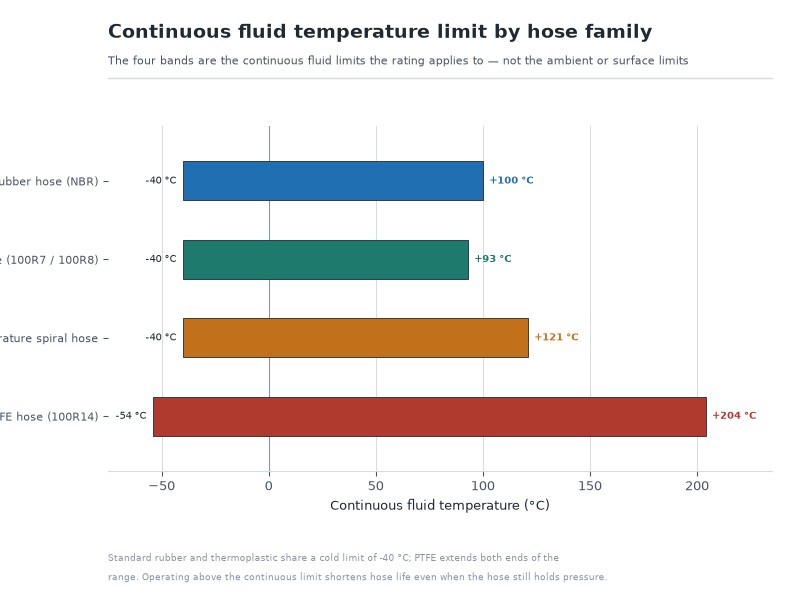
The reinforcement decides pressure, but the tube decides whether the hose survives at all. Standard nitrile (NBR) tubes cover mineral hydraulic oil, which is what most machines run. Water-glycol (HFC), biodegradable ester (HEES), and phosphate ester (HFD-R) fluids need a certified compatible tube — phosphate esters in particular will attack a standard NBR tube and swell it from the inside. Temperature works the same way: standard rubber hydraulic hose is published at −40 °C to +100 °C continuous with a +120 °C short-term allowance, four- and six-spiral hose at −40 °C to +121 °C, thermoplastic at −40 °C to +93 °C, and PTFE at −54 °C to +204 °C. Sustained operation above the family limit calls for a higher-temperature construction, not a higher pressure rating.
Step 4: Check Bend Radius and Routing Before Choosing the Construction
Minimum bend radius is published for every hose family and must be respected in the routing, not on the bench. Bending a hose tighter than its rated radius kinks the tube, distorts the reinforcement, and creates a fatigue point that fails months later under pressure. Route every line to at least its published minimum bend radius, then re-check the tightest bend at full pressure.
Where the routed hose touches structure, sleeve it: abrasion protection extends cover life more than a change of family at the same bore does. This is also where the construction choice gets practical: if the tightest bend in the machine falls below the radius of a spiral hose, the circuit needs a more flexible family — two-wire braid, thermoplastic, or a longer routing — rather than a stiffer hose forced into place.
Step 5: Match the Fittings to the Ports at Both Ends
End connections must match the ports physically and by thread family. The five families in common use are:
- JIC 37° flare — general industrial equipment
- ORFS — leak-critical high-pressure circuits
- NPT — North American pipe threads
- BSP — European and Asian machinery
- SAE flange — large high-flow lines
Mixing thread families produces a leak that no amount of torque will seal. The identification method and the seal geometry behind each family are set out in our guide to how to identify hydraulic hose end fittings and in the hydraulic fitting thread and seal standards reference; the NPT vs BSP thread guide covers the pair that is most often confused. Confirm the fitting size accepts the bore you selected; if it does not, the circuit needs an adapter or a different port, not a squeezed hose.
How Do You Tell What Size Hydraulic Hose You Have?
Measure the inside of the cut end with a caliper and read the dash size: by convention, dash size is the nominal inner diameter in sixteenths of an inch, so a 0.500-inch bore is a -8, though the true inside diameter carries a tolerance band rather than being one exact figure. Outside diameter identifies nothing on its own, because a 100R2 and a 100R1 of the same bore carry different covers and different outside diameters. If the hose is still on the machine, read the printed layline instead. The complete hydraulic hose size chart: dash size to ID and OD conversion, with the tolerance bands and the measuring procedure, is the page to use for the full table; this section only gives the two-step answer.
Which End Fittings Go With Each Type of Hydraulic Hose?
The attachment method is shared across the steel-reinforced hydraulic hose construction families — wire-braid and spiral hose are crimped with a matching ferrule and insert — but the ferrule itself is size- and construction-specific, so a ferrule built for a two-wire braid hose will not correctly crimp a four-spiral hose of the same bore. Thermoplastic and PTFE hoses use their own dedicated end connections, and suction hose uses its own. The thread family at the port is a separate question from the attachment method, and it is answered in the fittings cluster.
Selection Checklist: What to Send a Supplier
Work through this list before requesting a quote. Most answers are printed on the machine’s nameplate, the pressure gauge, or the old hose itself.
- Required working pressure (relief valve setting plus surge margin)
- Pump flow in gpm or l/min, and the dash size from the hydraulic hose size chart
- Fluid type with the maximum fluid temperature, minimum ambient temperature, and the working environment (abrasion, UV, chemical splash, washdown)
- Line length per position, routing allowance of 5 to 10 percent, and the tightest bend radius in the routing
- Fitting types and sizes at both ends, including elbow angles
- Required standard family (SAE J517, EN 853, EN 856, or ISO 18752)
- Quantity, target price, and delivery deadline
If you are replacing one line or standardizing a machine program, send this hydraulic hose selection checklist to our engineers and we will confirm the construction and the standard family before you commit to an order. Copy this list into your RFQ and nothing will be guessed.
Which Hydraulic Hose Type Goes Where: Applications by Industry
A hydraulic hose selection can be sanity-checked against industry practice: if a construction is the standard answer for the same duty on other machines, it is very likely the right answer on yours. The boom circuits on an excavator are the clearest reference case — see how they are routed and protected in our guide to excavator boom hose selection.
Table 7. Hydraulic hose type chart by line function — which construction goes on a pressure, return, suction, or pilot line
| Line function | Typical construction | Why |
|---|---|---|
| High-pressure supply lines (excavator, loader, crane booms) | Double wire braid (SAE 100R2) | Balances pressure rating with the flexibility the boom routing needs |
| High-impulse pressure lines (presses, drills, mining) | Spiral-wound (SAE 100R12, 100R13, 100R15) | More wires share the impulse load, with low volumetric expansion |
| Pilot and control lines | Single wire braid (SAE 100R1) or textile braid | Modest pressure, tight bends, small bore |
| Return lines and oil coolers | Textile or compact braid (SAE 100R3, 100R6, 100R16/100R17) | Low pressure with the flexibility to reach the reservoir |
| Pump inlet and suction lines | Suction and return (SAE 100R4) with wire helix | The helix prevents bore collapse under vacuum |
Table 8. Hydraulic hose type by industry — mobile, agricultural, utility, marine, and process duty
| Industry or equipment group | Typical construction | Why |
|---|---|---|
| Mobile machinery pressure lines (excavator, loader, crane, tractor remotes) | Double wire braid (SAE 100R2) | Pressure plus flexibility on long, exposed routings — move to spiral once the circuit exceeds roughly 4,000 PSI or spikes constantly |
| Hydraulic tools and utility equipment | Thermoplastic (SAE 100R7, 100R8) | Light, non-conductive, holds shape in tight routing |
| High-temperature or chemical-duty systems | PTFE (SAE 100R14) | Inert core plus stainless braid for heat and aggressive fluids |
| Space-constrained retrofit lines | Compact braid (SAE 100R16, 100R17) | Rated pressure in a smaller outside diameter |
| Marine deck machinery and offshore systems | Double wire braid or spiral, with stainless fittings | High pressure in a corrosive, wet environment |
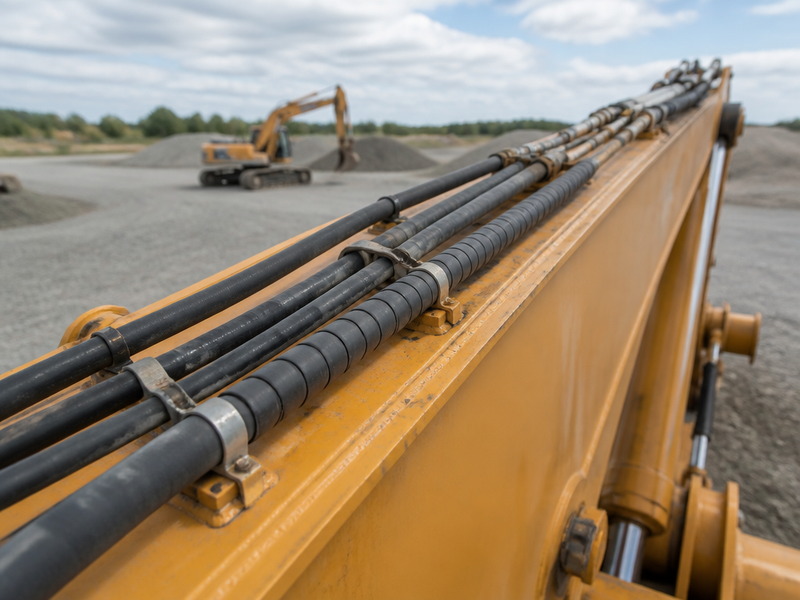
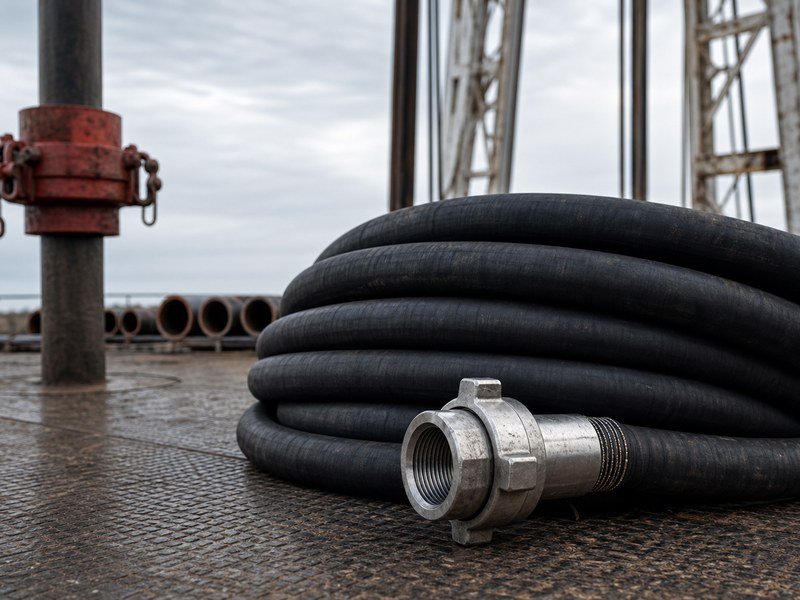
Figure 3. On real equipment the construction types usually appear side by side: spiral-wound hose on the highest-pressure circuits, double wire braid on most working lines, and textile or compact constructions on return and pilot lines.
What Is the Best Type of Hydraulic Hose for Your Application?
There is no single best hydraulic hose, but there is a best answer for each duty, and it is usually the cheapest construction that still meets the working pressure with the impulse life the circuit needs. In order of how often they are the right answer: double wire braid SAE 100R2 for general mobile and industrial pressure lines, single wire braid SAE 100R1 for steady medium-pressure duty, spiral-wound SAE 100R12 or 100R13 above roughly 4,000 PSI or in constant-impulse service, textile braid SAE 100R3 or 100R6 for return and pilot lines, thermoplastic SAE 100R7 or 100R8 for tools and tight routing, PTFE SAE 100R14 for heat and aggressive fluids, and SAE 100R4 where the line has to resist vacuum instead of pressure.
The “best” hose is therefore a by-product of the five numbers in the previous section, not a product tier — and a supplier that answers the question without asking for those numbers is guessing.
How Each Type of Hydraulic Hose Fails — and What to Inspect
Every construction family has a characteristic failure mode, and inspecting for the one that belongs to your type of hydraulic hose is faster than inspecting for everything.
Table 9. Typical failure mode, visible evidence, and first inspection point by construction type
| Bauwesen | Typical failure mode | Visible evidence | Check first |
|---|---|---|---|
| Wire braid (SAE 100R1, 100R2) | Braid fatigue at a kink or chafed spot, then pinhole leak or burst | Exposed wire, flattened sections, cover blisters | The six inches behind each fitting, then any contact point |
| Spiral (SAE 100R12, 100R13, 100R15) | Sound reinforcement with a damaged cover or weeping crimp | Cut or abraded cover, oil film at the ferrule | Abrasion points and the crimp, not the hose body |
| Textile braid (SAE 100R3, 100R6) | Tube swelling or cover cracking; collapse if over-pressurized | Soft or swollen tube, cracked cover, kinked section | The tube, once the hose is cut open at the suspect point |
| Thermoplastic (SAE 100R7, 100R8) | Kinking near the fitting; tube hardening in sustained heat | Tight bend at the ferrule, stiff or brittle tube | The first 150 mm behind each fitting and the hot spots along the run |
| PTFE (SAE 100R14) | Braid fatigue where the assembly flexes often | Broken or frayed stainless braid, core still intact | Any point where the assembly moves in service |
| Suction and return (SAE 100R4) | Helix collapse or tube delamination after vacuum spikes | Flattened section, separated layers at a cut end | The pump inlet and any point where the hose is bent sharply |
In our own assembly testing, the inspection point that catches the most imminent failures is the six inches behind each fitting: crimp stress, routing bend, and vibration all concentrate there, and a returned hose almost always shows its first damage in that zone.
How Long Does a Hydraulic Hose Last, and When Should You Replace It?
Rubber hydraulic hose is commonly given a service window of five to ten years from the date code printed on the cover — an industry practice rather than a fixed standard requirement, and shorter in hot, oily, or UV-exposed service. The two clocks are separate, and both are worth tracking: the storage clock starts at the date code and runs in the warehouse, while the service clock starts at installation and is shortened by heat, pressure cycling, and abrasion. Verify both against the hose manufacturer’s published guidance for your fluid and duty cycle.
Inspect hoses at every oil change and replace any hose that shows cover cracks or blisters, exposed wire braid, soft or bulging sections, leaks at the fitting or along the body, or a kink that will not straighten. A fitting that spins on the hose end is also a replacement, not a repair. For fleets, a one-line log per hose — position, size, standard family, install date, and date code — turns repair history into a scheduled replacement plan.
What Do Different Types of Hydraulic Hose Cost?
Price scales with reinforcement, and the honest answer to “how much does hydraulic hose cost” always starts with which of the types of hydraulic hose you are buying. The figures below are planning ranges for bulk hose only, excluding fittings and assembly, based on 2026 market levels; the assembled price of a finished hose is higher, because crimped fittings on both ends commonly add more to the total than the hose itself.
Table 10. Typical bulk hydraulic hose cost by type — planning ranges for bulk hose only, excluding fittings and assembly, 2026 market; confirm by RFQ
| Type | Typical cost per foot | Typical cost per meter | Cost driver |
|---|---|---|---|
| Textile braid (SAE 100R3, 100R6) | $0.80-$2.00 | $2.60-$6.50 | Fiber reinforcement |
| Single wire braid (SAE 100R1) | $1.50-$3.00 | $5.00-$10.00 | One steel braid |
| Double wire braid (SAE 100R2) | $2.00-$5.00 | $7.00-$16.00 | Second braid layer |
| Thermoplastic (SAE 100R7, 100R8) | $1.50-$4.00 | $5.00-$13.00 | Polymer tube, fiber reinforcement |
| Spiral-wound (SAE 100R12, 100R13) | $5.00-$12.00 | $16.00-$39.00 | Four to six spiral wire layers |
| PTFE (SAE 100R14) | $8.00-$20.00 | $26.00-$65.00 | PTFE core plus stainless braid |
Three commercial factors move the final number as much as the type does: order quantity and minimum order quantity, lead time, and the warranty behind the hose. Two quotes for the same 100R2 are rarely quoting the same product, because the difference is usually an in-house impulse-tested construction against an unbranded one. Send the duty, the bore, and the fitting ends, and we will price the same scope line by line so the comparison is real.
Frequently Asked Questions
These are the twelve questions buyers ask most often about hydraulic hose construction, with the short answer first and the detail behind it.
What are the main types of hydraulic hose?
Six construction families cover most hydraulic lines: single wire braid (SAE 100R1), double wire braid (SAE 100R2), spiral-wound (SAE 100R12, 100R13, 100R15), textile braid (100R3, 100R6), thermoplastic (100R7, 100R8), and PTFE (100R14). Suction and return hose (100R4) is a seventh group built for vacuum rather than pressure. Almost every catalogue entry you will meet is a variation on one of those seven.
What is the most common type of hydraulic hose?
Double wire braid, SAE 100R2 or EN 853 2SN, is the most common of all the types of hydraulic hose in service. In 3/8-inch bore it is rated 4,000 PSI working pressure, it bends well enough for mobile routing, and it covers the pressure range of most excavator, loader, tractor, and industrial circuits. It stops being the answer in two situations: when the circuit is above roughly 4,000 PSI or spikes constantly, where a spiral construction takes over, and when the line carries little pressure and needs maximum flexibility, where textile braid or a compact construction is cheaper and easier to route.
What is the difference between SAE 100R1 and 100R2?
The two designations refer to two of the main types of hydraulic hose in the braided family: 100R1 has one steel wire braid and 100R2 has two, which in 3/8-inch bore takes working pressure from 2,280 PSI to 4,000 PSI on the SAE J517 table. The practical boundary is not the pressure number but the duty: 100R1 is the economical answer for steady medium-pressure duty with low cycle counts, and it stops being acceptable as soon as the circuit sees regular shock loads, because one braid layer fatigues sooner. When a 100R1 line has failed young, the first question to ask is not whether the pressure rating was exceeded but how often the circuit spikes.
What is the difference between a two-wire braid and a four-wire spiral hydraulic hose?
Two-wire braid (SAE 100R2) weaves two steel layers; four-wire spiral (SAE 100R12 and similar) winds four layers in alternating directions, which distributes impulse load across more wires and expands less under pressure. The specification boundary is usually stated as pressure — above roughly 4,000 PSI, or where surge events are constant — but the deciding evidence is the impulse test: ask which standard a spiral claim was qualified to, at what pressure and cycle count, and compare the quoted cycle count against the 200,000-cycle published minimum before you compare it against the price.
How do I tell which type of hydraulic hose I already have?
Read the printed layline on the cover: it gives the standard family (for example SAE 100R2), the bore size, the working pressure, and often the burst pressure and date code. If the printing is worn away, a spiral hose is visibly stiffer and heavier in the hand than a braided hose of the same size, and a textile hose is noticeably lighter than either. When the marking is unreadable, treat the hose as unrated and replace it with a known family; the full field-by-field reading method is in our guide to the hydraulic hose layline and pressure ratings.
Can I crimp a new fitting onto an existing hose?
Only onto the hose end that has not been crimped before. A crimped ferrule takes a permanent set when it is installed, so cutting a fitting off and re-crimping the same hose end does not reproduce the original crimp geometry — the correct repair is to shorten the hose past the damaged section and crimp a fresh end, provided the remaining length still suits the routing. Reusable fittings exist for some sizes as an emergency practice; they must be specified as reusable from the start.
What temperature range does hydraulic hose work in?
Match the family to the hotter of the two temperatures — the fluid inside and the ambient or radiant heat outside. Standard nitrile-tube rubber hose covers the mineral-oil range at −40 °C to +100 °C continuous, spiral hose reaches +121 °C, thermoplastic stops at +93 °C, and PTFE runs to +204 °C with high-temperature grades above that. Then re-check the working pressure at the temperature you settled on, because a rating is only valid inside its printed window; the four-rung ladder in Step 3 carries the exact values.
Can I use a hydraulic hose for air, water, or steam?
A hydraulic hose is rated for oil and specified for its fluid compatibility, not for gas. High-pressure air service stores far more energy than hydraulic fluid at the same pressure, so it demands hose rated for that duty. For steam, chemical, or high-temperature water service, specify a PTFE or application-specific hose rather than adapting a hydraulic line — the comparison in our hydraulic hose vs air hose guide explains why compressed gas changes the calculation.
How do I know what pressure rating my hose needs?
Use the machine’s relief valve setting, then apply a surge factor of 1.25 for shock-loaded circuits — an industry practice rather than a fixed standard requirement: a 3,000 PSI system becomes a 3,750 PSI specification. Select the type whose working pressure — not burst pressure — meets or exceeds that number in the bore size you need, and then check the second requirement behind every hydraulic hose pressure rating: whether the hose’s impulse qualification suits how often the circuit spikes.
Which hydraulic hose sizes should a distributor stock?
Most territories are covered by 100R2 in -6, -8, and -12 as default pressure-line stock, plus -4 and -16 for compact and heavy equipment. Adding 100R1 in -6 and -8 for low-pressure work, a suction and return family in -12 and -16, and thermoplastic in -4 and -6 covers the majority of field calls. Two items move faster than any stocking theory: the sizes the local fleet actually runs, and the one or two sizes that every emergency call asks for.
How much does it cost to replace a hydraulic hose?
As a 2026 planning range — bulk hose only, with fittings and assembly priced separately — bulk 100R2 typically runs $2.00-$5.00 per foot, so a 4-foot assembled hose with two crimped fittings commonly lands in the $25-$80 range depending on fitting type, bore, and quantity. What moves that number is not the hose: fittings, proof testing, documentation, order quantity, and lead time usually decide the delivered cost of the assembly, and a spiral replacement costs more because both the hose and the fittings are heavier. Compare quotes on the delivered cost per assembly, not on the price per foot.
What happens if I send an incomplete specification?
You get a quote for the construction the supplier guessed, and the revision later costs more than the missing information. The three omissions that most often force a re-quote are duty cycle (which decides braid versus spiral), fluid type (which decides the tube compound), and end fittings with their angles (which decide whether the assembly installs at all). Sending the full seven-item checklist from this guide is the difference between a firm quote and an estimate; the items themselves are listed in the selection checklist under Step 5.
Final Verdict: Match the Construction to the Duty, Then Verify the Manufacturer
Choosing among types of hydraulic hose is not a matter of picking the strongest product on a catalogue page. It is a short sequence: read the working pressure and flow off the machine, confirm the fluid and temperature, respect the bend radius, match the fittings, and then choose the family whose published hydraulic hose pressure rating covers the duty — braid for general pressure lines, spiral for high-impulse circuits, textile or compact for returns, thermoplastic for tools and tight routing, PTFE for heat and aggressive fluids, helix-reinforced for suction.
The last step is the one buyers skip: verifying that the manufacturer actually tests what it sells. HENGHUA manufactures rubber hydraulic hose and assembled lines in single wire braid, double wire braid, and spiral-wound constructions from 1/4 to 2 inch bore, to SAE J517, DIN EN 853, and EN 856, with crimped JIC, ORFS, NPT, BSP, and SAE flange fittings in every dash size. Because compound mixing, wire braiding, extrusion, crimping, and pressure testing all happen in our own plant, we can supply the impulse and proof-test report with the shipment rather than on request — and we can supply compatible tube compounds for mineral oil, water-glycol, and biodegradable fluids. Whether you are replacing one line or standardizing a machine program, send your specification checklist and our engineers will confirm the correct construction and quote — request a quote and free samples.
 English
  Spanish
  Portuguese
  French
  German
  Arabic
  Russian