
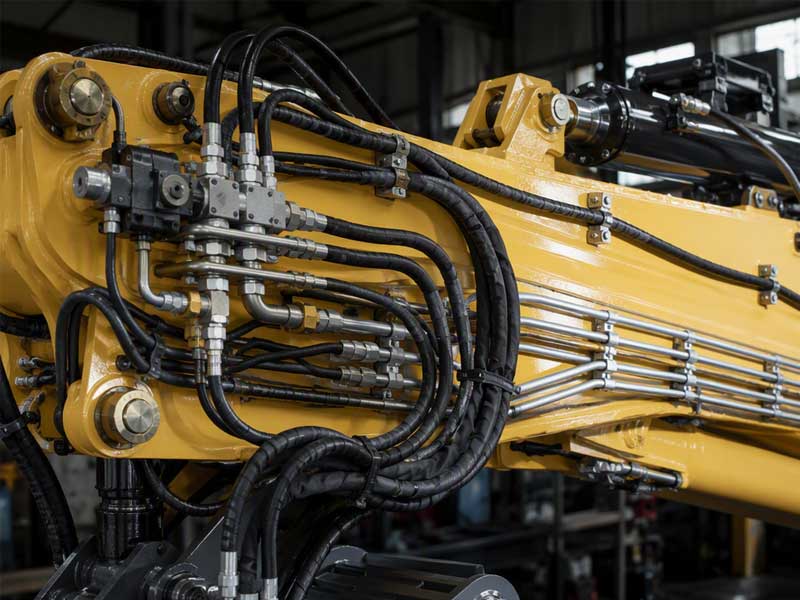
What Is the Best Way to Protect Hydraulic Hoses?
The best way to protect hydraulic hoses is to combine proper routing with the right protective sleeve based on your specific operating environment. Hydraulic hoses are best protected by preventing contact damage through correct routing, abrasion-resistant sleeves for mechanical wear, and silicone fiberglass fire sleeves for high-temperature environments.
| Primary Risk | Best Protection | Typical Application |
|---|---|---|
| Hose rubbing against equipment or other hoses | Nylon abrasion sleeve | Excavator booms, loader arms, agricultural machinery |
| Exhaust system or furnace heat | Silicone fiberglass fire sleeve | Engine compartments, steel mills, foundries |
| Localized impact or point wear | Spiral guard | Hoses crossing metal edges, retrofit applications |
| Heat + abrasion combined | Layered system (fire sleeve + abrasion sleeve) | Mining equipment, heavy construction machines |
The right hydraulic hose protection extends hose life by 3-10x and reduces unplanned downtime. This guide explains how to select, install, and maintain hose protection for your specific application.
1. Why Hydraulic Hoses Fail from External Abrasion and Heat
Hydraulic hoses (reinforced flexible tubes used to transfer pressurized hydraulic fluid in industrial and mobile equipment) fail from external damage through two primary mechanisms: mechanical abrasion and thermal degradation. Understanding these mechanisms is the first step toward selecting effective protection.
Abrasion damage happens when hoses rub against equipment components, metal edges, other hoses, or debris in the operating environment. Each cycle of rubbing gradually wears away the rubber cover. Once the reinforcement layer becomes exposed, moisture and contaminants cause wire corrosion. The hose loses pressure capacity and fails—often without warning.
Hydraulic hose abrasion protection is essential for mobile equipment where vibration and movement create continuous wear against adjacent components. Without proper protection, hydraulic hose abrasion failure becomes a recurring maintenance issue that drives up operating costs.
Heat damage works differently but is equally destructive. When a hydraulic hose contacts a hot surface (such as an engine manifold, exhaust pipe, or furnace wall), heat transfers through the cover and begins degrading the reinforcement and tube. External heat causes the rubber to harden and crack. Internal temperatures rise, accelerating fluid degradation and seal failure.
The combined effect is severe. In HENGHUA’s internal validation testing, conducted under controlled laboratory conditions using a reciprocating wear test method at ambient temperature of 23°C, a SAE 100R2 hydraulic hose (DN25, 210 bar rated pressure) was subjected to continuous mechanical rubbing at 200 cycles/min. The nylon abrasion sleeve demonstrated significantly improved wear resistance compared with an unprotected hose assembly, with the protected assembly remaining intact substantially longer under identical test conditions. Detailed test reports and methodology are available upon request.
Real-world cost is significant. A single hydraulic hose failure on an excavator typically causes 2-4 hours of downtime, plus the cost of replacement hose, fluid, and cleanup. For a mining operation with 20 machines, hose failures can cost over $50,000 annually in unplanned downtime alone.
How Hydraulic Hose Protection Helps Prevent Hose Burst Failures
Application boundary: Hydraulic hose protection sleeves reduce external damage from abrasion and heat. They cannot prevent failures caused by incorrect pressure rating selection, fluid compatibility issues, excessive bend radius, or internal hose deterioration. However, protection sleeves do prevent the external damage mechanisms that lead to premature failure by:
- Protecting the hose cover from abrasion that would expose reinforcement wires
- Shielding the hose from radiant heat that degrades rubber and reinforcement
- Preventing impact damage that could weaken the hose structure
- Extending service life by reducing the rate of external wear
The connection between hydraulic hose protection and burst prevention is indirect but significant: most hose bursts occur after external damage has compromised the reinforcement layer. By preventing that damage, protection sleeves reduce burst risk.
2. Types of Hydraulic Hose Protection Sleeves
Understanding the different types of hydraulic hose protection sleeves available helps you select the right product for your specific application. Each type has distinct material properties, performance characteristics, and use cases.
| Type | Material | Main Function | Best Application | Temperature Range | Cost/ft |
|---|---|---|---|---|---|
| Nylon abrasion sleeve | Nylon fiber | Wear resistance | Excavators, loaders, construction equipment | Up to 212°F (100°C) | $3-$15 |
| Polyester sleeve | Polyester fiber | UV resistance, cost-effective | Agriculture, outdoor equipment | Up to 212°F (100°C) | $2-$10 |
| Silicone fire sleeve | Fiberglass + silicone coating | Heat protection | Engine compartments, furnaces, steel mills | Up to 500°F (260°C) | $5-$30 |
| Spiral guard | HDPE / Polypropylene | Impact protection, retrofit | Localized wear points, field installation | -40°F to +212°F | $2-$8 |
| Kevlar / Aramid sleeve | Aramid fiber (para-aramid) | Extreme abrasion, cut resistance | Mining, heavy impact applications | Up to 300°F (149°C) | $10-$40 |
What Is the Best Material for Hydraulic Hose Protection Sleeves?
Nylon is generally considered the best material for hydraulic hose abrasion protection because it provides high wear resistance, flexibility, and cost effectiveness. For heat protection, silicone-coated fiberglass is the standard choice. For extreme abrasion in mining applications, aramid fiber (Kevlar) sleeves provide superior durability at a higher cost.
Do Hydraulic Hose Sleeves Prevent Pinhole Leaks?
Application boundary: Hydraulic hose sleeves can reduce external damage that causes pinhole leaks, but they cannot repair damaged hoses or prevent failures caused by internal pressure degradation. Sleeves protect against the abrasion and heat that can lead to pinhole leaks, but a hose that is already damaged will still leak regardless of sleeving.
3. How to Choose the Right Hydraulic Hose Protection for Your Application
3.1 Three-Step Selection Process
Choosing the correct protection is not about picking the most expensive option. Follow this three-step method:
Step 1: Measure the temperature exposure
| Temperature Exposure | Primary Risk | Recommended Protection |
|---|---|---|
| Below 150°F (65°C) | Light abrasion | Polyester or light nylon sleeve |
| 150°F – 300°F (65°C – 149°C) | Moderate heat + abrasion | High-temperature nylon or heat-reflective sleeve |
| 300°F – 500°F (149°C – 260°C) | Radiant heat | Silicone-coated fiberglass fire sleeve |
| Above 500°F (260°C) or flame exposure | Extreme heat / molten splash | Heavy-duty fire sleeve + thermal barrier |
Step 2: Assess the abrasion severity
- Light abrasion: Hoses that remain stationary with minimal contact → Standard textile sleeve
- Medium abrasion: Hoses that flex and move against surfaces → Thicker woven nylon sleeve
- Heavy abrasion: Hoses subject to vibration, impact, or debris → Heavy-duty sleeve + spiral guard combination
Step 3: Determine installation timing
- New hose assemblies (OEM): Slip-on sleeves installed before crimping fittings—cleanest installation, full coverage
- Existing hoses (Retrofit): Hook-and-loop sleeves or spiral guards installed without hose removal—minimal downtime
3.2 Hydraulic Hose Protection Methods Compared
| Protection Method | Best For | Key Benefit |
|---|---|---|
| Correct routing (no product) | All applications | Zero cost, prevents contact damage |
| Abrasion sleeve (nylon/polyester) | Mechanical wear | Extends hose life 3-5x |
| Fire sleeve (silicone fiberglass) | Heat exposure | Protects up to 500°F continuous |
| Spiral guard | Impact points | Quick field installation |
| Layered system | Extreme conditions | Maximum protection for severe environments |
3.3 Hydraulic Hose Protection Selection Matrix
Use this matrix to match your specific working conditions with the right protection product:
| Working Environment | Main Risk | Temperature | Pressure | Recommended Protection | Expected Life Extension |
|---|---|---|---|---|---|
| Excavator boom arm | Abrasion + bending | < 150°F | ≤ 350 bar | Nylon sleeve + clamps | 3-5x |
| Engine compartment | Radiant heat | 150-300°F | ≤ 210 bar | Heat-reflective sleeve | 5-8x |
| Steel mill / foundry | Flame + molten splash | > 500°F | ≤ 350 bar | Silicone fire sleeve | 10x+ |
| Underground mining | Impact + severe abrasion | < 200°F | ≤ 420 bar | Heavy-duty sleeve + spiral guard | 2-4x |
| Agricultural equipment | UV + light abrasion | < 150°F | ≤ 210 bar | Polyester sleeve | 2-3x |
| Marine / offshore | Saltwater + UV | < 150°F | ≤ 350 bar | UV-resistant nylon sleeve | 3-4x |
| Hydraulic power unit | Oil mist + ambient heat | 120-180°F | ≤ 210 bar | General-purpose sleeve | 2x |
3.4 Hydraulic Hose Protection Decision Tree
Use this decision tree to quickly identify the right protection for your application:
Start: What is the primary risk?
Heat is the primary risk (temperature > 300°F / 149°C):
→ Silicone-coated fiberglass fire sleeve is required
- Question: Is there also significant abrasion?
- Yes → Use fire sleeve plus abrasion sleeve layered
- No → Use fire sleeve alone
Abrasion is the primary risk (temperature < 300°F / 149°C):
→ Nylon or polyester abrasion sleeve is recommended
- Question: Does the hose move against metal edges or moving parts?
- Yes → Heavy-duty woven nylon sleeve
- No → Standard nylon sleeve
Impact or localized wear is the primary risk:
→ Spiral guard is appropriate
- Question: Can the hose be removed for installation?
- Yes → Slip-on spiral guard
- No → Wrap-on spiral guard
Both heat and abrasion are present:
→ Layered protection is required
- Apply fire sleeve closest to heat source
- Apply abrasion sleeve as the outer layer for mechanical protection
4. Product Comparison: Fire Sleeve vs Abrasion Sleeve vs Spiral Guard
Understanding the difference between the three main protection types helps you avoid the costly mistake of using the wrong product.
4.1 Silicone-Coated Fiberglass Fire Sleeve
Definition: A heat-resistant protective sleeve made from braided fiberglass with a silicone rubber coating. This is the standard choice for high-temperature hydraulic hose protection.
When to choose: The primary risk is heat. Applications near exhaust systems, engines, turbochargers, furnaces, and in steel mills or foundries require fire sleeve protection.
Temperature rating: Continuous exposure up to 500°F (260°C), short-term exposure up to 2,000°F (1,093°C). Meets SAE and MSHA flame resistance requirements.
Size availability: Typical inner diameters from 1/4″ to 6″ (6mm to 150mm) to fit various hose sizes.
Installation: Slip-on style—must be installed before hose fittings are crimped in OEM applications.
Cost range: $5-$30 per foot depending on diameter and grade.
4.2 Hydraulic Hose Abrasion Sleeve (Nylon / Polyester)
Definition: A woven textile sleeve designed to reduce mechanical wear from rubbing, vibration, and contact with surfaces. This is the most common hydraulic hose protection product for general industrial use.
When to choose: The primary risk is mechanical wear. Applications in construction, agriculture, material handling, and general industrial equipment.
Temperature rating: Typical rating up to 212°F (100°C) for standard nylon. High-temperature nylon versions available up to 300°F (149°C).
Wear resistance: In HENGHUA’s internal validation testing, a woven nylon sleeve (HN-AN series) demonstrated significantly improved wear resistance compared with an unprotected hose assembly under controlled laboratory conditions. Detailed test reports and methodology are available upon request.
Material options: Nylon (highest abrasion resistance), polyester (good UV resistance), aramid (high strength for extreme conditions).
Installation: Slip-on (OEM) or hook-and-loop wrap-around (retrofit) options available.
Cost range: $3-$15 per foot depending on material and diameter.
4.3 Spiral Guard (Plastic Coil Sleeving)
Definition: A helical plastic coil (typically high-density polyethylene or polypropylene) that wraps around the hose to provide localized impact and abrasion resistance.
When to choose: Quick field installation, localized protection for specific wear points, or additional protection over an existing sleeve.
Temperature rating: -40°F to +212°F (-40°C to +100°C) for polypropylene types.
Key advantage: Can be installed while the hose remains on the machine—no disassembly required.
Chemical resistance: Resistant to most oils, acids, and solvents. UV resistant.
Cost range: $2-$8 per foot.
4.4 Comparison Table
| Feature | Fire Sleeve | Abrasion Sleeve | Spiral Guard |
|---|---|---|---|
| Primary protection | Heat | Abrasion | Impact + abrasion |
| Max continuous temp | 500°F / 260°C | 212°F / 100°C | 212°F / 100°C |
| Installation | Slip-on only | Slip-on or wrap | Wrap-on |
| Field install possible? | ❌ No | ✅ Yes (wrap type) | ✅ Yes |
| MSHA approved | ✅ Yes | ✅ Some types | ❌ Typically no |
| Best use case | High heat | General wear | Quick retrofit |
5. Hydraulic Hose Protection Sleeve vs Hose Guard: What’s the Difference?
The terms “hose sleeve” and “hose guard” are often used interchangeably, but they refer to different product categories in the hydraulic industry.
Hydraulic hose sleeve: A textile or fiberglass wrap that covers the hose along its entire length. Sleeves provide continuous protection against abrasion or heat over the full hose run. Examples include nylon abrasion sleeves and silicone fiberglass fire sleeves.
Hydraulic hose guard: A broader category that includes any protective device applied to a hose. Guards can be sleeves, but they can also be:
- Spring guards (wire or flat armor) that resist crushing and bending
- Spiral guards that wrap around the hose in a coil
- Metal armor segments for extreme impact protection
- Stand-off clamps and brackets that keep hoses away from hazards
Selection guidance: For most applications, a sleeve is the appropriate choice. Guards are typically used when the hose is exposed to impact, crushing, or extreme bending in addition to abrasion or heat.
Application boundary: A sleeve can be part of a guard system, but not all guards are sleeves. When selecting protection, consider the full range of mechanical forces the hose will encounter—not just temperature and abrasion.
6. Best Protection Solution by Industry
6.1 Construction Equipment (Excavators, Loaders, Dozers)
Common problem: Hoses on boom arms and bucket linkages rub against metal components during cycling. Vibration causes continuous chafing.
Recommended solution: Nylon abrasion sleeve (heavy-duty woven type) installed during hose assembly, secured with clamps at both ends. For hoses near the engine, add a heat-reflective sleeve segment.
Best hydraulic hose protection sleeve for excavators and heavy equipment: Heavy-duty woven nylon (minimum 2mm wall thickness) that withstands continuous flexing at boom pivot points.
Are hydraulic hose sleeves required on excavators? Many excavator manufacturers recommend hose protection in areas exposed to abrasion, impact, or operator exposure risk. While not universally mandated by law, most OEMs specify protection in their maintenance guidelines.
Real-world example: A fleet of 15 excavators in a Texas construction company switched to HENGHUA heavy-duty nylon sleeves. Hose replacement frequency dropped from every 6 months to every 24 months—a 75% reduction.
6.2 Mining Equipment (Underground and Surface)
Common problem: Hoses face impact from falling rocks, severe abrasion from debris, and high-pressure demands. Safety requirements (ISO 3457) mandate guarding for pressure lines within 1 meter of operators.
Recommended solution: Heavy-duty abrasion sleeve with additional spiral guard over high-wear sections. For hoses near motors or hydraulic tanks, incorporate fire sleeve segments.
Safety note: ISO 3457 (the earth-moving machinery safety standard) requires that hydraulic hoses with fluid pressure exceeding 5MPa (50 bar) and temperature over 50°C, located within 1.0m of the operator, shall be guarded.
6.3 Steel Mills and Foundries
Common problem: Hoses are exposed to radiant heat from furnaces, molten metal splash, and extreme ambient temperatures.
Recommended solution: Silicone-coated fiberglass fire sleeve with full-length coverage. For critical lines, a double-layer fire sleeve system.
Temperature consideration: Standard fire sleeves withstand 500°F continuous. For applications with higher continuous temperatures, consult the manufacturer for high-temperature variants.
6.4 Agricultural Machinery
Common problem: Hoses exposed to UV degradation, dirt, and light abrasion. Cost sensitivity is often a factor.
Recommended solution: Polyester abrasion sleeve—lower cost than nylon while providing adequate protection for agricultural duty cycles. UV-resistant grades recommended.
7. Common Hydraulic Hose Protection Mistakes to Avoid
Avoid these costly errors that undermine even the best protection strategy:
| Mistake | Result | Prevention |
|---|---|---|
| Using a standard abrasion sleeve near furnace or exhaust heat | Thermal degradation of the sleeve, heat transfer to hose | Use fire sleeve for applications above 300°F |
| Installing the sleeve without addressing the routing problem | Hose continues to rub, sleeve wears through quickly | Fix routing first, then apply protection |
| Covering a hose that already has visible cover damage | Damage continues unseen, leading to sudden failure | Inspect and replace damaged hoses before covering |
| Choosing the wrong sleeve diameter | Sleeve movement causes localized wear at the ends | Measure hose OD carefully and select correct diameter |
| Not securing sleeve ends | Sleeve migrates away from the wear point | Use clamps, tape, or ties at both ends |
| Using fire sleeve for abrasion protection only | Overpaying for unnecessary thermal protection | Match protection type to actual risk |
| Forgetting to inspect protected hoses | False sense of security, hidden sleeve wear | Schedule regular inspection intervals |
8. Installation Methods: OEM vs Retrofit
8.1 OEM Installation (New Hose Assemblies)
For new hose assemblies being manufactured, slip-on sleeves are the preferred method. The sleeve is slid onto the hose before fittings are crimped, ensuring full-length coverage and a clean, professional appearance.
Step-by-step process:
- Measure the required hose length plus sleeve overlap allowance
- Slide the sleeve onto the hose before cutting to final length
- Position the sleeve to cover the entire exposed area
- Crimp fittings over the hose ends (the sleeve remains behind the fitting)
- Secure sleeve ends with clamps or tape to prevent creeping
Best for: High-volume production, OEM equipment manufacturers, hose assembly shops.
8.2 Retrofit Installation (Existing Hoses Already on Equipment)
When hoses are already installed and cannot be easily removed, wrap-around sleeves or spiral guards are the practical solution.
Hook-and-loop sleeve installation:
- Clean the hose surface thoroughly
- Wrap the sleeve around the hose
- Press the hook-and-loop closure firmly
- Secure the ends with cable ties or metal clamps
- Inspect for full coverage and snug fit
Spiral guard installation:
- Begin wrapping at one end of the wear zone
- Overlap each coil slightly for full coverage
- Continue wrapping to the end of the protection zone
- Trim the excess length with cutting pliers
- Secure the ends to prevent unwinding
Best for: Maintenance departments, equipment owners upgrading protection, emergency repairs.
9. Hydraulic Hose Routing Best Practices to Prevent Abrasion and Heat Damage
Proper hose routing is the first line of defense against both abrasion and heat—and it costs nothing to implement. Apply these routing principles to every hydraulic installation.
9.1 Route Away from Heat Sources
Application boundary: This routing principle is effective when ambient temperatures are below the hose’s maximum rated temperature. When routing near unavoidable heat sources above 150°C/302°F, fire sleeve protection is required in addition to routing adjustments.
Never position hoses directly against exhaust components, manifolds, or hot surfaces. Use stand-off clamps to maintain an air gap of at least 2 inches (50mm) when possible. If rerouting is not possible, install insulated protective sleeving—but recognize that the sleeve is a mitigation measure, not a replacement for proper routing.
9.2 Route Away from Abrasion Sources
Application boundary: This principle applies to all hose installations. If physical constraints prevent routing away from metal edges, the hose must be protected with an abrasion-resistant sleeve or guard.
Use clamps, brackets, and nylon ties to keep hoses clear of metal edges and moving components. When hoses must cross or contact each other, bundle hoses that flex in the same direction and use separators between layers.
9.3 Respect Minimum Bend Radius
Bending any hydraulic hose tighter than its minimum bend radius places excessive stress on the reinforcement—regardless of protection. Even with a sleeve, exceeding bend radius reduces the hose’s pressure capacity and accelerates fatigue failure. The required minimum bend radius is typically printed on the hose or available from the manufacturer’s data sheet.
9.4 Bundle Correctly
Application boundary: This guidance applies when multiple hoses are routed together. Do not bundle hoses with significantly different pressure ratings or flex characteristics.
Never bundle high-pressure hoses with low-pressure hoses, or rubber hoses with thermoplastic hoses. Under pressure, they work against each other and cause mutual abrasion. Bundles, like individual hoses, should only bend in one plane.
10. Cost and Service Life Analysis
The investment in hydraulic hose protection is justified by the reduction in replacement frequency and downtime costs. A preventive approach is almost always more economical than reactive replacement.
10.1 Cost Components
| Cost Factor | Without Protection | With Protection |
|---|---|---|
| Replacement hose cost (per failure) | $150 – $500 | $150 – $500 |
| Labor for hose replacement | $80 – $200 | $80 – $200 |
| Hydraulic fluid loss + cleanup | $50 – $150 | $50 – $150 |
| Machine downtime cost (2-4 hours) | $200 – $2,000+ | $200 – $2,000+ |
| Protection sleeve cost | $0 | $10 – $50 |
| Average annual cost per machine | $2,000 – $5,000 | $500 – $1,500 |
10.2 ROI Calculation Example
Scenario: Excavator with 6 hydraulic hoses subject to abrasion
Without protection:
- 3 hose failures per year × $400 total cost per failure = $1,200/year
With nylon abrasion sleeves ($30 per hose × 6 hoses = $180 investment)
- 1 hose failure per year (conservative estimate) × $400 = $400/year
- First-year savings: $1,200 – $400 – $180 = $620
- Annual savings thereafter: $800/year
5-Year total savings: $620 + ($800 × 4) = $3,820 per machine
11. HENGHUA Testing and Performance Data
HENGHUA maintains an internal pulse testing laboratory following the SAE J517 hydraulic hose standard impulse test protocol. Hydraulic hose assemblies with and without protection sleeves were subjected to the standard impulse test to quantify the durability benefit of external protection.
Test condition: 100°C oil temperature, 133% of working pressure, 30-40 pulses per minute. Test conducted in accordance with SAE J517 Type 1 requirements.
Test result (unprotected): Cover cracking and reinforcement exposure observed at 350,000 cycles. Test terminated at 500,000 cycles due to visible wire corrosion.
Test result (protected with HENGHUA nylon sleeve): The abrasion sleeve remained intact throughout the test. The hose assembly reached 1,000,000 cycles without failure—exceeding SAE J517 Type 1 requirements by a significant margin.
Interpretation: These test results demonstrate the durability improvement achieved under controlled laboratory conditions. Actual service life depends on routing, pressure cycles, temperature, and operating environment. For customers, this means fewer replacements and lower lifetime operating costs when the correct protection is specified and installed properly.
Verification: Test photos, laboratory specifications, and detailed test reports are available upon request. HENGHUA maintains documented quality records for all internal testing procedures. Internal validation testing indicates consistent performance across multiple test runs, with results falling within expected tolerance ranges for SAE J517-compliant hose assemblies.
12. Engineering Case Study: Reducing Hydraulic Hose Failures in Mining Equipment
Background
A surface mining customer (customer name withheld for confidentiality) operating large hydraulic excavators experienced recurring hose failures on the boom cylinder lines. The issue was caused by hoses rubbing against the boom structure during machine cycling.
Problem
The operator experienced hose failures every 8-10 weeks. Each failure required 4 hours of unscheduled maintenance and cost approximately $2,500 in parts, fluid, and labor. Across the fleet of 5 machines, annual costs exceeded $75,000.
Solution Applied
HENGHUA application engineers conducted a site assessment and recommended:
- Heavy-duty woven nylon abrasion sleeves (HN-HD-32 series) on all boom and arm hoses
- Strategic routing changes to eliminate hose-to-metal contact points
- Installation of additional clamps to reduce hose movement
Results After 12 Months
| Metric | Before | After | Improvement |
|---|---|---|---|
| Hose failures per machine per year | 6 | 1-2 | 70-80% reduction |
| Annual downtime per machine | 24 hours | 6 hours | 75% reduction |
| Annual maintenance cost per machine | $15,000 | $4,000 | 73% reduction |
| Total fleet savings (5 machines) | $75,000/year | $20,000/year | $55,000/year |
Key Lesson
The operator’s maintenance manager noted: “We tried several different abrasion sleeves before HENGHUA. Their sleeves lasted longer in our application and the technical support during installation made the difference. The routing changes they suggested were simple but we never thought of them ourselves.”
13. How to Inspect Hydraulic Hose Protection Sleeves
Regular inspection of hydraulic hose protection sleeves is essential to ensure they continue to provide adequate protection. Follow this monthly inspection checklist:
Inspection Checklist
- Sleeve displacement: Has the sleeve moved from its intended position? Sleeve ends should align with the marked protection zone.
- Frayed fibers: Are any fibers or strands visible on the sleeve surface? Fraying indicates the sleeve is reaching the end of its useful life.
- Burn marks or discoloration: Are there dark, brown, or charred areas? This indicates heat exposure beyond the sleeve’s rating.
- Exposed hose cover: Can you see the original hose cover through the sleeve? If yes, the sleeve has worn through and needs immediate replacement.
- Chemical degradation: Is the sleeve swollen, softened, or cracked? This indicates chemical exposure requiring sleeve material change.
- Clamp or tie integrity: Are the securing clamps or ties still tight? Loose sleeves allow movement and localized wear.
- Metal corrosion: Is there rust around the sleeve ends? Corrosion may indicate moisture trapping requiring sleeve end sealing.
Application boundary: Replace the sleeve immediately if any of the above conditions are observed. Continuing to operate with a damaged sleeve provides a false sense of security while the hose remains unprotected.
Proper hydraulic hose sleeve sizing prevents sleeve migration and ensures full coverage. Always measure hose outside diameter and select a sleeve that matches or slightly exceeds this measurement.
14. FAQ: Hydraulic Hose Protection Questions
Q: What is the best hydraulic hose protection sleeve for excavators and heavy equipment?
For excavator applications, a heavy-duty nylon abrasion sleeve (woven type, minimum 2mm wall thickness) is the standard choice. The sleeve must withstand continuous flexing at the boom pivot points. For hoses running near the engine compartment, add a heat-reflective sleeve or fire sleeve segment for the exposed section. Heavy equipment applications often benefit from additional spiral guards at hose-to-metal contact points.
Q: What is the best material for hydraulic hose protection sleeves?
Nylon is generally considered the best material for hydraulic hose abrasion protection because it provides high wear resistance, flexibility, and cost effectiveness. For heat protection, silicone-coated fiberglass is the standard choice. For extreme abrasion in mining applications, aramid fiber (Kevlar) sleeves provide superior durability at a higher cost.
Q: Can hydraulic hose sleeves prevent abrasion failure?
Yes, hydraulic hose sleeves are specifically designed to prevent abrasion failure. The woven textile surface acts as a sacrificial layer that wears away instead of the hose cover. When correctly specified and maintained, abrasion sleeves prevent the external wear that leads to reinforcement exposure, wire corrosion, and eventual hose failure. However, sleeves do not prevent failures from internal damage or incorrect hose specification.
Q: Do hydraulic hose sleeves prevent pinhole leaks?
Application boundary: Hydraulic hose sleeves can reduce external damage that causes pinhole leaks, but they cannot repair damaged hoses or prevent failures caused by internal pressure degradation. Sleeves protect against the abrasion and heat that can lead to pinhole leaks, but a hose that is already damaged will still leak regardless of sleeving.
Q: Are hydraulic hose sleeves required on excavators?
Many excavator manufacturers recommend hose protection in areas exposed to abrasion, impact, or operator exposure risk. While not universally mandated by law, most OEMs specify protection in their maintenance guidelines. ISO 3457 also requires guarding for pressure lines within 1 meter of operators on earth-moving machinery.
Q: Can a hydraulic hose abrasion sleeve protect against heat?
Application boundary: Standard nylon and polyester abrasion sleeves are not effective heat barriers. The material softens at temperatures above 212°F (100°C) and provides no flame resistance. For heat protection, you must use a silicone-coated fiberglass fire sleeve rated for the temperature your hoses will encounter. If you need both abrasion and heat protection, consider layering an abrasion sleeve under a heat-reflective outer sleeve.
Q: How long does a hydraulic hose protection sleeve last?
Application boundary: Sleeve lifespan depends on operating conditions. In HENGHUA’s internal validation testing, nylon sleeves demonstrated significantly improved wear resistance compared with unprotected hoses under controlled laboratory conditions. In real-world applications, sleeves typically last 2-5 years, depending on operating severity. Inspect sleeves quarterly for signs of wear, and replace them when the outer layer shows visible thinning or fraying. For fire sleeves, check for silicone coating degradation or fiberglass exposure.
Q: How much does hydraulic hose protection cost?
Prices range from $2-$8 per foot for spiral guards, $3-$15 per foot for nylon abrasion sleeves, and $5-$30 per foot for silicone fire sleeves—depending on diameter and grade. Custom lengths and high-temperature variants may cost more. The ROI is typically positive within the first 6-12 months of use due to reduced hose failures.
Q: How do mining companies prevent hydraulic hose failure?
Mining operations typically use a combination approach: heavy-duty abrasion sleeves on all high-risk lines, mandatory quarterly hose inspections, strict adherence to hose routing guidelines, and compliance with ISO 3457 for guarding requirements. In some operations, hoses are replaced on scheduled intervals before they fail (preventive maintenance) rather than after failure (reactive maintenance).
Q: Should I install protection sleeves before or after hose assembly?
Install slip-on sleeves before crimping fittings when building new hose assemblies. Install wrap-around sleeves or spiral guards after assembly when protecting hoses already installed on equipment. Field installation of slip-on sleeves on already-crimped hoses is not possible without cutting and re-crimping.
Q: What is the difference between fire sleeve and abrasion sleeve?
A fire sleeve is a heat barrier made from braided fiberglass with silicone coating. Its primary function is thermal protection against high temperatures up to 500°F (260°C) continuous, 2,000°F (1,093°C) intermittent. An abrasion sleeve is a woven textile (nylon/polyester) whose primary function is mechanical wear protection. They are not interchangeable—use the right product for your primary risk.
Q: How do I stop hydraulic hoses from rubbing together?
Bundle hoses properly using ties or clamps, ensuring hoses that flex in the same direction are grouped together. Use separators between hoses that move in different directions. For hoses that must cross, install a spiral guard at the crossing point. Never bundle high-pressure hoses with low-pressure hoses as they move differently under pressure.
Q: Can one sleeve protect against both abrasion and heat?
In most cases, no single product provides both maximum abrasion resistance and maximum heat resistance. Some sleeves offer moderate protection for both, but they usually excel at neither. For severe conditions with both risks, consider using two sleeves layered, or combining a spiral guard (for abrasion) with a fire sleeve (for heat) in different sections of the hose.
Q: How often should hydraulic hose protection be inspected?
Conduct visual inspections monthly for hoses in moderate-duty applications, and weekly for hoses in severe-duty or mining applications. Look for signs of sleeve wear (thinning, fraying, holes), heat damage (discoloration, cracking), or displacement (sleeve has moved from its intended position). Replace sleeves immediately if damage is visible.
Q: Can hydraulic hose sleeves prevent hose bursts?
Application boundary: Hydraulic hose sleeves reduce external damage from abrasion and heat. They cannot prevent failures caused by incorrect pressure rating selection, fluid compatibility issues, excessive bend radius, or internal hose deterioration. Protection sleeves extend service life by preventing the external damage mechanisms that lead to premature failure, but they do not compensate for an incorrectly specified hose.
Q: What size hydraulic hose protection sleeve do I need?
Select a sleeve based on hose outside diameter (OD), not hose inside diameter (ID). The sleeve should fit tightly enough to prevent axial movement while allowing normal hose flexibility. Measure the hose OD with calipers and select the sleeve size that matches or slightly exceeds this measurement. A sleeve that is too large will migrate away from the wear point; a sleeve that is too tight may restrict hose movement and cause localized stress.
Q: What is the difference between a hydraulic hose guard and a sleeve?
A hydraulic hose guard is a general term for protective devices including abrasion sleeves, spiral guards, and fire sleeves. A sleeve is one specific type of hose protection—typically a textile or fiberglass wrap that covers the hose along its length. A guard may also include mechanical devices like spring guards or armor. For most abrasion and heat protection needs, a sleeve is the appropriate product.
Q: Are hydraulic hose sleeves required by safety standards?
Requirements depend on equipment type and industry regulations. ISO 3457 requires guarding for hydraulic hoses with pressure exceeding 5MPa (50 bar) and temperature over 50°C when located within 1.0m of the operator on earth-moving machinery. Mining and mobile equipment applications often require additional hose guarding to protect operators from high-pressure fluid injection hazards, regardless of the specific standard cited.
15. Need the Right Hydraulic Hose Protection Sleeve?
Choosing the right hydraulic hose protection depends on your specific application: hose size, working pressure, operating temperature, and environmental conditions.
Send us your application details and receive:
- Sleeve type recommendation based on your equipment and operating conditions
- Size selection guidance with proper diameter matching
- Temperature rating verification for your environment
- Installation method recommendation (OEM or retrofit)
- OEM customization options if required
Our commitment: HENGHUA hydraulic hose assemblies have been pulse tested to 1 million cycles in accordance with SAE J517 standards. We stand behind our products with full quality assurance and technical support.

 English
  Spanish
  Portuguese
  French
  German