
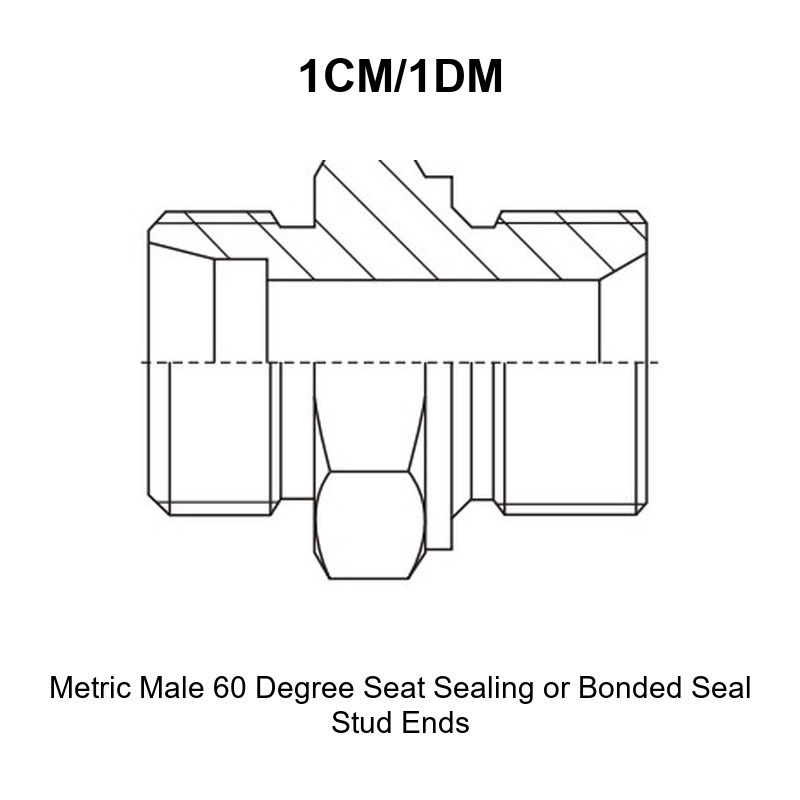
Why This Metric Male 60 Degree Seat Sealing Stud End Adapter 1CM/1DM Passes the Compliance Gate
The metric male 60 degree seat sealing stud end adapter 1CM/1DM is a straight stud-end adapter that joins a metric 60 degree seat port (sealed either by metal-to-metal 60 degree cone contact or by a bonded seal washer) to a metric male tube thread that accepts a tube nut. It exists because thousands of machines in service use a 60 degree seat metric port rather than an ISO 6149 O-ring port or a 74 degree cone port, and those machines still need a reliable way to leave the manifold and reach a hose or tube line.
- E end: metric male stud thread M12X1.5 to M52X2, dual-purpose 60 degree seat or bonded seal.
- F end: metric male thread M10X1 to M48X2 for metric tube from 6 mm to 42 mm outside diameter.
- Pressure groups taken directly from the drawing: 31.5 MPa and 16 MPa (light series L), 63 MPa, 40 MPa and 25 MPa (heavy series S).
Core Advantages
- Dual-purpose stud end: the same part seals on a machined 60 degree seat port by cone contact, or on a flat-faced port when a bonded seal washer is fitted under the hex, so one part number covers two port practices.
- Metric male 60 degree seat sealing stud end adapter 1CM/1DM matrix coverage: 34 catalogue rows in one drawing, from 6 mm to 42 mm tube outside diameter, so a single supplier can cover a whole machine build.
- Bonded seal option: parts ordered with a bonded seal washer are supplied as a matched set, washer included, which removes the risk of a mismatched sealing ring at assembly.
- Light and heavy series in one family: the 1CM block covers light series L and the 1DM block covers heavy series S, with heavier wall sections and larger hexes on the S rows.
- Thread and dimension traceability: every row carries its E thread, F thread, tube outside diameter and full dimensional set (B, l1, L1, S1, S2), so a drawing check needs no interpolation.
- Batch-level documentation: mill test reports, dimensional inspection reports and pressure test records are available per production batch, on request.
Technical Specifications
What Is a Metric 60 Degree Seat / Bonded Seal Stud End Adapter?
The metric male 60 degree seat sealing stud end adapter 1CM/1DM is a one-piece machined steel body with two different male ends. The E end is a metric male thread with a 60 degree seat, and the F end is a metric male thread sized for a tube nut. It is not an ISO 6149 O-ring stud end and it is not a 74 degree cone stud end; neither of those will seal correctly in a 60 degree seat metric port, and this adapter must not be substituted for them.
The practical difference between this family and the O-ring stud end families is where the seal is made. An ISO 6149 stud end seals at the base of the thread on a captive O-ring. This adapter seals at the 60 degree seat, or under the hex with a bonded seal washer, depending on which variant the port requires.
Connection 1: Metric Male 60 Degree Seat / Bonded Seal Stud End (E)
| Attribute | Detalhe |
|---|---|
| End type | Metric male stud end, straight |
| Thread range | M12X1.5 to M52X2 |
| Seat angle | 60 degree seat |
| Método de vedação | Metal-to-metal 60 degree cone contact, or bonded seal washer under the hex |
| Thread standard reference | Metric ISO thread profile (ISO 68-1 / ISO 261 practice) |
| Port compatibility | Metric 60 degree seat ports and flat-face ports that accept a bonded seal |
| Hex across flats | S1, per row (see dimension table) |
| Not interchangeable with | ISO 6149 O-ring stud ends, 74 degree cone stud ends, BSPT taper threads |
Connection 2: Metric Male Thread for Metric Tube Nut (F)
| Attribute | Detalhe |
|---|---|
| End type | Metric male thread for a tube nut, straight |
| Thread range | M10X1 to M48X2 |
| Tube outside diameter | 6 mm to 42 mm (D1) |
| System reference | Metric tube connection practice in the DIN 2353 / ISO 8434-1 family, light series L and heavy series S |
| Hex across flats | S2, per row (see dimension table) |
| Tube end preparation | Per the tube system selected; the adapter itself is a port-to-tube transition |
| Not interchangeable with | JIC 74 degree cone tube ends, BSP tube ends, JIS 60 degree cone tube ends |
Dimensional Data
| Symbol | Significado | Unit |
|---|---|---|
| PART NO. | Catalogue ordering code | – |
| E | Metric male stud thread, 60 degree seat / bonded seal end | – |
| F | Metric male thread for tube nut end | – |
| D1 | Tube outside diameter | mm |
| B | Insertion depth of the stud end into the port | mm |
| l1 | Length of the F end thread section | mm |
| L1 | Overall length of the adapter | mm |
| S1 | Hex across flats on the E end | mm |
| S2 | Hex across flats on the F end | mm |
Full Dimension Table (Part Number Matrix)
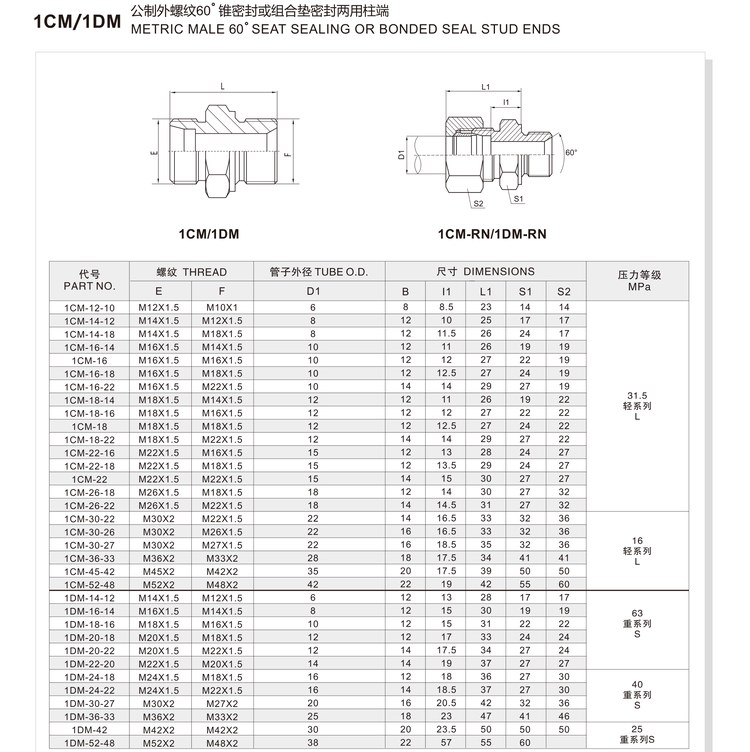
All dimensions in millimetres. Every row below is transcribed from the current 1CM/1DM drawing; pressure group is stated per row group.
| PART NO. | E THREAD | F THREAD | D1 | B | l1 | L1 | S1 | S2 | Pressure Group |
|---|---|---|---|---|---|---|---|---|---|
| 1CM-12-10 | M12X1.5 | M10X1 | 6 | 8 | 8.5 | 23 | 14 | 14 | 31.5 MPa, light series L |
| 1CM-14-12 | M14X1.5 | M12X1.5 | 8 | 12 | 10 | 25 | 17 | 17 | 31.5 MPa, light series L |
| 1CM-14-18 | M14X1.5 | M18X1.5 | 8 | 12 | 11.5 | 26 | 24 | 17 | 31.5 MPa, light series L |
| 1CM-16-14 | M16X1.5 | M14X1.5 | 10 | 12 | 11 | 26 | 19 | 19 | 31.5 MPa, light series L |
| 1CM-16 | M16X1.5 | M16X1.5 | 10 | 12 | 12 | 27 | 22 | 19 | 31.5 MPa, light series L |
| 1CM-16-18 | M16X1.5 | M18X1.5 | 10 | 12 | 12.5 | 27 | 24 | 19 | 31.5 MPa, light series L |
| 1CM-16-22 | M16X1.5 | M22X1.5 | 10 | 14 | 14 | 29 | 27 | 19 | 31.5 MPa, light series L |
| 1CM-18-14 | M18X1.5 | M14X1.5 | 12 | 12 | 11 | 26 | 19 | 22 | 31.5 MPa, light series L |
| 1CM-18-16 | M18X1.5 | M16X1.5 | 12 | 12 | 12 | 27 | 22 | 22 | 31.5 MPa, light series L |
| 1CM-18 | M18X1.5 | M18X1.5 | 12 | 12 | 12.5 | 27 | 24 | 22 | 31.5 MPa, light series L |
| 1CM-18-22 | M18X1.5 | M22X1.5 | 12 | 14 | 14 | 29 | 27 | 22 | 31.5 MPa, light series L |
| 1CM-22-16 | M22X1.5 | M16X1.5 | 15 | 12 | 13 | 28 | 24 | 27 | 31.5 MPa, light series L |
| 1CM-22-18 | M22X1.5 | M18X1.5 | 15 | 12 | 13.5 | 29 | 24 | 27 | 31.5 MPa, light series L |
| 1CM-22 | M22X1.5 | M22X1.5 | 15 | 14 | 15 | 30 | 27 | 27 | 31.5 MPa, light series L |
| 1CM-26-18 | M26X1.5 | M18X1.5 | 18 | 12 | 14 | 30 | 27 | 32 | 16 MPa, light series L |
| 1CM-26-22 | M26X1.5 | M22X1.5 | 18 | 14 | 14.5 | 31 | 27 | 32 | 16 MPa, light series L |
| 1CM-30-22 | M30X2 | M22X1.5 | 22 | 14 | 16.5 | 33 | 32 | 36 | 16 MPa, light series L |
| 1CM-30-26 | M30X2 | M26X1.5 | 22 | 16 | 16.5 | 33 | 32 | 36 | 16 MPa, light series L |
| 1CM-30-27 | M30X2 | M27X1.5 | 22 | 16 | 18.5 | 35 | 32 | 36 | 16 MPa, light series L |
| 1CM-36-33 | M36X2 | M33X2 | 28 | 18 | 17.5 | 34 | 41 | 41 | 16 MPa, light series L |
| 1CM-45-42 | M45X2 | M42X2 | 35 | 20 | 17.5 | 39 | 50 | 50 | 16 MPa, light series L |
| 1CM-52-48 | M52X2 | M48X2 | 42 | 22 | 19 | 42 | 55 | 60 | 16 MPa, light series L |
| 1DM-14-12 | M14X1.5 | M12X1.5 | 6 | 12 | 13 | 28 | 17 | 17 | 63 MPa, heavy series S |
| 1DM-16-14 | M16X1.5 | M14X1.5 | 8 | 12 | 15 | 30 | 19 | 19 | 63 MPa, heavy series S |
| 1DM-18-16 | M18X1.5 | M16X1.5 | 10 | 12 | 15 | 31 | 22 | 22 | 63 MPa, heavy series S |
| 1DM-20-18 | M20X1.5 | M18X1.5 | 12 | 12 | 17 | 33 | 24 | 24 | 63 MPa, heavy series S |
| 1DM-20-22 | M20X1.5 | M22X1.5 | 12 | 14 | 17.5 | 34 | 27 | 24 | 63 MPa, heavy series S |
| 1DM-22-20 | M22X1.5 | M20X1.5 | 14 | 14 | 19 | 37 | 27 | 27 | 63 MPa, heavy series S |
| 1DM-24-18 | M24X1.5 | M18X1.5 | 16 | 12 | 18 | 36 | 27 | 30 | 40 MPa, heavy series S |
| 1DM-24-22 | M24X1.5 | M22X1.5 | 16 | 14 | 18.5 | 37 | 27 | 30 | 40 MPa, heavy series S |
| 1DM-30-27 | M30X2 | M27X2 | 20 | 16 | 20.5 | 42 | 32 | 36 | 40 MPa, heavy series S |
| 1DM-36-33 | M36X2 | M33X2 | 25 | 18 | 23 | 47 | 41 | 46 | 25 MPa, heavy series S |
| 1DM-42 | M42X2 | M42X2 | 30 | 20 | 23.5 | 50 | 50 | 50 | 25 MPa, heavy series S |
| 1DM-52-48 | M52X2 | M48X2 | 38 | 22 | 57 | 55 | 60 | 60 | 25 MPa, heavy series S |
Reading the table: E is the metric 60 degree seat stud end, F is the metric male tube-nut end, D1 is the tube outside diameter the line side is prepared for, and the pressure group on the right applies to the whole row.
Thread Size and Dash Chart
| E Thread (stud end) | F Thread (tube end) | Tube O.D. D1 | Catalogue Row | Pressure Group |
|---|---|---|---|---|
| M12X1.5 | M10X1 | 6 | 1CM-12-10 | 31.5 MPa, L |
| M14X1.5 | M12X1.5 | 8 | 1CM-14-12 | 31.5 MPa, L |
| M14X1.5 | M18X1.5 | 8 | 1CM-14-18 | 31.5 MPa, L |
| M16X1.5 | M14X1.5 | 10 | 1CM-16-14 | 31.5 MPa, L |
| M16X1.5 | M18X1.5 | 10 | 1CM-16-18 | 31.5 MPa, L |
| M18X1.5 | M22X1.5 | 12 | 1CM-18-22 | 31.5 MPa, L |
| M22X1.5 | M22X1.5 | 15 | 1CM-22 | 31.5 MPa, L |
| M26X1.5 | M22X1.5 | 18 | 1CM-26-22 | 16 MPa, L |
| M30X2 | M27X1.5 | 22 | 1CM-30-27 | 16 MPa, L |
| M36X2 | M33X2 | 28 | 1CM-36-33 | 16 MPa, L |
| M45X2 | M42X2 | 35 | 1CM-45-42 | 16 MPa, L |
| M52X2 | M48X2 | 42 | 1CM-52-48 | 16 MPa, L |
| M14X1.5 | M12X1.5 | 6 | 1DM-14-12 | 63 MPa, S |
| M20X1.5 | M18X1.5 | 12 | 1DM-20-18 | 63 MPa, S |
| M24X1.5 | M22X1.5 | 16 | 1DM-24-22 | 40 MPa, S |
| M30X2 | M27X2 | 20 | 1DM-30-27 | 40 MPa, S |
| M42X2 | M42X2 | 30 | 1DM-42 | 25 MPa, S |
| M52X2 | M48X2 | 38 | 1DM-52-48 | 25 MPa, S |
Note how the same E thread appears in both series: 1CM-14-12 (light) and 1DM-14-12 (heavy) share the M14X1.5 stud thread but differ in B, l1, L1, S1, S2 and pressure group. Always select by row, not by thread alone.
Material and Heat Treatment
| Item | Especificações | Status |
|---|---|---|
| Body material | Carbon steel, machined from bar | Typical |
| Alternative material | Stainless steel on request | On request |
| Heat treatment | Stress relief / hardening per part size and pressure group | Typical |
| Surface treatment | Zinc plating with trivalent passivation; other finishes on request | Typical |
| Thread inspection | Go / no-go gauge check | Typical |
| Dimensional inspection | Batch sampling with report | On request |
| Documentation | Mill test report, dimensional report, pressure test record | On request |
Working Pressure and Operating Envelope
Working pressure for this adapter is set by the drawing pressure group for the row selected, together with the tube system and hose assembly it is fitted to.
| Group from Drawing | Série | Typical Application Envelope |
|---|---|---|
| 31.5 MPa | Light series L | Compact light-series tube lines, D1 6-15 mm |
| 16 MPa | Light series L | Light-series tube lines with larger tube, D1 18-42 mm |
| 63 MPa | Heavy series S | High-pressure heavy-series lines, D1 6-14 mm |
| 40 MPa | Heavy series S | Heavy-series lines, D1 16-20 mm |
| 25 MPa | Heavy series S | Large heavy-series lines, D1 25-38 mm |
The finished assembly is only as strong as its weakest member, so the tube, tube nut, ferrule / cone and hose assembly must be rated at or above the group shown for the row. (1 MPa is approximately 145 psi.)
Temperature Range
| Condition | Range | Notes |
|---|---|---|
| Serviço típico | -40 °C to +120 °C | Governed by the seal and the hose or tube selected |
| Bonded seal washer | Per washer material selected | Nitrile-type standard, other compounds on request |
| Low temperature | Below -40 °C | Requires low-temperature seal compound; confirm before order |
| High temperature | Above +120 °C | Requires high-temperature seal compound; confirm before order |
How to Read the Part Number Matrix
The ordering code follows a simple pattern: series prefix + E thread code + optional F thread code. The prefix tells you the family and which seat style the stud end uses, the first number block is the E stud thread, and the second number block is the F tube thread.
- Prefix: 1CM = light series metric 60 degree seat / bonded seal stud end; 1DM = heavy series metric 60 degree seat / bonded seal stud end.
- First block: nominal stud thread diameter in millimetres (12 means M12X1.5).
- Second block: nominal tube-end thread diameter in millimetres (10 means M10X1). When the block is missing, both ends share the same thread.
Example 1: 1CM-12-10 = light series, E stud end M12X1.5, F tube end M10X1, tube outside diameter 6 mm, 31.5 MPa group.
Example 2: 1CM-14-18 = light series, E stud end M14X1.5, F tube end M18X1.5, tube outside diameter 8 mm, 31.5 MPa group. This is a step-up row where the tube-end thread is larger than the stud thread.
Example 3: 1DM-52-48 = heavy series, E stud end M52X2, F tube end M48X2, tube outside diameter 38 mm, 25 MPa group, S1 and S2 both 60 mm.
Selection and Ordering
Ordering the metric male 60 degree seat sealing stud end adapter 1CM/1DM is a four-step check: identify the port, confirm the sealing style, match the tube, then compare the pressure group.
Selection Checklist and Decision Table
| Question | Answer | Consequence |
|---|---|---|
| What is the port thread on the manifold or cylinder? | Match to E exactly | Wrong E thread will not seal or will cross-thread |
| Does the port have a 60 degree machined seat? | If yes, seal by cone contact | No washer needed |
| Is the port face flat with a spot face? | If yes, use a bonded seal washer | Order the bonded seal version |
| What is the tube outside diameter? | Match to D1 | Determines the F thread row |
| Which series does the tube system use? | Light L or heavy S | Determines 1CM versus 1DM and the pressure group |
| What is the system working pressure? | Compare with group | Rows at 16 MPa must not be used on a 31.5 MPa line |
Cross Reference Service
Send us a photo or a dimension sketch of the adapter you are replacing, or the old marking if it is still readable. We measure the stud thread, the tube-end thread, the seat angle and the B, l1, L1, S1 and S2 dimensions, then map them to a row in the metric male 60 degree seat sealing stud end adapter 1CM/1DM matrix and quote it, free of charge. We do not copy or re-badge another manufacturer’s part number, and we do not claim that any third-party catalog number is ours.
Packaging and Logistics
| Item | Standard Practice |
|---|---|
| Unit protection | Individually bagged, thread protectors where applicable |
| Carton marking | Part number, batch number, quantity, pressure group |
| Batch traceability | Batch number on the carton and on request on the part |
| Documentation | Mill test report and dimensional report travel with the batch on request |
| Mixed shipping | Mixed sizes combined in one shipment to reduce freight cost |
| Urgent orders | Air freight for urgent replacement quantities |
Installation and Fitment Guide
Step-by-Step Assembly
- Confirm the port thread, the seat style and the tube outside diameter against the row you ordered before opening the packaging.
- Clean the port, the stud thread and the 60 degree seat. Remove swarf, old sealant and any damaged bonded seal washer.
- If the port is a flat-face design, fit a new bonded seal washer of the correct size; never reuse a deformed washer.
- Screw the E end in by hand until it seats, then tighten to the torque value for the thread size and material class.
- Assemble the tube nut, ferrule or cone on the tube end per the tube system instructions, then tighten to the tube-system torque table.
- Pressurise the line gradually and check both ends for weeping before returning the machine to service.
Torque and Sealing Notes
- Use the torque table for the exact thread size, material class and surface finish involved, taken from the applicable standard data sheet or the drawing supplied with the order. Do not use a single blanket torque figure for every row in the matrix.
- The 60 degree seat seals on the cone surface. Over-torque deforms the seat and creates a leak path that no amount of retightening will close.
- The bonded seal variant seals under the hex. The washer must be the correct size for the thread and must be renewed every time the joint is opened.
- Do not add thread sealant tape or paste to a 60 degree seat joint; the seat, not the thread, is the sealing element.
- Where a row and a port appear to match but the assembly still weeps, check the seat angle and the B insertion depth before increasing torque.
Installation Warnings
- Do not interchange this adapter with an ISO 6149 O-ring stud end: the seal location is different and the joint will leak.
- Do not interchange this adapter with a 74 degree cone stud end or a JIC fitting, even when the thread appears similar.
- Do not force a tapered thread into a straight metric port, and do not use a straight metric stud in a tapered port.
- Do not reuse a bonded seal washer, and do not substitute a plain flat washer.
- Do not machine or shorten the stud end to change the insertion depth; order the correct row instead.
- Do not exceed the pressure group of the selected row even if the thread size looks heavy enough for more.
Applications and Industries
Captive ports on imported machinery: the 60 degree seat metric port is common on equipment built to Asian and European machine practices, and this adapter is the direct way out of that port into a standard metric tube line.
Repair and replacement: when a machine is down and the original adapter is unavailable, the matrix maps thread, tube size and pressure group to a stocked row.
High-pressure test benches: the 63 MPa and 40 MPa heavy series rows suit test rigs where the tube line must carry high pressure without upsizing the port.
Oil and gas equipment: skids, valve packages and actuator lines that use metric 60 degree seat ports on manifolds and cylinders.
Construction and mining machinery: cylinders, rotary manifolds and hose runs that must remain serviceable in the field with standard metric tube components.
Industrial plant: machine tools, presses and hydraulic power units where light series rows cover most of the tube work.
Industry tags: hydraulic adapter, metric stud end, 60 degree seat, bonded seal, DIN 2353, ISO 8434-1, ISO 6149 comparison, tube adapter, hydraulic fitting.
OEM Customization and Quality Traceability
We produce hydraulic adapters and hose assemblies, and we support OEM programs with private labelling and laser marking of your own part number on the hex or the shank. Custom surface finishes, non-standard lengths and special sealing configurations are quoted from your drawing or sample, usually within 24 hours.
Every production batch is traceable. Parts pass a 100 percent pressure test before packing, and mill test reports, dimensional inspection reports and pressure test records are available with the shipment. Third-party inspection such as BV or SGS can be arranged on request. Our manufacturing system is certified to ISO 9001:2015 and ISO 18752.
FAQ
Q: Is this the same as an ISO 6149 O-ring stud end adapter?
A: No. An ISO 6149 stud end seals with an O-ring trapped at the base of the thread, while this adapter seals on a 60 degree seat cone or with a bonded seal washer under the hex. The two are not interchangeable in the same port.
Q: Can I use this metric male 60 degree seat sealing stud end adapter 1CM/1DM with a bonded seal washer on a 60 degree seat port?
A: Yes, and that is exactly why the family is called dual-purpose. The cone contact and the bonded seal washer are two sealing routes for the same stud end, so the same part works on a machined 60 degree seat port and on a flat-face port with a spot face.
Q: Which row should I order if my tube is 12 mm and the port is M18X1.5?
A: The M18X1.5 stud end with a 12 mm tube outside diameter appears as 1CM-18-16 (M16X1.5 tube end), 1CM-18 (M18X1.5 tube end) and 1CM-18-22 (M22X1.5 tube end). Choose the F thread that matches your tube nut, and check B, l1, L1, S1 and S2 in the matrix before ordering.
Q: What pressure can this adapter take?
A: The drawing groups the rows at 31.5 MPa and 16 MPa for light series L, and 63 MPa, 40 MPa and 25 MPa for heavy series S. Use the group of the row you order, and keep the rest of the assembly at or above that level.
Q: What material and plating do you supply as standard?
A: Carbon steel with zinc plating and trivalent passivation is typical, and stainless steel is available on request. Material and finish are confirmed on the drawing for OEM orders.
Q: How tight should the stud end be torqued?
A: Torque depends on thread size, material class and finish, so use the torque table from the applicable standard data sheet or the one supplied with your order rather than a single value applied across the matrix.
Q: Do you supply the bonded seal washer with the adapter?
A: The bonded seal variant is quoted and supplied as a matched set, so the washer reaching the line is the correct one for the thread. Specify WD-style sealing when you order if your port is flat-faced.
Q: What are your lead times and shipping options?
A: Standard catalogue rows are typically shipped as a 7-day batch, 48-hour custom sampling is available for new drawings, and urgent quantities can move by air freight. Mixed cartons are combined to control freight cost.
Solicitar um orçamento
Send us the port thread, the seat style (60 degree seat or bonded seal), the tube outside diameter, the series (light L or heavy S) and the quantity required. With those five details we map your requirement to the correct row in the metric male 60 degree seat sealing stud end adapter 1CM/1DM matrix, confirm pressure group and material, and return a quotation within 24 hours.
Browse the full Hydraulic Adapters range for the complete family, or contact us to request a quote, mill test reports, and samples.


 English
  Spanish
  Portuguese
  French
  German