
Why This BSP Banjo Bolt Passes the Compliance Gate
The BSP banjo bolt in the 720B series is the hollow bolt that passes through the eye of a banjo body and threads into a parallel G port (ISO 228). It is built for OEMs, distributors, and repair shops that need a matched, leak-free bolt to complete a banjo joint. Each bolt is machined from cold-forged carbon steel or 304/316L stainless steel, drilled with an oil passage, and zinc-plated or Dacromet-coated for corrosion resistance. Because the 720B is a straight G-thread bolt sealed by washers, this BSP banjo bolt works on BSPP ports without tapered-thread torque guesswork. Every batch ships with full material traceability plus 100% pressure and thread inspection.
Core Advantages
- Correct hollow-bolt geometry. The oil passage and thread are cut to match the mating banjo eye, so fluid flows through the bolt, not around it.
- Parallel G-thread seal. The straight ISO 228 thread relies on two washers for sealing, giving a stable, repeatable joint on BSPP ports.
- Matched hex and length. The head is sized for a standard wrench, and the length and oil-hole position suit the corresponding banjo body.
- Material and surface options. 20#/35#/45# cold-forged carbon steel or 304/316L stainless steel, with trivalent zinc, zinc-nickel, or Dacromet finishes.
Technical Specifications
What Is a Banjo Bolt?
A banjo bolt is a hollow bolt with a cross-drilled oil passage. It is threaded into a port and passes through the eye of a banjo body; the fluid travels through the bolt’s hollow core and exits the oil hole into the eye, then out through the hose. Two sealing washers, one above and one below the eye, are compressed against the port face and the bolt head to form a double face seal.
A BSP banjo bolt uses a parallel G thread and must not be confused with a tapered-thread bolt (BSPT/NPT) or used with a cone-seat end. The joint seals on the washer faces, not on the thread, so no PTFE tape or thread sealant is used. The bolt must be matched to the body on thread size, overall length, and oil-hole position; a bolt from another series is not interchangeable.
At the same nominal size, a banjo joint typically carries a lower pressure rating than an equivalent straight-thread end, because the seal depends on the washers and the hollow bolt wall. Always confirm the rating against the data sheet and the system pressure, and consult an engineer for high-pressure or pulsating duty.
Dimensional Data
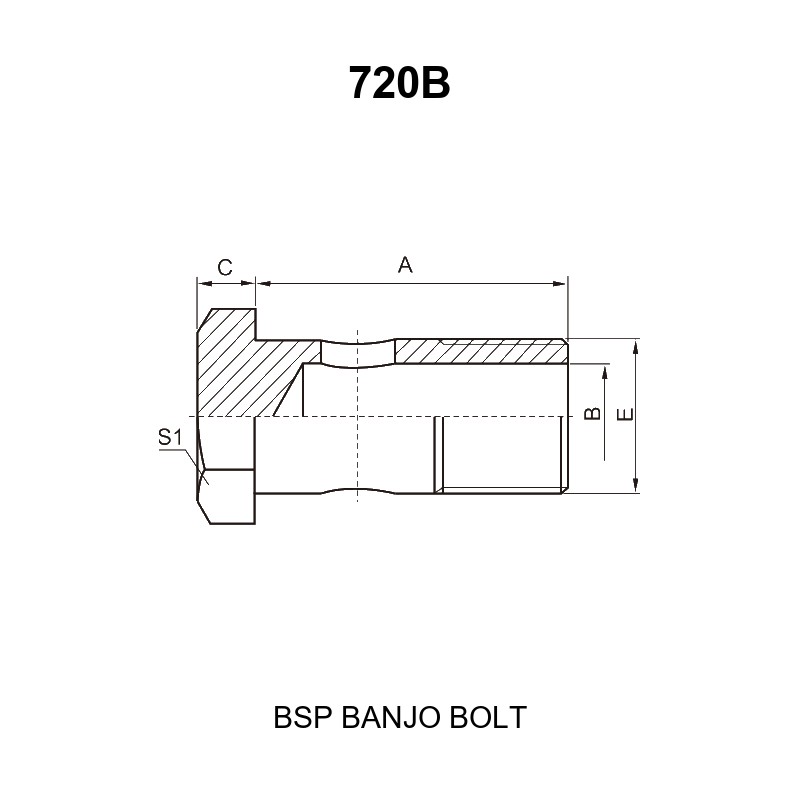
The drawing labels its dimension columns A, B, C, and S1. The table below records the meaning of each symbol as dimensioned on the drawing; the drawing provides no separate letter legend, so values are read directly from the columns.
| Symbol | Meaning (as dimensioned on the drawing) |
|---|---|
| A | Overall length of the banjo bolt from the head face to the thread end |
| B | Head / shank dimension as dimensioned on the drawing |
| C | Oil-hole / thread-related dimension as dimensioned on the drawing |
| S1 | Hex across flats (wrench size) |
Full Dimension Table (Part Number Matrix)
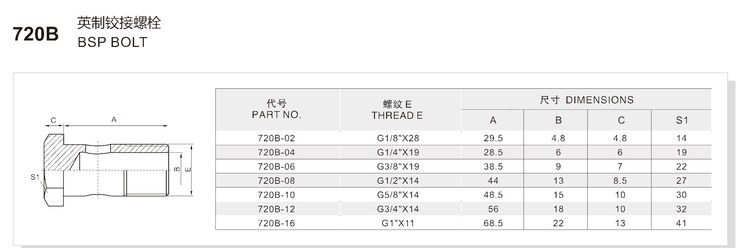
All dimensions are in millimeters unless stated. The thread is a parallel G thread per ISO 228 (for example G1/4″X19). The coding rule is 720B - port thread: the suffix follows the port thread size. Read each row to match the bolt to its port thread, then use column A for length, column S1 for the wrench size, and columns B and C for head and oil-hole geometry.
| PART NO. | THREAD E | DIMENSIONS A | DIMENSIONS B | DIMENSIONS C | DIMENSIONS S1 |
|---|---|---|---|---|---|
| 720B-02 | G1/8″X28 | 29.5 | 4.8 | 4.8 | 14 |
| 720B-04 | G1/4″X19 | 28.5 | 6 | 6 | 19 |
| 720B-06 | G3/8″X19 | 38.5 | 9 | 7 | 22 |
| 720B-08 | G1/2″X14 | 44 | 13 | 8.5 | 27 |
| 720B-10 | G5/8″X14 | 48.5 | 15 | 10 | 30 |
| 720B-12 | G3/4″X14 | 56 | 18 | 10 | 32 |
| 720B-16 | G1″X11 | 68.5 | 22 | 13 | 41 |
Version note: dimensions are transcribed from the series 720B drawing (7 sizes, G1/8″ to G1″). No additional footnote is printed on the drawing.
Material and Heat Treatment
| Item | Standard offering |
|---|---|
| Bolt material | 20#, 35#, 45# cold-forged carbon steel; 304 / 316L stainless steel on request |
| Heat treatment | Carburizing and quenching, HRC 20-28 |
| Surface finish | Trivalent zinc (96 h salt spray) / zinc-nickel (720 h) / Dacromet (1000 h) |
| Tópico | Parallel G thread per ISO 228, inspected 100% |
| Testing | 100% factory pressure test and thread gauge check |
| Documentation | Material test report (MTR) with the order; BV / SGS inspection on request |
Working Pressure and Operating Envelope
The working pressure of a banjo joint is set by the port-end standard and the hose rating together; it is not a fixed number for the bolt alone. A typical working temperature range is -40 °C to +120 °C, and the exact value depends on the hose and the seal materials used. Torque and crimp data tables are supplied with each order, and 100% of units are pressure tested before packing. For high-pressure, high-pulse, or safety-critical circuits, always confirm the rating against the data sheet and consult an engineer for the correct selection.
Selection and Ordering
How to Read the Part Number Matrix
Every part number in this series follows the pattern 720B - port thread. The “720B” prefix identifies the BSP hollow bolt family, and the two-digit suffix is the port thread code. To order, choose the suffix that matches your BSPP port, then confirm length, oil-hole position, and wrench size against the table. Order the banjo body and the sealing washers separately, since the bolt alone does not form a seal.
Thread Size and Dash Chart
The BSP banjo bolt is selected by port thread and then matched to the body’s hose dash. The table below pairs each 720B bolt thread with the banjo body dashes it is normally used with.
| Port thread (ISO 228) | Bolt PART NO. | Typical body hose dashes |
|---|---|---|
| G1/8″X28 | 720B-02 | 03, 04 |
| G1/4″X19 | 720B-04 | 03, 04, 05, 06 |
| G3/8″X19 | 720B-06 | 04, 05, 06, 08 |
| G1/2″X14 | 720B-08 | 05, 06, 08, 10 |
| G5/8″X14 | 720B-10 | 10 |
| G3/4″X14 | 720B-12 | 10, 12 |
| G1″X11 | 720B-16 | 08, 12, 16 |
Matching Banjo Bodies and Sealing Washers
A banjo joint has three parts: the hollow bolt, the banjo body, and two sealing washers. Match this BSP banjo bolt to the body’s port thread, and match the bolt length and oil-hole position to the body’s eye depth and port depth. Use one sealing washer above and one below the eye; the common choice is a DIN 7603 copper or aluminum ring, but always confirm the ring material and size against the port face and fluid. The body and the washers are ordered separately from the bolt, so please specify all three when raising an inquiry.
Cross Reference Service
If you are replacing an existing part and only have an OEM or legacy number, send it to us and we will translate it to the closest BSP banjo bolt (720B) and its matching body. We compare thread size, length, and oil-hole position to confirm fit before quoting. This helps distributors and repair shops consolidate several old numbers into one reliable family.
Packaging and Logistics
Each BSP banjo bolt is packed 10 pcs per box, with a batch label on each carton that records the series, part number, and batch code. Origin is marked Made in China – HENGHUA. Material test reports travel with the shipment, and third-party inspection (BV / SGS) can be arranged on request. We quote within 24 hours and support OEM and private-label programs.
Assembly and Use Guide
Four-Step Crimping Procedure
- Cut the hose vertically with a hose cutter so the end is square and free of burrs.
- Mark the insertion depth on the hose jacket using the crimp data sheet.
- Apply a thin film of compatible grease and insert the fitting (with a banjo body) until the mark is reached.
- Crimp to the specified diameter and verify the crimped outside diameter with a caliper.
Installing the Banjo Bolt
Place one sealing washer above and one below the eye, then pass the hollow bolt through the eye and thread it into the port by hand until it seats. Rotate the body to aim the hose in the required direction, then tighten the bolt to the torque in the data sheet. Keep the port face clean and flat, and use fresh washers each time; a deformed or reused washer is a common cause of leaks. Never use PTFE tape or thread sealant, because the joint seals on the washer faces, not on the thread.
Installation Warnings
- ❌ Missing sealing washers, wrong washer size, or reused and deformed washers.
- ❌ Mixing a banjo joint with tapered-thread or cone-seat ends (BSPT/NPT, JIC/ORFS/24°).
- ❌ Over-torquing, which can stretch the hollow bolt and deform the seal faces.
- ❌ Using a bolt from a different series, brand, or thread standard on the same joint.
- ✔ Correct practice: matched bolt, body, and washers; clean flat port face; correct torque; one washer above and one below the eye.
OEM Customization and Quality Traceability
Customization Options
We support OEM and private-label programs for this BSP banjo bolt, including laser marking, custom thread sizes, custom lengths, and custom surface finishes. Tell us your target thread, length, oil-hole position, and finish, and we will confirm the drawing before production. Private-label packaging and carton artwork are also available.
Quality and Traceability System
Each batch carries a traceable code that links the finished part back to the raw material and the heat-treatment and plating lots. We run 100% pressure testing and thread inspection, supply material test reports with the order, and can arrange BV / SGS third-party inspection. This full-chain traceability lets OEMs and distributors answer quality questions quickly.
FAQ
How does a banjo bolt seal? It seals on two flat washer faces. One washer sits above the eye and one below, and the bolt head and port face compress them when the bolt is tightened.
Can I adjust the hose angle after tightening? Yes, up to the point of final torque. Rotate the banjo body to the required direction, then tighten the bolt to the data-sheet torque, which locks the orientation.
Can the sealing washers be reused? No. Washers deform to match the seal faces, so we recommend new washers for every reinstallation to avoid leaks.
Will this fit a BSPT, NPT, or JIC port? No. This is a parallel G-thread banjo bolt and must not be mixed with tapered-thread or cone-seat ends. Match it only to a BSPP port with the correct body and washers.
Do I need thread sealant or tape? No. The joint seals on the washer faces, so PTFE tape and thread sealant are not used and can interfere with the seal.
Can you supply matched banjo bodies and washers? Yes. We supply the banjo body and DIN 7603 copper or aluminum washers as separate line items, matched to the bolt you order.
Do you offer bulk and custom orders? Yes. We support wholesale volumes and OEM/private-label customization with laser marking, custom lengths, and custom finishes.
How fast can I get a quote? Send your thread size, length, and quantity, and we will reply within 24 hours with pricing and lead time.
Solicitar um orçamento
Tell us the port thread, length, and quantity you need, and we will send a quotation with the matched banjo body and sealing washers included. As a manufacturer, we keep this BSP banjo bolt family in stock for fast sample and bulk delivery, and we are glad to help you confirm the right bolt for your BSPP port. Contact HENGHUA today for pricing, samples, and OEM options.
Browse the full Banjo Hydraulic Fittings range for the complete family, or contact us to request a quote, mill test reports, and samples.


 English
  Spanish
  Portuguese
  French
  German