
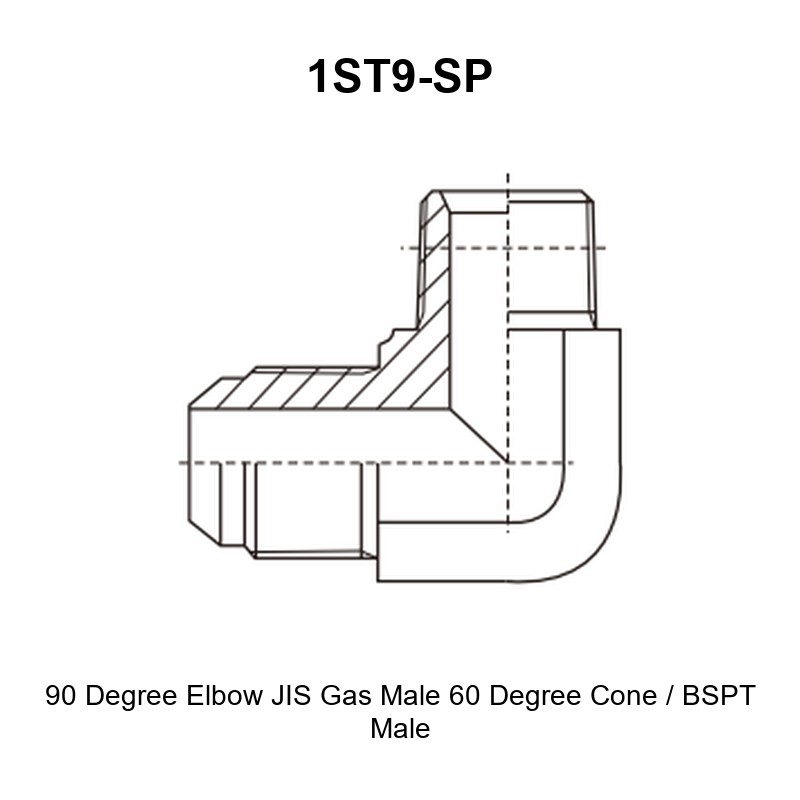
Series 1ST9-SP | 90° elbow adapter | JIS gas male 60° cone stud end (JIS B 0203) to BSPT male taper end (ISO 7-1)
1. What a 1ST9-SP Adapter Does
A 1ST9-SP adapter is a 90° elbow adapter that turns a JIS gas male port into a BSPT male connection at a right angle. The JIS end is a male stud with a 60° cone seat to JIS B 0203, and the BSPT end is a male taper thread to ISO 7-1, both machined into one forged or bar-stock elbow body.
The elbow exists for routing, not only for connection. Where a straight adapter would push the pipe or hose out through the machine frame, into a walkway or against another component, the 90° body takes the run away from the port along the shortest usable path. That single change often removes a bend from the assembly, which is where most hose failures start.
Both ends are male, the JIS end seals on its cone against the mating cone in the port, and the BSPT end seals on its thread flanks with a sealant. The series is used mainly where Japanese equipment with JIS gas ports is serviced in markets where BSPT fittings are the standard stock item.
2. 1ST9-SP Adapter Specifications
2.1 Connection 1 – JIS gas male stud end, 60° cone
- Thread family: JIS gas thread (parallel pipe thread) to JIS B 0203.
- Size range in this series: G1/8″x28 through G2″x11.
- Gender: male stud end on the elbow axis, with hex flats for wrench engagement.
- Sealing method: 60° cone seat on the stud end against the matching cone in the mating port.
- Mating port standard: JIS B 0203 gas thread port with a 60° cone seat.
The cone is the sealing element, so the thread carries load only. The port must have the matching internal cone; a flat face port with the same thread will not seal on the cone alone. Because the cone sits inside the elbow axis, marking the two ends clearly on the drawing side is worthwhile when several machines of the same family are piped from one work order.
2.2 Connection 2 – BSPT male taper end
- Thread family: BSPT taper pipe thread to ISO 7-1, R series.
- Size range in this series: R1/8″x28 through R2″x11.
- Gender: male taper end at 90° to the JIS axis, with hex flats for wrench engagement.
- Sealing method: taper thread sealing on the thread flanks, with a thread sealant applied.
- Mating port standard: ISO 7-1 BSPT port or BSPT female connection.
A BSPT adapter end is not interchangeable with a BSPP end that uses a parallel thread. BSPP is parallel to ISO 228-1 and seals on a seat or washer, while BSPT is tapered and seals on the thread flanks with a sealant. A BSPT male end in a BSPP female port engages only a few turns and damages the parallel thread, and a BSPP male end in a BSPT port bottoms without sealing.
2.3 Construction and Materials
Bodies are machined from bar stock on CNC lathes with the two thread axes set at 90°, then the JIS cone is cut in the same setup so that the cone runs true to its thread axis.
- Body material options: carbon steel, 304 stainless steel, 316 stainless steel, brass.
- Plating options for carbon steel bodies: trivalent chromium zinc plating (Cr3+), zinc-nickel plating.
- Seal options: the JIS 60° cone is a metal-to-metal seat, and the BSPT end uses a thread sealant applied at assembly.
- Hex features: S1 across flats on the body, with flats positioned so that both ends can be reached with a wrench.
- Identification: series and size code marked on the body where the size allows.
2.4 Pressure and Temperature
The JIS 60° cone end is a metal seat without an elastomer, so the temperature ceiling of the joint is set by the body material and by the sealant used on the taper end rather than by a rubber seal.
| Material | Typical service note |
|---|---|
| Carbon steel with zinc plating | General hydraulic service |
| 304 / 316 stainless steel | Corrosive and offshore service |
| Latão | Non-sparking and some water service |
Working pressure is not one figure for the whole series. It depends on the thread size, the wall thickness of the elbow body, the sealing method and the material grade, and it is confirmed per order by HENGHUA engineering against the drawing. An elbow carries a bending moment that a straight adapter does not, so the duty point and the support arrangement should be stated with the inquiry.
2.5 Part Number and Dimension Table
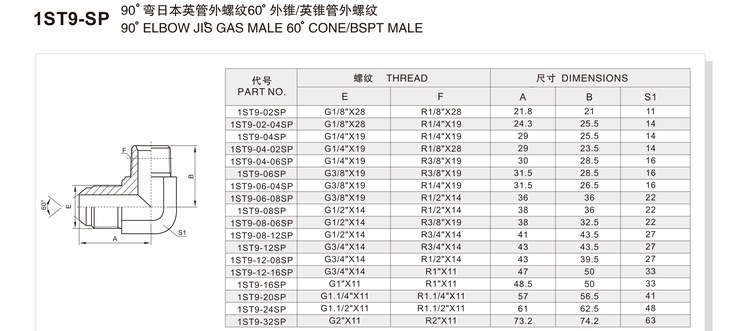
| PART NO. | E THREAD (JIS gas male 60° cone) | F THREAD (BSPT male) | A | B | S1 |
|---|---|---|---|---|---|
| 1ST9-02SP | G1/8″x28 | R1/8″x28 | 21.8 | 21 | 11 |
| 1ST9-02-04SP | G1/8″x28 | R1/4″x19 | 24.3 | 25.5 | 14 |
| 1ST9-04SP | G1/4″x19 | R1/4″x19 | 29 | 25.5 | 14 |
| 1ST9-04-02SP | G1/4″x19 | R1/8″x28 | 29 | 23.5 | 14 |
| 1ST9-04-06SP | G1/4″x19 | R3/8″x19 | 30 | 28.5 | 16 |
| 1ST9-06SP | G3/8″x19 | R3/8″x19 | 31.5 | 28.5 | 16 |
| 1ST9-06-04SP | G3/8″x19 | R1/4″x19 | 31.5 | 26.5 | 16 |
| 1ST9-06-08SP | G3/8″x19 | R1/2″x14 | 36 | 36 | 22 |
| 1ST9-08SP | G1/2″x14 | R1/2″x14 | 38 | 36 | 22 |
| 1ST9-08-06SP | G1/2″x14 | R3/8″x19 | 38 | 32.5 | 22 |
| 1ST9-08-12SP | G1/2″x14 | R3/4″x14 | 41 | 43.5 | 27 |
| 1ST9-12SP | G3/4″x14 | R3/4″x14 | 43 | 43.5 | 27 |
| 1ST9-12-08SP | G3/4″x14 | R1/2″x14 | 43 | 39.5 | 27 |
| 1ST9-12-16SP | G3/4″x14 | R1″x11 (v) | 47 | 50 | 33 |
| 1ST9-16SP | G1″x11 | R1″x11 | 48.5 | 50 | 33 |
| 1ST9-20SP | G1.1/4″x11 | R1.1/4″x11 (v) | 57 | 56.5 | 41 |
| 1ST9-24SP | G1.1/2″x11 | R1.1/2″x11 (v) | 61 | 62.5 | 48 |
| 1ST9-32SP | G2″x11 | R2″x11 (v) | 73.2 | 74.2 | 63 |
Column notes: E is the JIS gas male stud end thread with its 60° cone, F is the BSPT male taper thread at 90° to it, A is the distance from the JIS end to the outer face of the elbow as shown on the series drawing, B is the distance from the BSPT end centreline to the opposite outer face, and S1 is the across-flats of the body hex. Dimensions are in millimetres.
(v) [VERIFY WITH SUPPLIER]: the F thread pitch callouts in the lower half of the chart are small in the source drawing. The sizes R1″x11, R1.1/4″x11, R1.1/2″x11 and R2″x11 above are transcribed as read and are to be confirmed against the current drawing before the number is used in an order.
3. How to Read a 1ST9-SP Adapter Part Number
- 1ST9: series prefix for a 90° elbow with a JIS gas male 60° cone end and a BSPT male end. The 9 marks the elbow, while the straight version of the same connection carries no 9.
- -SP suffix: marks the taper thread family in this range, so a part ending in -SP always carries a BSPT end and requires a thread sealant.
- First size code (JIS gas end): 02 = G1/8″x28, 04 = G1/4″x19, 06 = G3/8″x19, 08 = G1/2″x14, 12 = G3/4″x14, 16 = G1″x11, 20 = G1.1/4″x11, 24 = G1.1/2″x11, 32 = G2″x11.
- Second size code (BSPT end): 02 = R1/8″x28, 04 = R1/4″x19, 06 = R3/8″x19, 08 = R1/2″x14, 12 = R3/4″x14, 16 = R1″x11.
- Single code: one number only, used where the two ends follow the standard coded pair for that size, for example 1ST9-04SP, 1ST9-06SP and 1ST9-12SP.
Worked example: 1ST9-08-12SP. The prefix 1ST9 fixes the elbow and the -SP suffix confirms the taper end. The first code 08 sets the JIS gas end at G1/2″x14 with a 60° cone to JIS B 0203, and the second code 12 sets the taper end at R3/4″x14 to ISO 7-1. The table gives A 41 mm, B 43.5 mm and S1 27 mm across the body hex. Quote 1ST9-08-12SP with the material and plating, and state the port direction so that the elbow can be oriented correctly before piping.
4. Installation and Fitment
Elbow fitment has one extra step compared with a straight adapter: orientation. The body must be turned to the final direction before the taper end is tightened, because the taper thread reaches its sealing position on the angle rather than on a shoulder.
- Screw the JIS end in first and bring the cone to its seat. If the elbow ends up pointing the wrong way, use a thin additional turn only within the cone seat allowance, or re-position the port fitting instead of forcing the cone.
- Set the orientation, then apply sealant to the BSPT end, leaving the first thread dry so that sealant does not enter the system. Never apply sealant to the JIS cone.
- Hold the body hex S1 with one wrench and tighten the taper side with a second wrench. Torque practice is snug contact and then a controlled tightening angle; the figure depends on thread size and material and is confirmed per order.
- Support the connected pipe or hose within one diameter of the elbow so that the bending moment is not carried by the JIS cone seat. An elbow that is loaded by an unsupported hose will work loose at the cone.
- Re-check both joints after the machine reaches working temperature, and never re-use a disturbed taper joint without cleaning the threads and applying fresh sealant.
Common fitment errors and their symptoms: an elbow forced past its cone seat to reach an orientation deforms the seat and leaks at the cone. A hose left to hang on the elbow loads the JIS joint until it weeps, and the leak is usually blamed on the thread. Sealant applied to the JIS cone holds the cone off its seat, so the joint leaks even when it is fully tightened.
5. Applications and Industries
Application tags: hydraulic systems, industrial equipment, construction machinery, agriculture, material handling, marine, oil and gas, water jetting.
- Japanese equipment aftermarket. Japanese-built machine tools, injection moulding machines, construction machinery and forklifts use JIS gas thread ports. Serviced outside Japan, those ports have to meet BSPT hose ends, so a JIS to BSPT conversion is needed at the port, and the machine frame usually leaves no room for a straight adapter plus a hose bend. The 1ST9-SP adapter is the elbow choice when the run has to turn immediately at the port.
- Elbow selection rationale. Choose the 90° elbow when the pipe or hose must leave the port parallel to a manifold face, when a straight adapter would foul a frame member or a walkway, when the hose bend radius is too large for the available space, or when the port faces an operator position. One elbow at the port replaces a straight adapter plus a separate angled fitting and removes a joint from the system.
- Tight assemblies and service access. In crowded manifolds the elbow also moves the connection to a position where a wrench can reach it, which matters on machines that are serviced in place rather than in a workshop.
- Repair and replacement. Matching the two thread callouts of a damaged original elbow against the table identifies the replacement, and the A, B and S1 dimensions confirm that it fits the space the old part occupied.
6. Replacement and Cross-Reference Guide
Cross-reference any BSP adapter or JIS gas part by standard and sealing method, never by another maker’s catalogue number. Three measurements identify the correct replacement: the thread, the cone, and the elbow geometry.
- Thread size and pitch. Measure the outside diameter and threads per inch of both ends. The JIS gas end is matched by its G size, for example G1/2″x14, and the taper end by its R size, for example R3/4″x14.
- Cone form. Confirm that the JIS side is a 60° cone stud end. If the old part carried a washer against a flat face, the application needs a different sealing method rather than this series.
- Elbow geometry. Measure A, B and S1 on the old part and compare them with the table. Two elbows can carry the same two threads and still differ in A and B, which decides whether the part fits the frame.
Related families in the same HENGHUA British Adapters range, by function: 1ST-SP is the straight version of the same JIS gas to BSPT male connection; 1T9-SP is the 90° elbow with two BSP ends; 1BT9-SP is the 90° elbow for a BSP 60° seat end to a BSPT male end; 1BT4-SP is the 45° version of that connection; 5T9-SP is the 90° BSPT male to BSPT female elbow.
7. Ordering, Packaging and Delivery
To place a quotation request for this BSP adapter, send these six items: series code, full part number, the thread size of each end, the body material, the plating, and the annual or first-order quantity.
Example of a complete inquiry line: series 1ST9-SP, part number 1ST9-08-12SP, JIS gas end G1/2″x14 with 60° cone to JIS B 0203, BSPT end R3/4″x14 to ISO 7-1, carbon steel body with trivalent chromium zinc plating, 200 pieces.
- Packaging. Parts are bagged and cartoned in quantities suited to distributor shelf handling, with larger sizes cartoned loose in single size groups. Carton labels carry the series code, the part number and the quantity.
- Labelling. Neutral labelling is available for distributors who re-label under their own brand, and customer label artwork can be applied where supplied.
- Samples. Single pieces or small sample sets can be supplied for fit validation, which is the practical way to confirm A, B and S1 in a congested installation before a production order.
- Lead time. Lead time depends on the size mix, the material grade and the plating selected, and is confirmed at quotation per order.
- Inspection. Each carton is checked against the drawing with thread gauges and dimensional checks before packing, and the batch is identified by the part number on the label.
8. FAQ
Q1. What is the difference between BSPP and BSPT, and can they be interchanged? BSPP is a parallel pipe thread to ISO 228-1 that seals on a seat or a washer rather than on the thread. BSPT is a taper pipe thread to ISO 7-1 that seals on the thread flanks and needs a thread sealant. They must not be interchanged: a BSPT male end in a BSPP port engages only a few turns and damages the parallel thread, and a BSPP male end in a BSPT port bottoms without sealing. On this page the -SP suffix marks the taper side.
Q2. What is the difference between a 60° cone seat and a bonded seal, and which should I choose? The 60° cone seat seals where a machined cone on the stud end meets the matching cone in the port. A bonded seal seals where a washer with a bonded elastomer ring is compressed against a flat port face. The JIS gas end of this series uses the 60° cone, so the port must carry the matching internal cone. If the port face is flat, select a series with a bonded seal instead of this one.
Q3. How do I identify the correct 1ST9-SP adapter size? Measure the outside diameter and pitch of both ends, then measure A, B and S1 on the part being replaced. Match the thread pair in the part number table and use the dimensions to confirm that the elbow will not foul the frame. The JIS gas end is matched by its G size and the taper end by its R size. Pairs that are not listed can be produced to drawing as a special.
Q4. What seal material should I select for my fluid and temperature? The JIS 60° cone end is a metal-to-metal seat and uses no elastomer, so no seal material is selected for that joint. Selection concerns the BSPT end, where the thread sealant must be compatible with the system fluid, and the body material, where 304 or 316 stainless steel is chosen for corrosive and offshore service. Brass bodies suit non-sparking and some water service.
Q5. How is the working pressure determined? Working pressure is not one figure for the whole series. It depends on the thread size, the wall thickness of the elbow body, the sealing method and the material grade, and it is confirmed per order by HENGHUA engineering. Taper thread joints also depend on the condition of the mating port and the sealant used. State the system and peak pressures with the inquiry so the size and grade can be confirmed for the duty.
Q6. What is the minimum order quantity and can I get samples? Sample quantities can be supplied for fit validation before a production order. The minimum order quantity depends on the size, the material grade and the plating selected and is confirmed in the quotation. Send the part numbers, material and expected annual quantity in one inquiry so the sample set and the production release can be quoted together.
Q7. When should I use the 90° elbow instead of the straight version? Use the elbow when the pipe or hose must leave the port at a right angle: to run parallel to a manifold face, to clear a frame member, walkway or another component, to stay inside the available space for the hose bend radius, or to bring the connection within reach of a wrench. The straight version 1ST-SP stays the better choice when the run continues straight, because it adds no bending moment to the port.
Q8. Does the elbow reduce the working pressure of the joint? An elbow is not a pressure rating in itself; the rating comes from the wall thickness and material at each size, confirmed per order. What matters in practice is that an elbow applies a bending moment to the JIS cone seat when the connected pipe or hose is unsupported. Support the run close to the elbow, and the joint behaves like any other JIS cone connection.
Browse the full Hydraulic Adapters range for the complete family, or contact us to request a quote, mill test reports, and samples.


 English
  Spanish
  Portuguese
  French
  German