
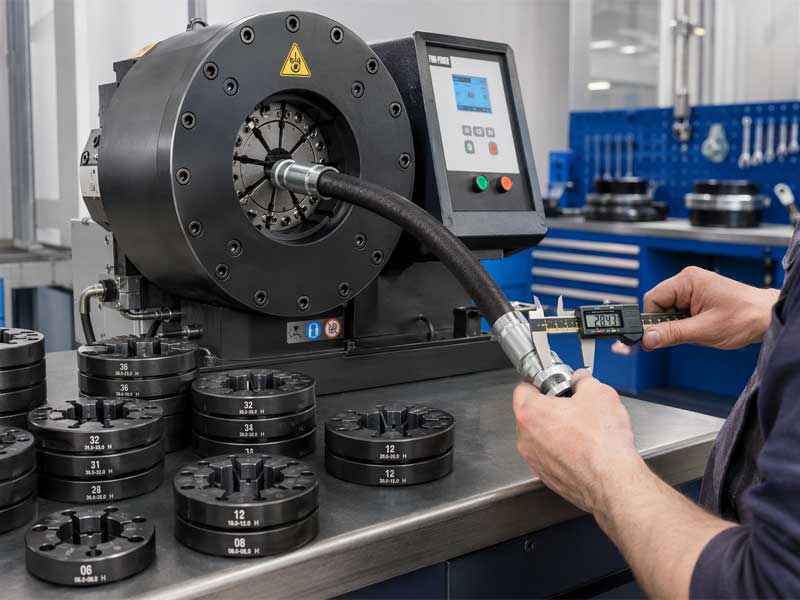
What Size Hydraulic Hose Crimper Die Do I Need?
The correct hydraulic hose crimper die size is determined by:
- Hose dash size (-4, -6, -8, -12, -16, etc.)
- Hose construction (1-wire, 2-wire braid, or 4/6-spiral)
- Fitting manufacturer’s required finished crimp diameter (from their data sheet)
- Crimper machine die compatibility
A hydraulic hose die size is NOT equal to hose inside diameter. Always select dies according to the specified finished crimp diameter, not the hose ID alone. Verify the final crimp diameter using a calibrated caliper.
The Golden Rule of Hydraulic Hose Crimping
The correct hydraulic hose crimper die is selected based on the required finished crimp diameter, not the hose size.
| Passo | Ação |
|---|---|
| Step 1 | Hose Size → Starting Point |
| Step 2 | Fitting Specification → Target Crimp Diameter |
| Step 3 | Caliper Measurement → Quality Verification |
This rule applies to every hydraulic hose assembly, regardless of brand, pressure rating, or application.
What Size Hydraulic Hose Crimper Die Do I Need?
The required hydraulic hose crimper die size depends on the hose dash size, hose construction, fitting series, and required finished crimp diameter. A -8 hydraulic hose does not necessarily use the same die size across different manufacturers because ferrule designs and crimp specifications vary. Always consult the specific fitting manufacturer’s data for the exact target crimp diameter.
Many operators search for a hydraulic hose die chart or crimper die chart when selecting tooling. However, die numbers are machine-specific and should not replace the manufacturer’s crimp specification.
1. What Is a Hydraulic Hose Crimper Die?
A hydraulic hose crimper die is a precision-ground tooling component that fits into a crimping machine. When the machine applies hydraulic pressure, these dies close radially around the hose fitting, permanently compressing the ferrule onto the hose to create a secure, leak-free assembly.
How It Works:
The dies are arranged in a segmental cage. As the machine’s piston advances, it forces the dies inward. The amount of inward travel (controlled by the die size and machine settings) determines the finished crimp diameter, which is the critical measurement for assembly integrity.
2. Why Correct Die Selection Matters
Selecting the wrong die is not a minor error; it is a direct path to system failure. In practical hydraulic maintenance and manufacturing environments, many hose assembly failures are caused by incorrect crimp specifications, improper tooling selection, or insufficient inspection procedures.
Consequences of Incorrect Selection:
- Under-Crimping (Die too large): The fitting will not grip the hose adequately. Under pressure, the fitting can blow off, leading to catastrophic fluid loss, injury, and equipment damage.
- Over-Crimping (Die too small): The die crushes the hose’s inner tube and reinforcement wires. This restricts flow, drastically reduces the assembly’s burst pressure, and accelerates fatigue failure.
- Uneven Crimp: Worn or misaligned dies create an inconsistent crimp profile, creating weak points that lead to premature leaks.
HENGHUA Engineering Experience: After years of supplying hydraulic hose crimping equipment, our engineers have found that most assembly failures are caused by incorrect die selection, missing crimp diameter verification, worn die segments, or wrong fitting compatibility. A simple crimp measurement procedure can prevent most hose failures.
3. Hydraulic Hose Crimper Die Size Chart by Dash Size
Selecting the correct die starts with identifying the hose size. However, this chart is a starting guide. The exact die size is always determined by the fitting manufacturer’s specified finished crimp diameter.
| Tamanho do traço | Common Hose ID | Typical Hose Construction | Common Die Size Range (Example) | Common Standards | Typical Application |
|---|---|---|---|---|---|
| -4 | 1/4 inch (6.4 mm) | 1-Wire Braid | 10 – 14 mm | SAE 100R1 | Instrumentation, low-pressure return lines |
| -6 | 3/8 inch (9.5 mm) | 1/2-Wire Braid | 14 – 19 mm | SAE 100R1/R2 | General industrial & mobile hydraulics |
| -8 | 1/2 inch (12.7 mm) | 2-Wire Braid | 19 – 23 mm | SAE 100R2 | Construction equipment, agriculture |
| -10 | 5/8 inch (15.9 mm) | 2-Wire Braid | 23 – 27 mm | SAE 100R2 | Material handling, earthmoving |
| -12 | 3/4 inch (19.0 mm) | 4-Spiral / Braid | 27 – 31 mm | SAE 100R12 | Heavy equipment, high-pressure circuits |
| -16 | 1 inch (25.4 mm) | 4/6-Spiral | 31 – 35 mm | SAE 100R13 | High-pressure, large-bore applications |
⚠️ Critical Note: The die size is not a direct match to the hose ID. For example, a 1/2″ hose does not use a 1/2″ die. The die size corresponds to the desired outer diameter of the crimped fitting. Always consult the specific hose and fitting manufacturer’s crimp specification.
How to Use This Chart: This chart helps identify the approximate die range based on hose size. The final die selection must always be confirmed by the fitting manufacturer’s finished crimp diameter specification.
4. Approximate Finished Crimp Diameter Reference Chart
The finished crimp diameter is the most critical measurement. This chart provides typical values for reference only. Actual crimp diameter must always follow the hose and fitting manufacturer’s specification.
| Hose Dash Size | Diâmetro interno da mangueira | Approximate Finished Crimp Diameter Reference Range | Fitting Series Example |
|---|---|---|---|
| -4 | 1/4″ | 0.433″ – 0.472″ (11.0 – 12.0 mm) | Standard JIC / ORFS |
| -6 | 3/8″ | 0.551″ – 0.630″ (14.0 – 16.0 mm) | Standard JIC / ORFS |
| -8 | 1/2″ | 0.709″ – 0.787″ (18.0 – 20.0 mm) | Standard JIC / ORFS |
| -10 | 5/8″ | 0.866″ – 0.945″ (22.0 – 24.0 mm) | Standard JIC / ORFS |
| -12 | 3/4″ | 1.024″ – 1.102″ (26.0 – 28.0 mm) | High-pressure spiral |
| -16 | 1″ | 1.181″ – 1.260″ (30.0 – 32.0 mm) | High-pressure spiral |
Important: If your measured crimp diameter falls outside the specified range, the assembly is unsafe and should be scrapped.
5. How to Select the Correct Die Step-by-Step
This is the definitive process for selecting and verifying your die setup.
Step 1: Identify the Hose and Fitting
Read the layline on the hose. Record the hose inner diameter (ID), outer diameter (OD), and construction type. Note the manufacturer and series of the fitting.
Step 2: Consult the Manufacturer’s Crimp Specification
Find the specific part number in the manufacturer’s catalog and look for the “Crimp Diameter” or “Finished Crimp Diameter” specification. This is usually given with a tolerance, e.g., 0.598 inches ± 0.008 inches.
Step 3: Determine the Required Die Size
The relationship between die selection, dial setting, and finished crimp diameter varies by crimper manufacturer. Always follow the machine manufacturer’s calibration chart. For example, some machines use calibrated dial systems where the adjustment value controls the final die closure.
Step 4: Verify with a Caliper
After making a test crimp, use a digital caliper to measure the finished fitting diameter.
- Measure exactly at the center of the crimp band.
- Take two measurements, 90 degrees apart.
- Ensure both readings fall within the manufacturer’s specified tolerance.
Our Engineering Recommendation: Maintain a “Crimp Log Book.” Record the hose type, fitting number, die size, dial setting, and final measured diameter for every job. This builds a valuable reference library and ensures repeatable quality.
6. How to Measure Finished Crimp Diameter
Proper measurement is critical for assembly safety. Follow these three steps:
- Measure at the center of the ferrule — not at the edges where the die segments meet.
- Measure at two points — take readings 90° apart and average them.
- Compare with the specification — the measured value must fall within the tolerance specified by the fitting manufacturer.
7. How to Calculate Finished Crimp Diameter
The crimp diameter is based on the ferrule’s outside diameter after compression. The target value is provided exclusively by the fitting manufacturer.
Key Principle: Operators should never calculate the crimp diameter only from hose ID because different ferrule thicknesses and reinforcement structures affect the final dimension.
Finished Crimp Diameter = The specified outer diameter of the crimped ferrule (from the fitting data sheet)
For example, if a fitting manufacturer specifies a crimp diameter of 0.598 inches for a -8 hose assembly, that is your target. You then set your machine’s dial or select a die that will close the dies to produce that exact measurement.
8. Hydraulic Hose Die Types Explained
Understanding the different die categories helps you select the right tooling for your application:
- Standard Dies: Used for most 1-wire and 2-wire braid hoses. Available in common size ranges (e.g., 14mm to 76mm).
- High-Pressure Dies: Engineered for 4-spiral and 6-spiral hoses. Often longer and made from harder steel.
- System Compatibility: Different manufacturers use proprietary systems. A die from one brand may not fit another brand’s crimper without specific adapter rings.
9. Hydraulic Crimper Die Compatibility Guide
Not all dies are interchangeable. Understanding compatibility is critical for safety and performance.
| Crimper Brand | Die System | Compatibility Note |
|---|---|---|
| Parker | 80C Series | Requires Parker-specified dies for that series |
| Finn-Power | P Series | Uses calibrated die settings with specific die sets |
| Manuli | GoldenCrimp | Uses dedicated die sets for their machines |
| HENGHUA | Universal / Custom Systems | Supports multiple hose assembly types with adaptable tooling |
Important: Always verify die compatibility with your machine’s manufacturer to avoid damaging the equipment or producing unsafe assemblies.
10. Common Crimping Mistakes and How to Fix Them
Problem: Loose Crimp / Fitting Spins
- Cause: Die too large, or dial setting insufficient.
- Solution: Disassemble and use new hose and fittings with the correct die setting. Do not re-crimp.
Problem: Over-Crimped / Visible Crushing
- Cause: Die too small, or dial setting too high.
- Solution: Scrap the assembly. Over-crimping compromises reinforcement and leads to premature failure.
Problem: Wavy or Uneven Crimp Profile
- Cause: Worn, damaged, or misaligned dies.
- Solution: Inspect dies for chipped edges or wear. Replace if they no longer form a perfect circle when closed.
11. Quality Control Checklist for Hose Assemblies
To ensure every assembly meets international standards, implement these quality control steps:
- First-Off Inspection: Crimp a sample and measure it before running the entire batch.
- Regular Calibration: Have your crimping machine and calipers professionally calibrated at least once a year.
- Visual Inspection: The fitting’s witness ring should be almost completely closed, but not fully touching.
- Impulse (Pulse) Testing: For critical applications, impulse testing according to SAE J343 is commonly used to verify hose assembly durability. HENGHUA applies strict quality control procedures, including performance verification, to ensure consistent crimping reliability.
12. Hydraulic Hose Crimper Die Manufacturer
For workshops, OEMs, and maintenance operations, selecting the right equipment supplier is as important as selecting the right die.
HENGHUA is a hydraulic hose crimper die manufacturer providing standard and custom hydraulic hose crimper dies for OEM and maintenance applications.
Available solutions include:
- Standard hydraulic crimper die sets
- Custom hydraulic hose dies
- Replacement die segments
- Complete hose crimping machines
- OEM tooling solutions
Our die systems are designed for:
- Repair workshops
- OEM manufacturers
- Mobile service trucks
- Industrial maintenance facilities
Whether you need replacement hydraulic hose crimper dies, complete crimping machines, or custom tooling solutions, selecting a reliable hydraulic hose die supplier is critical for long-term assembly quality.
13. Hydraulic Hose Crimper Die Selection FAQ
Q1: How do I know what size crimper die I need?
The required die size is determined by the fitting manufacturer’s specified finished crimp diameter. Consult the fitting’s data sheet, not just the hose diameter.
Q2: What die size is used for a 1/2 inch hydraulic hose?
A 1/2 inch hydraulic hose commonly uses a die producing the specified fitting crimp diameter, not a 1/2 inch die. The exact die depends on fitting manufacturer specifications. Typically, a -8 hose may use a die in the 19-23 mm range.
Q3: Are hydraulic hose crimper dies universal?
No. Different machines require specific die designs, closing mechanisms, and adapter systems. Always verify compatibility.
Q4: Do Parker and Gates hoses use the same crimper dies?
Not usually. Even if the hose sizes are identical, Parker and Gates have different ferrule thicknesses and fitting geometries, requiring different crimp diameters. Always check the specific brand’s crimp chart.
Q5: How do I read a hydraulic hose crimp chart?
Find the hose dash size and fitting series, then locate the corresponding specified finished crimp diameter. Use that value to set your crimper’s dial or select the correct die.
Q6: What is the difference between a 14mm and 16mm hydraulic crimper die?
The difference is the closing diameter. A 14mm die produces a smaller finished crimp diameter than a 16mm die. The correct choice depends on the hose and fitting specification.
Q7: How do I know if my hydraulic hose is over-crimped?
Signs include visible crushing, cutting into the inner tube, and the fitting’s witness ring completely closing (or missing). Over-crimped assemblies must be scrapped.
Q8: How often should hydraulic crimper dies be replaced?
The service life varies depending on hose size, material hardness, crimping force, operating environment, and maintenance practices. Regular inspection is more reliable than using a fixed replacement cycle.
Q9: What is the difference between crimper die and ferrule?
The crimper die is the tooling component in the machine. The ferrule is the metal sleeve on the hose fitting that the die compresses.
Q10: Can hydraulic hose crimper dies be reused?
Yes, but they must be inspected regularly. Worn or damaged dies produce inconsistent crimps and should be replaced.
Q11: What is the most common hydraulic hose crimper die size?
Common hydraulic hose crimper die sizes include 14mm, 16mm, 19mm, 23mm, 27mm, and 31mm ranges. The correct size depends on hose construction and fitting specifications.
Q12: Can I use one crimper die set for all hydraulic hoses?
No. Different hose sizes, pressure ratings, and fitting designs require different die sizes.
Q13: Why does my hydraulic hose fitting leak after crimping?
Common causes include incorrect die selection, incorrect crimp diameter, damaged fittings, worn dies, or improper hose insertion depth.
Selecting the correct hydraulic hose crimper die is essential for assembly safety, equipment reliability, and operational efficiency. Following the steps outlined in this guide—identifying the hose and fitting, consulting the manufacturer’s crimp specification, verifying with a caliper, and maintaining your tooling—will prevent costly failures.
Whether you need replacement hydraulic hose crimper dies, complete crimping machines, or custom tooling solutions, selecting a reliable hydraulic hose die supplier is critical for long-term assembly quality.
Related Hydraulic Hose Resources:
- [Hydraulic Hose Crimping Machine Buying Guide] — hydraulic hose crimping machine
- [How to Crimp Hydraulic Hose Step by Step] — hydraulic hose assembly process
- [SAE Hydraulic Hose Standards Explained] — SAE hydraulic hose standards
- [Hydraulic Hose Assembly Failure Causes and Prevention] — hydraulic hose failure analysis
Ready to improve your hydraulic hose assembly quality and reduce rework?
HENGHUA offers precision hydraulic hose crimping machines, dies, and custom tooling solutions for workshops, OEMs, and maintenance operations. Our engineering team provides expert support for die selection and process optimization.
[Contact HENGHUA] today to discuss your crimping requirements.

 English
  Spanish
  Portuguese
  French
  German