
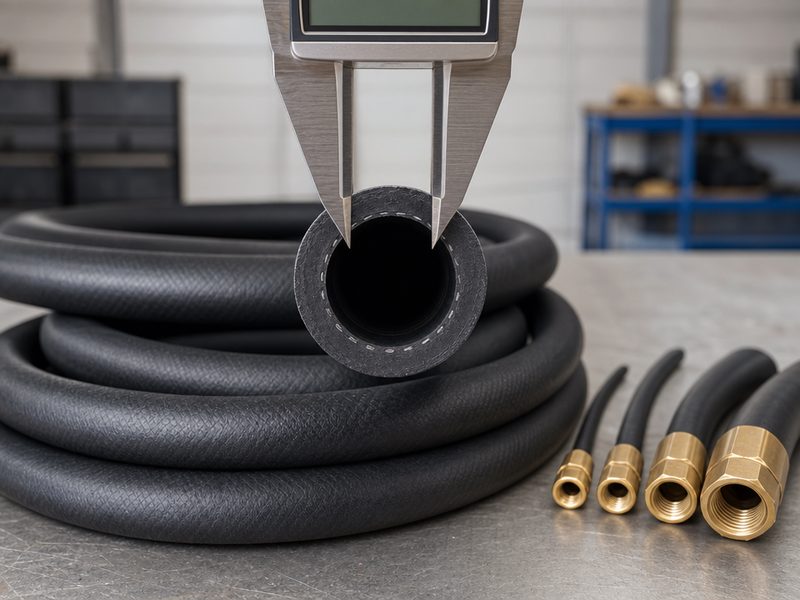
Cover. Measure the open bore with a caliper — the air hose size is the inside diameter.
Air hose size is the inside diameter (ID) of the bore — the passage compressed air actually flows through — always expressed by the bore, in fractions of an inch or in dash sizes. Quick answer: measure the open bore with a digital caliper, match it to the nearest standard air hose size (1/4, 3/8, or 1/2 inch), and multiply the inch value by 16 for the dash size (-4, -6, -8). In four steps you can identify any hose on your rack in about two minutes — including its NPT threads and quick-connect couplers. This guide shows you how to measure air hose size with a caliper, tape measure, or printed cover markings, how to tell inside diameter (ID) from outer diameter (OD), how to convert an ID into a dash size with the air hose size chart, and the measurement mistakes that cause undersized hose.
What Does Air Hose Size Mean? Inside Diameter, Outside Diameter, and Dash Size
Air hose dimensions come in three values people routinely confuse: the inside diameter, the outer diameter, and the dash size. The air hose size is always the inside diameter — the bore that carries compressed air. The outer diameter is the same bore plus two wall thicknesses, so it is always larger and varies with the rubber, PVC, or polyurethane construction. The dash size is a shortcut number that expresses the same inside diameter in sixteenths of an inch.
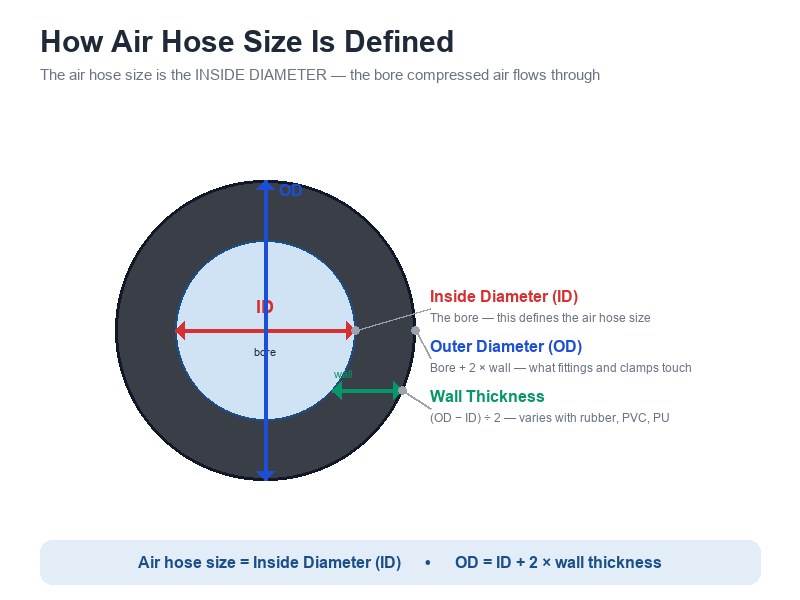
Figure 1. The inside diameter defines the size; the outer diameter is the bore plus two wall thicknesses.
| Air Hose Size (ID) | Metric Equivalent | Tamanho do traço | Typical OD (Rubber) | Utilização típica |
|---|---|---|---|---|
| 1/4 inch | 6.35 mm | -4 | 1/2 inch | Brad nailers, tire inflators, blow guns |
| 3/8 inch | 9.53 mm | -6 | 5/8 inch | Most workshop tools, impact wrenches |
| 1/2 inch | 12.7 mm | -8 | 3/4 inch | Spray guns, sandblasters, high-flow tools |
| 5/8 inch | 15.9 mm | -10 | 7/8 inch | Air brake lines, long distribution runs |
| 3/4 inch | 19.1 mm | -12 | 1 inch | Shop mains, manifold supply |
| 1 inch | 25.4 mm | -16 | 1-1/4 inch | Main header lines, high-volume systems |
Two rules of thumb keep this straight: the ID is always smaller than the OD — by two wall thicknesses — and the OD column above holds for standard rubber hose. A dash number of -8 means the same 1/2-inch bore in any construction: dash sizes describe the bore, so the air hose size stays the same whether the label reads 1/2 in, 12.7 mm, or -8. When you are choosing among the three standard air hose sizes, our what size air hose do i need guide walks through tool-by-tool recommendations.
How to Measure Air Hose Size: 4 Steps at the Bench
Measuring an air hose takes one tool — a digital caliper — and two minutes at the bench. This is the method we use in the HENGHUA test shop for every incoming reel, and it answers the question we hear most: “My compressor sits 60 feet from the bench — which hose should I run?” The answer starts with the bore.
- Read the printed markings first. Every quality hose prints its true bore, working pressure, and temperature range on the cover, often as “3/8 in (9.53 mm) 300 PSI W.P.” The printed size is usually the answer — verify it with the caliper, because worn covers do lie. If you are comparing ratings across hoses, our working pressure and ratings guide explains what the printed numbers mean.
- Measure the air hose inside diameter across the open bore. Set the caliper’s inside jaws into the hose opening until they touch the wall on both sides, and read the value. Straighten the hose, take two readings at 90 degrees, and use the average. A 3/8-inch hose should read 9.4–9.6 mm, a 1/4-inch hose about 6.2–6.5 mm, and a 1/2-inch hose about 12.5–12.9 mm. Measure at room temperature (20–25 °C): below about 0 °C, rubber stiffens and the bore shrinks — our factory records show 3/8-inch bores read 0.1–0.2 mm small at -20 °C.
- Measure the outer diameter and wall if you need them. Close the outside jaws around the hose body away from any fitting or ferrule and read the OD. Wall thickness is then (OD − ID) ÷ 2. This matters for push-on fittings, clamps, and bracket clearance. Measure at room temperature here too — the OD is less temperature-sensitive than the bore, and the same 20–25 °C bench condition keeps readings consistent.
- Convert to the nearest standard air hose size and dash number. Match the measured ID to the nearest standard air hose size — 6.35 mm = 1/4 inch, 9.53 mm = 3/8 inch, 12.7 mm = 1/2 inch, 15.9 mm = 5/8 inch — then multiply the inch value by 16 for the dash size. A 9.5 mm (0.375 in) bore gives 0.375 × 16 = 6, so the hose is -6.
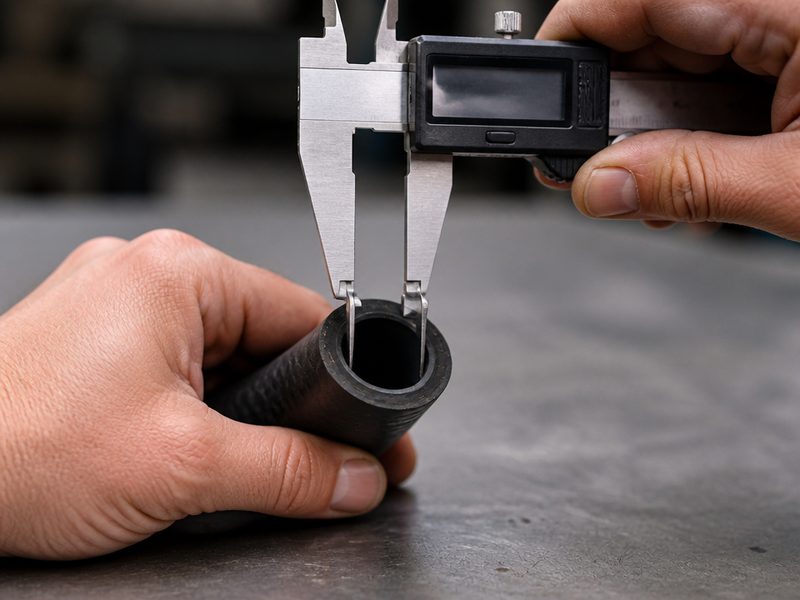
Figure 2. Measure the open bore across two points and average the readings — coiled hose is rarely perfectly round.
A note on used hose: new 3/8-inch hose reads 9.4–9.6 mm on the bore. Our factory records show the bore grows about 0.1–0.3 mm after roughly two years of service, as reinforcement and cover wear relax the wall — so a reading above 9.6 mm on used hose suggests service growth, and it is a sign to check flow and replace the line.
In our shop tests across five production lots, 3/8-inch rubber hose measured 9.4–9.6 mm on the bore and 15.8–16.0 mm outside, matching the 9.53 mm ID / 5/8 inch OD standard within molding tolerance. If your reading lands between two sizes, choose the larger one — the larger bore flows more air, and an oversized bore only costs a little extra.
How to Measure Air Hose Outer Diameter and Wall Thickness
The air hose outer diameter is what fittings, clamps, ferrules, and reels actually touch, so it matters for mechanical fit, while the bore defines the air hose size. Measure it with the caliper’s outside jaws at two points 90 degrees apart, away from any seam or printing that would skew the reading, then calculate wall thickness as (OD − ID) ÷ 2.
Wall thickness explains why two hoses with the same ID look different: a heavy rubber hose rated for 300 PSI has roughly a 1/8-inch (3.2 mm) wall, while a lightweight polyurethane recoil hose runs about half that — 1/16 to 3/32 inch. The table below lists typical values.
| Hose Construction | Typical Wall Thickness | 3/8-Inch Hose Typical OD | Ideal para |
|---|---|---|---|
| Rubber with textile reinforcement | 1/8 in (3.2 mm) | 5/8 in (15.9 mm) | Workshops, cold weather, abrasion |
| PVC | 1/8–5/32 in | 5/8–11/16 in | Budget-friendly general use |
| Polyurethane recoil | 1/16–3/32 in | 1/2 in | Garage use, kink resistance |
| Braided hybrid rubber | 5/32–3/16 in | 11/16–3/4 in | High working pressure, fleet use |
When ordering, always specify both the ID and the OD — a 5/8-inch OD can mean a 3/8-inch ID rubber hose or a 1/2-inch ID thin-wall hose, two completely different air hose outer diameter specifications. Pair the OD with an ID measurement or the printed bore. Wall thickness also decides which air hose fittings grip correctly: push-on fittings and clamps need a wall thick enough to hold.
What Is Air Hose Dash Size and How Do You Convert It?
A dash size is the inside diameter counted in sixteenths of an inch, written with a minus sign: -4, -6, -8, and so on. The conversion is a single multiplication — dash = ID in inches × 16. A 1/4-inch bore is 4/16, hence -4; a 3/8-inch bore is 6/16, hence -6. The dash numbering system comes from SAE J514 hydraulic fitting standards — each dash equals 1/16 inch.
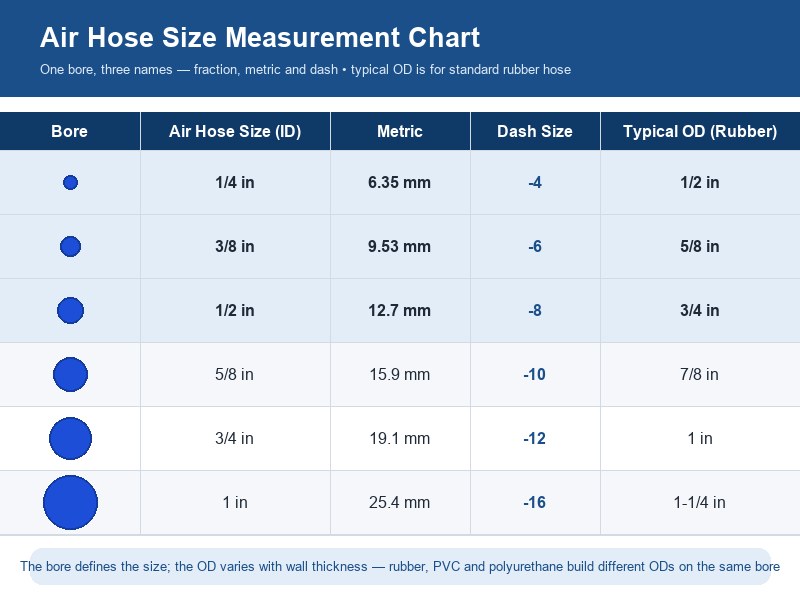
Figure 3. Dash number to inch to millimeter: -4 = 1/4 in = 6.35 mm, -6 = 3/8 in = 9.53 mm, -8 = 1/2 in = 12.7 mm.
| Tamanho do traço | Inches (ID) | Millimeters | Where You See It |
|---|---|---|---|
| -4 | 1/4 | 6.35 | Small air tools, gauge lines |
| -5 | 5/16 | 7.94 | Metric 8 mm counterpart; rare on inch air hoses |
| -6 | 3/8 | 9.53 | Air brake hose, most air tools |
| -8 | 1/2 | 12.7 | High-flow tools, hydraulic return lines |
| -10 | 5/8 | 15.9 | Trailer air brake lines |
| -12 | 3/4 | 19.1 | Shop mains, hydraulic pressure lines |
| -16 | 1 | 25.4 | Header lines, large hydraulic hoses |
| -20 | 1-1/4 | 31.8 | Industrial air distribution |
| -24 | 1-1/2 | 38.1 | Compressor discharge piping |
Dash sizes appear wherever hose is specified by number rather than by fraction — most often on DOT air brake hose built to SAE J1402 (the construction standard behind U.S. DOT FMVSS 106 — the air brake hose size on trucks is commonly -6 or -8), on hydraulic hose with JIC fittings (Joint Industry Council 37° flare, per SAE J514) or ORFS fittings (O-Ring Face Seal, per SAE J1453), and on many OEM drawings. If a spec sheet says “1/2-inch hose, -8,” both names describe the same bore; the air hose dash size simply replaces the fraction with a number you can check on the label.
| Naming System | Typical Label | Bore Example | Where It Applies |
|---|---|---|---|
| Inch/dash (SAE convention, used on J1402 air brake hose) | 3/8 in or -6 | 9.53 mm | US air brake hose, US tool market |
| ISO metric naming (per ISO 4397) | 10 mm | 10.0 mm | EU industrial hose and fittings |
| Fractional inch | 3/8 in | 9.53 mm | US workshop hose |
A -6 and a 10 mm label are close but separate bores (9.53 mm vs 10.0 mm) — the caliper reading tells you which one you have. This distinction matters for OEM drawings and export orders, where one decimal place in the bore spec decides the fitting family.
Metric Air Hose Sizes: 6 mm, 8 mm, 10 mm, and 13 mm
If you buy hose for the EU market, metric bores — 6 mm, 8 mm, 10 mm, and 13 mm — are the naming convention, and the method for how to measure air hose size is identical: caliper across the open bore. The conversion trap: an 8 mm bore is 5/16 inch, and treating it as 3/8 inch is the most common metric mix-up on this topic.
| Metric Bore | Inch Equivalent | Nearest Dash | What It Is For |
|---|---|---|---|
| 6 mm | 0.236 in | -4 (6.35 mm) | Gauge lines, light tools |
| 8 mm | 0.315 in (5/16 in) | -5 (5/16 in) | EU workshop hose — 8.0 mm is 0.06 mm larger than the -5 dash bore, so treat it as its own size |
| 10 mm | 0.394 in | -6 (9.53 mm) | EU workshop hose, close to 3/8 in |
| 13 mm | 0.512 in | -8 (12.7 mm) | EU high-flow hose, close to 1/2 in |
Two practical notes: measure in millimeters and compare against 6.35 mm, 9.53 mm, and 12.7 mm — fraction conversion adds a step where errors creep in; and check the label for OD. On polyurethane recoil tubes the printed size is sometimes the outer diameter (8 mm OD and 10 mm OD tubes are common), so confirm which dimension the label states before ordering. HENGHUA supplies both metric- and inch-labeled air hoses, so the same reel can be specified either way.
How to Measure Air Hose Fitting Size: Threads and Couplers
The air hose fitting size is a separate measurement from the hose bore, and mismatches here cause more field failures than the hose itself. Two things need measuring:
- Thread size on the end fittings — the NPT thread outer diameter.
- Coupler body size — the quick-connect body and plug profile.
For NPT threads (the standard on air hose per ANSI B1.20.1 — see our NPT vs BSP threads guide for the metric alternative), measure the outside diameter of the male thread at its widest point with the caliper jaws. A 1/4-inch NPT thread measures about 0.54 in (13.7 mm) across the crests; 3/8-inch NPT measures about 0.68 in (17.1 mm); 1/2-inch NPT about 0.84 in (21.3 mm). Measure the male thread the female end mates with, then confirm the fit before assembly.
| Nominal Thread Size | Measured Thread OD (Male) | Roscas por polegada | Common Location |
|---|---|---|---|
| 1/4 in NPT | 0.54 in (13.7 mm) | 18 | Most pneumatic tool inlets |
| 3/8 in NPT | 0.68 in (17.1 mm) | 18 | High-flow hoses, regulators |
| 1/2 in NPT | 0.84 in (21.3 mm) | 14 | Mains, large couplers |
| 3/4 in NPT | 1.05 in (26.7 mm) | 14 | Headers, filter/regulator sets |
Quick-connect couplers are sized by body, and the two common air hose fitting size families are 1/4 inch (most workshops) and 3/8 inch (high flow). Use only matching plug profiles: I/M (Industrial/Military) plugs fit I/M couplers, and A (Automotive) plugs fit A couplers. To identify a plug with a caliper, measure the widest point of its outer profile — our shop measurements put A-type plugs at about 0.31 in and I/M-type at about 0.32 in — and the profile width is the dimension that tells the two families apart. Our quick-connect couplers page shows the profiles side by side. The fitting bore should be at least as large as the hose bore: at 90 PSI inlet, a 1/4-inch bore hose through a coupler with a 1/8-inch internal bore delivers roughly 12 SCFM, where a matching 1/4-inch-bore coupler passes about 20 SCFM (experience values from our test bench). A reducing bushing adapts a larger coupler to a smaller tool inlet only; for a larger tool, use a full-size coupler.
Air Hose Size Chart: ID, OD & Dash Sizes at a Glance
The chart below combines every measurement from this guide into one selection table for the standard air hose sizes. To read it, start with your tool’s SCFM demand at 90 PSI, find the matching air hose size row, then check the dash number and comfortable run length against what your fittings and reels accept.
| Air Hose Size (ID) | Tamanho do traço | Typical Tool Demand (SCFM @ 90 PSI) | Max Comfortable Run | Best Tool Match |
|---|---|---|---|---|
| 1/4 inch | -4 | 5–10 | 25 ft | Brad nailers, inflators, blow guns |
| 3/8 inch | -6 | 10–20 | 50 ft | Impact wrenches, ratchets, die grinders |
| 1/2 inch | -8 | 20–35 | 100 ft | HVLP spray guns, sandblasters |
| 5/8 inch | -10 | 35–50 | 150 ft | Air brake lines, distribution runs |
| 3/4 inch | -12 | 50–75 | 200 ft | Shop mains, manifold supply |
| 1 inch | -16 | 75–100 | 250 ft | Header lines, high-volume systems |
Airflow values are typical tool demand at 90 PSI inlet (industry experience values) — the hose itself passes more, and a 1/4-inch bore with a matching coupler flows roughly 20 SCFM. Max comfortable run assumes typical tool demand with roughly ≤10% pressure drop. Typical OD by construction — see the size table above.
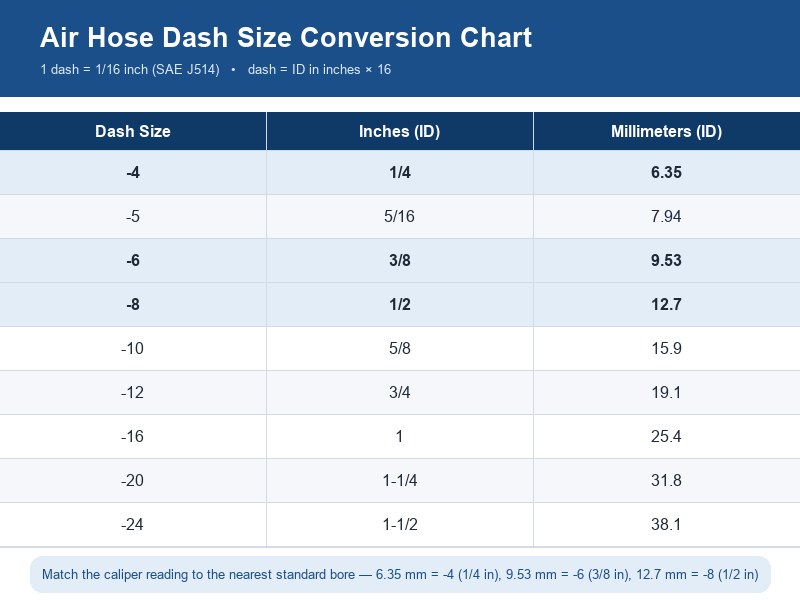
Figure 4. The same bore can be named three ways: a fraction of an inch, a metric value, or a dash number. The image summarizes the main sizes; the size table above is the full reference.
Pressure drop is the hidden cost of a wrong reading: in our shop tests at 90 PSI inlet and 20 SCFM flow, a 50-foot run of 1/4-inch hose loses 6–8 PSI, while 1/2-inch hose over the same run loses about 1 PSI under the same conditions — enough to starve tools rated above 15 SCFM. When in doubt, choose the larger bore for flow and the larger dash number for fittings.
Material changes how the size reads in practice — rubber, PVC, or polyurethane each handle pressure, cold, and kinking differently — so our rubber vs PVC air hose comparison is worth a read before you commit to one construction.
Not sure which bore your tool line needs? Browse the HENGHUA air compressor hoses range, then send your tool list and longest run to our engineering team for a confirmed specification within one business day.
Common Air Hose Measurement Mistakes
| Erro | Result | Corrigir |
|---|---|---|
| Measuring the outside diameter and calling it the size | A “1/2-inch” hose that is actually 3/8-inch bore | Always measure the open bore or check the printed ID |
| Measuring across the brass ferrule or nipple | A reading that matches no standard size | Measure the hose body away from any fitting |
| Measuring a coiled or kinked section | Oval reading, often 0.3–0.5 mm off | Straighten the hose and average two readings |
| Mixing metric and imperial | An 8 mm bore treated as 3/8 inch (it is 5/16 inch) | Convert both to millimeters or both to inches |
| Trusting worn or reprinted cover markings | Installing the wrong size, failing pressure tests | Verify with a caliper when the print is unclear |
The most expensive mistake is the quiet one: a hose that fits the coupler but is one size too small for the tool. It runs, so nothing is flagged, and the tool performs below rating until someone measures the bore — a caliper reading takes less time than replacing a starved tool.
FAQ: How to Measure Air Hose Size
Is air hose size measured by inside or outside diameter?
By inside diameter — the air hose inside diameter is the dimension that defines the size, and the OD is always larger by two wall thicknesses. If a seller quotes a size without saying “ID” or “inside diameter,” the convention is the bore — for lightweight recoil hoses, confirm with a caliper, since some are labeled by OD.
How do I know what size air hose I have?
Read the markings printed on the cover, then confirm with a digital caliper across the open bore. Match your air hose inside diameter reading to the nearest standard size (6.35 mm = 1/4 inch, 9.53 mm = 3/8 inch, 12.7 mm = 1/2 inch), then multiply the inch value by 16 for the dash size.
How do you measure an air hose without a caliper?
Wrap a tape measure around the hose and divide the circumference by 3.14 for the OD, or insert drill bits into the bore until one fits snugly for the ID. A 1/2-inch OD rubber hose wraps to about 1.57 inches. These methods are accurate to roughly 1/32 inch — use them for identification, and use a caliper for fitting-critical measurements.
What size is a -6 air hose?
An air hose dash size of -6 is 6/16 of an inch, or 3/8 inch (9.53 mm) inside diameter. The dash number divided by 16 gives the bore in inches: -4 is 1/4 inch, -8 is 1/2 inch, -12 is 3/4 inch, and -16 is 1 inch.
Does air hose size matter?
Yes — the bore controls how much airflow reaches the tool at usable pressure. An undersized hose starves high-flow tools and adds pressure drop over long runs; an oversized hose costs and weighs more. The right bore matches the tool’s SCFM demand and run length.
What size air hose do I need?
Start from three numbers: your most demanding tool’s SCFM demand at 90 PSI, the longest run to it, and how many tools draw air at once. 3/8 inch is the safe default for most workshops — it clears impact wrenches, framing nailers, and ratchets on runs up to 50 ft. Step up to 1/2 inch when the run goes beyond 50 ft, several tools run at once, or the compressor output exceeds roughly 20 SCFM; drop to 1/4 inch for short, light-duty lines. Match the fitting bore to the hose bore so the connection keeps full flow, and see our air hose selection guide for tool-by-tool detail.
I’m setting up a workshop with an impact wrench — what size air hose do I need to keep full torque?
Use 3/8 inch (-6) for impact wrenches up to 1/2-inch drive. An impact wrench draws roughly 4–6 SCFM at 90 PSI, well inside what 3/8-inch hose delivers over 50 ft (10–20 SCFM), and 1/4-inch hose handles light 3/8-inch-drive wrenches on short 25 ft runs. Keep the coupler bore at least equal to the hose bore so the fitting holds the flow.
How do I measure an air hose fitting or coupler size?
Measure the male NPT thread outer diameter at its widest point: 1/4-in NPT reads about 0.54 in (13.7 mm), 3/8-in NPT about 0.68 in (17.1 mm), and 1/2-in NPT about 0.84 in (21.3 mm). For quick-connect couplers, measure the plug’s outer profile at the widest point — A (Automotive) plugs read about 0.31 in and I/M (Industrial/Military) plugs about 0.32 in. Then match the coupler sizes — the body (1/4 in or 3/8 in) — to the hose bore.
What is the air hose size for a HVLP spray gun?
HVLP spray guns are flow-hungry — most models draw 6–12 SCFM at 40 PSI at the gun — so use 3/8-inch (-6) hose for runs up to 50 ft and 1/2-inch (-8) for longer runs or production finishing. The larger bore keeps the pressure stable so the finish stays consistent.
How do I read the numbers printed on an air hose?
The cover printing usually reads bore, working pressure, and temperature range, for example “3/8 in (9.53 mm) 300 PSI W.P.” The first number is the air hose size — the inside diameter in inches or mm — and W.P. means working pressure. On used hose, our factory records show bores can grow 0.1–0.3 mm after roughly two years of service, so verify with a caliper when the print is worn or the hose is old.
Are metric air hoses (8 mm, 10 mm) the same as 5/16-inch and 3/8-inch?
8 mm is labeled 5/16 inch (0.315 in), and 10 mm (0.394 in) sits between 3/8 inch (9.53 mm) and 7/16 inch. Treat metric hose as its own size: measure the bore in millimeters and match fittings to the same metric bore — an 8 mm or 10 mm hose pairs with metric couplers directly, or with inch couplers through a reducer.
How do I verify the size of a DOT air brake hose on a trailer?
DOT air brake hose is built to SAE J1402, the construction standard behind U.S. DOT FMVSS 106, and the two common sizes are -6 (3/8 in, 9.53 mm) and -8 (1/2 in, 12.7 mm). Verify the size with a caliper across the open bore, then confirm the cover printing shows SAE J1402 and the same dash or inch size. When replacing a line, match both the bore and the end fitting type so the new hose carries the same airflow and pressure rating as the original.
How do I specify air hose size on an OEM drawing?
State the bore in inches and millimeters plus the dash number — for example “3/8 in (9.53 mm), -6” — then add the working pressure, temperature range, and fitting standard (NPT per ANSI B1.20.1, or a metric thread). Note the naming system, because SAE and ISO conventions label the same bore differently (see the dash and metric tables above); a drawing that states all three names reads the same in any market.
Final Verdict: Measure the Bore, Then Choose the Fitting
Measuring an air hose is a four-step habit: read the printed markings, confirm the air hose size on the bore with a caliper, convert it to the dash number if your fittings use dash sizes, and match the NPT threads and couplers to that bore. OD and wall thickness matter for mechanical fit, and the common mistakes above — OD-as-size, ferrule readings, metric mixing — are all avoidable with one caliper and two minutes. If you are sourcing air hoses for a retail line, distribution, or OEM program, send your required bore sizes, lengths, and fitting types to the HENGHUA engineering team — we will confirm the correct specification, provide samples and technical documentation, and quote bulk pricing with factory lead times before you commit to an order. Contact our engineering team.
About HENGHUA: Reinforced Air Hose Manufacturer
HENGHUA is a professional reinforced air hose manufacturer of rubber air hoses and hose assemblies, supplying workshops, distributors, and OEM brands worldwide. Every size in this guide — 1/4, 3/8, 1/2, 5/8, 3/4, and 1 inch bore — is a standard production size in our plant, so the ID, OD, wall thickness, and dash size conversions described here match what we actually ship. Each reel is bore-checked with calibrated gauges and pressure-tested before packing, with factory-crimped brass fittings, custom lengths, and OEM branding as standard options — the inside diameter printed on the cover is the value you can design around, the same number you will measure with the caliper method above.
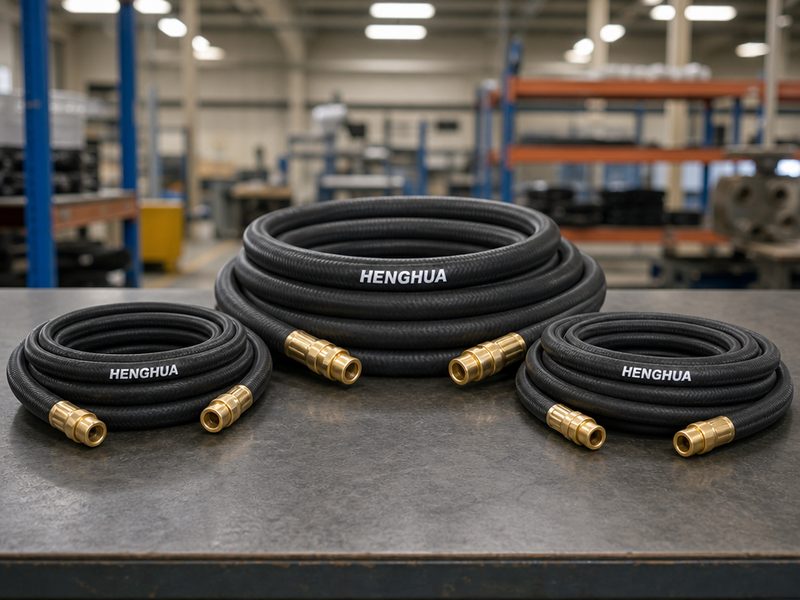
Figure 5. HENGHUA reinforced air hoses — the bore printed on the cover is the value this guide teaches you to verify.

 English
  Spanish
  Portuguese
  French
  German