
A garden hose flow rate calculator answers one practical question: how many minutes should the water run to put a target depth on a known area? Three inputs are enough. You need the area in square feet, the depth you want in inches, and the flow rate your hose actually delivers in gallons per minute (GPM). For a 1,000 square foot lawn at one inch and 8 gallons per minute, that is 77.9 minutes.
Minutes equal the gallons required divided by the delivered flow rate. This article documents that method in written form, with worked tables instead of a live widget.
The sections below move from principle to numbers to selection. You will see what the calculation can and cannot tell you, then the one inch per week rule and the step-by-step method. Worked examples follow for a lawn, a bed and a container. The final sections cover the physical factors that move the answer, so you can choose a hose and fittings with the numbers already in hand.
What a Garden Hose Flow Rate Calculator Can and Cannot Tell You
The hose flow rate calculation is a volume problem, not a pressure problem. It takes a water depth on a known area and turns that depth into a volume of water. It then converts the volume into time at a flow rate you supply. For those inputs, the arithmetic is exact.
The calculation converts depth into volume, then volume into time
Depth multiplied by area gives a volume of water. Flow rate then tells you how quickly that volume arrives at the soil. Two multiplications and one division complete the whole method. Nothing in it depends on the material, color or brand of the hose you use.
The flow rate is an input, not an output
The formula converts a flow rate that you supply. Delivered flow depends on static pressure, bore size, hose length, couplings and any nozzle restriction. Treat the flow figure as your weakest input and measure it once if you can. A bucket test at the tap you actually use replaces an assumption with a measurement.
The inputs the calculation needs
The method needs exactly three numbers before it can return a time:
- The wetted area in square feet.
- The target depth in inches.
- The delivered flow rate in gallons per minute.
Scope and Limits of the Method
The method applies to level ground with even application across the whole area. On heavy clay, water can run off before the soil accepts it; on a slope, the same watering time can leave the top dry and the bottom saturated. For infiltration rate, slope runoff, soil texture and wind drift, use the numbers as a starting point and then watch the soil.
Different types of water hoses behave differently under the same supply pressure, so record which hose and which tap produced your flow figure. Without that note, the result cannot be reproduced next season.
The Garden Hose Flow Rate Calculator Method in Five Steps
The method below works for any hose, any area and any target depth. Work through the steps in order and write your numbers down as you go. Each step uses the output of the step before it, so a single slip propagates forward.
Step 1: measure the area you are watering
Measure length and width in feet, then multiply the two figures together. Split irregular shapes into rectangles and add the parts. For a circular bed, square the radius in feet and multiply by 3.1416. Record the total in square feet.
Step 2: set the target depth in inches
Lawn targets are commonly quoted as one inch per week. Beds are often given less water than lawns, and containers less again. Write the depth as a decimal number, so half an inch becomes 0.5. Keep every depth in inches so the constant in step three stays valid.
Step 3: convert the depth into gallons
Multiply the area by 0.6234 US gallons per square foot per inch. Then multiply that result by the target depth in inches. The single constant carries the conversion from a depth of water to a volume of water. The next section derives it from first principles.
Step 4: divide gallons by the delivered flow rate
Divide the gallons you need by the flow rate in gallons per minute. The result is the number of minutes the water must run. Only this final division changes when your flow rate changes, so a faster hose shortens every run proportionally.
Step 5: verify with a catch cup and correct
Place straight-sided cups across the area and run the water for a fixed time such as 15 minutes. Measure the average depth collected in the cups. Then scale the running time up or down in proportion to the depth you measured. This check catches screened washers, long hose runs and uneven nozzles.
The whole method reduces to one expression, and everything else in this article is a rearrangement of it: minutes = (area in square feet × 0.6234 × target depth in inches) ÷ delivered flow rate in gallons per minute
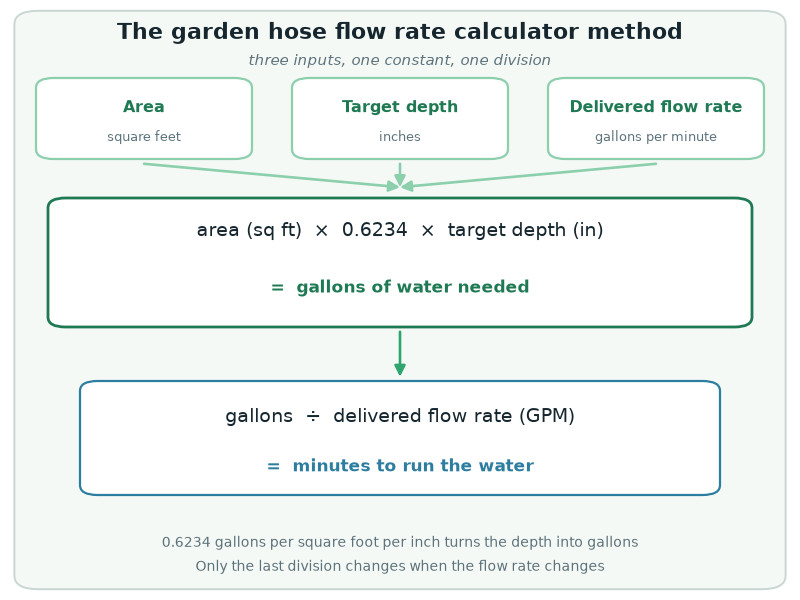
Figure 1: Area, target depth and flow rate enter the method once, and 0.6234 converts depth into gallons.
The One Inch of Water Per Week Rule in Numbers
Why one inch per week is the common target
Garden guidance converges on roughly one inch of water per week through the growing season. That figure is a working target rather than a measurement of your own soil. It exists because most established lawns and beds use about that depth to replace daily losses. Deeper and less frequent watering usually encourages deeper roots than light daily sprinkling does.
Where 0.6234 gallons per square foot comes from
One inch is one twelfth of a foot. A square foot covered to a depth of one inch therefore holds one twelfth of a cubic foot. One cubic foot holds 7.4805 US liquid gallons, which is a fixed conversion. Multiplying one twelfth by 7.4805 gives 0.6234 gallons per square foot per inch, calculated.
Scale that constant and the whole method scales with it. One thousand square feet needs 623.4 gallons per inch of depth, calculated. Five thousand square feet needs 3,117 gallons for the same inch, calculated. Nothing else in the arithmetic depends on which units you measured in.
Gallons needed by area
Gallons required for a target depth, calculated as area in square feet × 0.6234 × depth in inches
| Area (sq ft) | 0.5 inch (gallons) | 1 inch (gallons) | 1.5 inches (gallons) |
|---|---|---|---|
| 100 | 31.2 | 62.3 | 93.5 |
| 250 | 77.9 | 155.9 | 233.8 |
| 500 | 155.9 | 311.7 | 467.6 |
| 1,000 | 311.7 | 623.4 | 935.1 |
| 2,500 | 779.3 | 1,558.5 | 2,337.8 |
| 5,000 | 1,558.5 | 3,117.0 | 4,675.5 |
Read the table by finding your measured area and then taking the column for the depth you want. The one inch column is the weekly lawn figure. The half inch column is one session if you split that weekly target across two watering days.
Convert depth to inches and area to square feet before step three, because 0.6234 is defined for inches of depth and square feet of area. A millimeter to inch conversion chart handles that step in one line of arithmetic, and every other unit needs converting the same way first.
How to Convert Flow Rate and Area Into Minutes
The minutes formula
Minutes equal gallons divided by flow rate. At 1,000 square feet and one inch of depth, the gallon figure is 623.4. A hose delivering 8 gallons per minute therefore needs 623.4 ÷ 8 = 77.9 minutes, calculated. Change the flow and only that final division changes.
A reusable minutes table
Minutes needed to apply a target depth to 100 square feet, calculated as 62.34 gallons per inch of depth ÷ delivered flow rate, scaled by column
| Delivered flow (GPM) | 0.5 inch (min) | 1 inch (min) | 1.5 inches (min) |
|---|---|---|---|
| 2 | 15.6 | 31.2 | 46.8 |
| 4 | 7.8 | 15.6 | 23.4 |
| 6 | 5.2 | 10.4 | 15.6 |
| 8 | 3.9 | 7.8 | 11.7 |
| 10 | 3.1 | 6.2 | 9.4 |
| 12 | 2.6 | 5.2 | 7.8 |
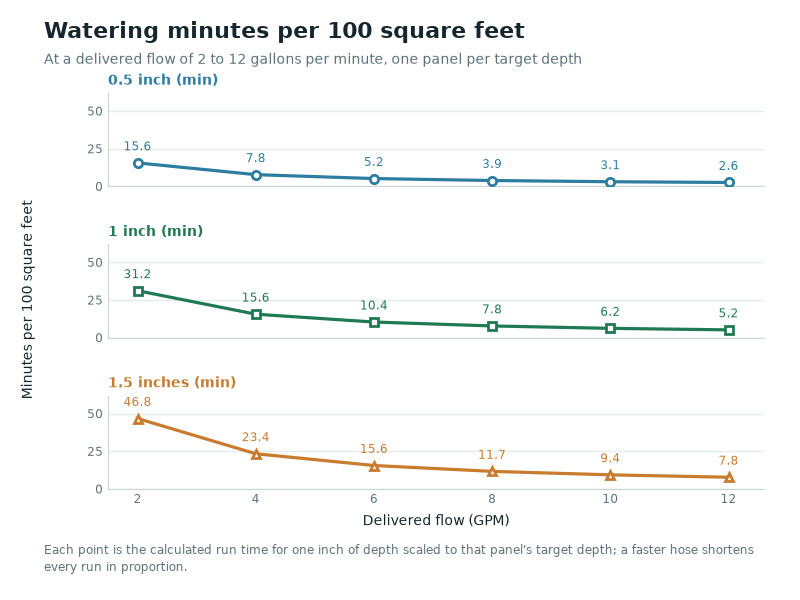
Figure 2: The same minutes data plotted, so each depth curve is visible at a glance.
Each value in the reusable minutes table equals 62.34 gallons divided by the delivered flow rate, calculated. That quotient is the time needed to put one inch on 100 square feet. Multiply the table value by your area measured in hundreds of square feet to reach your own number.
Working backwards from minutes to depth
Invert the formula and you can check what a run actually applied: depth in inches = (flow rate × minutes) ÷ (area in square feet × 0.6234)
Running 8 gallons per minute for 30 minutes delivers 240 gallons, calculated. Spread over 1,000 square feet, that volume gives 240 ÷ 623.4 = 0.385 inches of depth, calculated. This is the fastest way to audit a schedule you inherited from someone else.
Working backwards from depth and minutes to flow
Solve for flow instead and you get a requirement rather than a result: flow in gallons per minute = (area in square feet × 0.6234 × depth) ÷ minutes
To place one inch on 1,000 square feet within 60 minutes, you need 623.4 ÷ 60 = 10.39 gallons per minute, calculated. That figure is the minimum your hose and supply must deliver together for the schedule to be achievable in one pass.
How Long to Water Lawn: A Worked Example at 1,000 Square Feet
A 1,000 square foot lawn is a convenient reference area because the gallon figures come out as whole numbers. Front lawns, courtyards and terraces can all be scaled from it by simple proportion. Every other lawn area scales from this example, so the garden hose flow rate calculator procedure needs no new formula for a different size.
One inch at eight gallons per minute
The gallon requirement is 1,000 × 0.6234 × 1 = 623.4 gallons, calculated. At a delivered flow of 8 gallons per minute the run time is 623.4 ÷ 8 = 77.9 minutes, calculated. In clock terms that is roughly one hour and eighteen minutes of continuous running.
Splitting the inch on compacted soil
Where the soil is compacted or the surface crusts, split the weekly depth further. Expect the first pass to wet only the top layer, and let it soak before the next one.
How Long to Water Lawn in Summer
Hot, dry and windy weather raises evaporation, so many gardeners lift the weekly target to 1.5 inches. That is 935.1 gallons per 1,000 square feet, calculated, or 116.9 minutes at 8 gallons per minute. Two sessions of 58 minutes are easier on the soil than one long run.
When you water with a sprinkler instead of a hose
A sprinkler changes the delivery pattern but not the arithmetic. Run it for 15 minutes with cups placed across the throw, then measure the average depth collected. Minutes for one inch equals 15 divided by the measured depth, calculated. If the cups hold 0.25 inches in 15 minutes, the area needs 60 minutes for one inch, and no flow-rate figure is needed at all.
How Long to Water a Garden Bed
A four by eight raised bed
The area is 4 × 8 = 32 square feet. One inch of water over that area is 32 × 0.6234 = 20.0 gallons, calculated. At 4 gallons per minute the run time is 5 minutes, calculated. That is a short but genuine soak, and it is the main reason beds rarely need the long timings that lawns do.
A ten by twenty foot border
The area is 10 × 20 = 200 square feet. One inch needs 200 × 0.6234 = 124.7 gallons, calculated. At 5 gallons per minute the run time is 24.9 minutes, calculated. A border of this size is close to the practical limit for careful hand watering before your attention wanders.
Why beds need less running time than lawns
Beds are usually smaller than lawns, and they are often watered to a lower target depth. Mulch also slows surface evaporation, so a given volume of water stays available in the soil for longer. Area and target depth are inputs, so a smaller bed and a lower target depth both shorten the run automatically.
Rows, drip lines and the limits of a hose calculation
Hand watering a row with a hose applies water unevenly along its length. Move steadily and overlap each pass by about half the watering width. For long rows and larger plots, inline drip lines and micro-sprinklers distribute water by design rather than by hand. That is where the agriculture and irrigation hose range becomes relevant, because those layouts are chosen for uniform delivery rather than for reach.
How Long to Water a Container or Pot
Containers are a seconds problem, not a minutes problem
A 12 inch diameter pot has an area of π ÷ 4 × 1² = 0.7854 square feet, calculated. One inch of water over that area is 0.7854 × 0.6234 = 0.49 gallons, calculated. At 1 gallon per minute the run is 0.49 minutes, or about 29 seconds. The same arithmetic that gives a lawn 78 minutes gives this pot half a minute.
Container examples by pot diameter
One inch of water on a round container, calculated as π ÷ 4 × (diameter in feet)² × 0.6234
| Pot diameter (in) | Area (sq ft) | Water for 1 inch (gallons) | Seconds at 1 GPM |
|---|---|---|---|
| 8 | 0.349 | 0.22 | 13 |
| 12 | 0.785 | 0.49 | 29 |
| 14 | 1.069 | 0.67 | 40 |
| 18 | 1.767 | 1.10 | 66 |
| 24 | 3.142 | 1.96 | 118 |
The watering time for a 24 inch pot at 1 gallon per minute is under two minutes, which you can judge by eye rather than by stopwatch. A garden hose flow rate calculator gives you the volume for one watering, not a calendar of when to water.
Why a very dry pot needs two passes
When potting mix dries out it can shrink away from the sides of the pot. Water then channels straight down the gap and out of the drainage holes. Apply half the calculated volume, wait a few minutes for the mix to swell, then apply the rest. The total volume stays the same but far more of it ends up in the root zone.
Worked examples side by side
Worked examples for lawn, bed and container, each calculated from the stated area, depth and flow rate
| Target | Area (sq ft) | Water for 1 inch (gallons) | Flow assumed (GPM) | Run time |
|---|---|---|---|---|
| Lawn, 1 inch | 1,000 | 623.4 | 8 | 77.9 min |
| Lawn, 0.5 inch | 1,000 | 311.7 | 8 | 39.0 min |
| Raised bed, 4 × 8 ft | 32 | 20.0 | 4 | 5.0 min |
| Border, 10 × 20 ft | 200 | 124.7 | 5 | 24.9 min |
| Pot, 12 in diameter | 0.79 | 0.49 | 1 | 0.5 min (29 s) |
| Pot, 18 in diameter | 1.77 | 1.10 | 1 | 1.1 min (66 s) |

Figure 3: Watering minutes for a lawn at two depths, a bed, a border and two containers.
What Changes the Answer: Diameter, Pressure and Fittings
Inside diameter sets a ceiling on flow
At the same supply pressure, flow scales roughly with the cross-sectional area of the bore. Double the inside diameter and the area rises fourfold, so the hose can pass about four times the flow if friction is ignored. Real hoses deliver less than that, because friction grows with length and with velocity.
Cross-sectional area by nominal size
Cross-sectional area of common garden hose bores, calculated as π ÷ 4 × inside diameter²
| Nominal size (in) | Inside diameter (in) | Area (sq in) | Relative to 1/2 in |
|---|---|---|---|
| 1/2 | 0.500 | 0.196 | 1.00 |
| 5/8 | 0.625 | 0.307 | 1.56 |
| 3/4 | 0.750 | 0.442 | 2.25 |
| 1 | 1.000 | 0.785 | 4.00 |
The cross-sectional areas in the bore table use nominal inside diameters. A real hose of a given nominal size can be smaller inside, especially when a thin wall is traded for higher working pressure. Always prefer the manufacturer’s stated inside diameter over the nominal label.
Pressure, elevation and friction
Tap pressure is not the pressure at the far end of the hose. Every foot of hose and every fitting costs some pressure to friction. Elevation costs more, at about 0.433 psi for each foot of rise, calculated from the density of water. A hose run up a slope therefore delivers less at the top than at the tap.
Nozzles, wands and timers
Any nozzle, wand, quick-connect or timer adds a restriction, and a restriction reduces delivered flow. A lower flow lengthens the run, so your watering time grows accordingly. Measure with the complete assembly you actually water through; a figure taken at an open hose end overstates what the nozzle passes.
Why the flow figure must match your setup
Measure flow with the same fittings you intend to water through. A hose size selection guide helps here, because bore and length are chosen together with the couplings and the nozzle. Repeat the bucket test once and keep the number with the hose, so next season’s schedule starts from a measurement instead of a guess.
What a single flow number does not cover
One number cannot describe everything a hose does. Use the garden hose flow rate calculator with the fittings you will actually water through, then treat the output as a plan rather than a promise. Coverage pattern, wind during the run, soil infiltration rate and pressure loss along a long run all sit outside the arithmetic.
Choosing a Target Depth by Plant Type
Depth is the input people guess most often, and it is the one that changes the answer most. A single weekly figure works for turf, but vegetables, shrubs and containers each want something different. Set the depth first and then let the arithmetic produce the minutes.
How much water does an established lawn need?
For established lawns, one inch of water per week through the growing season is the long-standing working target. On sandy ground you may need a little more, and in shade you may need less. Check once with cups before you trust any figure, including this one.
Vegetables and annual beds
Most vegetable crops respond to roughly one inch per week as well, delivered in one or two sessions. Shallow-rooted crops such as lettuce and radish prefer lighter and more frequent applications on sandy soil. Deep-rooted crops such as tomato and squash do better with fewer, heavier soaks that reach the full root zone.
Trees and shrubs
A mature tree needs far more water than a lawn per unit of canopy, but far less often. Water the root zone rather than the trunk, and count the area under the canopy rather than the trunk diameter. One deep session every week or two in dry weather is usually enough for an established tree.
How long should you run a hose on a balcony hanging basket?
Small containers hold little reserve water and dry fastest. Treat the calculated volume as a single application and be ready to repeat it daily in hot weather. A pot 8 inches across needs only 0.22 gallons to gain an inch of depth, calculated, so accuracy comes from watching the plant rather than from precise timing.
How Soil and Mulch Change the Session Plan
The arithmetic tells you how much water to apply. The soil decides how fast it can accept that water. When the two disagree, water runs off the surface and the session is wasted.
Sandy soil
Sand drains quickly and holds little water between sessions. Reach the same weekly volume through more and smaller sessions, and expect to repeat them sooner. Each session runs for fewer minutes because you are applying a smaller depth.
Clay soil
Clay absorbs slowly and can pond within minutes. Split the weekly depth into three or four sessions instead of two, and pause whenever water stops soaking in. The gallon total stays the same, and the running time is simply divided across the extra sessions.
Loam and improved beds
Loam accepts water readily and holds it well. A loam bed usually takes the full weekly depth in one or two sessions without runoff. Adding compost moves any soil toward this behavior over a few seasons.
Mulch
Mulch slows evaporation from the surface and keeps the soil cooler. A mulched bed can often hold its moisture with a smaller weekly volume than bare soil. Reduce the target depth rather than the session length, so the method stays consistent from season to season.
Adjusting for Slope, Wind and Shade
Slopes
Water applied to a slope flows downhill before it soaks in. Apply it in short, repeated passes and let each one soak before the next. The volume needed does not change, but the time to deliver it in a usable form increases.
Wind
Wind blows spray away from the target and raises evaporation. Water early in the morning, when wind is usually lightest. If you must water in wind, expect a longer run and check the cups afterwards to see what actually landed.
Shade and microclimate
Shaded ground loses less water than ground in full sun. A bed against a wall that faces the afternoon sun dries fastest of all. Adjust the target depth for the spot rather than for the whole garden, because one average figure hides real differences.
Morning rather than evening
Early watering loses least to evaporation and leaves foliage dry through the day, which reduces disease pressure. Evening watering leaves leaves wet overnight. The volume and the run time are identical either way, and only the result in the soil differs.
Reading the Result: When the Run Time Looks Wrong
The run time comes out over an hour
A long run usually means a large area, a low flow rate, or both. Check the flow first with a bucket and then check the area measurement. A hose with a smaller bore, an unusually long run or a restricting nozzle produces exactly this symptom.
The run time comes out under five minutes
A short run usually means a small area or a high flow rate. Small beds and pots genuinely finish in minutes. If a lawn finishes this quickly, the area figure is probably wrong, or the target depth is well below one inch.
The same hose gives different numbers on two days
Pressure at the tap varies through the day as other users draw water. Measure at the time of day you actually water. If the number moves a lot, plan with the lower figure so the schedule still holds on the worst day.
Send HENGHUA your measured area, target depth and delivered flow rate and the team will check your fittings against it.
Common Mistakes That Change the Result
The method is short, so most errors come from the inputs rather than from the arithmetic. These are the ones that appear most often when a schedule fails to match what the soil actually receives.
Using the nominal size as the inside diameter
A half inch hose does not always measure half an inch across the bore. Walls are thicker on higher-pressure constructions, so the inside diameter can be noticeably smaller than the label suggests. The label also describes the coupling thread in some product families. Measure the bore or read the manufacturer’s specification sheet instead.
Averaging over two different soil types
A garden with sand at one end and clay at the other needs two schedules rather than one average figure. Treat the two areas separately, because the clay zone needs more sessions while the sandy zone needs more total volume. Two calculations take a minute longer and produce a far better schedule.
Treating the weekly figure as one long session
Applying a full week of water in a single pass usually pushes the soil past its infiltration rate. The excess runs off, and the effective depth in the root zone stays well below the target. Splitting the total into two or three sessions raises the depth that actually remains in the soil.
Ignoring the difference between applied and stored water
The calculation gives the applied depth. Some water evaporates from the surface, some runs off, and some drains below the roots on light soil, so the stored depth comes out lower. Check with a trowel after a session to see how deep the moisture actually went.
Assuming the first session is typical
New hoses, new couplings and a freshly cleaned screen all behave differently from a settled setup. Re-measure once after a month of use, and again whenever you change a fitting or a nozzle. A single early measurement can drift, and the drift shows up as a bed that is either too dry or too wet.
The three numbers worth keeping
Write three figures on the hose reel or in a garden notebook: the area you watered, the target depth, and the delivered flow. Next season you can repeat the schedule in seconds without re-measuring anything, and any change in the result can be traced back to one of the three.
Perguntas Frequentes
What is a garden hose flow rate calculator?
It is a documented method for converting a target water depth into running minutes. You supply three numbers: the area in square feet, the depth in inches, and your hose’s delivered flow in gallons per minute. The method multiplies area by 0.6234 and by depth to get gallons, then divides by flow to get minutes. The worked tables in this article replace an embedded widget.
What inputs does the calculation need?
Three inputs are enough. You need the wetted area in square feet, the target depth in inches, and the delivered flow rate in gallons per minute. Area comes from measuring length and width; depth comes from the one inch per week rule or your own target; flow comes from a bucket test. Nothing else enters the arithmetic.
How many gallons does one inch of water need on 100 square feet?
One hundred square feet needs 62.3 gallons for one inch of depth, calculated as 100 × 0.6234. That is the smallest row of the gallon table. Scale from it directly: 1,000 square feet needs 623.4 gallons, and 5,000 square feet needs 3,117 gallons, both calculated from the same constant.
How long to water lawn for 1 inch?
For 1,000 square feet at 8 gallons per minute the answer is 77.9 minutes, calculated. The answer changes only through area, depth and flow rate. A smaller 500 square foot lawn takes 39 minutes at the same flow, and a 12 gallon per minute hose cuts the 1,000 square foot time to 52 minutes.
Does hose diameter change the watering time?
Yes, indirectly. Diameter changes the flow a hose can deliver, and flow is one of the three inputs. At the same pressure, a larger bore carries more water per minute, so the run shortens. Diameter does not change how many gallons the soil needs, only how quickly those gallons arrive.
Can I use the same numbers for a raised bed?
You can use the same method, but not the same totals. A raised bed is much smaller than a lawn, so its gallon requirement is small. A 32 square foot bed needs 20.0 gallons for one inch, which is 5 minutes at 4 gallons per minute, calculated. Depth and area both scale the answer.
How long should I run a hose on a container plant?
Far less time than most people expect. A 12 inch pot needs 0.49 gallons for one inch of water, which is 29 seconds at 1 gallon per minute, calculated. Use a throttled wand and watch the drainage holes. Stop when water first appears and then allow the pot to drain fully.
What if I do not know my hose flow rate?
Measure it once with a bucket and a timer, then convert to gallons per minute. The companion guide on measuring hose GPM covers the test procedure in full. Where a measurement is not practical, a deliberately conservative figure shortened after the first cycle still keeps the schedule workable.
Should I water once a week or split the week?
Split it where the soil allows. Two sessions of half an inch usually infiltrate better than one session of a full inch, especially on clay. Halving the depth halves the gallon requirement and therefore halves the run time. The weekly total stays the same while runoff falls.
Why do the tables say calculated instead of giving one number?
Because area, depth and flow all vary between gardens. Every figure in the tables is derived from stated inputs with the constant 0.6234, so you can check each one by hand. A single published number would hide those inputs and would be wrong wherever your area or your flow differs.
How long should you water a newly seeded lawn?
Water a newly seeded lawn in short, light passes rather than one long soak. Seed and new roots sit in the top inch of soil, so keep that layer damp. Run the hose until the surface is damp, then repeat two or three times a day. Once the grass reaches about two inches, move to the one inch per week target.
What is the recommended run time for a sprinkler zone?
Sprinkler zones differ in area and in delivery, so one clock setting rarely fits a whole system. Time each zone with straight-sided cups: run it for 15 minutes, measure the average depth collected, then divide 15 by that depth for the minutes per inch, calculated. Zones that throw wider reach the inch sooner, so schedule each on its own figure.
About HENGHUA
HENGHUA is a hose manufacturer supplying distributors, retailers, OEM and private-label programmes, and end users who research before buying. The company makes hydraulic hose under the GLOBHOSE brand and flexible industrial hose under the FLEXMAX brand, alongside water and garden hose for irrigation and washdown duties. Custom branding, tailored lengths and bespoke assembly are supported.
Every production batch is measured against the stated bore, working pressure and material specification. For buyers comparing suppliers, the relevant figures are the inside diameter, the working pressure and the material of the cover and reinforcement.
You can review the current hose range for specifications and available sizes. For irrigation layouts, distribution programmes or private-label questions, contact the HENGHUA technical team with your area, target depth and expected flow rate. The engineers will help you match bore, length and fittings to the schedule you have calculated.






 English
  Spanish
  Portuguese
  French
  German
  Arabic
  Russian
  Indonesian
  Japanese
  Korean