
A food grade composite hose is a hose whose wetted lining is made from food-contact-approved material and can be documented as such. In practice that means a polypropylene, UHMWPE or PTFE liner supported by a written declaration of compliance, not a white cover. FDA rules, EU 10/2011 and 3-A sanitary standards each ask a different question, and a hygienic audit will ask for all three answers.
This guide separates those three frameworks, shows which lining suits which cleaning regime, and lists the documents to request before a food grade hose is installed on a line that carries product rather than water.
The short answer: a compliant hose needs a named liner grade, a finished-article migration report, and a declaration that links both to the batch you receive.
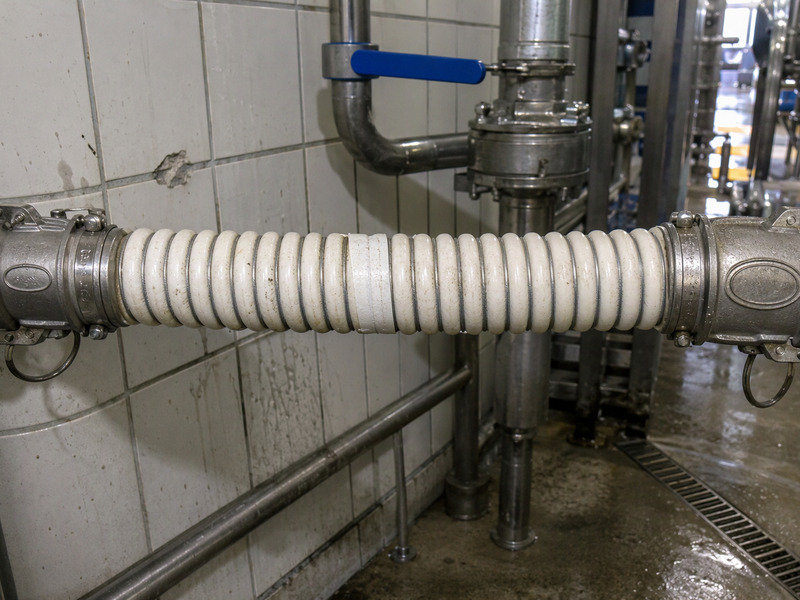
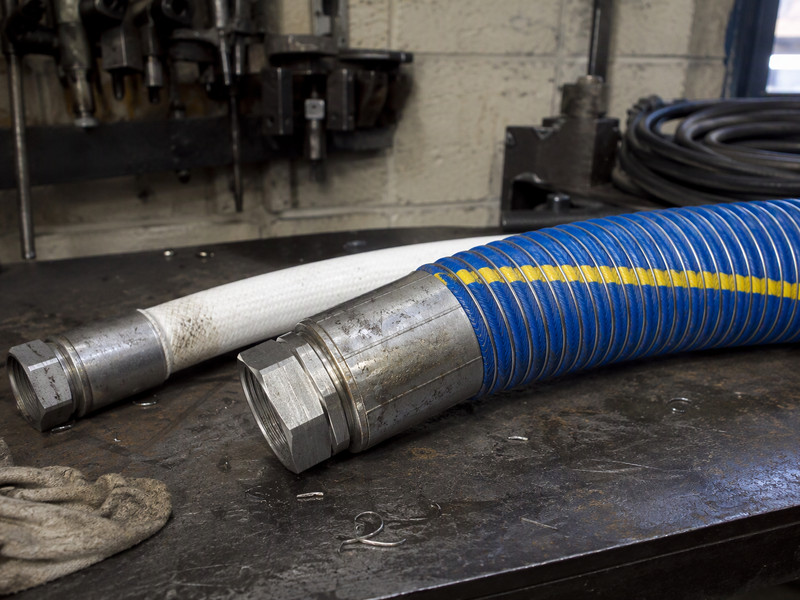
Figure 1. A white composite hose on a dairy transfer line. The cover is white and the end carries a stainless coupling; the lining sits behind the cover.
What Makes a Food Grade Hose Food Grade?
“Food grade” is a purchasing term, not a legal one. No single regulation certifies a hose as food grade, and no authority issues a food grade certificate for an assembly. What exists is a chain of evidence: the lining resin is listed for food contact, the finished article passes migration testing, and the supplier declares both in writing.
That distinction matters at audit, and it is where a composite hose datasheet earns its place. An inspector will not accept a product photo or a cover colour. They will ask for the regulation the material complies with, the migration test behind it, and the batch traceability that ties the hose in the rack to that report.
The most common gap we see in files from new buyers is a declaration that covers the resin but not the finished hose. The resin approval is the starting point, not the conclusion, because heat, adhesives and fabrication all change what can migrate.
An FDA food hose claim is also narrower than buyers expect. It speaks to food-contact substances, so a supplier who writes “FDA food hose” without naming the regulation and the liner grade has told you very little about what was tested.
Which Regulation Applies to Which Market?
Three frameworks dominate food and beverage projects: US FDA 21 CFR, EU Regulation 10/2011 on plastic food-contact materials, and the 3-A sanitary standards. They are not interchangeable. A hose that satisfies one may still be questioned under another.
| Framework | What it covers | What the supplier must provide |
|---|---|---|
| US FDA, 21 CFR | Food-contact substances, including olefin polymers and perfluorocarbon resins | Statement of compliance citing the regulation and the resin grade |
| EU 10/2011 | Plastic materials and articles in contact with food, per layer | Declaration of compliance with migration test data |
| 3-A sanitary standards | Product-contact materials and cleanability for dairy and hygienic duty | Assessment of wetted materials plus cleaning validation support |
Table 1. Three food-contact frameworks and the document each one produces. One hose can sit under more than one framework, and a declaration usually answers only the one it cites.
The FDA route is substance-based. Polypropylene food-contact grades are covered by the olefin polymer regulation, and PTFE by the perfluorocarbon resin regulation. The EU route is article-based: the finished plastic layer must meet an overall migration limit, and the supplier must issue a declaration of compliance that names the layers covered.
3-A is different again. It is a sanitary design standard concerned with cleanability and material suitability, widely specified in dairy and beverage work in North America. A 3-A sanitary hose claim should be read as a statement about the wetted materials and the cleaning routine the assembly survives, not as a certificate.
Where a tender asks for a 3-A sanitary hose, ask which standard number applies and whether the assessment covered the lining alone or the assembled hose. The answer usually separates a real file from a copied phrase.
Why Does the Lining Decide Compliance, Not the Cover?
Only the layer that touches product is a food-contact surface, and in a composite hose that layer is a thermoplastic film. The wall build puts that film behind fabric and wire, never in front of them. The fabric, the wire and the cover sit behind it and are not food-contact materials, although they must not compromise the lining.
This is why a white cover proves nothing on its own. Two hoses can look identical and carry different liners, one approved for fatty foods and one only for aqueous products. Two simulant families decide coverage. A declaration naming an aqueous simulant covers aqueous product; fatty and alcoholic product need their own line in the declaration.
Ask for the liner grade by name against the chemical resistance chart, then check the declaration covers that grade at the wall thickness used in your bore. Thin films and thick films can behave differently in migration testing.
A food grade hose that is approved only for aqueous product will still be sold as food grade. The qualifier is the part that matters, and it is the part most datasheets leave out.
Which Lining Suits Which Duty?
Lining choice follows three variables: product chemistry, cleaning regime and temperature. The same logic drives temperature derating on chemical duty. The table below is a starting point for the specification conversation, not a substitute for the supplier’s compatibility statement.
| Duty | Sensible lining | Why | Watch point |
|---|---|---|---|
| Aqueous dairy, beer, soft drinks | PP | Broad food approval, low cost, good cleanability | Service temperature ceiling around 100 °C |
| Abrasive or high-fat product | UHMWPE | Wear resistance, low moisture uptake | Lower temperature ceiling than PP |
| Aroma-sensitive, aggressive or hot product | PTFE | Widest chemical and temperature range | Higher cost, lower flexibility at small bore |
| CIP with caustic | PP or UHMWPE | Alkali resistance | Confirm concentration and temperature |
| Saturated steam SIP above 120 °C | PTFE | Steam temperature exceeds polyolefin limits | Confirm cycle count with supplier |
Table 2. Lining options for common food and beverage duties. Values are material tendencies; confirm each against the product datasheet.
PP is the workhorse for aqueous product. It is cheap, approved in most markets and easy to clean.
A PP liner fails in two predictable ways: hot product above its service ceiling, and aggressive solvents that swell it.
Most food grade hose enquiries arrive with a product name and a bore, and nothing else. The three questions that decide the lining are usually missing: fat content, cleaning temperature, and whether the line is sterilised with steam.
PTFE earns its cost when temperature or chemistry leaves the polyolefins behind. It is also the liner to specify when saturated steam sterilisation is part of the routine, because steam at 121 °C sits above what PP and UHMWPE tolerate continuously.
Can a Composite Hose Be Cleaned in Place?
Yes, and that is often the reason a composite hose is chosen over a rigid line for the last few metres. CIP compatibility depends on the liner, the bore finish and the end connections, not on the reinforcement.
Caustic CIP at typical food-plant concentrations is handled by PP and UHMWPE. The variables that matter are concentration, temperature and contact time, and the supplier should state the envelope rather than a single “CIP compatible” tick.
Three practical rules cover most of the risk.
- Flush product out before caustic, because sugar and protein burn onto a hot liner.
- Keep the CIP temperature inside the liner rating instead of pushing it to save cycle time.
- Drain the hose after cleaning, since standing caustic in a coiled hose attacks the same surface twice.
What Documents Should You Request?
A complete file for a food grade composite hose has six items. Missing any one of them usually means the compliance claim stops at the resin, which is the easiest place for a claim to look complete and be useless.
- Declaration of compliance naming the regulation and the liner grade
- Migration test report for the finished article, with the test conditions
- Material certificate for the liner batch
- Cleaning recommendation with concentration, temperature and contact time
- Marking record linking the hose to the batch
- Statement of what the declaration does not cover
That last item is the one buyers rarely ask for and the one that protects them. A supplier who states the limits of a declaration is easier to trust than one who claims blanket approval.

Figure 2. Three closed binders and a white hose on a stainless bench. The filing is only as good as the wall behind it.
How Do You Verify a Claim Before the Audit?
Verification is a paper exercise plus one physical check. Start with the declaration: read the regulation cited, the grade named, and the layers covered. If the document lists a resin but not the hose, ask for the second page.
Then compare the marking on the delivered hose with the batch on the certificate. A hose with no batch marking cannot be traced to a test report, which turns a compliance file into a marketing brochure.
Finally, ask one technical question that requires real knowledge: what happens to the liner at the top of your cleaning temperature. A supplier who answers with a number and a failure mode is quoting from data. One who answers “food grade, no problem” is quoting from a template.
How Should a Food Grade Hose Be Specified on a Purchase Order?
Write the duty, not the product name. A line that says “food grade hose, 2 inch” leaves the liner, the ends and the documentation open, and the supplier will fill the gaps at the cheapest compliant option.
A specification that survives an audit has seven entries:
- Product and temperature range, because they exclude half the linings.
- Cleaning regime, because CIP and steam sterilisation point to different polymers.
- Liner grade by name, so the declaration can be matched.
- Bore and length, with tolerances.
- End connections, with material and gasket.
- Marking and batch traceability.
- The documents required at delivery.
Put the declaration requirement in the order, not in an email afterwards. Suppliers treat documentation as a deliverable when it is a line item.
Chase the declaration with a dated reminder in the order file, because a document requested after installation is read as a favour rather than a deliverable.
One further field is worth adding for multi-site buyers: the reference of the last audit the site passed. It tells the supplier which framework the customer actually lives under, and it prevents a hose that satisfies FDA from arriving at a plant inspected against EU rules.

Figure 3. A clipboard and a marking band on a white hose. The band is the first thing goods-in checks.
What Does Goods-In Inspection Look Like?
Receiving is the last point where a food grade hose can be rejected cheaply. An inspector needs four things: the marking on the hose, the declaration that covers it, the batch record and the cleaning instruction.
Check the marking first. A food grade hose without a batch reference cannot be tied to a test report, and in an audit that is the same as having no report. Then match the declaration to the liner grade named on the order, not to the grade in the brochure.
Open one end and look at the lining. A liner that is dull, discoloured or has visible seams at the helix is a manufacturing issue, not a shipping issue, and it will not clean. Smell is a crude test but a useful one: a solvent smell on a new liner means the film was not fully dried.
Finally, confirm the FDA food hose statement is in the file you keep, not only in the quotation. Quotations get archived by sales; declarations get archived by quality. The audit asks the second department.
How Does Cleaning Validation Support the Claim?
A declaration proves what the material is. Cleaning validation proves the line can be returned to a sanitary condition, and the two are asked for by different people. Quality wants the declaration; production wants a cleaning routine that works in the time available between batches.
The hose contributes three variables to that routine. The liner finish decides how easily soil releases. The bore and length decide the flow needed to reach the far end. The end connections decide whether the line can be drained or has to be blown through.
For a coiled hose, the third variable is the one that catches plants out. Product sits in the low points after a flush, and a hose that is coiled on a hook drains differently from one laid straight on a rack. If the cleaning procedure was written for a rigid pipe, it will not transfer unchanged.
Three practical steps make validation cheaper. Run the first cycle with a tracer or conductivity check at the outlet, not by eye. Record the temperature at the hose inlet rather than at the CIP unit. And repeat the cycle on a hose that has been in service for a month, because a new liner cleans better than a used one.
Documentation for this step is short: the cycle parameters, the verification method and the person who signed it. Auditors accept a plain sheet with real numbers over a glossy procedure nobody follows.
Frequently Asked Questions
Is a white food grade hose safer than a coloured one?
No. Colour is a hygiene convention, not a compliance property. The lining grade and its declaration decide safety, and the same liner can be supplied under a white, blue or natural cover.
Does FDA approval cover the whole hose?
It covers food-contact substances, so the lining and any wetted end-fitting surfaces. The cover, fabric and wire are not food-contact materials and are assessed for other properties.
Can a standard chemical hose be used for food by flushing it first?
No. Flushing removes residue but does not change the material’s approval status or its migration behaviour. Food contact requires an approved lining from the start.
What temperature limit applies to a PP-lined food hose?
Roughly 100 °C as a continuous ceiling for typical PP liners, lower for some grades. Confirm the exact figure on the datasheet, because cleaning cycles often run close to that limit.
Is a 3-A sanitary hose the same as an FDA-compliant hose?
No. 3-A is a sanitary design standard, FDA is a food-contact substance regulation. A dairy project may require both, and they answer different questions.
How often should a food grade hose be replaced?
Replacement follows inspection, not a calendar. Look for staining that will not clean, liner swelling, cover cracks and fitting corrosion, then retire the hose when cleaning no longer restores it.
Can composite hose be used on the suction side of a food pump?
Yes, where the assembly is rated for vacuum. The internal helix provides the collapse resistance, and the liner still has to meet the same food-contact requirements.
About HENGHUA
HENGHUA builds composite hose and hose assemblies with PP, UHMWPE, PTFE and XLPE linings on its own site, with fabric reinforcement and a stainless or coated carbon steel helix. Food-contact grades, white or blue covers, camlock or flanged ends and batch marking are all specified at order stage, so the declaration and the marking match the hose that ships.
If you are preparing a hygienic audit, send the duty, the cleaning regime and the target market, and we will return the declaration scope in writing before you order. We will tell you which lining we can document, which we cannot, and what the declaration will and will not cover.

 English
 Spanish
 Portuguese
 French
 German
 Arabic
 Russian
 Indonesian
 Japanese
 Korean