

There is no single best garden hose, because “best” depends on the bore, material, thread and storage that suit one particular yard. What a test or a review should do is measure those properties under stated conditions and let you compare them. This article explains what each relevant measurement means, how to read a garden hose comparison, and how to build a decision profile you can check before you buy.
This article’s scope is the measurement method itself. It names no products and reports no test of its own.
A coiled garden hose beside a tap, ready to be measured against a written specification.
1. What Should the Phrase Best Garden Hose Actually Mean?
Why Is There No Single Best Garden Hose?
The phrase best garden hose is a question about fit, not about a winner. A hose that is ideal for a short patio is wrong for a long allotment, and a hose that survives a desert summer may be over-built for a shaded courtyard. Picking the right hose therefore means matching four variables to one yard. Any list that ignores your bore, climate, tap thread and storage will mislead you, however confident it sounds.
Should You Trust a Ranking or a Specification?
A ranking compresses many judgments into one order and hides the reasoning behind it.
Two badges often describe the same hose from opposite directions: a best rated garden hose badge reports what buyers valued, and a best quality garden hose badge claims something about how the hose is built. Neither is a specification. A specification states the bore, wall, material, pressure rating and thread, so you can compare it with your own needs. If a review does not state its test conditions, you cannot check its result. Prefer the source that shows its method. An opinion is useful only after you know the conditions it was formed under.
What Should a Specification Profile Include?
Four things a specification profile should state:
- Bore and length, which set flow and reach.
- Material and wall thickness, which set weight and cold behavior.
- Working and burst pressure, each with its test condition.
- Thread standard and fittings, which decide whether it seals.
Why Does the Word Best Hide a Trade-off?
Every hose trades one property against another. A thicker wall resists kinking but adds weight. A softer compound coils easily but wears faster on abrasive ground. A wide bore flows freely but holds more water and feels heavier when charged. The word best hides these trade-offs. Name the trade-off you care about, and the shortlist narrows quickly. That is a more honest basis than a single score.
2. What Should Lab Testing Measure on a Garden Hose?
What Does a Burst Test Measure?
A hydrostatic burst test raises the internal pressure of a filled hose until the wall fails, and it records the pressure at failure. The result is meaningless without the temperature and the hold time, because both change the outcome. A burst figure is a ceiling, not a service pressure. The figures published for the HENGHUA garden hose range are 150 psi working and 400–500 psi burst.
What Does an Impulse Test Measure?
An impulse test cycles the hose between low and high pressure many times and counts how many cycles it survives. It models the pressure surges a hose meets in real use, including the spike when a valve shuts quickly. The report should state the pressure band, the cycle rate and the temperature. That measurement, not a single burst number, is what a durability claim should rest on.
What Do Cold Bend and Aging Tests Measure?
A cold bend test cools the hose and then bends it to a stated radius, checking whether the wall cracks. An aging test exposes the cover to ultraviolet light or ozone and then inspects it for hardening and cracking. Plasticized PVC stiffens below about 5 °C, which is 41 °F, so a cold bend result matters in cold climates. Both tests describe the condition as well as the outcome.
What Should a Test Report State?
A durability test report should state:
- The pressure band, the hold or cycle count and the temperature.
- The sample length and whether the ends were restrained.
- The failure mode, such as a wall split or a coupling pull-off.
- The standard or method followed, so results can be compared.
What each garden hose measurement should state, and what it cannot show
| Measurement | Should state | Leaves unanswered |
|---|---|---|
| Burst test | Failure pressure, temperature, hold time | Service pressure or fatigue life |
| Impulse test | Pressure band, cycle count, cycle rate | Abrasion or sun resistance |
| Cold bend test | Temperature and bend radius | Behavior at the working pressure |
| Aging test | UV or ozone dose and duration | Real garden exposure over years |
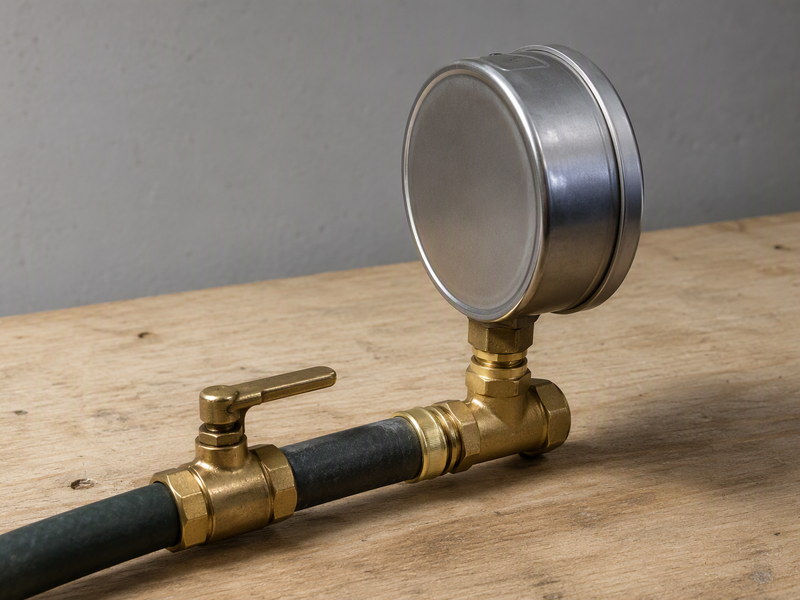
A pressure gauge on a test rig records the failure pressure and the temperature together.
What Does a Test Leave Unanswered?
A test tells you how one sample behaved under one set of conditions. It cannot predict how your hose will age against a hot wall or how it will feel when dragged across gravel. It cannot capture handling, coil memory or how easily a coupling seals on your tap. Treat a test as one input, not a verdict. The gap between a test bench and a real garden is why a specification profile still needs your own criteria.
What Should a UV Aging Test Measure?
An aging report is comparable only when it states the dose and the duration. Two samples aged under the same dose can be compared with each other; neither can be scaled to a number of seasons in your own yard.
How Do You Ask a Seller for Test Evidence?
Ask a direct question: which pressure, which temperature and how many cycles? A seller who holds the data will answer in one line. If the reply stays at the level of a warranty phrase, you have learned something useful about the depth of the specification. Ask the same question of every candidate, so that the answers are comparable. The value of test evidence lies in its conditions, not in the fact that a test took place.
3. How Does Bore Decide Which Hose Is Right for a Run?
How Do You Read Bore and Flow From a Table?
Bore is the inside diameter, and it is the number that controls flow. The four common nominal bores are 12.7 mm, 15.9 mm, 19.1 mm and 25.4 mm, which is half an inch, five eighths, three quarters and one inch. Inside area grows faster than the bore, so a small step up in size is a larger step up in capacity. The table sets out the four nominal bores, the inside area of each and the flow ratio between them.
Nominal bore, inside area and relative flow
| Nominal size | Bore (mm) | Inside area (mm²) | Relative flow at equal velocity |
|---|---|---|---|
| 1/2 in | 12.7 | 127 | 1.00 |
| 5/8 in | 15.9 | 198 | 1.56 |
| 3/4 in | 19.1 | 285 | 2.25 |
| 1 in | 25.4 | 507 | 4.00 |
What Does Relative Flow Mean for Choosing?
Relative flow compares bores at equal water velocity, so it is a ratio rather than a promise. A five-eighths bore carries about 1.56 times the flow of a half-inch bore at the same velocity. A three-quarter bore carries about 2.25 times, and a one-inch bore about 4.00 times. Those flow figures are calculated from the inside areas of the four bores listed above. Your tap pressure and hose length still set the real number you feel.
Why Does Length Change the Best Choice?
Friction grows with length, and the Hazen-Williams friction-loss diameter exponent is 4.87. Doubling the bore cuts friction loss by about 29 times, a figure calculated from that exponent. That is why a long run needs a larger bore to deliver the same flow at the far end. A hose that is too thin for its length feels weak and runs at higher internal pressure, which stresses the joints.
How Do You Handle a Very Long Run?
A long run magnifies every loss. A thin hose loses more pressure per meter than a wide one. If the run is long, step up one bore rather than adding a second coupling, because a joint adds both a restriction and a leak path. Keep the route as straight as the garden allows. A wide bore on a gentle path reaches the far end with more pressure than a thin hose that doubles back on itself.
4. How Do You Make a Fair Garden Hose Comparison?
What Makes a Comparison Fair?
A fair garden hose comparison holds every variable constant except the one you are judging. If you want to judge wall thickness, compare two hoses of the same bore and length. If you want to judge cold performance, compare them at the same temperature. Changing two things at once makes the result impossible to read. State the constant before you compare anything.
How Do You Handle a Ranking That Gives No Method?
If a ranking gives no method, treat it as a summary of opinion. Ask which property was measured and how. A verifiable specification is worth more than a confident verdict.
What Should You Put Side by Side?
Compare the two candidates row by row, holding everything else equal:
- Bore and length, compared at one size and one length.
- Wall thickness, compared at one temperature and one bore.
- Pressure ratings, compared only where both state the same conditions.
- Thread standard and fittings, matched to the same tap.
- Storage notes, read for the same climate.
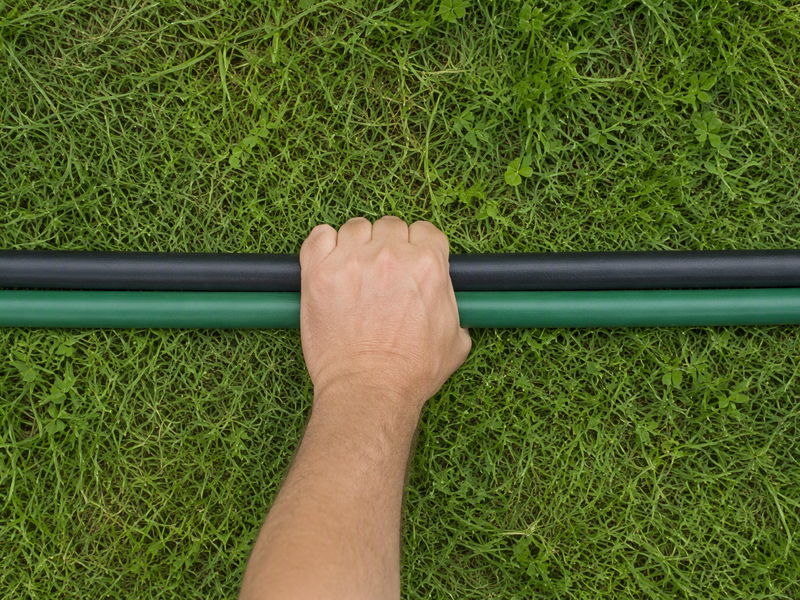
Two hoses of the same bore and length, held together for a like-for-like comparison.
Why Do Review Scores Disagree?
Two reviews of the same hose can disagree because they weight different properties. One may reward light weight, another burst pressure, another price. Neither is necessarily wrong; they answer different questions. Read the weighting before you read the score. When reviews disagree, the disagreement itself shows you which trade-off is real, and that is more useful than a single number.
Should You Care About Outside Diameter?
Outside diameter matters for storage, for reel capacity and for how the hose sits against a wall. Flow follows the bore alone. A thick cover can make a five-eighths hose look larger than a three-quarters hose while carrying less water. Confirm the bore from the written specification rather than from the look of the coil. That single check avoids most wrong turns when you compare two hoses side by side.
5. What Defines Garden Hose Quality in the Materials?
How Do You Judge Garden Hose Quality From a Specification?
Hose quality shows up in wall thickness, reinforcement, cover compound and the stated test conditions. Wall thickness resists kinking but adds mass. A reinforcement layer holds the wall round under bending. A cover that resists ultraviolet light lasts longer in the sun. Judge quality by what the label states, not by price alone.
Which Signals Point to Better Quality?
Signals of sound construction in a specification:
- A stated wall thickness in millimeters rather than a vague phrase.
- A reinforcement layer described by its material or construction.
- A temperature range rather than a single all-season claim.
- A thread standard named as GHT, NH or NPT.
Construction, wall thickness and calculated mass per meter at a 5/8 in bore
| Construção | Wall (mm) | Mass per meter (g, calculated) | Cold behavior |
|---|---|---|---|
| Plasticized vinyl (PVC) | 1.5 | about 115 | Stiffens below about 5 °C (41 °F) |
| EPDM rubber | 2.0 | about 135 | Keeps flexibility when cold |
| Hybrid | 2.0 | about 140 | Partly retains cold tolerance |
| Reinforced multi-layer | 2.5 | about 166 | Holds the bore round as the wall stiffens |
How Do Material and Climate Affect Quality?
Choose for the worst week of your year. Plasticized PVC stiffens below about 5 °C, which is 41 °F, and hot sun attacks the plasticizer in vinyl. Rubber and hybrid compounds keep more flexibility when cold. For a climate-by-climate treatment, see the PVC vs rubber garden hose materials. The material families themselves are compared on the flexible hose materials guide. A yard in hot, dry heat and a yard that freezes each winter need different cover compounds. A reader watering a very long run needs a different bore from one watering a short bed.
Does a Brand Name Prove Quality?
A brand name proves only that a company made the hose. It says nothing about the wall, the compound or the tested pressure. Ask for the specification, and compare it with your criteria. Certificates and test reports carry weight only when they name the method and the conditions. That is the honest way to weigh garden hose quality between two candidates. Our own constructions are described on the consumer products page.
How Do Fittings Affect Perceived Quality?
Fittings shape both the first impression and the daily experience. A coupling that is machined square seats better than one that is distorted. A swivel that turns smoothly saves wear on the hose end. A washer that fits the seat keeps the joint dry. None of these is captured by a burst figure, yet each affects how long the hose serves. Judge fittings by how they seat, how they turn and how easily they can be replaced.
6. What Determines Garden Hose Durability in Service?
What Shortens Garden Hose Durability?
Hose durability depends on the wall, the cover and how you store it, in that order of control. The first two are fixed when the hose is made. The third is a habit, and the four habits below are the ones that buy the most service life. The two that shorten it fastest are a cover left in the sun and water left in the bore through a frost.
Which Habits Protect Durability?
Habits that protect service life:
- Draining the hose after use and leaving it shaded.
- Storing it dry before the first frost arrives.
- Coiling it in wide loops that follow its natural bend.
- Carrying it across sharp edges and hot surfaces.
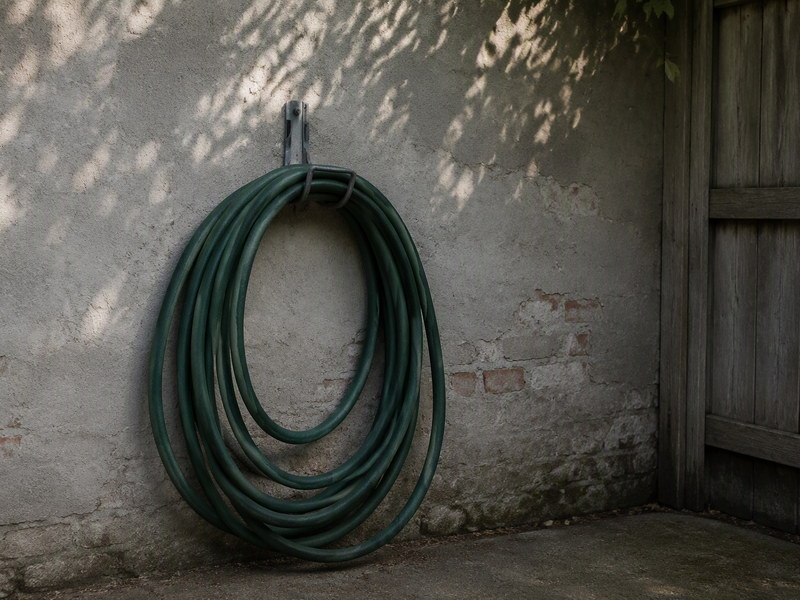
A hose coiled in wide loops and stored in the shade, which costs nothing and protects the hose wall.
What Does an Impulse Life Number Mean?
An impulse life figure counts pressure cycles to failure under stated conditions. A higher count suggests that the wall and the couplings survive more surges. It does not describe abrasion, sunlight or cold. A verifiable figure is the best evidence of expected life you can get before purchase, provided the report states its pressure band, temperature and cycle rate. Without those, the number cannot be compared.
Can Any Hose Be Truly Long-Lasting?
No hose lasts forever, and any lifetime claim needs a definition. Ask what the warranty covers: the wall, the cover, the couplings, or only a manufacturing defect. The scope of that cover is one useful basis for judging garden hose durability, and the specification is the other.
How Does Storage Affect Service Life?
Storage does more for service life than most owners expect. Draining and shading a hose costs nothing and removes the two most common causes of early failure. Treat storage as part of the specification, and treat the coil you leave behind as part of the wall you are storing.
7. Which Ratings Make a Best Garden Hose Verifiable?
What Do the Pressure Ratings Mean?
A working pressure is the level a hose should see in normal service, and a burst pressure is where the wall fails in a test. The range figures are 150 psi working and 400–500 psi burst. Both are values this manufacturer publishes for its range rather than the result of an independent third-party test. A range of 40–80 psi is a domestic supply planning range, not a guarantee. A garden hose pressure rating is comparable only when both figures were measured at the same temperature and hold time. A psi rating for garden hose carries those two conditions with it.
Pressure and supply figures published for the HENGHUA garden hose range
| Artigo | Value used |
|---|---|
| Pressão de serviço | 150 psi (published range figure) |
| Burst pressure | 400–500 psi (published range figure) |
| Burst-to-working ratio, general service | 3:1 |
| Burst-to-working ratio, higher consequence | 4:1 |
| Domestic supply planning range | 40–80 psi |
Why Is Top Rated Garden Hose Not a Specification?
A top rated garden hose label tells you what other buyers valued, not what your yard needs. A hose can be top rated for light weight and still be too thin for a long run. Buy on the specification, and use the rating only to build a shortlist.
What Burst-to-Working Ratio Is Reasonable?
A burst-to-working ratio of 3:1 suits general service, and 4:1 suits a situation where failure could injure someone or release a large volume. Check that the working pressure sits well below your supply.
How Do You Verify a Pressure Claim?
Ask for the test condition behind the number. A pressure claim is checkable only against the pressure band it was measured in, so ask which band applied.
What Does a Working-Pressure Margin Look Like?
Compare the working pressure with your supply. A domestic supply planning range of 40–80 psi sits far below a 150 psi working rating, so a normal tap leaves a wide margin. That margin narrows if the hose feeds a pressure washer, or if a valve shuts quickly and sends a surge along the line. Keep the margin generous where the hose is long, warm or often flexed, because heat and bending both reduce the pressure the wall can hold.
8. How Do You Build Your Own Decision Profile?
What Is the Decision Order?
Build the best garden hose shortlist by passing each candidate through the filters in this order:
- Bore and length, a hard filter set by your flow and reach.
- Material and wall, a hard filter in a freezing climate.
- Thread and fittings, a hard filter confirmed against your tap.
- Pressure rating, a condition to check rather than a filter on its own.
- Storage and weight, a tie-breaker chosen for how you lift and coil.
How Do You Use the Profile to Decide?
Write the five values for each candidate on one line, then apply them in the order above. Discard any hose that fails a hard filter such as thread or bore. Compare the survivors on the properties you can measure, then use handling as the final tie-breaker. This written profile is a repeatable way to weigh a garden hose comparison without leaning on someone else’s ranking. It chooses the best garden hose for one yard rather than for an average.
For the wider family of water hoses, see the types of water hoses guide, and for bore selection in depth, see the hose size selection guide.
What If a Test Report Is Missing?
If no test report exists, fall back on the specification and on the stated conditions. A material and wall thickness you can see, a thread standard you can confirm, and a temperature range you can read already answer most of the decision. The absence of testing is not proof of poor quality, but it does limit what you can verify. Choose the profile you can check.
What Should You Confirm at the Tap?
Confirm the thread standard and the washer before you buy, because the thread and the washer decide whether the hose seals at all. Garden hose thread (GHT, also written NH) is straight, three quarters of an inch nominal, with 11.5 threads per inch, and it seals on a rubber washer. Tapered pipe thread (NPT) seals on the threads themselves. If your tap uses a different standard, plan the adapter at the same time.
How Do You Shortlist Without a Ranking?
Shortlist on hard filters. Set the bore and the length first, because they decide flow and reach. Then remove any hose whose thread does not match your tap, and any hose whose temperature range does not cover your winter. What remains is a short list of candidates that can all do the job. Compare those on the measurable properties, and let handling settle a tie. This is the honest substitute for a ranked list.
What Should You Do With the Results?
Keep the written profile next to the hose after you buy it. When the hose fails, the profile tells you which property failed first, and whether the failure was a product limit or a storage mistake. That record is more useful than any score you read online. Over a few seasons it teaches you which trade-offs matter in your own yard, and it makes the next choice faster.
9. What Should a 2026 Buyer Still Check?
Has Anything About Hose Measurement Changed?
The definitions have not moved. Bore, thread standards, working pressure and burst pressure are long-standing conventions. A best garden hose sold this year uses the same straight thread, still 11.5 threads to the inch, and the same washer seal as before. What drifts is the labeling, which tends toward adjectives. Read the year in a title as a reminder to check that a specification is current, not as evidence that the numbers themselves have changed.
What Should You Recheck Each Season?
Recheck five points before each season starts:
Seasonal checks and the failure each one prevents
| Check | What to look for | Failure it prevents |
|---|---|---|
| Washer | Hardening, cracks, a deformed seat | A drip at the tap |
| Couplings | Cracks, distortion, a rough swivel | A pull-off under pressure |
| Capa | Dull patches, surface crazing | A cracked wall after a frost |
| Coil | A set bend that stays after uncoiling | A kink during use |
| Tópico | Crossed threads, a missing washer | A leak and a stripped fitting |
Replace a hardened washer early rather than in the middle of a watering job. Dull patches on the cover signal sunlight damage before the wall itself cracks. Uncoil the hose in wide loops so that it returns to shape. A five-minute check each spring finds most failures before they interrupt anything.
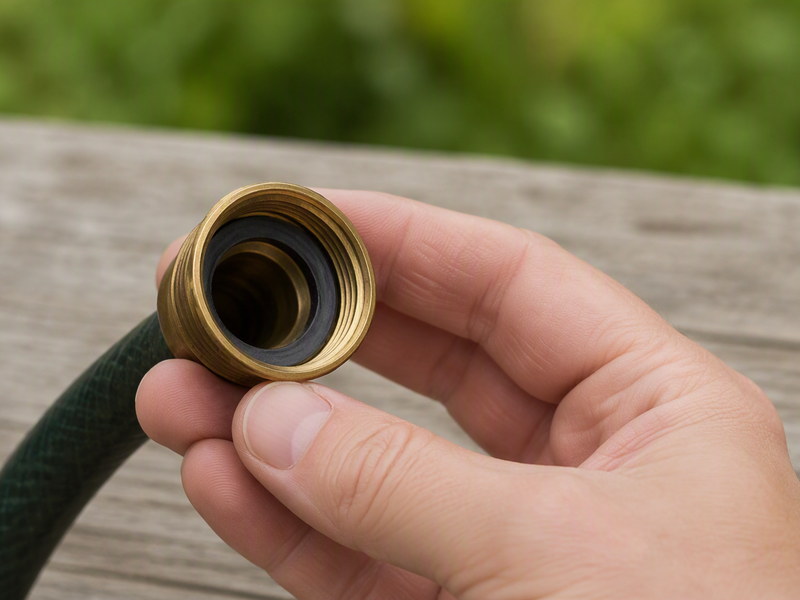
A washer and a coupling checked by hand before the season starts.
Perguntas Frequentes
What Should I Do When Two Hoses Fit My Yard Equally Well?
Two hoses can pass every hard filter and still be tied on paper, and then the decision moves to the properties that are not pass or fail. Weigh handling first, because a hose you avoid using is the wrong hose. Then compare the warranty terms, the replaceable fittings and the coil memory, and choose the one that costs you the least effort. Neither is the best garden hose in general; one fits your routine better.
What Should I Ask Before I Trust a Test Number?
Ask the seller for the temperature, the hold or cycle count and the failure mode before you read any test number. A test of burst pressure, impulse cycles or cold behavior states the conditions for each one. Without those conditions, the numbers cannot be compared, and the test tells you very little.
What Should I Write Down Before I Compare Two Hoses?
Write down the one variable you are judging, then list both candidates’ values for it on the same line. Hold every other variable constant: judge wall thickness at one size and one length, and judge cold performance at one temperature. Then read each candidate’s stated test conditions, because a verdict without a method is an opinion rather than a measurement.
Does a Top Rated Garden Hose Always Suit My Yard?
A top rated garden hose reflects what other buyers valued, which may be light weight, low price or a long warranty. None of that confirms the bore, thread or working pressure you need. Treat the rating as a shortlist and check each name against your own four variables before you decide. If a rated hose passes all four, the rating has done its job.
What Separates a Hose Built for Ten Seasons From One Built for Two?
No label states a number of seasons, and a warranty term is the maker’s own estimate rather than a measurement. What you can compare is the failure each hose is built to survive. Look at the wall that keeps its flexibility in a cold snap, the cover that holds up to sun, and the fittings that can be replaced when they wear. A hose designed to be maintained lasts longer than one designed to be replaced.
How Can I Judge Garden Hose Durability Before Buying?
Judge durability from the three statements a specification can give you: the wall thickness, the cover compound and the test conditions. An impulse life figure with its pressure band and cycle rate is the most useful single number. Check what the warranty covers and what it excludes, because a warranty that excludes sun damage, freezing and abrasion says little. Then store the hose well, which you control.
What Pressure Rating Should a Garden Hose Have?
A working pressure rating of 150 psi with a burst rating of 400–500 psi is the published range figure. Check the ratio against the two pressures in your own shortlist, because the 3:1 and 4:1 figures are starting points rather than limits. A supply in the 40–80 psi planning range sits well below that working rating. Always ask which conditions produced those figures.
Is a Heavier Hose a Better Hose?
A heavier hose often has a thicker wall, which resists kinking, but it is harder to carry and slower to coil. At a five-eighths bore the calculated mass per meter rises from about 115 g for a thin vinyl wall to about 166 g for a reinforced multi-layer wall. Mass is a consequence of construction, not a measure of quality on its own.
How Long Should a Garden Hose Last?
Service life depends on the material, sunlight and storage, so no single number applies to every hose. A hose kept out of the sun, drained and coiled in wide loops outlasts one left charged on a hot path. Reinforcement and a rated working pressure are signs of a longer-lived construction. Check the stated storage and temperature range before you buy.
Why Do Reviews Disagree About the Same Hose?
Read the method before the score, if a method is given at all. Each review weights different properties and tests different conditions: one may reward low weight, another high burst pressure, another a long warranty. Each answers a slightly different question, so when two sources conflict, read the weighting rather than the score. The disagreement usually points to the trade-off that matters.
About HENGHUA
HENGHUA is a hose manufacturer supplying distributors, retailers and OEM or private-label programs. Our families include GLOBHOSE for high-performance hydraulic hose and FLEXMAX for flexible industrial hose, alongside a garden hose range. We support custom branding and tailored product solutions. Our technical content team writes about how hose properties are measured, so buyers can compare specifications rather than slogans. We do not rank other makers’ products. To see the current range, browse the hose range, or send an enquiry through our contact form.






 English
  Spanish
  Portuguese
  French
  German
  Arabic
  Russian
  Indonesian
  Japanese
  Korean