
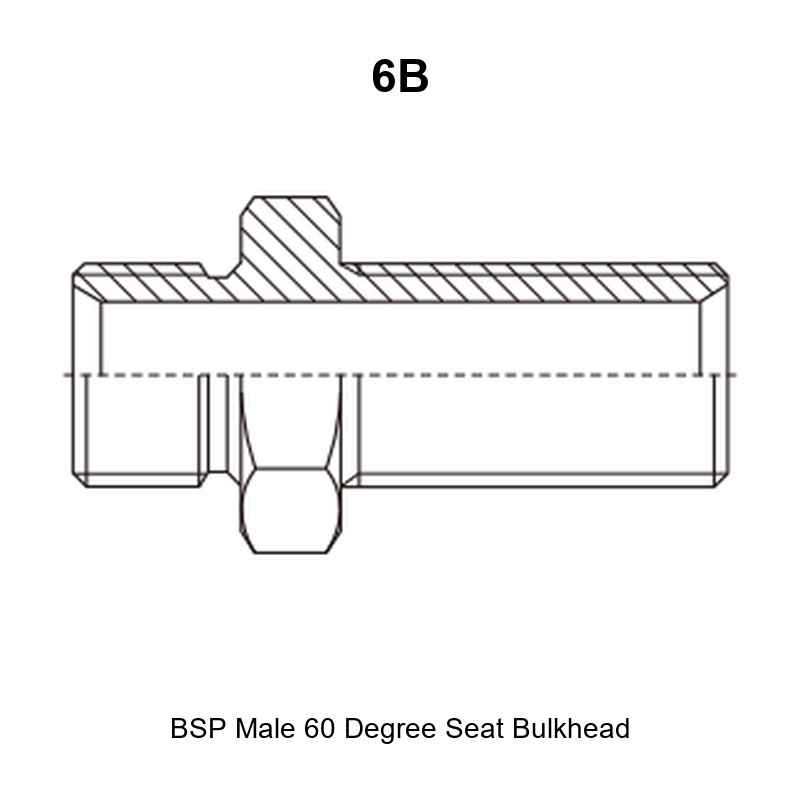
The 6B adapter is a BSP male 60 degree seat bulkhead fitting. It carries a hydraulic line through a panel, a bracket or a housing wall and is locked in place by a lock nut, so the line can be connected and disconnected from either side of the panel. Both ends seal on the same 60 degree cone seat used across the rest of the range. Because the 6B adapter passes through a wall rather than sitting against a port, the panel hole and the panel thickness matter as much as the thread size.
A bulkhead fitting is the point where a machine stops being a collection of hoses and becomes a designed assembly. Used properly, it fixes the routing, protects the line from chafing at the panel edge and gives the service technician a defined place to break the circuit. This page explains the mounting principle, the role of the lock nut and washer, the panel hole logic, the complete dimension table and the questions buyers ask most often.
1. What the 6B Adapter Does
A bulkhead fitting works by clamping, not by threading into a port. The body has a 60 degree seat stud end on one side, a shoulder, and a threaded shank that passes through the panel. On the far side, a lock nut is tightened against the panel, so the shoulder and the lock nut grip the panel between them and hold the fitting rigid. Because the fitting is held by the panel rather than by the pipework, the tube or hose on each side can be connected and disconnected without disturbing the other side.
The 60 degree cone seat is used on both ends. Each end is a male stud end, so each one screws into a female port with a matching cone, and each joint seals on the cone rather than on the thread. No bonded washer and no thread sealant is needed on the seat joints. Where a sealing washer is used on a bulkhead installation, its job is different: it protects the panel surface and, in some designs, provides a secondary seal between the shoulder and the panel face, but it is not what seals the hydraulic joint.
The lock nut and the washer have separate functions that are often confused. The lock nut carries the clamping load and sets the position of the fitting in the panel; once tightened it also prevents the body from turning when the hose is fitted. The washer spreads the clamping load over a larger area of the panel, which matters on thin sheet, composite or painted panels where a nut alone would mark or deform the surface. Neither part compensates for a poorly sized panel hole.
2. 6B Adapter Specifications
2.1 Product Scope and Configuration
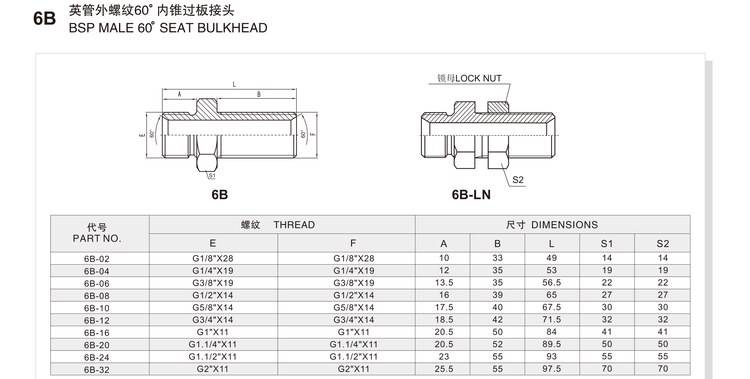
The range covers straight bulkhead fittings from G1/8 to G2, with a 60 degree seat stud end on each side and a lock nut on the panel thread. Two body styles are shown on the drawing: the 6B, supplied as the basic bulkhead body, and the 6B-LN, supplied with the lock nut. The 6B-LN is the style to order when the panel fixing hardware is required with the fitting.
2.2 Materials and Surface Treatment
Standard supply is carbon steel with zinc plating for general hydraulic service. For corrosive fluids or aggressive atmospheres, 304 stainless steel or 316 stainless steel is available, and brass is offered for lower-pressure industrial and instrument lines. Plating options include trivalent chromium zinc (Cr3+) and zinc-nickel for a higher corrosion demand. No salt-spray hours and no plating thickness figures are published on this page; request the current test report from the supplier before a specification is frozen.
2.3 Threads, Standards and Sealing Principle
The table has two thread columns and both ends are BSP parallel threads to ISO 228-1. E is the seat stud end on one side of the panel and F is the seat stud end on the other; in the standard range the two are the same size, so the fitting carries one line size straight through the wall. The seal is made by the 60 degree cone seat on each end, so a female port with the matching cone is required on both sides of the panel. The panel thread, which is not listed as a separate column, is the thread on which the lock nut runs.
2.4 Dimensions and Part Numbers
All dimensions are in millimetres. A, B and L are the lengths defined on the drawing, S1 is the across-flats size of the body hex and S2 is the across-flats size of the lock nut. Panel designers should work from the drawing and confirm the hole diameter, the panel thickness range and the thread engagement with the supplier before the panel is machined. [VERIFY WITH SUPPLIER]
| PART NO. | E THREAD | F THREAD | A | B | L | S1 | S2 |
|---|---|---|---|---|---|---|---|
| 6B-02 | G1/8″X28 | G1/8″X28 | 10 | 33 | 49 | 14 | 14 |
| 6B-04 | G1/4″X19 | G1/4″X19 | 12 | 35 | 53 | 19 | 19 |
| 6B-06 | G3/8″X19 | G3/8″X19 | 13.5 | 35 | 56.5 | 22 | 22 |
| 6B-08 | G1/2″X14 | G1/2″X14 | 16 | 39 | 65 | 27 | 27 |
| 6B-10 | G5/8″X14 | G5/8″X14 | 17.5 | 40 | 67.5 | 30 | 30 |
| 6B-12 | G3/4″X14 | G3/4″X14 | 18.5 | 42 | 71.5 | 32 | 32 |
| 6B-16 | G1″X11 | G1″X11 | 20.5 | 50 | 84 | 41 | 41 |
| 6B-20 | G1.1/4″X11 | G1.1/4″X11 | 20.5 | 52 | 89.5 | 50 | 55 |
| 6B-24 | G1.1/2″X11 | G1.1/2″X11 | 23 | 55 | 93 | 55 | 55 |
| 6B-32 | G2″X11 | G2″X11 | 25.5 | 55 | 97.5 | 70 | 70 |
2.5 Working Conditions and Limits
The usable working pressure of a bulkhead fitting depends on the thread size, the body material and the panel it is clamped to, so no single figure covers the whole range. A thin, flexible panel can deflect under load long before the fitting reaches its own limit, which is why the panel thickness and the washer diameter belong in the same calculation as the thread size. For a specific project, state the fluid, the working pressure, the peak pressure, the temperature range, the panel material and the panel thickness, and the supplier will confirm the suitable material, plating and assembly torque.
3. Part Number Decoding
The part number is built from the port sizes, written in the same order as the thread columns E and F.
- 6B-02: seat stud ends G1/8″X28 on both sides of the panel.
- 6B-08: seat stud ends G1/2″X14 on both sides of the panel.
- 6B-16: seat stud ends G1″X11 on both sides of the panel.
- 6B-32: seat stud ends G2″X11 on both sides of the panel.
The LN suffix marks the version supplied with the lock nut. A single size code means the two seat stud ends are the same size. Where a different combination is required, the drawing number replaces the standard code and both port sizes are listed separately on the order.
4. Installation and Fitment
Bulkhead mounting is a panel design task as well as a fitting task, and the work should start before the panel is drilled.
- Confirm the panel hole size. The hole must clear the panel thread so the shank passes through, and it must be smaller than the shoulder so the fitting cannot pull through the panel. Work from the drawing rather than from the thread size alone.
- Confirm the panel thickness. The lock nut must have enough thread to clamp the panel with full engagement, and a panel that is too thin will deflect under torque instead of clamping. Where the panel is thin, use a washer or a backing plate to spread the load.
- Deburr both sides of the hole. A sharp edge cuts into the thread and the washer when the fitting is tightened.
- Insert the fitting from the side that gives the best access, fit the washer and the lock nut, and tighten the nut while holding the body on its flats.
- Check that the shoulder is seated squarely against the panel before the seat joints are tightened. An out-of-square mounting loads the cone seat.
- Connect the two lines, tightening each seat joint in the normal way, and re-check the lock nut after the first heat cycle.
The lock nut should be tightened once and left alone. Repeated re-tightening of a bulkhead nut on a thin panel deforms the panel and loosens the joint again.
5. Applications and Industries
Typical applications include:
- Control panels and operator consoles where lines must pass through a plate.
- Machine frames and guarding, where hoses must be routed through a wall rather than around it.
- Pump and motor housings where a line passes into a closed compartment.
- Enclosures and cabinets that must stay sealed against dust or wash-down.
- Mobile equipment where a defined break point is needed for field service.
- Marine and offshore equipment: stainless steel versions for continuous salt exposure.
- Test benches where instrument lines cross a panel between the test area and the controls.
6. Replacement and Cross-Reference
When replacing an existing bulkhead fitting, work from measurements rather than from a colour code or an old marking. Record the two thread designations, the panel thread and the panel hole diameter, the across-flats sizes S1 and S2, the stud-end lengths and the overall length. A replacement is equivalent only when the thread family, the seat angle, the panel thread and the overall envelope all match. If the original part carries an unfamiliar number, measure the threads with a pitch gauge, measure the panel hole, check that both ends have a 60 degree cone, and send the values with a photograph so the equivalent can be identified.
A bulkhead fitting and a straight adapter are not interchangeable. Removing the panel fixing and replacing it with a plain adapter leaves the line unsupported and removes the service break point that the panel was designed around.
7. Ordering, Packaging and Delivery
To place an order, provide:
- the part number, for example 6B-08 or 6B-08-LN;
- the two thread designations, in E, F order;
- whether the lock nut is required with the fitting;
- the panel hole diameter and the panel thickness;
- the material and the plating option;
- the quantity and the required delivery date.
Parts are supplied individually protected and packed in bulk cartons or in kit bags, with the part number marked on the bag or the label. Minimum order quantities, carton quantities, marking and traceability requirements, and lead times are confirmed at the quotation stage, and special packing, kitting or the supply of matched lock nuts and washers can be arranged for OEM programmes.
8. Frequently Asked Questions
Q1. What is a bulkhead fitting used for? A 6B adapter carries a line through a panel or a wall and fixes it there with a lock nut. It gives the routing a defined, supported break point, so the line on each side can be serviced without disturbing the other side.
Q2. How do I size the panel hole? The hole must be large enough for the panel thread to pass through and small enough that the shoulder and the washer cannot pull through. Size it from the drawing rather than from the nominal thread size, and deburr both faces after drilling.
Q3. What does the lock nut do? The lock nut clamps the panel between itself and the body shoulder and sets the position of the fitting. It also stops the body turning when a hose is fitted. It is not a sealing element.
Q4. Is a washer always needed? A washer spreads the clamping load over a larger area, which matters on thin or soft panels. On a thick, rigid plate it is often fitted anyway to protect the panel finish and the thread.
Q5. Do I need sealant on the seat joints? No. Both ends seal on the 60 degree cone seat, so no sealant is used on the thread. Sealant in the system can also block a small orifice downstream.
Q6. How thick can the panel be? The panel must be thin enough for the lock nut to clamp with full thread engagement and thick enough not to deflect under the tightening torque. Confirm the range for the size you are using with the supplier before the panel is machined.
Q7. Can I use the 6B adapter without the lock nut? No. Without the lock nut the fitting is not clamped to the panel and the whole line is left unsupported. Use the LN version if the lock nut must be supplied with the body.
Q8. Which material should I choose for a marine application? 316 stainless steel is the usual choice for continuous salt exposure. 304 stainless steel suits many wash-down applications, and carbon steel with zinc-nickel plating is used where the environment is controlled and the cost target is tight.
Browse the full Hydraulic Adapters range for the complete family, or contact us to request a quote, mill test reports, and samples.


 English
  Spanish
  Portuguese
  French
  German
  Arabic