
Uma mangueira para camião-cisterna é um conjunto de mangueiras de borracha flexíveis e condutoras utilizado para carregar e descarregar gasolina, gasóleo e óleo combustível de camiões-cisterna, tanto em estrada como fora de estrada — com uma pressão de serviço nominal de 150 PSI (10 bar), vácuo total, com diâmetros internos de 2 a 4 polegadas, em conformidade com a norma EN 1761, EN 1765 ou ISO 1823. Se estiver a substituir uma mangueira, a verificar um orçamento ou a especificar conjuntos de mangueiras para camiões-cisterna fabricados em fábrica com extremidades do tipo camlock, roscadas ou flangeadas, este guia aborda os quatro parâmetros essenciais — pressão, dimensão, vácuo e temperatura — além das normas impressas na capa e o que deve indicar exatamente ao seu fornecedor quando fizer a encomenda. Este guia destina-se a compradores de frotas, operadores de depósitos e gestores de manutenção que substituem ou encomendam novamente conjuntos de mangueiras para camiões-cisterna.
Para que serve esta mangueira num camião-cisterna?
Será que uma mangueira consegue realmente funcionar em ambos os lados da bomba — retirando combustível de um depósito subterrâneo por sucção e, em seguida, empurrando-o sob pressão na descarga? Sim, se for construída com uma hélice de arame. Esta mangueira é a conduta que liga o compartimento ou a bomba de um camião-cisterna a um braço de carregamento, a um coletor de um depósito ou ao reservatório de um cliente; tem de manter o vácuo enquanto a bomba retira o produto de um reservatório subterrâneo e, em seguida, transportar o mesmo produto sob pressão no lado de descarga. É essa dupla função que justifica a construção da mangueira com uma hélice de arame, e não apenas com material têxtil — a hélice mantém o interior da mangueira redondo durante a sucção.
A construção segue a mesma lógica de três camadas que outras mangueiras para produtos petrolíferos, com uma adição que é importante num camião:
- Tubo: uma camada interior de nitrilo (NBR) resistente ao óleo, de interior liso e condutora, de modo a que a carga estática se dissipe em vez de se acumular enquanto o combustível flui.
- Reforço: camadas têxteis de alta resistência à tração para suportar a pressão, além de uma hélice em espiral de fio de aço para resistência ao vácuo.
- Capa: uma camada exterior de borracha resistente ao óleo, à abrasão, ao ozono e às intempéries, que resiste a ser arrastada sobre lancis, a ser armazenada ao ar livre e a ser atropelada por veículos.
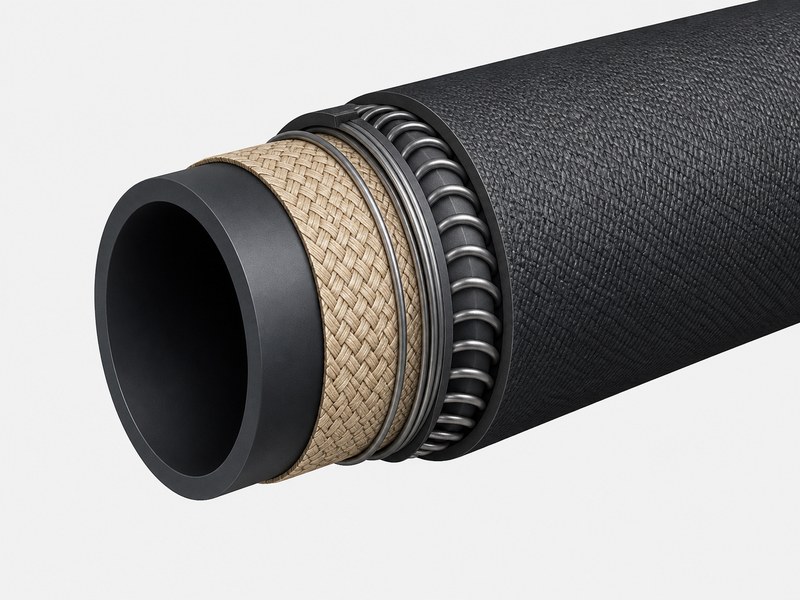
Figura 1. O conjunto tubo-reforço-cobertura; a hélice de aço é o que permite o funcionamento em sucção.
Construção da mangueira, camada a camada
| Camada | Material típico | Emprego |
|---|---|---|
| Tubo | Nitrilo condutor (NBR) | Transporta gasolina, gasóleo e óleo combustível sem inchar; drena a carga estática |
| Reforço | Camadas de tecido sintético + hélice de fio de aço | Suporta pressão; impede o colapso sob vácuo |
| Capa | Borracha resistente ao óleo e à abrasão, normalmente borracha de cloropreno (CR) | Resistente a salpicos de óleo, abrasão, raios UV e intempéries |
A mesma família de produtos montados em veículos é comercializada sob vários nomes — mangueira para camião-cisterna, mangueira para camião-cisterna de combustível, mangueira para camião-cisterna de petróleo — dependendo da região e do fornecedor. «Mangueira de transferência de petróleo» é o termo mais abrangente do catálogo, que também inclui aplicações em terminais e carregamento a granel; para essa vertente do negócio, consulte o nosso guia sobre carregamento a granel e mangueiras de descarga assim que estiver disponível, e para conhecer a gama completa da família, comece por consultar o nosso Guia para mangueiras de sucção e descarga de óleo, que abrange toda a gama de tamanhos e potências desta família, ou consulte o mangueira de sucção e descarga de óleo Consulte a página do produto para conhecer os tamanhos e as classificações atuais. A nomenclatura varia, mas a construção e as classificações seguem as mesmas normas, razão pela qual os números indicados na capa são mais importantes do que o nome na embalagem.
Camião-cisterna vs. cisterna de combustível vs. mangueira OS&D: Qual é a diferença?
Três nomes, uma família de mangueiras: a linha norte-americana para camiões, a linha europeia para abastecimento de combustível e a linha de engenharia OS&D partilham a mesma construção reforçada com hélice e resistente ao óleo — os nomes diferem consoante a região, a norma e a etiqueta, e não pela forma como a mangueira é fabricada. Eis a diferença prática numa das linhas:
- Termo relativo aos veículos, América do Norte: uma mangueira para petróleo de 150 PSI (10 bar) destinada à transferência a partir do camião, normalmente com um diâmetro interno de 2 a 4 polegadas, com capacidade total de vácuo, vendida como mangueira simples ou como conjunto completo para compartimentos de carga e descarga.
- Mangueira para camião-cisterna de combustível é o termo europeu para «mangueira de distribuição»: o mesmo tipo de mangueira utilizada nos camiões-cisterna que abastecem as estações de serviço com gasolina e gasóleo. Na Europa, está em conformidade com a norma EN 1761, que abrange tanto as mangueiras de distribuição como as de sucção e distribuição para combustíveis líquidos.
- Mangueira de sucção e descarga de óleo (OS&D) é a designação técnica para a família mais ampla: mangueira de vácuo total reforçada com hélice para o carregamento a granel de produtos petrolíferos em terminais, depósitos e navios-tanque, em conformidade com a norma EN 1765 ou ISO 1823.
Três nomes para uma família de mangueiras, num relance
| Característica | Mangueira de bordo (EUA) | Mangueira para camiões-cisterna (EN 1761) | Mangueira OS&D (EN 1765 / ISO 1823) |
|---|---|---|---|
| Pressão de serviço | 150 PSI (10 bar) (valor típico) | Até 10 bar (145 PSI) | Aulas de 10 e 20 bar |
| Capacidade de vácuo | Vácuo total com hélice | Vácuo total (Tipo SD) | Vácuo total (0,9 bar) |
| Diâmetro interior típico | 2 a 4 polegadas | 1-4 polegadas | 3/4-6 inch |
| Typical standard | US petroleum transfer service, 150 PSI class | EN 1761 | EN 1765, ISO 1823, DIN 20023 |
| Main job | Loading and unloading tank truck compartments | Fuel truck delivery of petrol and diesel | Terminal, depot and tanker bulk transfer |
For a fleet buyer the practical message is simple: one construction often carries several of these names and certificates, and a single hose can be tested and marked to more than one standard. A tanker truck hose fitted in Houston and a fuel tanker hose fitted in Hamburg often come off the same production line. Specify the numbers — bore, working pressure, vacuum, temperature, fluid — and let the standard follow the application.
Tank Truck Hose Specs: Sizes, Pressure, Vacuum and Temperature
Four numbers define the product: working pressure, bore, vacuum rating and temperature range — they are printed on the cover of every compliant hose and they are the numbers a supplier needs to quote correctly. Static safety is the fifth requirement and has its own section below.
Quick specification: typical service class for truck-side petroleum hose
| Especificações | Typical value | Notes |
|---|---|---|
| Pressão de serviço | 150 PSI (10 bar) | US truck-side class; EN 1761 maximum for fuel truck delivery |
| Minimum burst pressure | 600 PSI (4:1 safety factor) | A design margin, never a service value |
| Capacidade de vácuo | Vácuo total (0,9 bar) | Requires the wire helix (Type SD construction) |
| Temperature range | -30 °C to +80 °C continuous, +100 °C peak | Per data sheet; hotter service needs a heat-rated compound |
| Typical bores | 2, 3 and 4 inch (DN 50, 75, 100) | 3 inch is the workhorse; 4 inch for high-rate duty |
| Tubo | Nitrilo condutor (NBR) | Drains static end to end |
What PSI Rating Should the Hose Carry?
Working pressure is the maximum continuous internal pressure at the rated temperature, and for this product family the market standard is 150 PSI (10 bar). The US market is built around the 150 PSI class — distributor catalogues commonly list 150 PSI as the default for truck-side petroleum transfer — and European fuel truck hose under EN 1761 is capped at the same 10 bar maximum. The minimum burst pressure is four times working pressure (a 4:1 safety factor), so a 150 PSI hose must burst at not less than 600 PSI; the factor absorbs pressure surges, aging and abrasion damage in service. Our oil hose working pressure vs burst pressure guide explains why you always select by working pressure, never by burst.
What size hose do we need for multi-compartment tanker loading and delivery?
We run heating oil tankers in the UK and mostly deliver through 2 inch hose — is that the right size for the job? Size means inside diameter (ID). On trucks, 3 inch is the workhorse for multi-compartment petrol and diesel loading and delivery, while 4 inch is used where the pump or loading arm can move more volume; 2 inch suits fuel oil and heating oil deliveries and smaller compartments. UK heating-oil drops, where the term oil tanker hose is common, are almost always 2 inch. If the 150 PSI rating is the industry default, the bore is the number you actually engineer.
Common sizes for tank truck duty and what each is used for
| Size (ID) | DN | Typical job | Flow at 3 m/s (planning value) |
|---|---|---|---|
| 2 inch | DN 50 | Fuel oil and heating oil deliveries, small compartments | ~21 m³/h (95 US gpm) |
| 3 inch | DN 75 | Multi-compartment petrol and diesel loading and delivery | ~48 m³/h (210 US gpm) |
| 4 inch | DN 100 | High-rate terminal loading arms and bulk transfer | ~85 m³/h (375 US gpm) |
European orders quote DN (nominal bore in millimetres); US orders quote inches — they describe the same bore, so DN 50, DN 75 and DN 100 equal 2, 3 and 4 inch. Size from flow and velocity, never from the port you happen to have. A good planning rule for oil service is 1.5-4 m/s (about 5-13 ft/s): below 1.5 m/s sediment settles, above 4 m/s the hose wears faster and the pump wastes energy. Flow capacity rises with the square of the bore, so going from 3 to 4 inch roughly doubles what the line can move — that is why a 4 inch hose, not a stronger pump, is usually the fix for a slow loading rate.
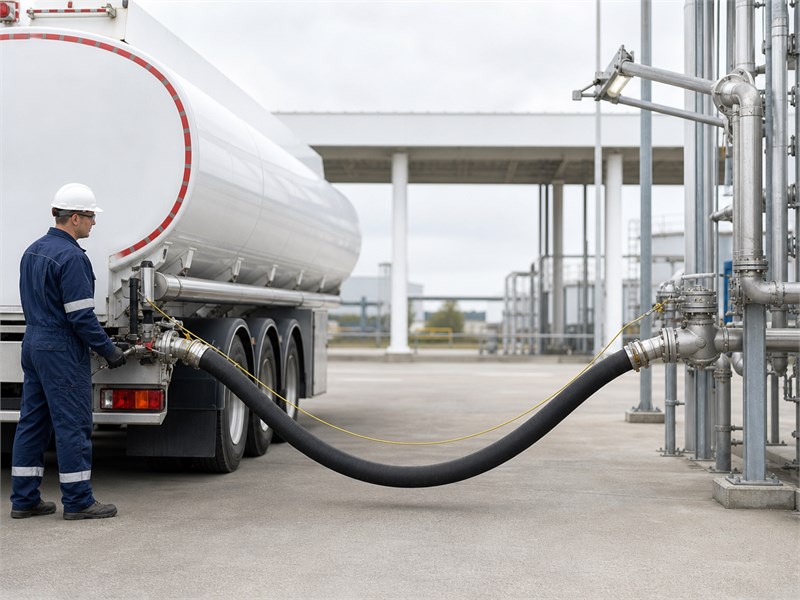
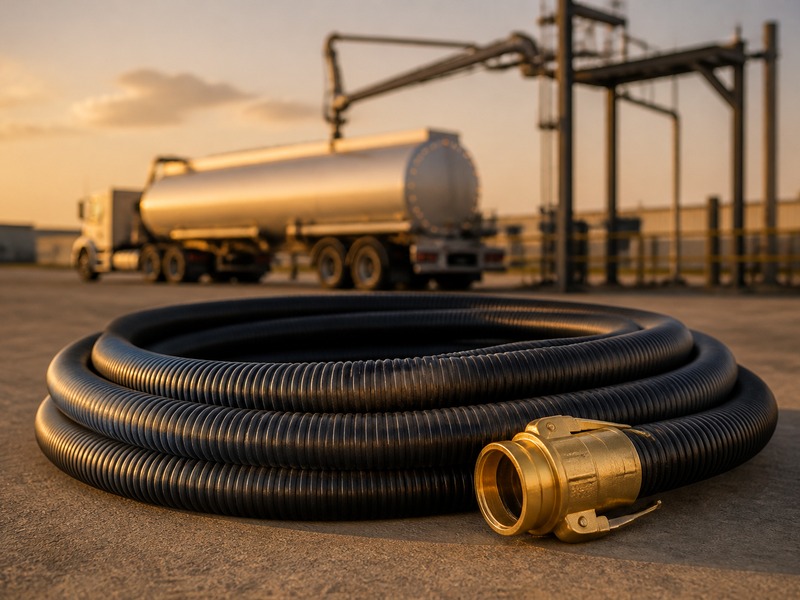
Figure 2. Tanker loading pulls vacuum on suction, pushes pressure on discharge, and drags the hose across the yard in between.
Can the Hose Handle Full Vacuum?
What happens if a hose without a wire helix is used on the suction side of the pump? It collapses: a delivery-only hose with textile reinforcement but no helix cannot hold the bore open under vacuum. A hose that is built with the wire helix and marked for full vacuum service operates down to about 0.9 bar negative pressure without collapsing. Because the line must pull product out of underground and customer tanks, specify full vacuum on every run that sits on the inlet side of a pump, and confirm it on the data sheet rather than assuming it from the 150 PSI rating.
What Temperature Range Does It Handle?
For the standard construction in this guide, flexibility is retained to about -30 °C, with continuous service from -30 °C to +80 °C and short peaks up to +100 °C within the limits stated on the data sheet. The cold end matters for winter fuel oil deliveries — the hose must stay flexible when the truck operates in freezing conditions; at the hot end, continuous service above +80 °C needs a heat-rated compound. Check both the coldest ambient temperature where the truck operates and the hottest fluid temperature before ordering — the printed range is the binding value.
Do the hoses have to be conductive, and how do we bond and ground during loading and unloading?
Yes — static safety is part of the spec, not an option. Moving petroleum generates static charge, so the tube is conductive and the finished assembly is checked for electrical continuity end to end before shipment. On the vehicle, fleet operators bond the hose ends to the tank and the receiving vessel during transfer, following the site’s grounding procedure — the NFPA 385 operating context explained in the standards section below. Ask for the continuity test record with every assembly: the test result is part of the deliverable, not a brochure claim.
Standards Behind the Marking: EN 1761, EN 1765 and NFPA 385
Standards are how a buyer verifies a hose without trusting the supplier’s word: the standard number on the cover says which tests the hose passed and what its ratings mean. Four documents cover almost every hose of this type on the road.
Standards that apply to this product family
| Padrão | Scope | When to specify it |
|---|---|---|
| EN 1761:2025 | Rubber hoses and hose assemblies for fuel truck delivery — two types: delivery (D) and suction-and-delivery (SD), maximum working pressure 10 bar | European fuel trucks delivering petrol and diesel |
| EN 1765:2016 | Rubber hose assemblies for oil suction and discharge service for petroleum products, in 10 and 20 bar classes with a 4:1 safety factor | Road tanker, depot and terminal loading and unloading across Europe |
| ISO 1823:2015 | International standard for rubber hose and hose assemblies for oil suction and discharge service, with surge-pressure allowance | Export and OEM specifications outside Europe |
| NFPA 385 (2022 edition) | US standard for tank vehicles for flammable and combustible liquids — vehicle design and operation, including hose mounting, bonding and grounding practice | US fleets and terminals; confirms operating context, not a hose test spec |
EN 1761 is the standard most buyers mean by “fuel truck hose”. The current edition, EN 1761:2025 — Rubber hoses and hose assemblies for fuel truck delivery — Specification — specifies two hose types, Type D (delivery) and Type SD (suction and delivery), for the loading and discharge of liquid hydrocarbon fuels at up to 10 bar working pressure. EN 1765:2016 and its German national relative DIN 20023 cover the wider oil suction and discharge family used for tanker and terminal work; ISO 1823:2015 is the international version of the same spec, often written into export and OEM orders.
What is the difference between EN 1761 Type D and Type SD, and which do we need if our truck only delivers fuel without pulling from underground tanks? Type D is the delivery-only construction: the lighter, lower-cost choice when the hose only ever sits on the pressure side, delivering fuel from the truck to a customer tank. If the same hose also pulls product out of underground or customer tanks, or moves between compartments on the inlet side of the pump, specify Type SD — its wire helix prevents collapse under suction. When in doubt, choose SD: it covers both duties in one hose, which is why it is the version most fleets standardise on.
“Our US terminal asks about NFPA 385 — do we need a special certified hose?” No: NFPA 385 (2022 edition) regulates the tank vehicle itself — its design, operation, and bonding and grounding practice during transfer — not the hose as a tested product, so it is not a hose test standard like EN 1761. Specify the hose to a product standard such as EN 1761 or EN 1765, follow NFPA 385 for vehicle and transfer procedure, and ask your terminal operator which rules apply at their rack.
Read the cover before you install. A compliant hose carries a printed layline that states the standard, the type, the bore and the ratings — for example “EN 1761 SD 3 inch 10 bar” — plus a date code that tells you the manufacturing period. If the cover marking is missing, faded, or does not state a standard, treat the hose as unverifiable and send it back; the marking is the only proof you have that the ratings are real. In our factory, tank truck hose assemblies are proof-tested and checked for electrical continuity end to end before shipment, and the test record is packed with each assembly.
Tank Truck Hose Assemblies: Fittings, Ends and Ordering
Most buyers do not buy bare hose: they buy a complete assembly — hose cut to length with factory-fitted end connections, ready to bolt onto the truck. Ordering an assembly correctly removes the most common field failure, which is a coupling fitted on site that pulls out under pressure.
What Tank Truck Hose Fittings Are Available?
Three fitting families cover nearly every connection on a truck:
- Camlock (cam and groove) couplings are the standard for frequent hook-up because they connect in seconds without tools. They are commonly supplied male or female, and they are the fitting you see on most truck-side hose ends.
- Threaded ends — BSP (British Standard Pipe, parallel thread) and NPT (National Pipe Thread, tapered) — suit fixed connections to pumps, manifolds and tank outlets. BSP and NPT are not interchangeable: a BSP male will not seal in an NPT female, so match the thread family on both ends and confirm it when you order.
- Flanged ends suit large bores and terminal loading arms where the hose bolts to a fixed pipe.
Whatever tank truck hose fittings you standardise on, confirm the thread family and pressure rating at both ends. Remember that an assembly is only as strong as its weakest end: in the larger sizes a camlock coupling’s working pressure can sit at or below the hose rating — a 4 inch coupling in common carbon steel is commonly rated in the 100-150 PSI band against a 150 PSI hose. Confirm the coupling’s working pressure and material in the supplier’s catalogue, and state the required coupling rating on your order — never assume the fitting is rated to the hose. Our hydraulic fittings types guide explains the thread families in detail.
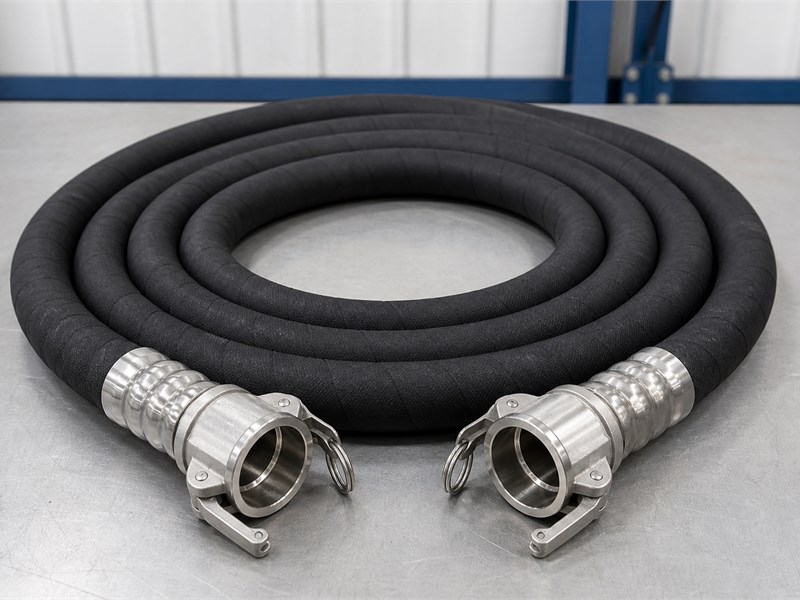
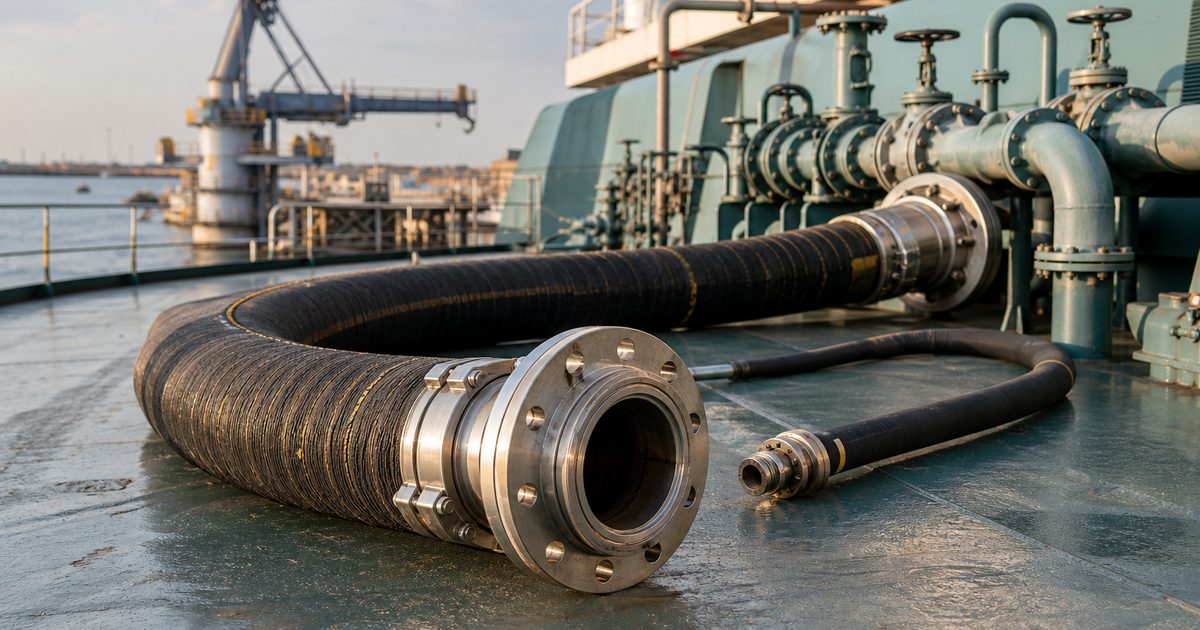
Figure 3. A complete assembly: hose, crimped ferrules and end fittings, tested as one unit.
Crimped or Clamped Ends?
For petroleum service, factory-crimped ends are the standard. The ferrule is sized to the hose’s outside-diameter tolerance and compressed in a controlled cycle, so the crimped joint’s pull-out strength is verified against the hose’s own strength — a correctly crimped end fails by hose rupture, not by the coupling pulling off. Field-attached clamp or reusable couplings are quicker but are the classic source of pull-out failures on suction lines. If you buy bare hose and fit ends yourself, use the coupling manufacturer’s crimp spec and verify with a pull test on the first assembly of every batch. Distributors catalogue tank truck hose fittings by bore, thread family and pressure class, so quote all three when you order replacements.
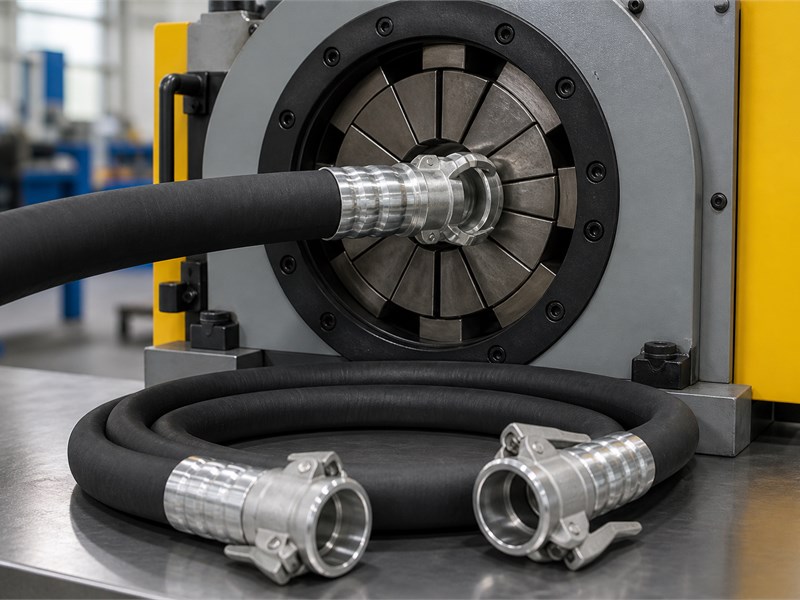
Figure 4. Factory proof test of a crimped assembly — ferrule, hose and pressure gauge are verified as one unit before shipment.
What to Specify When Ordering
How do I measure and order a replacement assembly with camlock ends so it fits the loading arm the first time? Hand this checklist to any supplier and you will get a comparable quotation on the first pass:
- Bore in inches or DN — 2, 3 or 4 inch as a rule.
- Working pressure and vacuum — 150 PSI (10 bar) and full vacuum for truck duty.
- Fluid and temperature range — petrol, diesel, fuel oil, and the coldest and hottest service temperatures.
- Overall length, end to end, not hose length — the distance between the two fitting faces.
- End fittings at both ends, each stated separately — for example “4 inch camlock female both ends”, or “3 inch NPT male × camlock female”.
- Fitting pressure rating at each end — state the required working pressure class of the couplings, not just the hose (a 4 inch camlock band is 100-150 PSI in common carbon steel).
- Minimum bend radius from the data sheet — confirm your routing keeps every bend above it, or the helix can fatigue at the kink point.
- Standard and marking — EN 1761, EN 1765, ISO 1823, or the customer’s spec.
- Test documentation — proof test and continuity records with the shipment.
Factory-made assemblies for this duty are typically ordered in lengths from 1 to 20 metres (about 3 to 65 ft), with 3 metre and 6 metre lengths covering most truck-side runs. Confirm the routing on the actual vehicle before ordering: a hose that is too short strains the couplings, and one that is too long drags on the ground.
Have a checklist ready? Send us your bore, length, fittings and quantity — our engineering team will confirm the specification and quotation the same day. Contact our team and mention “tanker truck assembly” with the EN 1761/1765 standard you need.
How Long Does the Hose Last — and How to Inspect It
How long can a delivery hose stay in service, and which signs mean it has to be replaced before the next delivery? A well-built hose of this type normally lasts five to ten years from its date code; hot, sunny climates and ozone-rich locations shorten that. Age alone is not the failure — abuse is. Dragging the cover over sharp edges, parking with the hose coiled in the sun, and exceeding the working pressure in surges all shorten life, and each leaves a visible trace.
I’m replacing the delivery hose on our tanker before the winter season — what inspection signs mean the old one has to go? Inspect on a fixed schedule, not when something leaks. Many fleet operators run a visual check before every shift and a documented proof test every six to twelve months; the exact interval is set by the operator’s procedure and the fuel company’s rules. Look for these failure signs and replace the assembly when any of them appears:
Field failure signs in service: what they mean and what to do
| Sign you see | Most likely cause | Ação |
|---|---|---|
| Cover cracks, blisters, or cuts to the reinforcement | Ozone, UV, or oil splash on the cover | Replace the assembly; store out of sun and away from motors |
| Flat or kinked section | Helix fatigue, crush, or over-bending in routing | Replace; check the routing and minimum bend radius on the data sheet |
| Coupling loose, corroded, or leaking at the ferrule | Field-fitted end or wrong crimp spec | Replace; use factory crimp spec and pull-test the first of every batch |
| Cover stiff or hose hard to coil | Age or heat exposure | Check the date code; replace if past the five-to-ten-year service band |
| Failed proof test or continuity check | Reinforcement or static-path damage | Take out of service immediately and quarantine |
Store the hose correctly and it lives longer:
- Drain it after use, then cap both ends to keep out dirt and water.
- Coil it on a tanker truck hose rack or tray, not on the ground.
- Keep it out of direct sun and away from ozone sources such as electric motors.
Stored indoors out of direct sun, a hose cover typically lasts longest between inspections.
Frequently Asked Questions
What PSI is a tank truck hose rated for?
Standard service hose for this duty is rated 150 PSI (10 bar) working pressure, with a minimum burst pressure of 600 PSI at the 4:1 safety factor. European fuel truck hose to EN 1761 is capped at the same 10 bar maximum. Select by working pressure — never run a hose at its burst rating.
What size hose do I need for tank truck duty?
Choose by flow and velocity, not by the existing port. 3 inch (DN 75) moves about 48 m³/h (210 US gpm) at 3 m/s and covers most multi-compartment petrol and diesel work; 4 inch (DN 100) roughly doubles that and suits high-rate loading arms; 2 inch (DN 50) suits fuel oil and heating oil deliveries. Keep oil velocity between 1.5 and 4 m/s.
Can I use a hydraulic hose on a tank truck?
No. A hydraulic hose is built to transmit fluid power at 1,000-6,000 PSI and carries no vacuum rating; this product is a low-pressure, high-flow petroleum hose with a helix for suction. They are different product families, and using one in the other’s job fails quickly — see the selection guidance in our how to select hydraulic oil hose article for the boundary.
How do these names differ from an oil transfer hose?
Fuel tanker hose, oil tanker hose and oil transfer hose describe the same helix-reinforced, oil-resistant petroleum hose family from different angles. The truck-side versions in this guide are the 150 PSI (10 bar) class; the wider oil suction and discharge family also includes a 20 bar class for high-pressure terminal and tanker service (see the comparison table above). Differences between the names are regional — EN 1761 vs EN 1765 vs ISO 1823 — and the fittings fitted at the factory. Compare the numbers on the cover, not the name.
What fittings are used on this hose?
Camlock (cam and groove) couplings for frequent hook-up, BSP or NPT threaded ends for fixed pump and tank connections, and flanges for large bores and loading arms. Check the coupling pressure rating — in 4 inch carbon steel a camlock commonly sits in the 100-150 PSI band, at or below the hose rating — and match thread families exactly.
How often should the hose be replaced?
Replace on failure signs — cover cracks or blisters, exposed reinforcement, kinked sections, leaking couplings, failed proof tests — and plan for a five to ten year service life from the date code in normal duty. Shorter in hot, sunny climates. A visual check before every shift and a documented proof test every six to twelve months is common fleet practice; follow your operator’s procedure and the fuel company’s rules.
EN 1761 Type D or Type SD — which hose type do I need?
Choose Type SD when the hose will ever sit on the suction side — pulling fuel from underground or customer tanks — because its wire helix stops collapse under vacuum. Choose Type D only when the hose is used purely for pressure delivery from the truck. When in doubt, Type SD covers both duties in one hose and is the version most commonly ordered for multi-duty trucks.
How should a tanker truck hose be stored between shifts?
Drain the hose after use, cap both ends, and coil it on a rack or tray out of direct sun and away from ozone sources — shaded indoor storage is the longest-life option between inspections.
What is the difference between a tanker truck hose and a fuel transfer hose?
They sit on different sides of the same job. The vehicle-mounted delivery hose is the line that loads and unloads tank compartments — 150 PSI (10 bar), full vacuum, to EN 1761 or EN 1765. Fuel transfer hose is the wider label for hoses that move fuel between tanks and equipment with a pump; some constructions overlap, so the ratings and standards printed on the cover decide fit, not the name.
Final Verdict: Buy the Assembly, Not Just the Hose
A tank truck hose is a simple product with a strict spec: 150 PSI (10 bar) working pressure, full vacuum, the right bore for the flow, a temperature range that covers the duty, and a conductive tube for static safety. Match those numbers, confirm the standard on the cover, and buy the hose and fittings as one factory-tested assembly — that combination removes the two most common failures in the field, wrong fittings and bad crimps.
HENGHUA manufactures complete assemblies in 1 to 4 inch bores to EN 1761, EN 1765 and ISO 1823, in the 150 PSI (10 bar) class with full vacuum, conductive NBR tube and abrasion-resistant cover. Every assembly is crimped in our factory, proof-tested, and continuity-checked before shipment, with camlock, BSP, NPT and flanged ends fitted to your drawing. Send us your checklist — bore, length, fittings, quantity — and our engineering team will confirm the specification and quotation the same day. Contact our team to start, or browse the oil hose range for current sizes and ratings.
By the HENGHUA Engineering Team — Senior Hose Application Engineers with 15+ years in industrial hose design and field failure analysis, at a manufacturer with full in-house production, testing, and custom assembly.


 English
  Spanish
  Portuguese
  French
  German