

An oil hose is a flexible rubber or thermoplastic line engineered to carry petroleum-based fluids — hydraulic oil, engine oil, lubricating oil, and diesel fuel — without swelling, softening, or contaminating the fluid. This guide compares the six main hose families, explains where each one works best by industry and machine, and walks through a five-step selection process that covers fluid compatibility, pressure, size, fittings, and environment, with size charts and cost data you can apply to a real purchase.
What Is an Oil Hose and What Makes It Oil Resistant?
A hose that moves oil is built around three concentric layers, and each layer answers a different engineering question: the inner tube decides chemical compatibility, the reinforcement decides pressure and vacuum capability, and the outer cover decides how long the hose survives its working environment.
Three layers of an oil hose and the job each one performs
| Camada | Primary job | Material típico |
|---|---|---|
| Inner tube | Contains the oil; must resist swelling, softening, and particle shedding | NBR (nitrile) for mineral oils; CR (chloroprene) for general oil service; FKM for hot or aggressive fluids |
| Reforço | Carries the pressure; prevents collapse under vacuum | Textile braid for low pressure; steel wire braid for high pressure; wire helix for suction and large bores |
| Outer cover | Protects the reinforcement from abrasion, oil mist, ozone, and weather | Oil- and abrasion-resistant rubber; polyurethane for extra cut resistance |
The chemistry of the tube compound is the first thing to verify, because it is the most common source of field failure. EPDM, an excellent general-purpose rubber, swells and softens in contact with oil, so it has no place in an oil line. Nitrile (NBR) is the workhorse tube for mineral hydraulic oil, lube oil, and diesel; chloroprene (CR) covers general oil service; and FKM takes over when the oil runs hotter than about 120°C or contains aggressive additives. In our own compounding and field-failure reviews, the parts returned to us most often are not burst hoses — they are hoses whose tube swelled, shed particles, and plugged a filter because the compound was matched to the pressure rating but not to the fluid.

Figure 1. The tube carries the fluid, the reinforcement carries the load, and the cover carries the abuse — a mismatch in any layer shortens the life of the whole hose.
Not every flexible hose is oil-rated, and the label alone is not proof. A genuine oil resistant hose is built around an oil-compatible tube compound and tested against the specific fluid it will carry; when the duty is severe, request the supplier’s immersion test data for your exact oil before you commit.
Oil Hose Types: Six Families Compared
Every hose in this category belongs to one of six families, and the family is defined by construction: how the reinforcement is built, whether the line must hold vacuum, and what pressure class it meets. Knowing the types of oil hose is the first step, because each family is built for a different pressure class and duty. The table below is the quick reference; the sections after it explain the duty of each family in plain terms.
Main oil hose types, typical construction, pressure class, and duty
| Tipo de mangueira | Construção | Pressão de funcionamento típica | Signature duty |
|---|---|---|---|
| Hydraulic oil hose | NBR tube; steel wire braid or spiral | 1,000–6,000 PSI | Power lines on mobile machinery, presses, and machine tools |
| Oil suction and discharge hose | NBR tube; textile plus wire helix | 10–20 bar (145–290 PSI) | Pump inlet and outlet lines, oil changers, tank trucks |
| Oil transfer hose | Smooth NBR tube; fabric plus helix; static-dissipative options | 150–300 PSI | Loading arms, lube dispensing, drum and tank transfer |
| Fuel hose | Low-permeation NBR tube; conductive options | 150–300 PSI | Diesel, kerosene, and heating-oil lines |
| Oil return hose | Textile braid over NBR tube | 250–500 PSI | Return lines in hydraulic and lubrication circuits |
| Oil cooler hose | Textile or light wire braid; high-temperature tube | 250–500 PSI | Engine and transmission oil cooling circuits |
Hydraulic Oil Hose: Power Transmission at High Pressure
A hydraulic line transmits force through pressurized mineral oil, and it is the highest-pressure member of the hose family. Standard constructions follow the SAE 100R ratings: 100R1 carries one steel wire braid (2,250 PSI working pressure at a 3/8-inch bore), 100R2 adds a second braid (4,000 PSI), and spiral-wound 100R12 and 100R13 constructions handle 4,000–6,000 PSI in impulse-heavy circuits such as excavator booms and press cylinders. Because the fluid is hot, circulated oil, the NBR tube must be compounded for sustained oil contact, and the steel reinforcement must absorb shock loads that no textile hose can survive. For a full comparison of the 100R series, see our SAE 100R hydraulic hose guide; for a step-by-step buying process, see how to select a hydraulic oil hose.
Oil Suction and Discharge Hose: Rated for Vacuum and Pumped Flow
An oil suction hose must do something a pressure hose cannot: hold a vacuum without collapsing. The wire helix embedded in its wall resists the inward crush of suction, which is why a plain braided hose fails on the inlet side of a pump. Common classes are the frequently searched oil suction hose 10 bar and 20 bar ratings; bores run from 3/4 inch up to 4 inches for workshop and tank-truck service. The same helix that resists vacuum also gives the hose crush resistance if a truck drives over it, and it keeps the hose flexible enough to coil after use. You will find this type on waste-oil extractors, workshop oil changers, and the suction and discharge legs of transfer pumps.
Oil Transfer Hose: Bulk Movement Between Tanks and Trucks
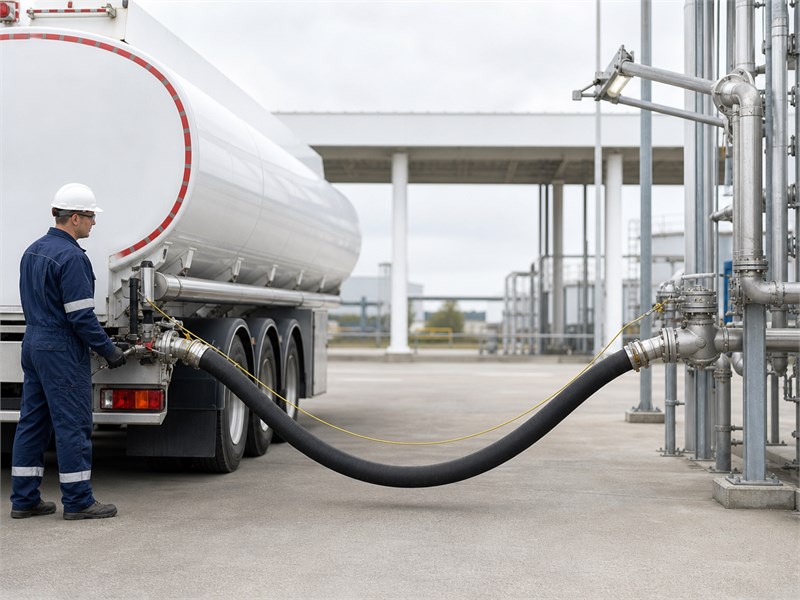
An oil transfer hose moves petroleum products between fixed points — from a loading arm into a tank truck, from a storage drum into a machine sump, or across a plant floor between process tanks. Its smooth NBR tube keeps flow resistance low so oil drains quickly and completely, and its fabric-plus-helix reinforcement keeps the hose flexible without kinking at working pressures of 150–300 PSI. For flammable products, specify a static-dissipative construction and ground the assembly; this is a safety feature, not an option, whenever the oil is a fuel or solvent. End connections are typically camlock couplings or flanges for fast, leak-free hookup, and the hose is available in long continuous lengths to reduce the number of joints in a run.
Fuel Hose: Low Permeation and Static Safety
A fuel hose is a specialist within the oil family: its tube is compounded for low fuel permeation, and conductive versions are built to dissipate static charge instead of letting it accumulate. The practical rule is one-way: fuel-rated hose is oil-resistant, but a general-purpose hose is not automatically fuel-rated. If the line carries diesel, kerosene, or heating oil, specify a fuel hose and confirm the permeation and conductivity requirements for your local standard — automotive fuel lines, dispenser lines, and marine fuel lines each have their own classes. When in doubt, the printed standard on the cover, such as SAE J30 for automotive service, is the binding specification.
Oil Return and Oil Cooler Hose: Low Pressure, Real Heat
Oil return hose and oil cooler hose look unglamorous next to the high-pressure families, but they carry oil that is often hotter. Textile braid handles the 250–500 PSI range comfortably, and the tube compound still must be oil-resistant because the fluid is hot, circulated oil rather than fresh oil from a drum. Oil cooler hose in particular can see sustained temperatures above 100°C on engine and transmission circuits, so check the temperature rating before substituting a standard return hose in a cooler line. These hoses are short, routed, and clamped in tight engine bays, which means flexibility and bend radius matter as much as the pressure figure on the layline.
Where Oil Hose Types Are Used: Applications by Industry
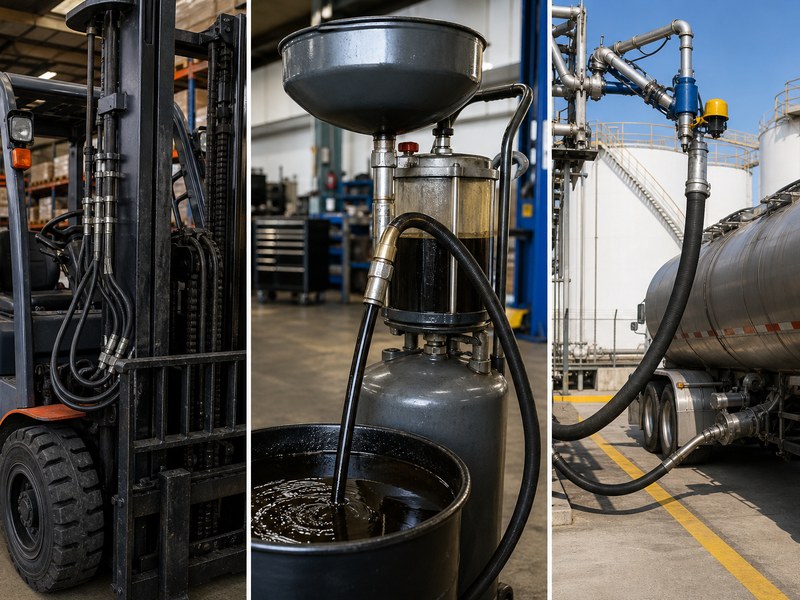
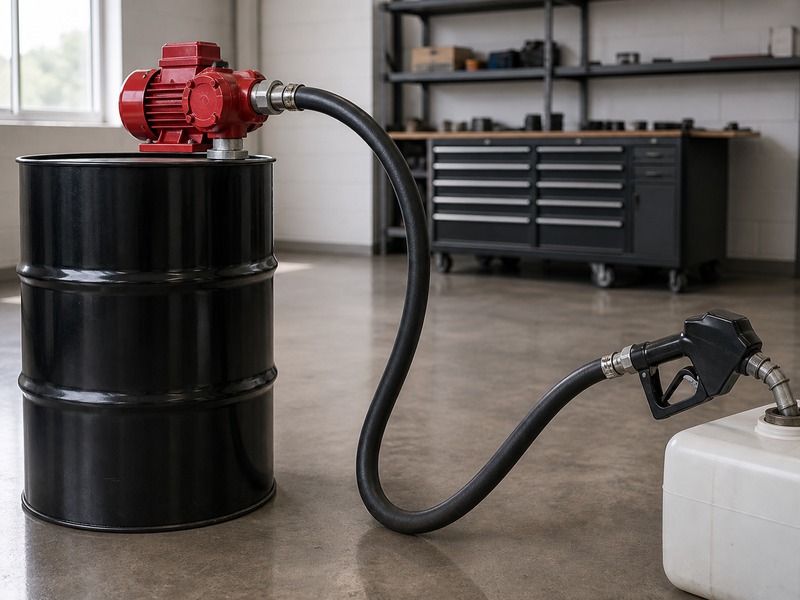
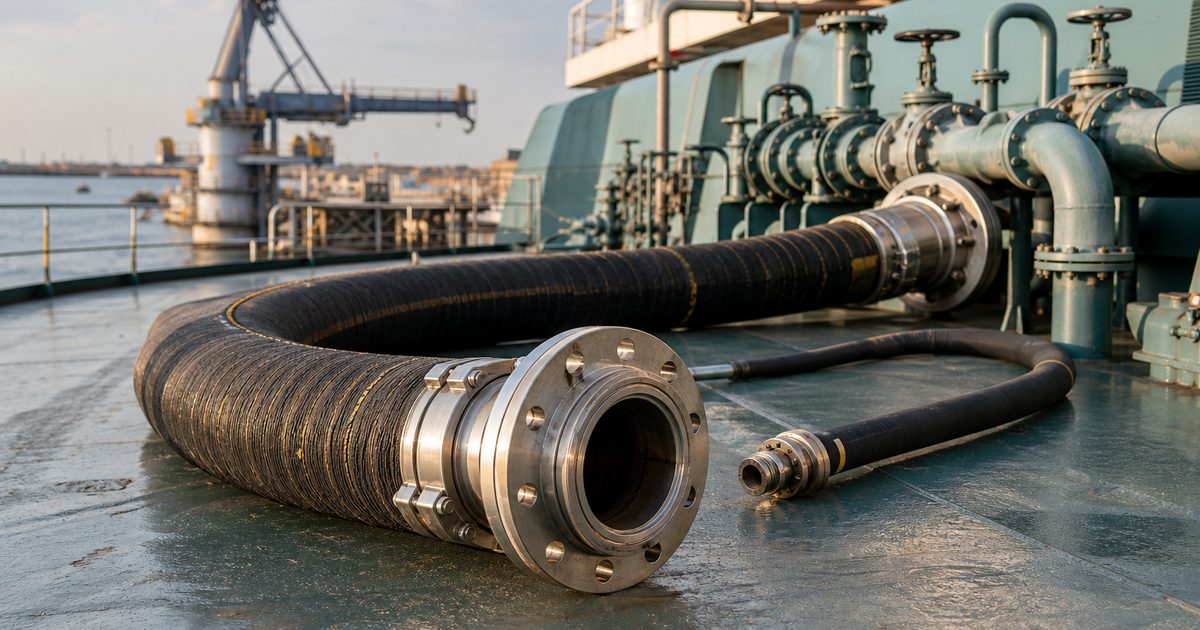
Figure 2. Different hose families for different duties — power transmission, vacuum pickup, and bulk transfer.
The application decides the pressure and the duty cycle, and those two decide the family. A workshop oil changer works at a few bar with full vacuum on the pickup; an excavator boom runs at thousands of PSI with shock loads; a tank farm runs at low pressure but large volume, round the clock.
- Construction and mining — excavators, wheel loaders, and drills use hydraulic hose at 2,250–6,000 PSI for boom, arm, and attachment circuits; mining adds the need for flame-resistant covers.
- Agriculture — tractor and implement hydraulics use hydraulic hose, while diesel transfer and refuelling circuits on the farm use fuel-rated transfer hose.
- Workshops and garages — oil changers, waste-oil extractors, and lube dispensing equipment rely on vacuum-rated oil suction hose and low-pressure transfer lines.
- Tank farms, depots, and tank trucks — loading and unloading arms use transfer hose and large-bore oil suction and discharge hose, frequently with camlock ends and static-dissipative construction.
- Marine and offshore — bunker transfer and lube-oil lines use transfer hose with covers that resist saltwater and UV; engine rooms add fire-resistant requirements.
- Manufacturing and power — hydraulic presses, injection moulding machines, and lubrication systems run hydraulic and return hose under continuous duty, where impulse life and temperature rating drive the choice.
- Truck and bus fleets — fuel lines, oil cooler hose on automatic transmissions, and air-brake-adjacent routing call for hoses with tight bend radius and proven oil resistance.
In our experience servicing machinery builders, the pattern is consistent: teams that specify the family by application, then confirm the compound and pressure with the supplier, rarely see premature hose failure; teams that buy by price alone replace the same line three times as often.
How to Select the Right Oil Hose: Five Decisions in Order
Selection is a sequence of five decisions — fluid and temperature, pressure, bore size, fittings, and environment. Work through them in order and the correct family selects itself; skip one and you pay for it in service life.
Step 1: What fluid and what temperature will the hose carry?
Confirm the exact fluid before anything else. Mineral hydraulic oil, lube oil, and diesel all suit NBR-based tubes; phosphate esters, brake fluid, and some synthetic oils demand different compounds entirely, and hot oil above 120°C pushes you toward FKM. The fluid identity is usually on the machine plate or the material safety data sheet, and the operating temperature should be measured at the worst point of the circuit, not the average. If you cannot confirm compatibility from the supplier’s chart, ask for an immersion test: soak a short sample of the tube in the actual oil for 72 hours and check for swelling, softening, or weight change. That 72-hour test has saved more installations than any catalogue page we know. If the supplier cannot provide immersion data, treat the product as a general-purpose line rather than an oil resistant hose until the test proves otherwise.
Step 2: What working pressure — and will the line ever see vacuum?
Rate the hose on working pressure, never on burst pressure. Working pressure is the continuous rated pressure; burst pressure is typically four times higher and is a destruction test, not a service figure. Hydraulic circuits also impose impulse loads, so choose a construction rated for the number and severity of pressure cycles, not just the peak number on a gauge. If the line is on the inlet side of a pump, or it can be drained and left open to atmosphere, it may see vacuum — and vacuum requires a helix-reinforced suction hose, because a pressure-rated braided hose collapses under suction. Our oil hose working pressure vs burst pressure guide explains the two ratings and the safety-factor math in detail.
Step 3: What bore size and flow rate do you need?
Size the line by inner diameter, which sets the flow capacity, not by outer diameter, which is set by the reinforcement. Undersized lines create back pressure, heat the oil, and shorten pump life; oversized lines add cost and weight for no benefit. Measure a clean cut end with a caliper, or read the dash size on the layline — a dash size is the inner diameter in sixteenths of an inch, so dash -8 equals 8/16 inch, or 1/2 inch. The oil hose size chart below lists common sizes with typical maximum flow rates for oil service at moderate velocity; treat the flow figures as planning values and confirm them against the manufacturer’s data for your exact fluid and temperature.
Oil hose size chart: dash size, inner diameter, and typical maximum flow for oil service
| Dash size | Inner diameter (inch) | Inner diameter (mm) | Typical max flow (US gpm) |
|---|---|---|---|
| -4 | 1/4 | 6.4 | 3 |
| -6 | 3/8 | 9.5 | 7 |
| -8 | 1/2 | 12.7 | 12 |
| -10 | 5/8 | 15.9 | 18 |
| -12 | 3/4 | 19.0 | 25 |
| -16 | 1 | 25.4 | 45 |
| -20 | 1-1/4 | 31.8 | 70 |
| -24 | 1-1/2 | 38.1 | 100 |
| -32 | 2 | 50.8 | 180 |
If the machine already has a hose that worked, measure it and read its layline rather than guessing — the old hose carries the complete specification, including size, pressure, standard, and manufacture date.
Step 4: Which fittings and end connections?
The fitting must match both the hose and the port on the machine. Crimped fittings are factory-pressed and are the standard for hydraulic assemblies; reusable fittings can be rebuilt in the field and suit low-frequency, large-bore lines. On the port side, the thread standard must match the machine exactly — mixing JIC and BSP, or NPT and BSP, is one of the most common reasons for leaks at the fitting. Our hydraulic fittings types guide covers the full family; the NPT vs BSP thread guide and JIC fittings guide explain the differences that cause the most cross-market confusion.
Common fitting and connection standards for oil lines
| Ligação | Sealing principle | Typical use |
|---|---|---|
| JIC (37-degree flare) | Metal cone-to-seat seal | Hydraulic lines in mobile and industrial equipment |
| ORFS | O-ring face seal | High-pressure hydraulic lines where leaks are unacceptable |
| NPT | Tapered pipe thread with sealant | General oil and fuel lines in North American markets |
| BSP (BSPP / BSPT) | Parallel or tapered thread | General oil and fuel lines in European and Asian markets |
| SAE flange (code 61 / 62) | Flange face with O-ring | Large-bore, high-pressure hydraulic connections |
| Camlock (cam and groove) | Quick-connect lever arms | Low-pressure oil transfer and tank-farm hookups |
Step 5: What environment and what standard?
Finally, look at where the hose will live. Abrasion from dragging over concrete, oil mist that attacks the cover, ozone and UV outdoors, and cold starts below -20°C all change the specification. Choose a cover matched to the abuse, protect the hose with sleeving or guards at wear points, and verify the low-temperature flexibility if the machine sits outside in winter. On the standard side, specify a construction that carries a recognized rating — SAE J517, DIN EN 853/856, or ISO 18752 for hydraulic lines, and the applicable fuel or transfer standards for the other families — because the standard is your guarantee that the hose was actually tested to a pressure and impulse level, not just labelled.
Selection checklist
- Confirm the exact fluid, its additives, and the worst-case temperature, then require an oil resistant hose construction matched to them.
- Rate the hose on working pressure; check impulse duty and any vacuum condition.
- Size by inner diameter for the required flow, using a caliper or the dash size.
- Match the fitting standard to the machine ports; crimp vs reusable by application.
- Protect against abrasion, ozone, and cold; require a recognized standard.
- Ask for immersion test data when the fluid is unusual or the temperature is high.
How to Install, Inspect, and Know When to Replace an Oil Hose
Installation quality decides how much of the rated life you actually get. Route the hose with a bend radius above its minimum, never force a kink, and add length where the machine moves so the hose flexes instead of stretching. Support long runs with clamps, keep hose away from hot manifolds and sharp edges, and torque fittings to the manufacturer’s specification — an over-torqued fitting distorts the seal, and an under-torqued one leaks. On suction lines, verify every joint is airtight; a single loose clamp lets air in and the pump loses prime.
Inspect oil lines on a fixed schedule, and look for the warning signs in the list below. Replace the hose when you see any of them; a failed hose on a machine is downtime, and on a fuel line it is a fire risk.
- Cover cracks, cuts, or exposed reinforcement from abrasion or ozone.
- Blisters or soft spots in the tube or cover — signs of chemical attack or overheating.
- Leaks at the fitting, or fittings that have pulled away from the hose.
- Kinks, crushing, or flat spots from misrouting or impact.
- Stiffness or hardening that no longer matches the original flexibility.
- An end fitting that has slipped under pressure, visible as a gap at the crimp.
Storage matters as much as installation for spare hose. Keep coils flat or hanging on wide-radius hooks, out of direct sunlight, ozone sources such as motors, and temperatures above 40°C. Rubber degrades slowly even in storage, so use the oldest stock first and respect the date code printed on the cover; most manufacturers rate rubber hose for roughly five to ten years of total life from manufacture, and a hose that has sat for years should be inspected before it goes into service.
Oil Hose Cost, MOQ, and What Factory-Direct Really Means
Price follows construction first: steel wire and spiral reinforcement cost more than textile braid, larger bores use more material, and certified, tested constructions carry a premium over uncertified equivalents. Fittings, end types, and order volume then move the unit price either way. The ranges below are typical market planning figures for bulk hose by the foot, not quotes; request a written quotation for your size and volume.
Typical market price ranges by hose family (planning reference, USD per foot)
| Hose family | Typical range (USD per foot) |
|---|---|
| Textile return and cooler hose | $0.80–$2.00 |
| Fuel and light transfer hose | $1.50–$4.00 |
| Oil suction and discharge hose (1 inch and up) | $3.00–$8.00 |
| Hydraulic wire-braid hose (3/8 inch) | $1.50–$5.00 |
| Hydraulic spiral hose (1 inch and up) | $6.00–$15.00 |
Buying factory-direct changes the economics in two ways. First, the price sits closer to the manufacturing cost because distributor margins are removed — for identical standard constructions, factory-direct pricing typically lands 20–40% below reseller channels. Second, you can specify the assembly: cut lengths, factory-crimped fittings, printed laylines, and packaging that match your maintenance program. The trade-offs are honest ones: minimum order quantities apply on custom work, lead time depends on production schedule, and warranty covers manufacturing defects — always confirm the written warranty terms and delivery date before you commit, and keep a sample for incoming inspection. We publish our MOQ, lead time, and warranty policy in every quotation so there are no surprises at the receiving dock.
Frequently Asked Questions
Which rubber is best for an oil hose tube: NBR, EPDM, or FKM?
NBR (nitrile) is the default for mineral oils from about -40°C to +100°C; FKM (fluoroelastomer) is the choice above that range or for aggressive additives; EPDM must be avoided for oil because it swells and softens on contact, though it is excellent for water and hot air; CR (chloroprene) sits between NBR and EPDM for general oil service.
Can an oil hose be used for water, air, or coolant?
Only if the tube compound and pressure rating suit the new fluid. An NBR hose tolerates incidental water but is not built for steam or hot water, and its pressure rating still applies to any fluid you put through it — check the supplier’s compatibility chart before changing service, because a hose that is perfect for oil can fail fast in another duty.
What does the layline on a hydraulic oil hose tell you?
The printed layline states the standard (such as SAE 100R2AT), the size in dash or inch terms, the working pressure, and the manufacture date and batch; it is the binding specification for the hose, so match replacement hose to the layline rather than to memory.
How long can rubber hose be stored before installation?
Rubber hose is typically rated for five to ten years of total life from the manufacture date when stored cool, dark, and dry, away from ozone sources and direct sunlight; inspect stored hose for cracks, stiffness, or flat spots before it goes into service and use the oldest stock first.
Why does my oil hose blister, soften, or weep?
The usual causes are a tube compound incompatible with the fluid, sustained temperatures above the hose rating, cover damage from abrasion or ozone, or continuous pressure above the working rating — blisters and softening mean chemical or heat attack, so replace the hose and correct the specification before reinstalling.
How do I measure oil hose size correctly?
Measure the inner diameter with a caliper on a clean, square-cut end — never the outer diameter, which includes the reinforcement — or convert the dash size by dividing by 16 (dash -8 equals 8/16 inch, or 1/2 inch); confirm your reading against the layline printed on the cover.
The Bottom Line: Match the Oil Hose to the Duty
An oil hose is not a commodity; it is a component with a specification, and the specification is the difference between a line that outlives the machine and one that fails in the first season. Decide the fluid and temperature first, rate on working pressure, size by inner diameter, match the fittings, and require a recognized standard — then buy from a manufacturer who tests what they ship. HENGHUA manufactures hydraulic oil hose, oil suction and discharge hose, oil transfer hose, fuel hose, and custom assemblies from 1/4 inch to 4 inch bore to SAE J517, DIN EN 853, EN 856, and ISO standards, with factory-crimped fittings and proof-tested lines. Send us your application details — fluid, pressure, temperature, bore, fittings, and quantity — and our engineers will confirm the correct oil hose and quotation within one working day. Request a quote and samples.
By the HENGHUA Engineering Team — a hose manufacturer with full in-house compounding, production, testing, and custom assembly.

 English
  Spanish
  Portuguese
  French
  German