

A fuel transfer hose is a flexible rubber hose engineered to move gasoline, diesel, petrol, and fuel oil between tanks, pumps, trucks, and machines — and choosing the right one comes down to five checks: fluid compatibility, inner diameter, working pressure, end fittings, and static-safety construction. This guide explains what a transfer hose is, provides the size chart and pressure data you need, walks through selection step by step, and covers the safety, inspection, and standards that keep fuel lines working without leaks, collapse, or static discharge.
What Is a Fuel Transfer Hose?
A fuel transfer hose is a low-pressure rubber hose built for moving refined fuels from a storage tank into a vehicle, machine, drum, or generator. It is the product between the pump and the tank on a fuel skid, a service truck, an agricultural fill point, or a construction site. Unlike an automotive fuel line, which is a fixed small-bore pipe from tank to engine, a transfer hose is handled, coiled, dragged, and connected repeatedly — so it is built for flex life and abrasion resistance as much as for fuel resistance.
The construction follows a tube-reinforcement-cover sandwich, with one addition for static safety:
- Tubo: an oil- and fuel-resistant inner layer, almost always nitrile (NBR), smooth-bore, and conductive so static charge drains instead of building up.
- Reforço: synthetic textile plies that carry the working pressure; suction-duty constructions add a steel helix wire that stops the hose collapsing under vacuum.
- Capa: an abrasion-, ozone-, and weather-resistant rubber outer layer, often chloroprene (CR), that survives dragging across concrete and sitting in the sun.
- Grounding: a copper continuity wire bonded end to end that gives the static charge a controlled path to the bonded fittings.
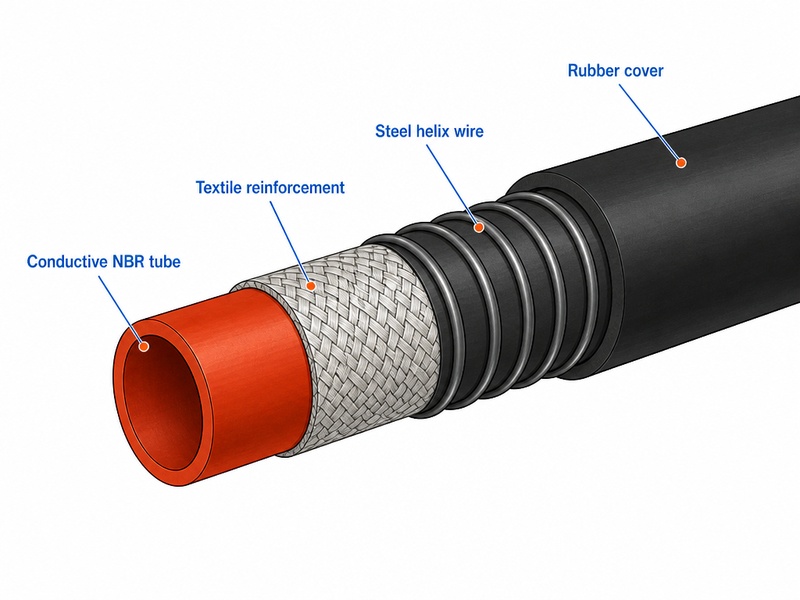
Figure 1. A transfer hose is a tube-reinforcement-cover assembly; the conductive tube and helix wire are what separate transfer duty from ordinary fuel line service.
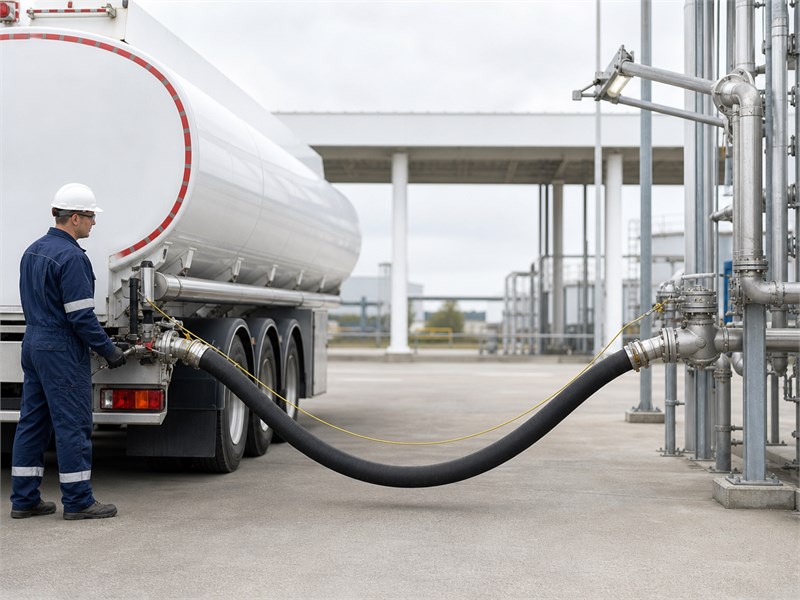
Where is it used? Transfer hoses move diesel into tractors and excavators, gasoline into pumps and generators, and fuel oil into boilers. They appear on 12-volt transfer pump kits, service trucks, farm tanks, generator sets, and small bulk deliveries. The one rule across all these jobs is the same: the hose must be rated for the specific fuel, sized for the flow, and built for the pressure — never improvised from a garden hose or a water line.
Transfer Hose vs Fuel Hose vs Oil Transfer Hose: What Is the Difference?
The three category names overlap at the edges, and buyers frequently mix them up. The difference decides whether the product survives the job:
- Fuel hose is the broad category, covering everything from automotive fuel line (SAE 30R-series small-bore hose) to dispenser hose at a service station. Most of it sold at retail is automotive or small-engine hose rated for low pressure and small diameters, not for repeated coupling and bulk flow.
- Transfer hose is the industrial subset of that category: larger bores, higher working pressure, a thicker cover, and — in suction constructions — a helix wire with a full vacuum rating. It is the product this guide covers.
- Fuel dispenser hose is the station-grade hose between a dispenser and a nozzle, regulated under UL 330 in North America. It is flexible, continuously conductive, and tested for millions of flex cycles, but it is a service-station product, not a bulk transfer line.
- Fuel delivery hose describes hose used on fuel trucks and delivery tankers, typically built to EN 1761 in Europe. It overlaps with transfer hose; the name comes from the job — delivering fuel from a truck into a customer’s tank.
- Oil transfer hose (and oil suction and discharge hose) moves heavier petroleum products — lube oil, fuel oil, hydraulic oil — often with suction service and larger bores up to 4-6 inches. For a full comparison see our Guia para mangueiras de transferência de óleo.
Hose types at a glance: what each product is really for
| Tipo de mangueira | Diâmetro interior típico | Pressão de serviço | Capacidade de vácuo | Main job |
|---|---|---|---|---|
| Fuel line hose (automotive) | 1/4-3/8 in | Low (gravity to ~50 PSI) | None | Fixed engine fuel feed |
| Transfer hose | 1/2-4 in | 150-300 PSI typical | Full vacuum on suction types | Tank-to-machine bulk transfer |
| Fuel dispenser hose | 3/4-1 in | Rated for station service | None | Station pump to vehicle nozzle |
| Fuel delivery hose (tanker) | 1-4 in | 150 PSI (10 bar) class | Full vacuum on suction types | Truck or tanker unloading |
| Oil transfer hose (OS&D) | 3/4-6 in | 150 PSI (10 bar) class | Full vacuum | Heavy petroleum, suction and discharge |
If you are refuelling a tractor from a 12-volt pump, you need a transfer hose. If you are unloading a delivery truck into underground tanks, you need a delivery-grade construction with the right fittings. If the product is a heavy oil rather than a fuel, see the oil transfer guide instead.
Step 1: Size the Fuel Transfer Hose for the Flow You Need
Size the inner diameter (ID) from the pump flow, never from the port size you happen to have. A hose that is too small raises fluid velocity, which increases pressure drop, can damage the pump on suction, and makes the hose whip and harden in service. A hose that is too large costs more, weighs more, and is harder to coil and handle.
The classic design rule is to keep fuel velocity at or below about 5 ft/s (1.5 m/s) on suction lines and 10-15 ft/s (3-4.5 m/s) on discharge lines. At those velocities, the table below gives typical flow capacity by bore. These are planning values for selection; confirm the final size against the manufacturer’s flow table for the exact hose.
Fuel hose sizes chart — typical flow capacity by inner diameter (planning values)
| Inner diameter (in) | Inner diameter (mm) | Typical flow at 10-15 ft/s (US gpm) | Common use |
|---|---|---|---|
| 1/2 | 13 | 6-9 | Small 12-volt pumps, generator fill |
| 3/4 | 19 | 14-20 | 12-volt and 110-volt transfer pumps, pickup tanks |
| 1 | 25 | 25-38 | Standard transfer pumps, service trucks |
| 1-1/4 | 32 | 39-58 | Higher-flow transfer, generator farms |
| 1-1/2 | 38 | 55-83 | Bulk pumps, agriculture fill points |
| 2 | 51 | 98-147 | Fuel delivery trucks, bulk storage |
| 3 | 76 | 220-330 | Delivery tankers, high-rate unloading |
| 4 | 102 | 390-590 | Bulk terminals, large tanker service |
To read the chart: find the pump output in gpm, read across to the bore that keeps velocity inside the recommended band, then confirm both end fittings accept that bore. If the pump pulls from a tank, use a suction-rated hose and hold suction velocity near 5 ft/s — a smaller bore here risks cavitation and a collapsed line.
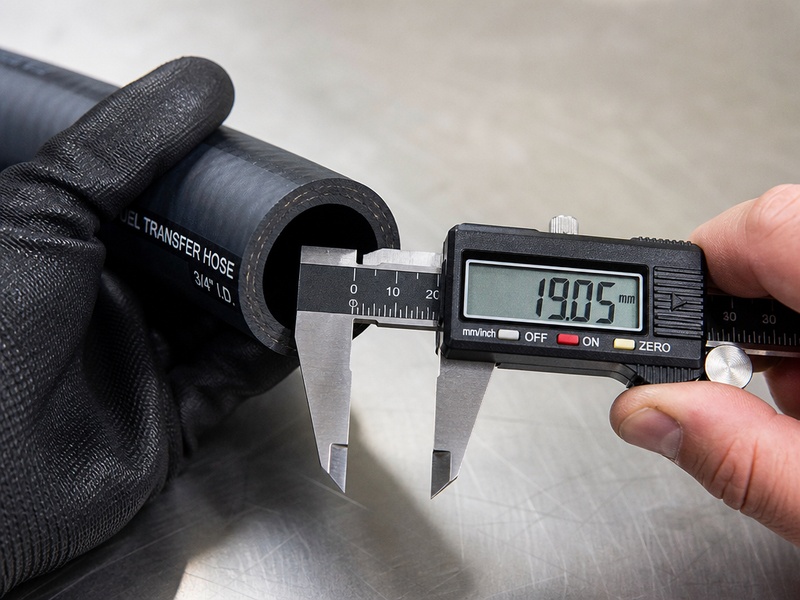
Figure 2. Size always means inner diameter: measure the cut end across the bore with a caliper.
To identify an unmarked hose, measure the bore of the cut end with a caliper, or compare the hose end against a fitting gauge. Size is the inner diameter, never the outer diameter — the OD changes with reinforcement plies and helix wire, so two hoses with the same ID can have different ODs. If the hose is still marked, the size line usually reads something like “EN 1761 1 inch” — that 1 inch is the ID.
Length is the last dimension. Measure the straight-line distance between connection points, add 5-10% for bends and fitting allowance, then order the next standard length up. A hose that is exactly tight is a hose already under stress.
Step 2: Match the Hose Construction to the Fuel and the Duty
The inner tube must tolerate the actual fuel. Refined fuels differ in aromatic content, and aromatics attack ordinary rubber. Gasoline can carry 30-45% aromatics depending on region and season, which is why the default tube for this category is a conductive nitrile (NBR) compound rated for petroleum fuels. Most transfer hose is marked for gasoline, diesel, and biodiesel blends up to about 50% aromatics, and a gasoline hose and a diesel transfer hose usually share the same conductive NBR tube — the difference sits in the cover and the certification.
A few compatibility rules from our test bay:
- Diesel and gasoline suit the standard conductive NBR tube; no special compound is needed for normal road diesel or pump gasoline.
- Ethanol blends change the picture. Pump gasoline with up to 10% ethanol (E10) is fine in a standard transfer hose. E85 and other high-alcohol blends require an alcohol-rated construction — standard NBR swells and softens in high-ethanol fuel. If your line runs E85, say so when ordering.
- Biodiesel in normal blends (B5-B20) is handled by standard constructions, but biodiesel is more aggressive to some cover compounds and degrades faster in storage; confirm the hose is marked for biodiesel service.
- Aviation fuel (Jet A-1) and racing fuels are separate categories with their own certifications — never assume a road-fuel line is approved for them.
The second construction decision is suction versus discharge. A discharge-only hose pushes fuel; a suction hose is helix-reinforced and rated for full vacuum so it stays round when the pump pulls. If the line ever sucks — unloading a tank, drawing from a drum, or feeding a pump inlet — buy a suction-rated transfer hose. Many operators standardize on one full-vacuum construction for everything, so nobody has to ask which line can pull. In our field inspections, a collapsed discharge-only hose on a suction line is one of the three most common failures we photograph.
For a diesel transfer hose on a farm or construction site, abrasion resistance matters as much as fuel resistance: the hose drags over gravel, gets stepped on, and sits in the sun. A thick chloroprene cover and a hose reel protect the hose more than any compound change does.
Step 3: Check Working Pressure, Burst Pressure, and Temperature Range
Every transfer hose datasheet lists three pressure numbers, and each has a different job:
- Pressão de serviço is the continuous operating rating — the number that matters. Typical transfer hose is rated 150 PSI (10 bar) working pressure, with heavier delivery constructions available to 300 PSI and EN 1761 tanker hose commonly certified in the 10-16 bar (145-232 PSI) range.
- Burst pressure is the destruction-test value. The ratio between burst and working pressure is the safety factor — 4:1 is the common design margin for this category, meaning a 150 PSI hose is built to burst near 600 PSI.
- Temperature range defines the service window. A standard delivery hose operates from about -30°C to +90°C (-22°F to 194°F); premium cold-weather constructions extend the low end to about -40°C.
Transfer hose pressure and temperature classes (typical ratings)
| Service class | Pressão de serviço | Safety factor | Temperature range |
|---|---|---|---|
| Light transfer (12-volt pumps, farm) | 50-150 PSI | 4:1 | -30°C to +90°C |
| Standard transfer hose | 150 PSI (10 bar) | 4:1 | -30°C to +90°C |
| Fuel delivery / tanker (EN 1761 class) | 10-16 bar (145-232 PSI) | 4:1 | -30°C to +90°C |
| Heavy-duty / cold-weather construction | 150-300 PSI | 4:1 | -40°C to +90°C |
Select by the working pressure printed on the cover, never by burst pressure alone. Burst pressure is a design-margin reference used in testing; a hose chosen exactly at the pump rating leaves no room for the pressure wave every pump start sends down the line. A small margin above the system pressure is a sensible planning rule, and it costs little on a hose this short.
Temperature failures are slower but just as real. Cold fuel thickens and raises pressure drop on long runs; hot fuel softens the tube over time. Check three temperatures before ordering: the coldest ambient temperature the line sees, the hottest fuel temperature in continuous service, and any hot surface near the routing — an exhaust or a hot pump body can cook a hose that is otherwise correctly rated.
Step 4: Choose Fittings, Nozzles, and Reels That Fit the Job
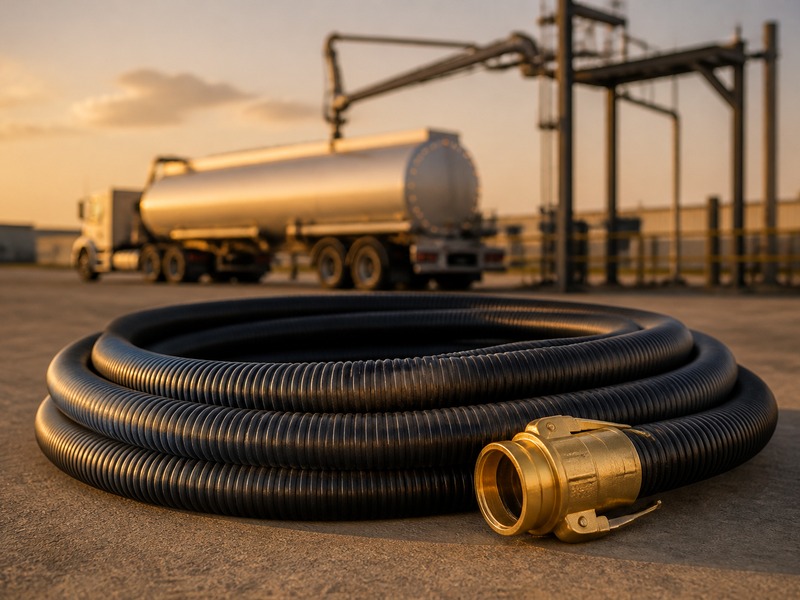
The most common transfer hose connections are camlock couplings, threaded ends, and flanges — the same families used across industrial hose work.
- Camlock (cam and groove) couplings are the workhorse of transfer work: two halves snap together with levers, no tools, and they disconnect in seconds. They dominate service trucks and tank-to-machine hook-ups.
- Threaded ends (BSP or NPT) screw onto pump ports and tank outlets. BSP dominates European and Asian equipment; NPT dominates North American pipe threads. Use the same thread family at both ends — a mixed pair leaks immediately. For the full comparison, see our NPT vs BSP thread guide.
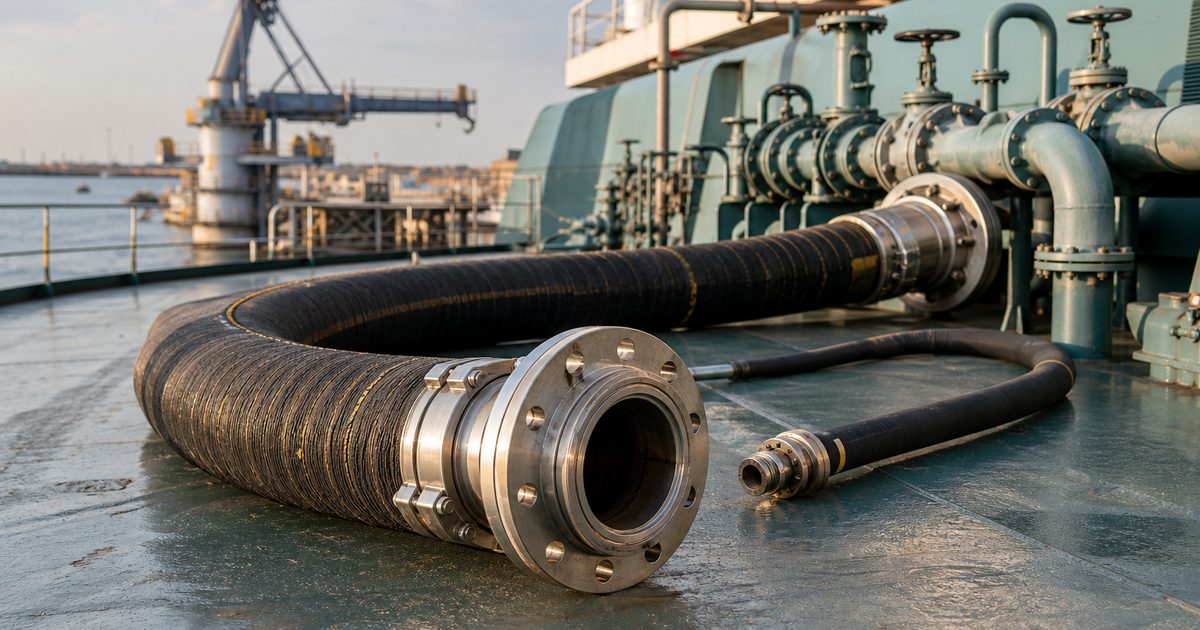
- Flanged ends suit large bores (3 inches and up) on tankers and fixed installations where bolted connections are safer.
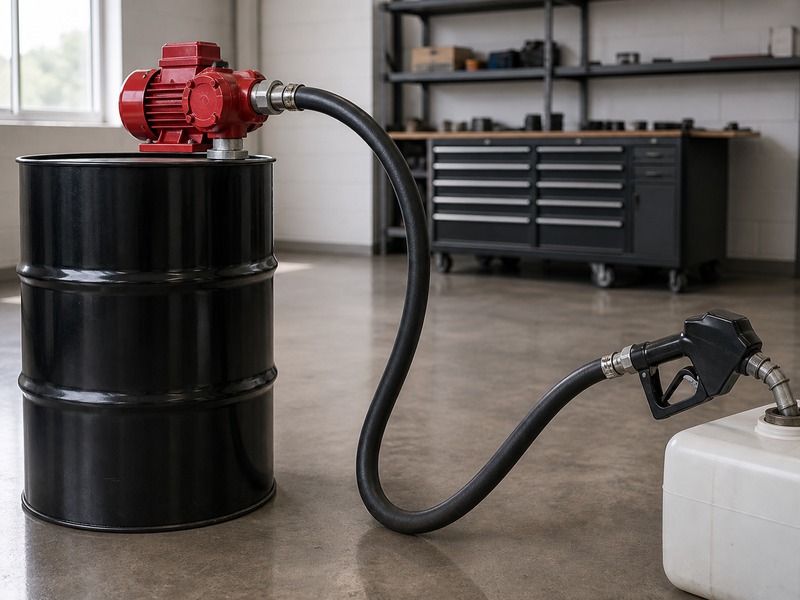
- Nozzles and swivels complete the transfer line: a manual or automatic nozzle on the delivery end for refuelling, and a swivel where the hose connects to a reel so the hose does not twist every time it is pulled out.
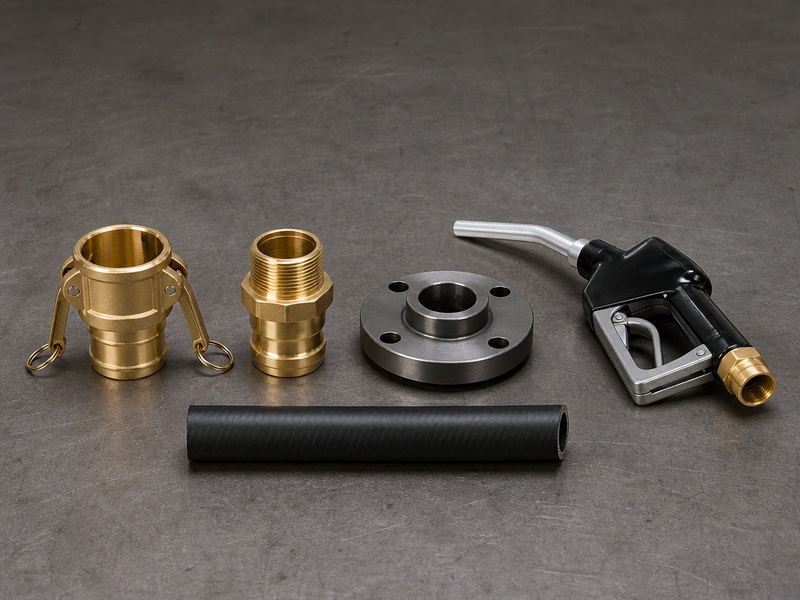
Figure 3. Camlock, threaded, and flanged ends cover the connections; a nozzle and swivel turn the hose into a refuelling line.
Two practical details from our assembly shop. First, crimped ends must be applied by the manufacturer or with certified equipment: a swage that is too loose weeps under pressure, one that is too tight crushes the tube, and both are the most common leak sources at the fitting. Second, on a hose reel, confirm the swivel and bend radius at the reel are within the hose’s minimum bend radius — that point is where fatigue cracks start. Record the crimp specification with every assembly so a replacement can be built identically.
A hose reel is worth the investment when the hose is used daily: it protects the cover from UV and abrasion, keeps the line out of vehicle traffic, and stops the kinking that comes from coiled storage. Match the reel to the hose bore and length, and fit a swivel so the hose feeds out straight.
Fuel Transfer Hose Safety: Static, Bonding, Inspection, and Storage
Flowing fuel generates static charge, and low-conductivity fuels hold that charge instead of draining it. Every refuelling and transfer operation is therefore a controlled static event: the hose, the tank, the truck, and the pump must be bonded and grounded so the charge drains safely instead of sparking.
That is why a proper transfer hose has a conductive tube and a copper continuity wire bonded end to end. The conductive path is a requirement of the standards this category is built to — EN 1761 and UL 330 both demand continuity — and flame-retardant, anti-static covers are standard on premium constructions. The hose is one link in a chain that also includes bonding cables and grounding clamps; follow API RP 2003 and NFPA 77 guidance for loading and dispensing operations.
A field checklist we hand to every fleet customer:
- Bond the tank and the receiving equipment together before any connection, and keep the bond in place until the line is disconnected.
- Use a conductive transfer hose with an intact continuity wire; verify the wire with a multimeter between the two coupling halves at every inspection.
- Keep flow velocities moderate — high velocity multiplies static generation.
- Cap hose ends when not in use; never store open to dirt or water.
- Inspect the cover for cuts, cracks, and bulges, and check both ends for loose fittings before every use.
- Keep the line away from sharp edges, hot surfaces, and vehicle traffic; use an abrasion sleeve where it crosses a corner.
- Replace any hose that has kinked, been crushed, run over, or failed a continuity check.
In the two-year inspection program we ran with a fuel distributor customer, seven of eleven failed assemblies traced to crushed continuity wires at the fittings and cover damage from being dragged across a concrete lip — both field issues, not tube failures. Re-routing with an abrasion sleeve and re-crimping to the recorded spec eliminated the repeats across the following twelve months.
Static is invisible, and its failures are rare — until they are catastrophic. The conductive tube and grounding wire are not optional extras on a fuel line; they are part of the product’s job.
Service life follows the same inspection logic. A common industry reference for transfer hose is five to ten years from the date code, with hot, sunny, fuel-soaked, or ozone-rich service at the short end. Replace a hose when you see cover cracks or blisters, a soft or bulging section, kinks that will not straighten, exposed reinforcement, leaks at the fitting or along the body, or a failed continuity check — and replace any hose that has survived a burst or a severe impact even if it looks intact.
Storage matters more than most operators think. Store hoses off the ground on a rack or reel, out of direct sunlight, away from ozone sources such as motors, and capped at both ends. Fuel hoses stored in a dark, cool bay measurably outlive identical hoses stored on a sunny yard — in our own warehouse comparison, the difference ran to several years on identical production batches.
Standards and Markings: EN 1761, SAE J1527, UL 330, and ISO 7840
Standards tell you what a hose was tested to, and a marking is only as good as the testing behind it. Four documents cover nearly all fuel transfer service:
Transfer hose standards and their scope
| Padrão | Scope | Typical marking |
|---|---|---|
| EN 1761 | Rubber hoses for fuel truck delivery — petroleum fuels with up to 50% aromatics | EN 1761 |
| UL 330 | Hose and hose assemblies for dispensing flammable liquids (service stations) | UL 330 |
| SAE J1527 | Marine fuel systems (USCG Type A1/A2 and B1/B2 classifications) | SAE J1527 A1 |
| ISO 7840 | Small-craft fuel systems, fire-resistant | ISO 7840 |
| API RP 2003 / NFPA 77 | Static protection procedures for loading and dispensing (not product standards) | n/a — procedure |
The right standard depends on the job. Road and site fuel transfer service in most markets is covered by EN 1761-type testing or an equivalent national standard; service-station dispenser hose is a UL 330 product in North America; marine fuel lines carry SAE J1527 or ISO 7840 depending on the vessel and flag state. A certified hose is proof-tested, burst-tested, continuity-verified, and date-stamped on the cover. Ask for the test report with any bulk order — a serious supplier ships it without hesitation. If a supplier cannot show the test certificate behind the marking, the marking is just paint.

Figure 4. The printed line tells you the standard, the size, and the date code — read it before you install it.
Gasoline dispenser hose deserves a special note: it is the one product of its kind where the flex-life rating matters as much as the pressure rating, because a dispenser hose flexes thousands of times a year at the nozzle. That is why station operators buy UL 330-listed fuel dispenser hose from a certified assembler rather than adapting a transfer hose. For a farm or workshop transfer line, the same logic runs the other way — a dispenser hose is not built for bulk flow rates or suction service.
How Much Does a Fuel Transfer Hose Cost?
The price depends mainly on bore, pressure class, and construction. As a 2026 planning benchmark in USD — verify against current quotes before budgeting: standard 3/4-inch transfer hose runs roughly $2.50-$5 per foot, 1-inch about $3.50-$7 per foot, 2-inch about $8-$14 per foot, and 3-inch delivery-grade about $12-$20 per foot, with fittings on top — a camlock coupling typically $5-$40 depending on size and material, and a nozzle $10-$60. Automotive-grade gasoline hose is cheaper per foot but is a different product; it is not a substitute for transfer duty.
When comparing quotes, compare the whole package: unit price, MOQ (minimum order quantity), lead time, crimping certification, and warranty terms. A clear warranty — covering manufacturing defects and premature failure under specified conditions — signals that the manufacturer stands behind the testing it claims. Ask for samples and a test report before a bulk order, and confirm the markings you receive match the standard you specified.
Factory-direct manufacturers typically undercut distributor pricing on identical standard constructions — an estimate based on HENGHUA’s published price comparisons and customer feedback. Get a factory-direct quote covering unit price, MOQ, lead time, and warranty in one document, and check it against two distributors before you commit. Request a factory-direct quote.
Seven Mistakes That Shorten Fuel Transfer Hose Life
Most premature failures trace back to selection, not manufacturing. These are the seven mistakes we see most often in the field:
- Sizing by outer diameter instead of inner diameter — the hose fits the fitting but starves the flow.
- Using a discharge-only hose on a suction line — it collapses and the pump cavitates.
- Selecting by burst pressure instead of working pressure — the hose passes the bench test and fails in service.
- Buying an automotive gasoline hose for transfer duty — it is not built for bulk flow, repeated coupling, or abrasion.
- Installing a non-conductive hose on a fuel line — static has nowhere to drain.
- Mixing BSP and NPT threads at the ports — a leak no torque setting fixes.
- Routing tight bends at the fittings and skipping abrasion protection — fatigue and chafing end the hose early.
Each of these is preventable at the specification stage, which is why this guide exists.
Frequently Asked Questions
What size fuel transfer hose do I need?
Size the bore from the pump flow, not from the port. At recommended velocities, a 3/4-inch hose carries roughly 14-20 gpm, a 1-inch about 25-38 gpm, a 2-inch about 98-147 gpm, and a 3-inch about 220-330 gpm. Keep suction velocity at or below about 5 ft/s and discharge between 10 and 15 ft/s, then confirm the end fittings accept the bore.
What is the difference between a fuel hose and a transfer hose?
Fuel hose is the broad category, from automotive fuel line to station dispenser hose. A transfer hose is the industrial subset: larger bores, higher working pressure, a thicker abrasion-resistant cover, and — on suction constructions — a steel helix wire and full vacuum rating. Most retail product sold as automotive or small-engine hose is not rated for transfer duty.
Can I use a regular fuel-line hose for diesel transfer?
Only in an emergency, and never as a permanent line. A small-bore automotive hose is not rated for the flow, pressure, repeated coupling, or abrasion of transfer duty, and it carries no vacuum rating. For a diesel transfer hose, buy a product rated for the fuel, the flow, and the duty.
What PSI is a transfer hose rated for?
Typical transfer hose is rated 150 PSI (10 bar) working pressure with a 4:1 safety factor — a 150 PSI hose is built to burst near 600 PSI. Heavier delivery constructions are available to 300 PSI, and EN 1761 tanker hose is commonly certified in the 10-16 bar (145-232 PSI) range. The working rating printed on the cover is the binding value.
Do I need a conductive transfer hose?
Yes, for any petroleum fuel. Flowing fuel generates static charge, and a non-conductive hose lets that charge build up instead of draining it. A proper transfer hose has a conductive tube and a copper continuity wire bonded end to end, and the whole line — hose, tank, truck, and pump — must be bonded and grounded. Verify the continuity wire with a multimeter at every inspection.
How long does a transfer hose last?
A common industry reference is five to ten years from the date code in normal service — shorter in hot, sunny, fuel-soaked, or ozone-rich conditions. Inspect at every maintenance interval and replace on the failure signs listed in this guide: cover cracks or bulges, kinks, exposed reinforcement, leaks, or a failed continuity check.
Can a transfer hose handle oil or hydraulic service?
Not for hydraulic service — a transfer hose is a low-pressure product, and hydraulic lines run at thousands of PSI. For light lube-oil transfer it will work within its rating, but heavy petroleum products, suction duty, and large bores belong to an oil suction and discharge hose. Match the hose to the fluid: fuels are one category, oils and hydraulic fluids another.
What is the difference between a fuel delivery hose and a transfer hose?
The products overlap; the names come from the job. A fuel delivery hose is the EN 1761-type construction used on fuel trucks and tankers unloading into customer tanks, typically 1-4 inch bore in the 150 PSI (10 bar) class. A transfer hose is the general name for tank-to-machine transfer lines. For tanker unloading, specify a delivery construction with the right fittings; for a pump-to-tractor line, a standard transfer hose is correct.
What size hose do I need for a 12-volt fuel transfer pump?
Most 12-volt transfer pumps move 8-15 gpm, which a 3/4-inch hose handles comfortably; larger pumps toward 20 gpm suit a 1-inch hose. Match the hose ID to the pump outlet — most kits ship with 3/4-inch fittings — and use a suction-rated hose if the pump pulls from a tank that sits below it.
Transfer Hose Selection Checklist
Print this page and tick each box before you order — it covers every number a supplier needs to quote correctly:
- Fuel first: confirm the exact fuel — diesel, gasoline, ethanol blend, biodiesel, or aviation — and the hose is certified for it.
- Flow and size: bore sized to the pump output at or below 5 ft/s suction and 10-15 ft/s discharge.
- Working pressure: at or above system pressure, with room for start-stop surges.
- Suction or discharge: full-vacuum construction if the line ever pulls.
- Temperature range: coldest ambient and hottest fuel inside the printed window.
- Fittings: camlock, threaded, flange, or nozzle — and the exact thread family at both ends.
- Static safety: conductive tube and an intact continuity wire, verified.
- Marking: EN 1761, UL 330, SAE J1527, or ISO 7840 as appropriate, with a date code.
- Test report: proof-test and continuity records with the quote.
- Commercial terms: warranty, MOQ, and lead time compared side by side.
Send us this completed checklist for a quick spec confirmation and samples on request. Send your checklist.
Final Verdict: Specify by the Numbers, Buy from a Certified Manufacturer
Choosing the right fuel transfer hose is a sequence of five checks: fuel compatibility, size, pressure, fittings, and static-safety construction — then a certified product from a manufacturer who tests. Get them right and the hose is the most reliable part of your fuel line. Get one wrong and it becomes a spill, a shutdown, or worse. HENGHUA manufactures fuel transfer and delivery hose from 1/2 to 4 inch bore for diesel, gasoline, and fuel oil service, to EN 1761 and equivalent standards, with factory-fitted camlock, BSP, NPT, and flange ends; every line is proof-tested and continuity-checked before shipment, and we build nozzle-and-reel assemblies to your specification. Send us your checklist and our engineers will confirm the right fuel transfer hose for your line — request a quote and free samples.

 English
  Spanish
  Portuguese
  French
  German