
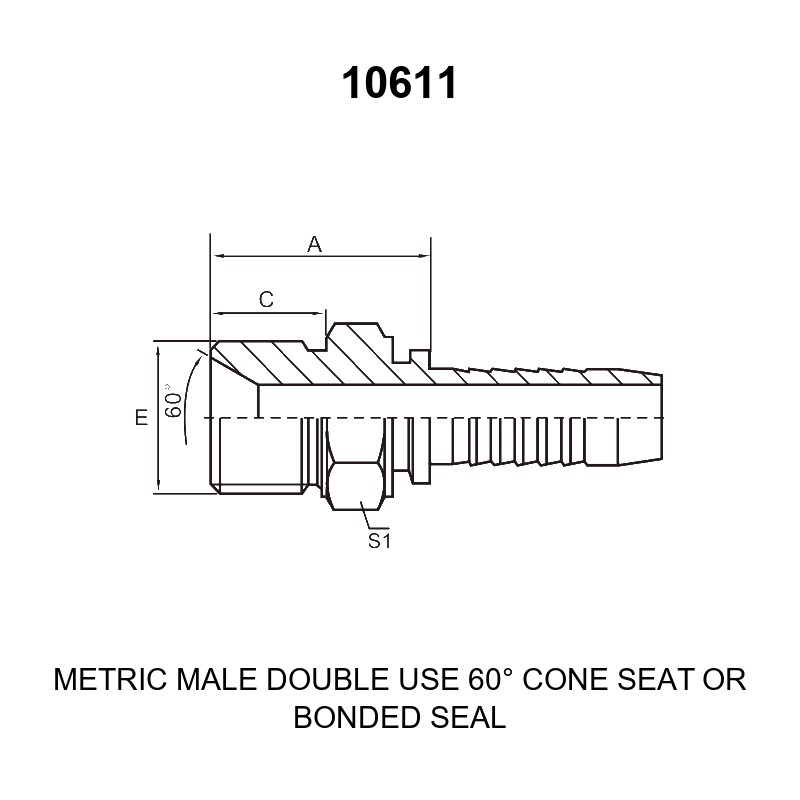
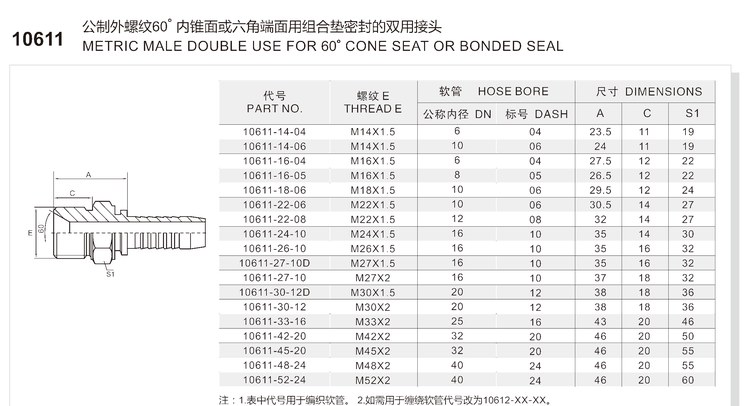
Metric 60-degree cone hydraulic hose fittings seal two ways from one part number: against a female 60-degree cone seat for metal-to-metal sealing, or against a flat port face with a bonded seal washer. The 10611 double-use series covers 18 part numbers from DN6 (-04) to DN40 (-24), with metric threads from M14x1.5 to M52x2, engineered for wire-braided hydraulic hose. If you build or maintain machines with metric 60-degree cone ports or flat-face ports, this page is your working reference: dimensions, part numbers, seal selection rules and OEM options.
Why Choose These 60-Degree Cone Hose Fittings
- One fitting, two seal methods. The same male end seals in a 60-degree internal cone seat or on a flat face with a bonded seal washer, so one part number covers both port types and you carry less stock.
- 18 sizes from DN6 to DN40. Metric threads from M14x1.5 to M52x2, including fine-pitch D versions, cover small control lines to large return lines.
- No tape, no O-ring to lose. The 60-degree cone gives a metal-to-metal seal; the bonded seal option uses a washer that stays in place on the hex face. Neither method needs thread sealant.
- Pronto para OEM. Laser marking, custom plating, material test reports and batch traceability for every order, with bonded seal washers supplied to match.
Normas e rastreabilidade. Threads are ISO 724 metric threads, standard or fine pitch. The sealing geometry follows the double-use 60-degree cone seat / bonded seal configuration used across the widely adopted Chinese 10-series hose fitting numbering system. Fittings are designed to pair with wire-braided hose built to EN 853 1SN/2SN or SAE 100 R1AT/R2AT performance classes. Dimensional inspection reports and material test certificates are available for OEM gate checks.
Double-Use Explained: 60-Degree Cone Seat or Bonded Seal
“Double use” means the same 10611 fitting body can create a leak-free joint on two different port designs:
- 60-degree cone seat. If the female port has a machined internal 60-degree cone, the cone on the fitting seats metal-to-metal inside it. No washer, no sealant, no O-ring. This is the classic cone-seal joint found on many Chinese-built hydraulic cylinders, pumps and manifolds.
- Bonded seal. If the female port face is flat, place a bonded seal washer (a steel washer with a bonded rubber ring, DIN 7603 style) under the hex head. As the fitting is torqued, the rubber ring compresses against the flat face and seals the joint.
The port determines the method: a cone seat takes the cone seal, a flat face takes the bonded seal. Never use both at once, and never put a bonded seal into a cone seat, because the washer will keep the cone from seating and the joint will leak.
One sentence to remember: the 60-degree cone or the bonded seal does the sealing, and the thread only holds the joint together. That is why you must never wrap PTFE tape on these straight metric threads. Tape belongs on taper threads such as NPT or BSPT.
Which seal method should I use?
| Your port | Seal method | Parts needed |
|---|---|---|
| Female port with internal 60-degree cone | Cone seal (metal-to-metal) | Fitting only |
| Flat-face port | Bonded seal under hex | Fitting + bonded seal washer |
| Taper thread port (NPT/BSPT) | Interferência entre roscas | Not this fitting family – use taper fittings |
60-degree cone vs 24-degree cone (DIN 2353 style)
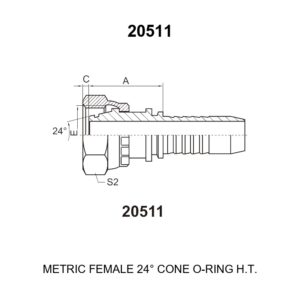
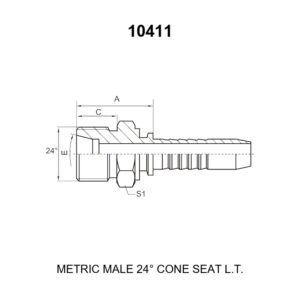
Both families are metal cone seals, but the cone angle is different. DIN 2353 / ISO 8434-1 style fittings seal on a 24-degree cone; these fittings seal on a 60-degree cone. Even when the metric thread size looks the same, the two cones will not mate. Check the cone angle of your port before ordering, and never force one family into the other.
Metric 60-degree cone vs related cone systems
Fittings that look similar exist under other thread systems: ISO 8434-6 and BS 5200 describe 60-degree cone stud ends on BSP G-threads, and Japanese JIS B 8363 covers 60-degree cone joints with subtle dimensional differences. The 10611 series is the metric-thread double-use configuration common on Chinese and Asian equipment. If your machine is of Japanese or European origin, send us a photo of the port and the old fitting, and we will confirm whether the 10611 series is the correct match before you order.
10611 Series Technical Specifications
Materiais e processamento
- Opções de material da carroçaria: aço ao carbono de alta resistência (classes 20#/35#/45#, moldado a frio ou maquinado) como padrão; aço inoxidável 304 ou 316L disponível para ambientes corrosivos ou sujeitos a lavagem.
- Tratamento de superfícies: Zinco por galvanização como padrão; estão disponíveis revestimentos de zinco amarelo, branco ou preto, zinco-níquel e Dacromet para requisitos mais exigentes em termos de ensaio de névoa salina.
- Tratamento térmico: hardness and case depth are controlled per drawing to keep the thread and the cone zone fatigue-resistant; typical surface hardness range HRC 20-28 (confirm the exact code on your drawing or PO).
- Bonded seal washer: supplied as standard with the fitting or on request per order; specify the seal material for your fluid (NBR type for mineral oils as standard).
Tabela completa de dimensões e referências
All linear dimensions are in millimeters. E = thread, DN = hose bore, A and C = lengths per the supplier drawing, S1 = hex across flats. Part numbers with a D suffix are the fine-pitch version of the same thread size (for example 10611-27-10D is M27x1.5 while 10611-27-10 is M27x2).
| N.º de referência | Tópico E | Diâmetro nominal (DN) da mangueira (mm) | Tamanho do traço | A (mm) | C (mm) | S1 hex (mm) |
|---|---|---|---|---|---|---|
| 10611-14-04 | M14x1,5 | 6 | -04 | 23.5 | 11 | 19 |
| 10611-14-06 | M14x1,5 | 10 | -06 | 24.0 | 11 | 19 |
| 10611-16-04 | M16x1,5 | 6 | -04 | 27.5 | 12 | 22 |
| 10611-16-05 | M16x1,5 | 8 | -05 | 26.5 | 12 | 22 |
| 10611-18-06 | M18x1,5 | 10 | -06 | 29.5 | 12 | 24 |
| 10611-22-06 | M22x1,5 | 10 | -06 | 30.5 | 14 | 27 |
| 10611-22-08 | M22x1,5 | 12 | -08 | 32.0 | 14 | 27 |
| 10611-24-10 | M24x1.5 | 16 | -10 | 35.0 | 14 | 30 |
| 10611-26-10 | M26x1,5 | 16 | -10 | 35.0 | 16 | 32 |
| 10611-27-10D | M27x1,5 | 16 | -10 | 35.0 | 16 | 32 |
| 10611-27-10 | M27x2 | 16 | -10 | 37.0 | 18 | 32 |
| 10611-30-12D | M30x1.5 | 20 | -12 | 38.0 | 18 | 36 |
| 10611-30-12 | M30x2 | 20 | -12 | 38.0 | 18 | 36 |
| 10611-33-16 | M33x2 | 25 | -16 | 43.0 | 20 | 46 |
| 10611-42-20 | M42x2 | 32 | -20 | 46.0 | 20 | 50 |
| 10611-45-20 | M45x2 | 32 | -20 | 46.0 | 20 | 55 |
| 10611-48-24 | M48x2 | 40 | -24 | 46.0 | 20 | 55 |
| 10611-52-24 | M52x2 | 40 | -24 | 46.0 | 20 | 60 |
Full dimensioned CAD drawings are available on request so your engineers can verify every length and the cone geometry before you commit a batch.
Pressão de trabalho: a resposta sincera de que os engenheiros precisam
A crimp hose assembly fails at its weakest link, so the rating of a 10611 fitting depends on the hose you pair it with and the crimp quality. Wire-braided hydraulic hose in this size range typically operates between roughly 80 and 350 bar depending on bore size and construction (1SN or 2SN). Send us your hose specification and we will confirm the working pressure, burst margin and the recommended ferrule for your exact hose brand – the check is free and takes one message. For derating at elevated temperature, follow the hose manufacturer’s pressure-temperature curve, because the rubber cover and tube lose capacity above about +100°C.
Which Fitting Series Do You Need: 10611 (Braided) or 10612 (Spiral)?
The part number changes with the hose construction, because the barb geometry and the crimp parameters are different. This is the first selection check for every order.
| Tipo de mangueira | Construção | Séries por encomenda |
|---|---|---|
| Mangueira com malha metálica | 1SN / 2SN (tranças de um ou dois fios), ou SAE 100 R1AT / R2AT | 10611-XX-XX |
| Mangueira em espiral | Reforço em espiral do tipo 4SP / 4SH | 10612-XX-XX |
When in doubt, check the hose label: braided hose is marked 1SN, 2SN or R1AT, R2AT; spiral hose is marked 4SP, 4SH or similar. Ordering the wrong series means the ferrule will not crimp correctly, so confirm the hose construction before you buy.
Decodificador de números de referência e como encomendar
The 10611 part number carries the whole specification, so purchasing can copy it straight into a PO without another round of emails:
10611 – 22 – 08
- 10611 = double-use 60-degree cone seat / bonded seal series for braided hose
- 22 = thread nominal size (here M22x1.5)
- 08 = tamanho da mangueira (aqui DN12, diâmetro nominal de 1/2 polegada)
- D suffix = fine-pitch thread version (for example 10611-27-10D uses M27x1.5)
Because one thread size can serve several hose bores, always quote both the thread size and the dash size. If you are replacing an existing fitting, send us a photo of the thread end, the port face and the hose side, plus the hex size, and we will confirm the matching part number the same day. This service is the fastest way to convert an unreadable old part number into a confirmed 10611 order number, and it also tells you whether your port is a cone seat or a flat face.
Bonded seal washers are available as spares or pre-fitted with the fitting. If your maintenance team loses a washer, you replace the washer – never the fitting – which keeps downtime and spares cost low.
Guia de montagem: Quatro passos para uma crimpagem fiável
These fittings are crimp-style hose ends: the barbed tail is pushed into the hose and a matching ferrule is crimped over the cover. Follow the four steps below on every assembly.
Passo 1 – Corte a mangueira em ângulo reto. Utilize um cortador de mangueira afiado ou uma serra de corte. Um corte reto e limpo permite que a virola se fixe uniformemente na cobertura. Um corte biselado ou irregular é a causa mais comum de falhas por arrancamento.
Passo 2 – Preparar a profundidade de inserção. Empurre a extremidade do encaixe para dentro da mangueira até que encoste firmemente no ressalto interno. A extremidade da mangueira deve ficar na profundidade máxima de inserção, sem ficar curta, caso contrário a zona de crimpagem ficará incorreta.
Passo 3 – Lubrificar e inserir. Apply a thin film of assembly lubricant to the hose bore and the barb. Push the fitting in with a steady twisting motion until it bottoms out, then wipe away excess lubricant. Do not use grease on the cone face or the bonded seal washer.
Passo 4 – Fixar e verificar. Prenda a virola correspondente de acordo com as especificações de fixação do fabricante da mangueira. Após a fixação, meça sempre o diâmetro exterior da fixação com um paquímetro e compare-o com a tabela de fixação. O valor medido deve situar-se dentro da banda de tolerância permitida. Se estiver fora da tolerância, não coloque o conjunto em serviço – corte-o e volte a crimpá-lo com uma configuração corrigida.
Avisos: três erros que provocam fugas e explosões
- Never mix hoses, fittings and ferrules from different manufacturers. Even when the dash size matches, crimp parameters and barb geometry differ, and a mismatched set can leak or pull apart under pressure.
- Never use a bonded seal in a 60-degree cone seat, and never stack a cone seal with a bonded seal on the same joint. Each port design takes exactly one sealing method. Double sealing prevents the cone from seating and guarantees a leak.
- Never put PTFE tape or sealant on the straight metric thread, and never force a 24-degree cone fitting or a flat-face O-ring fitting onto a 60-degree cone port because the threads happen to fit. The seal face will not mate, and the joint will leak or damage the port.
Aplicações típicas
Metric 60-degree cone ports and flat-face bonded-seal ports are specified across a wide range of hydraulic equipment, especially machines built to Chinese or Asian standards and their global service networks:
- Hydraulic cylinders, power units, presses and machine tools
- Plastic injection and die-casting machinery
- Mining, tunneling and construction equipment
- Agricultural and forestry machinery
- Material handling and mobile equipment
- Marine and offshore auxiliary systems
Wherever the port carries a machined 60-degree internal cone or a flat face, the 10611 series is the direct hose connection for braided hose circuits – with one part number serving both.
Personalização OEM e rastreabilidade da qualidade
For equipment builders and large maintenance programs, the 10611 series can be adapted to your exact drawing and your traceability rules.
Opções de personalização
- Rosca e geometria: special threads, modified lengths and non-standard barb configurations machined to your drawing or to a sample.
- Tratamento de superfícies: zinco-níquel, Dacromet ou outros revestimentos para níveis mais elevados de resistência ao teste de névoa salina; confirmamos as horas de teste alcançadas para o revestimento que escolher, em vez de indicarmos um valor genérico.
- Marcação a laser: your logo, part number and batch or date code laser-marked on the hex for full field traceability.
- Material: versões em aço inoxidável 304/316L para meios corrosivos ou para aplicações que exijam lavagem com jato de água.
- Bonded seal supply: washers pre-fitted, boxed loose, or kitted per assembly to match your line-side process.
- Embalagem e preparação de kits: etiquetas personalizadas, códigos de barras, quantidades por saco de plástico ou caixa e conjuntos completos de mangueiras.
Documentação de qualidade
- Rastreabilidade do número de lote: cada encomenda possui um código de lote que remete para os registos de produção.
- Estão disponíveis relatórios de ensaio de materiais (MTR) para os lotes de aço ao carbono e de aço inoxidável.
- Relatórios de inspeção dimensional para verificações de portas por parte dos fabricantes de equipamento original (OEM).
- É possível organizar uma inspeção por uma entidade independente (BV, SGS ou similar) antes do envio.
Amostras e quantidade mínima de encomenda. As amostras dos tamanhos em stock são enviadas rapidamente e mantemos quantidades mínimas de encomenda (MOQ) baixas para os números de referência padrão, para que os distribuidores possam testar a série sem imobilizar capital. Os programas OEM podem passar a entregas programadas assim que o desenho for aprovado.
Embalagem e Logística
Standard export packing: fittings are individually poly-bagged or boxed to protect threads, cone faces and bonded seals, then packed in export cartons labeled with part number, quantity and batch code. Custom labeling, kitting and barcode requirements are available for distributors and OEMs. Exact carton quantity, gross weight and CBM are confirmed on the packing list for every order so you can calculate freight before you commit.
Perguntas Frequentes
Q: What is a double-use 60-degree cone hydraulic hose fitting? A: It is a crimp-style hose fitting with a metric male thread that seals two ways: metal-to-metal against a female 60-degree cone seat, or against a flat port face using a bonded seal washer under the hex. One part number covers both port types.
Q: Should I use the cone seal or the bonded seal? A: Read the port. A port with a machined internal 60-degree cone takes the cone seal with no washer. A flat-face port takes the bonded seal washer. Never use both on one joint, and never put a washer into a cone seat.
Q: What is the difference between 10611 and 10612 series? A: 10611 is for wire-braided hose (1SN/2SN or R1AT/R2AT) and 10612 is for spiral hose (4SP/4SH style). The thread range is the same, but the barb geometry and crimp parameters differ.
Q: What does the D suffix in the part number mean? A: The D suffix marks the fine-pitch version of the same nominal thread. For example 10611-27-10D is M27x1.5 while 10611-27-10 is M27x2. Order the pitch that matches your port.
Q: Do I need thread tape or sealant on the male thread? A: No. The 60-degree cone or the bonded seal does the sealing. Tape on a straight metric thread is useless and can contaminate the system. Use tape only on taper threads.
Q: Is this fitting the same as a 24-degree cone or ORFS fitting? A: No. DIN 2353 style fittings seal on a 24-degree cone, and SAE ORFS uses inch threads with an O-ring. This series seals on a 60-degree cone or a bonded seal with metric threads. The families are not interchangeable.
Q: Is this the same as ISO 8434-6 or JIS 60-degree cone fittings? A: Related but different thread systems. ISO 8434-6 / BS 5200 60-degree cone stud ends use BSP G-threads, and Japanese JIS B 8363 has subtle dimensional differences. The 10611 series is the metric-thread configuration common on Chinese and Asian equipment. Send a photo of your port and we will confirm the match before you order.
P: Qual é a pressão de serviço destas peças de ligação? R: A classificação da montagem depende da mangueira, da virola e da qualidade da crimpagem. Envie-nos as especificações da sua mangueira e iremos confirmar a pressão de serviço e a virola recomendada para a sua combinação.
P: É possível criar referências de peças personalizadas com o meu logótipo? A: Yes. We offer laser marking, custom plating, stainless versions and special dimensions, with MTR and batch traceability for OEM programs.
Order Today: 60-Degree Cone Hydraulic Hose Fittings with Confirmed Fit
Every 10611 metric 60-degree cone hydraulic hose fitting in this range is made to controlled dimensions, inspected before packing and backed by batch traceability. Send us your hose type, thread size and port face – or just a photo of the old fitting and the port – and you will get a confirmed part number, the correct seal method, a delivery date and a quote within one working day. Request samples first if you want to test the fit on your own bench. Whether your port takes a 60-degree cone or a bonded seal, we make sure the fitting, ferrule and hose work as one leak-free assembly.

 English
 Spanish
 Portuguese
 French
 German
 Arabic
 Russian
 Indonesian
 Japanese
 Korean