
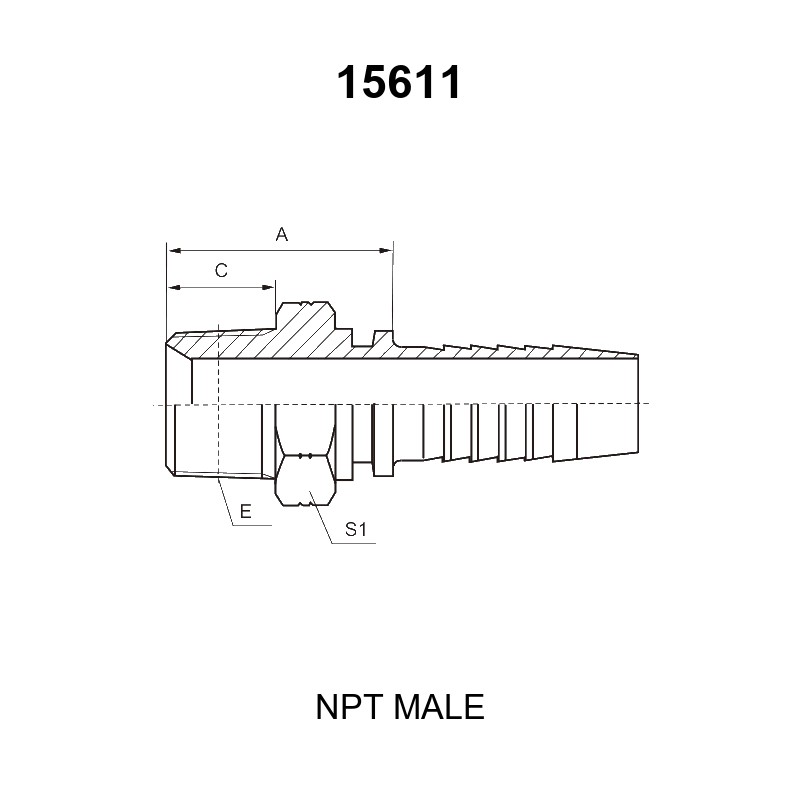
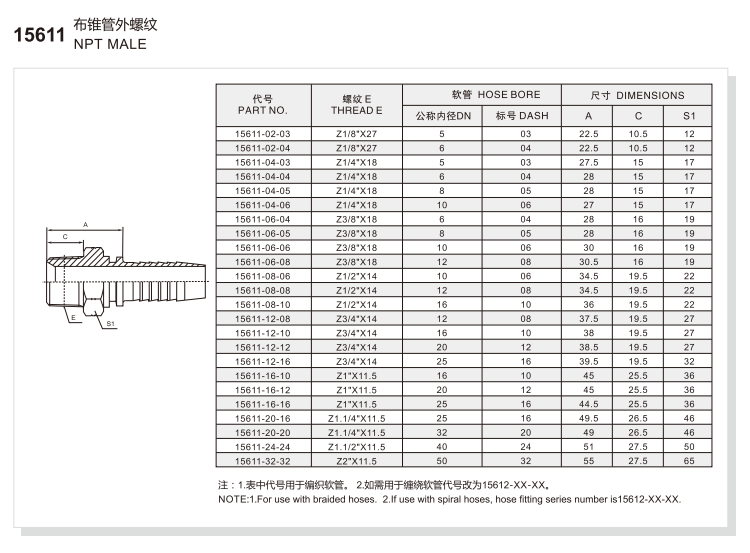
Need the most common NPT male hydraulic hose fittings on the market, in one complete range? The 15611 series is a straight male NPT crimp hose fitting for braided hydraulic hose – SAE 100R1AT / 100R2AT (EN 853 1SN / 2SN) – covering male NPT threads from 1/8″ to 2″ and hose sizes from 3/16″ to 2″ (dash -03 to -32). Twenty-four part numbers include the reducer combinations that real machines need, like a 1/4″ NPT port feeding a 3/8″ hose. If your equipment uses NPT ports and braided hose, this is the fitting range to standardize on.
Why Buyers Choose This NPT Male Fitting Range
| One complete range | 24 part numbers, 1/8″ to 2″ NPT, dash -03 to -32, straight and reducer combinations. One supplier covers the whole plant or fleet. |
| Industry-standard one-piece design | The classic fixed male NPT crimp fitting – no moving parts, no extra seal, simple to spec and stock. |
| Made for braided hose | Machined for SAE 100R1AT / 100R2AT and EN 853 1SN / 2SN hose, the most widely used hydraulic hose families. |
| NPT to ASME B1.20.1 | Tapered 60-degree pipe thread, sealed per standard NPT practice with tape or sealant. |
What Is a Male NPT Hydraulic Hose Fitting?
A male NPT hose fitting terminates a hose into a female NPT port. For most buyers, NPT male hydraulic hose fittings are the default termination for braided-hose lines onto NPT-ported equipment, and the 15611 is the design those buyers stock. The port end carries a National Pipe Taper thread – a 60-degree thread form with a 1:16 taper, dimensioned to ASME B1.20.1 – and the hose end is a one-piece crimp tail: a serrated nipple over which the hose is pushed, then locked by a ferrule crimped with a machine. The taper thread seals by interference as the fitting is drawn into the port, which is why NPT is the default pipe thread across North American hydraulic and industrial equipment.
The 15611 is the fixed (non-swivel) version of this connection. Because the whole fitting rotates as one piece, it is simpler, cheaper, and has no rotating-joint seal to maintain. The trade-off: you rotate the entire hose assembly when tightening. If your installation has tight access, or the hose must not twist during assembly, a swivel version (rotating NPT nut) is the better choice – we make both and will tell you honestly which fits the job.
How the 15611 Is Built
Every NPT male hydraulic hose fittings order is CNC-machined and thread-gauged 100% before plating, because a thread that fails inspection fails a machine.
- Port end: male NPT taper thread to ASME B1.20.1, 1/8-27 through 2-11.5. Precision-cut for consistent thread engagement and sealing.
- Hex section: wrench flats (S1 in the table) sized to each thread for proper torquing without damage.
- Hose tail: one-piece serrated nipple machined for braided hose. The ferrule (supplied separately or in the assembly kit) is crimped over the hose to lock the nipple into the reinforcement.
- Material and finish: carbon steel with trivalent zinc plating (Cr3+), salt-spray verified per batch; 304/316L stainless steel available.
Technical Specifications – 15611 NPT Male
Complete Part Number Table (24 Sizes)
| Part No. | Thread E (Male NPT) | Hose Bore DN (mm) | Traço | A (mm) | C – Thread Length (mm) | S1 – Hex (mm) |
|---|---|---|---|---|---|---|
| 15611-02-03 | 1/8-27 NPT | 5 | -03 | 22.5 | 10.5 | 12 |
| 15611-02-04 | 1/8-27 NPT | 6 | -04 | 22.5 | 10.5 | 12 |
| 15611-04-03 | 1/4-18 NPT | 5 | -03 | 27.5 | 15 | 17 |
| 15611-04-04 | 1/4-18 NPT | 6 | -04 | 28 | 15 | 17 |
| 15611-04-05 | 1/4-18 NPT | 8 | -05 | 28 | 15 | 17 |
| 15611-04-06 | 1/4-18 NPT | 10 | -06 | 27 | 15 | 17 |
| 15611-06-04 | 3/8-18 NPT | 6 | -04 | 28 | 16 | 19 |
| 15611-06-05 | 3/8-18 NPT | 8 | -05 | 28 | 16 | 19 |
| 15611-06-06 | 3/8-18 NPT | 10 | -06 | 30 | 16 | 19 |
| 15611-06-08 | 3/8-18 NPT | 12 | -08 | 30.5 | 16 | 19 |
| 15611-08-06 | 1/2-14 NPT | 10 | -06 | 34.5 | 19.5 | 22 |
| 15611-08-08 | 1/2-14 NPT | 12 | -08 | 34.5 | 19.5 | 22 |
| 15611-08-10 | 1/2-14 NPT | 16 | -10 | 36 | 19.5 | 22 |
| 15611-12-08 | 3/4-14 NPT | 12 | -08 | 37.5 | 19.5 | 27 |
| 15611-12-10 | 3/4-14 NPT | 16 | -10 | 38 | 19.5 | 27 |
| 15611-12-12 | 3/4-14 NPT | 20 | -12 | 38.5 | 19.5 | 27 |
| 15611-12-16 | 3/4-14 NPT | 25 | -16 | 39.5 | 19.5 | 32 |
| 15611-16-10 | 1-11.5 NPT | 16 | -10 | 45 | 25.5 | 36 |
| 15611-16-12 | 1-11.5 NPT | 20 | -12 | 45 | 25.5 | 36 |
| 15611-16-16 | 1-11.5 NPT | 25 | -16 | 44.5 | 25.5 | 36 |
| 15611-20-16 | 1-1/4-11.5 NPT | 25 | -16 | 49.5 | 26.5 | 46 |
| 15611-20-20 | 1-1/4-11.5 NPT | 32 | -20 | 49 | 26.5 | 46 |
| 15611-24-24 | 1-1/2-11.5 NPT | 40 | -24 | 51 | 27.5 | 50 |
| 15611-32-32 | 2-11.5 NPT | 50 | -32 | 55 | 27.5 | 65 |
Reading the part number. 15611-12-16 = series 15611 (fixed male NPT, braided-hose) – male NPT 3/4-14 – hose dash -16 (1″ bore). Reducer codes such as 15611-04-06 (1/4″ NPT to 3/8″ hose) and 15611-08-06 (1/2″ NPT to 3/8″ hose) let one port size serve several hose sizes – a real stock-simplifier for maintenance teams.
Dimensional note: A is measured from the thread end to the hose-stop shoulder per the factory dimension sheet; C is the effective thread length. Ferrule, insert depth, and crimp dimensions are on the CAD drawing and crimp spec supplied with your quotation.
Materials and Surface Treatment
- Material: high-strength carbon steel (cold-forged and machined, 20# / 35# / 45# grades as standard). 304 / 316L stainless steel option for washdown, marine, and chemical environments.
- Surface: trivalent chromium zinc plating (Cr3+), salt-spray verified per batch. Zinc-nickel and Dacromet upgrades available.
- Documentation: material certificates (MTR), dimensional reports, and third-party inspection (BV / SGS) available per batch.
Pressure and Temperature – What the Assembly Can Do
The 15611 is engineered so the fitting is never the weak link in a braided-hose assembly, covering the working range that most NPT male hydraulic hose fittings are called on for – 1SN / 2SN duty up to 400 bar at 1/4″ bore:
- Designed for SAE 100R1AT / 100R2AT and EN 853 1SN / 2SN braided hose. Standard 2SN ratings reach 400 bar (5,800 psi) at 1/4″ bore and derate with size – the working pressure of your assembly follows the hose datasheet.
- Burst performance verified per batch to the 4:1 safety factor of braided-hose service. Burst test reports available.
- Typical service temperature: -40 C to +100 C with standard seals and 2SN hose; confirm the window for continuous hot-oil duty against the hose data sheet.
Honest limitation: the 15611 is for braided hose. For spiral (four-wire) hose, use the matching spiral series (15612 codes) – crimping a braided-series fitting onto spiral hose risks ferrule and fitting failure. We will point you to the right code for your hose.
By Hose Series
The 15611 is machined for braided hose:
- SAE 100R1AT / EN 853 1SN – one-wire braid, general industrial and mobile hydraulics.
- SAE 100R2AT / EN 853 2SN – two-wire braid, higher-pressure circuits; the most common pairing.
- Confirm the hose brand and OD before ordering so we can match the ferrule; braided-hose OD varies slightly between brands at the same dash. If you are building a distributor stock list of NPT male hydraulic hose fittings, the 1SN / 2SN pairing covers the majority of daily counter demand.
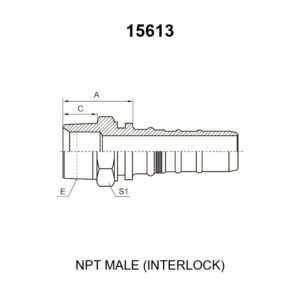
Need the swivel version (rotating NPT nut) or the push-on (socketless) version of this range? Both exist in the 15611 family – tell us how the line is installed and we will spec the right tail.
By Thread Size
This table condenses the full range of NPT male hydraulic hose fittings by port thread, so you can jump straight from your port size to the part numbers that fit.
| Male NPT Thread | Hex S1 (mm) | Typical Part Numbers | Typical Ports |
|---|---|---|---|
| 1/8-27 | 12 | 15611-02-03, -02-04 | Gauges, small pilots |
| 1/4-18 | 17 | 15611-04-03 … -04-06 | Valves, cylinders, small equipment |
| 3/8-18 | 19 | 15611-06-04 … -06-08 | Mobile and industrial lines |
| 1/2-14 | 22 | 15611-08-06, -08-08, -08-10 | Pumps, motors, manifold ports |
| 3/4-14 | 27 / 32 | 15611-12-08 … -12-16 | Large valves, return lines |
| 1-11.5 | 36 | 15611-16-10, -16-12, -16-16 | Main lines, large equipment |
| 1-1/4-11.5 | 46 | 15611-20-16, -20-20 | High-flow lines |
| 1-1/2-11.5 | 50 | 15611-24-24 | Very high flow |
| 2-11.5 | 65 | 15611-32-32 | Largest braided-hose circuits |
NPT identification tip: NPT is the tapered 60-degree pipe thread (1:16 taper). Straight (parallel) threads are not NPT and need O-ring or washer sealing – mixing the two leaks. Send a photo of your port thread and our team identifies it free.
Cross Reference
The 15611 follows the classic one-piece male NPT geometry used across the global market, so it is a direct dimensional and functional match for equivalent male NPT hose fittings from major international brands – same thread, same dash coding, same crimp approach.
How to verify a replacement in one step: read the code on your current fitting (a 4-4, 8-8, or reducer pair), match the thread and dash, and send it to us. Our engineers confirm the equivalent 15611 code and provide the matching crimp specification before you order. Distributors and OEMs can request a full cross-reference list covering their installed base.
Packaging and Logistics
- Standard packing: poly-bagged fittings in export cartons; typical counts 100-500 pcs per carton for small sizes, 20-100 for large sizes.
- Ferrule options: ferrules supplied separately or pre-kitted with fittings per your crimping workflow.
- Mixed-size cartons, OEM carton printing, and barcode labels available.
- We ship worldwide by sea, air, or express; combined orders with hose and other NPT fittings consolidate into one shipment.
How to Crimp and Install: Four-Step Guide
Correct assembly prevents 90% of premature fitting failures. Follow these steps for every fitting you build:
Step 1 – Cut square. Cut the hose at 90 degrees to its axis with a sharp blade. A square cut lets the ferrule grip evenly; ragged cuts cause early pull-out. Skiving is not required for 1SN / 2SN covers.
Step 2 – Mark the insert depth. Measure insert depth from the crimp spec for your hose series and mark the hose cover. Slide the fitting on until the hose reaches the mark so the nipple seats fully inside the reinforcement.
Step 3 – Insert and lubricate. Apply a light film of assembly lubricant (or soapy water) to the nipple and hose bore, push the hose on square and fully to the depth mark. Never hammer the fitting on.
Step 4 – Crimp, then verify with calipers. Crimp with the die set from the crimp chart. After crimping, measure the crimp O.D. with a caliper and compare it to the target and tolerance in the crimp spec. Out-of-tolerance crimps are the number-one cause of blow-offs – never skip the measurement.
Installation Warnings (read before tightening)
- NPT threads need sealant. Wrap the male threads with PTFE tape (2-3 wraps, leave the first thread clear) or apply thread sealant. Tighten hand-tight plus 1-2 turns maximum; overtightening a taper thread can crack the port or the hex.
- Straight threads are different. Parallel-thread ports (UN / UNF) seal with O-rings or washers, never with tape. If your port is straight-threaded, this NPT fitting is the wrong end type.
- Never mix hose brands and fitting brands blindly. Crimp parameters differ between manufacturers even at the same dash – use our crimp chart for the exact hose you are crimping.
- Never reuse a crimped fitting. Crimp fittings deform permanently by design; replace them after removal.
- Wrench on the hex only. Use the S1 hex for tightening; never grip the ferrule or hose with pliers or a pipe wrench.
Typical Applications
- Hydraulic systems on construction, mining, and agricultural machinery.
- Industrial power units, presses, machine tools, and lubrication systems.
- Oil-field and off-highway equipment with NPT ports.
- Compressors, injection molding machines, and material handling equipment.
- Truck and trailer hydraulic systems.
From 1/8″ gauge lines to 2″ main lines, NPT male hydraulic hose fittings in the 15611 range are the everyday workhorse of NPT-ported equipment: standard sizes, standard crimp data, and a part number for every thread-and-hose combination a plant or fleet actually runs.
Fixed or Swivel: Which NPT Male Fitting Do You Need?
| Factor | Fixed one-piece (this series) | Swivel nut version |
|---|---|---|
| Parts | One piece + ferrule | Stem + rotating NPT nut + ferrule |
| Installation | Rotates the whole hose to tighten | Nut rotates alone; hose stays put |
| Seal points | NPT thread only | NPT thread + swivel-joint seal |
| Best for | Straightforward access, high volume, stock simplicity | Tight spaces, pre-routed hose, angled assemblies |
| Cost | Lower | Higher |
Rule of thumb: if you can rotate the hose freely when installing, choose the fixed 15611. If the hose is pre-routed, clamped, or in a tight bay, choose the swivel version. Both are in the 15611 family – ask us and we will confirm the right code for your machine.
OEM and Custom Options
- Size and thread customization: non-standard dash combinations, special reaches, and alternate port ends machined to your drawing.
- Coating customization: zinc-nickel, Dacromet, or finishes matched to your salt-spray requirement (96 h to 720 h+).
- Laser marking: your logo, part number, and batch code for traceability.
- Kitting: fitting + ferrule kits, or full hose assemblies per your BOM.
- Documentation: MTRs, dimensional reports, and BV / SGS third-party inspection on request.
Quality and Traceability
Every batch is traceable end to end: material incoming inspection, cold forging and machining, plating, 100% thread gauge inspection, dimensional sampling, salt-spray verification, and burst testing on crimped assemblies. Ask for a sample batch and test it with your own calipers and pressure rig – we are confident in what the data will show.
NPT Male Fitting FAQ
What is the difference between NPT and NPTF? Both are 60-degree tapered pipe threads. NPT seals by interference and normally needs PTFE tape or sealant; NPTF (dryseal) is machined tighter to seal without sealant. A male NPT thread usually assembles into an NPTF port, but match the class for guaranteed dry-seal performance.
Why are NPT fittings so common in North America? NPT is the standard tapered pipe thread for US and Canadian hydraulic and industrial equipment. Any machine built for that market – tractors, loaders, presses, oil-field gear – has NPT ports, which is why NPT male hydraulic hose fittings are the highest-turnover item in most distributors’ stock.
Can I use the 15611 on spiral or thermoplastic hose? No. The 15611 tail is machined for braided rubber hose. Spiral hose needs the matching spiral series (15612 codes) and thermoplastic or PTFE hose needs its own fitting family. Send us the hose and we will match it correctly.
Why does my NPT fitting leak without tape? NPT relies on controlled thread deformation, and normal tolerance differences leave microscopic spiral paths that tape or sealant closes. Threads to ASME B1.20.1 minimize the gap but sealant is still part of correct installation.
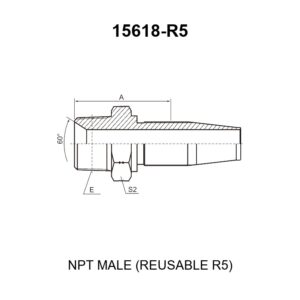
Are these fittings reusable? No. The 15611 is a permanent crimp fitting. If your application needs field re-termination, ask about reusable fittings for your thread size.
How do I choose between 1/4 and 3/8 NPT for my hose? Match the fitting thread to the PORT, not the hose. The same 3/8″ hose can terminate into a 1/4″, 3/8″, or 1/2″ NPT port using reducer codes like 15611-04-06 or 15611-06-06. The reducer tables above show the combinations available.
Get a Quote for NPT Male Hydraulic Hose Fittings
You now have the full picture: a complete range of NPT hydraulic hose fittings covering every common thread-and-hose combination, honest guidance on fixed versus swivel and braided versus spiral, and batch-level quality documentation.
If you are comparing suppliers of NPT male hydraulic hose fittings, the questions that matter are thread gauge accuracy, ferrule match, crimp data, and batch traceability – this page answers all four, and the sample order will prove them.
Send us your port thread, hose brand and dash, and quantity – we reply within 24 hours with the fitting recommendation, ferrule and crimp specification, CAD drawings, and a landed-cost quotation. Distributors: ask for the full cross-reference list, kitting options, and volume pricing.


 English
  Spanish
  Portuguese
  French
  German