
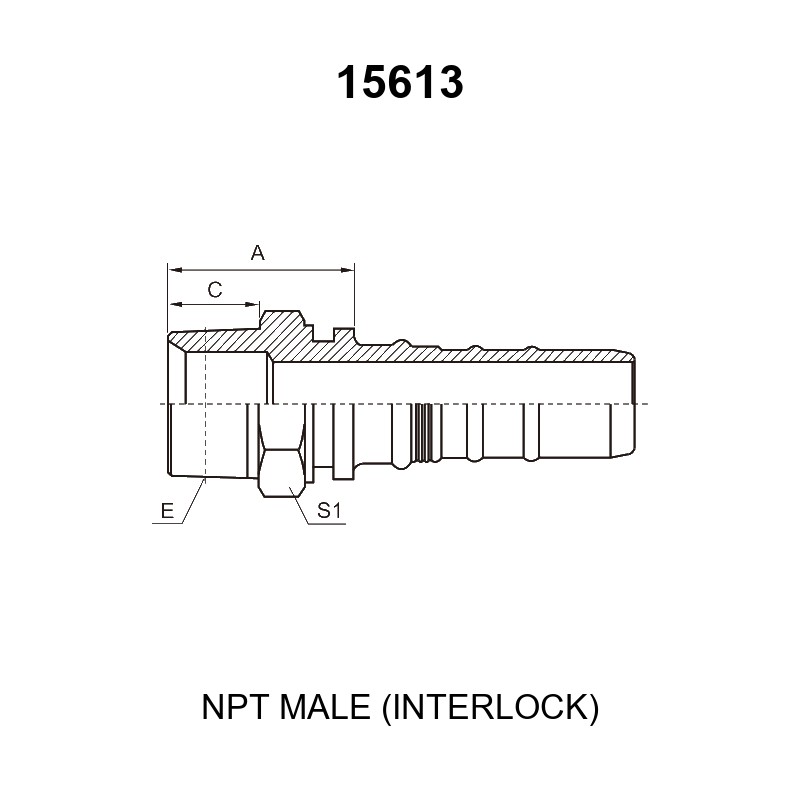
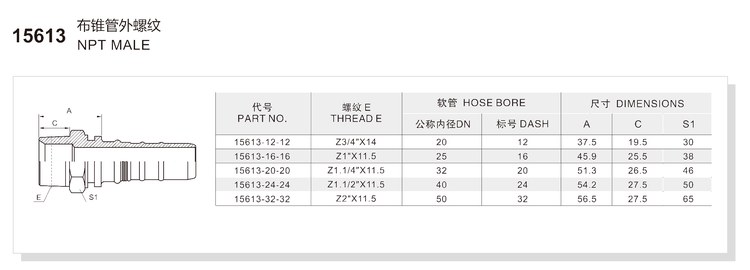
Need interlock hose fittings for big-bore, high-pressure lines that a standard crimp fitting cannot hold? The 15613 series is a straight male NPT interlock fitting engineered for large-diameter four-spiral hydraulic hose – SAE 100R12 / EN 856 4SP and 4SH class – in sizes from 3/4″ to 2″ NPT (DN 20-50). The interlock tail and its matched ferrule lock the hose mechanically, so the assembly resists the extreme pull-out forces that large-bore high-pressure circuits generate. If you terminate 1″ to 2″ spiral hose onto NPT ports on mining, construction, or industrial equipment, this is the connection built for it. For distributors who stock interlock hose fittings for mining and construction accounts, the 15613 covers the five bore sizes that dominate large-line replacement demand.
Why Buyers Choose This Interlock Fitting
| True interlock grip | The stem tail and matched ferrule are machined as an interlocking pair. After crimping, the ferrule interlocks with the stem profile for maximum pull-out resistance on four-spiral hose. |
| Purpose-built for large bore | DN 20-50 (dash -12 to -32) – the range where ordinary one-piece fittings run out of holding force and interlock geometry takes over. |
| NPT to ASME B1.20.1 | Straight male NPT, 3/4-14 through 2-11.5, sealed by the taper thread per standard NPT practice. |
| Matched pair, batch traceable | Stem and ferrule carry the same part number and batch code; no mix-and-match at the crimping bench. |
What Are Interlock Hose Fittings?
An interlock fitting is a two-piece crimp connection: a stem (nipple) whose tail is machined with an interlock profile, and a ferrule (socket) machined to match. During crimping the ferrule compresses the hose and simultaneously interlocks with the stem tail, creating a mechanical lock in addition to the radial grip. Where a conventional one-piece fitting relies on the ferrule squeezing the hose against a smooth stem, the interlock design adds a positive mechanical engagement – which is why it is the standard choice for large-bore, high-pressure wire spiral hose where hose-end forces are at their highest.
When do you need it? When the hose is 3/4″ bore or larger, when the circuit is four-spiral class (SAE 100R12 and equivalents), or when the assembly has failed at the hose end before. Put simply, interlock hose fittings exist for the biggest, highest-pressure lines a machine carries – the ones a failure brings down. For these large bore hydraulic hose fittings, the interlock system delivers the strongest stem-to-ferrule connection available in a crimp fitting.
How the 15613 Is Built
- Port end: male NPT taper thread to ASME B1.20.1 (60-degree thread form, 1:16 taper). NPT seals by thread interference; PTFE tape or thread sealant is part of correct installation.
- Hex section: wrench flats (S1 in the dimension table) sized for the torque these large threads need.
- Interlock tail: precision-machined interlock profile that the matched ferrule engages during the crimp. Full-diameter internal bore keeps flow losses low.
- Matched ferrule: supplied with the stem, machined for the same dash size and hose OD. The pair is crimped with the die set from our crimp chart.
- Material and finish: zinc-plated carbon steel as standard (salt-spray verified per batch); 304/316L stainless steel available for corrosive and washdown duty.
Technical Specifications – 15613 Interlock NPT Male
Dimension Table (Part Numbers, Threads and Key Dimensions)
| Part No. | Thread E (Male NPT) | Hose Bore DN (mm) | Tamanho do traço | A (mm) | C – Thread Length (mm) | S1 – Hex (mm) |
|---|---|---|---|---|---|---|
| 15613-12-12 | 3/4-14 NPT | 20 | -12 | 37.5 | 19.5 | 30 |
| 15613-16-16 | 1-11.5 NPT | 25 | -16 | 45.9 | 25.5 | 38 |
| 15613-20-20 | 1-1/4-11.5 NPT | 32 | -20 | 51.3 | 26.5 | 46 |
| 15613-24-24 | 1-1/2-11.5 NPT | 40 | -24 | 54.2 | 27.5 | 50 |
| 15613-32-32 | 2-11.5 NPT | 50 | -32 | 56.5 | 27.5 | 65 |
Reading the part number. 15613-20-20 = series 15613 (interlock) – male NPT 1-1/4-11.5 – hose dash -20 (DN 32). Straight dash-matched codes are standard; reduced combinations are machined on request.
Dimensional note: A is measured from the thread end to the hex shoulder per the factory dimension sheet; C is the effective thread length. Full stem, ferrule, and crimp dimensions are on the CAD drawing supplied with your quotation.
Materials and Surface Treatment
- Material: high-strength carbon steel (cold-forged and machined, 20# / 35# / 45# grades as standard). 304 / 316L stainless steel option.
- Surface: trivalent chromium zinc plating (Cr3+), salt-spray verified per batch. Zinc-nickel and Dacromet upgrades available for extended corrosion life.
- Documentation: material certificates (MTR), dimensional reports, and third-party inspection (BV / SGS) available per batch.
Pressure and Temperature – What the Assembly Can Do
The 15613 is designed so the interlocked assembly holds at least the full rating of the four-spiral hose it is crimped onto:
- Typical pairing: SAE 100R12 (four-spiral, rated at the 4,000 psi / 276 bar class across its size range) and EN 856 4SP / 4SH equivalents in DN 20-50. The exact working pressure of your assembly follows the hose you crimp – check the hose layline and datasheet.
- Burst performance is verified per batch with the standard 4:1 safety factor of four-spiral hose service. Burst test reports are available.
- R12-class hose service temperature is typically -40 C to +121 C; confirm the window against your hose data sheet for continuous hot-oil duty.
Honest limitation: the 15613 is a permanent crimp fitting – it cannot be removed and reused like a field-attachable fitting, and it must be crimped with the matched interlock ferrule. Do not substitute a standard (non-interlock) ferrule: the holding force depends on the pair. For lower-pressure or field-service applications, ask us about reusable or standard crimp series instead.
By Hose Series
The 15613 interlock pair is machined for large-bore, high-pressure wire spiral hose:
- SAE 100R12 – four-spiral hose, 4,000 psi class, the workhorse for high-flow high-pressure circuits.
- EN 856 4SP / 4SH – four-spiral equivalents widely specified on European and Asian equipment.
- Confirm the hose brand, OD, and reinforcement before ordering so we can verify ferrule sizing – interlock ferrules are hose-OD sensitive.
This series does not fit rubber-cover braided hose (1SN / 2SN), textile, or thermoplastic hose – those use their own fitting families. Send us your hose part number and we will confirm the correct series. Buyers who standardize on interlock hose fittings across a fleet keep one stem-ferrule pair number per hose size: simple stock, one crimp chart, predictable results.
By Thread Size
| Part No. | Male NPT Thread | Hose Bore / Dash | Typical Application |
|---|---|---|---|
| 15613-12-12 | 3/4-14 | DN 20 / -12 | Machine and mobile high-pressure lines |
| 15613-16-16 | 1-11.5 | DN 25 / -16 | Main boom and implement lines |
| 15613-20-20 | 1-1/4-11.5 | DN 32 / -20 | Large excavator, mining machine lines |
| 15613-24-24 | 1-1/2-11.5 | DN 40 / -24 | High-flow main lines, presses |
| 15613-32-32 | 2-11.5 | DN 50 / -32 | Very high flow main lines |
NPT identification tip: NPT is the tapered 60-degree pipe thread (1:16 taper). If your port is straight-threaded, it is not NPT – choose a straight-thread or O-ring-seal fitting instead. Unsure about a thread? Send a photo and our team identifies it free of charge. Ordering NPT interlock fittings is a three-field decision: thread size, hose dash, and hose OD for the ferrule – we walk you through it in one email.
Cross Reference
The 15613 follows the standard interlock geometry used across the heavy-equipment market, making it a direct functional match for equivalent NPT male interlock fittings from major international brands – same interlock principle, same dash coding, same matched-ferrule crimping approach.
How to verify a replacement in one step: read the code on your current stem (a 16-16 or 24-24 style pair), match the NPT thread and dash, and send it to us with your hose brand. Our engineers confirm the equivalent 15613 code and check the ferrule against your hose OD before you order. If you currently buy interlock hose fittings from another source and want a second qualified supplier, this is the fastest way to start – we reply with the 15613 equivalent the same day. OEM customers can request a full cross-reference list covering their installed base.
Packaging and Logistics
- Standard packing: stem and matched ferrule poly-bagged together as a set, with the same part number and batch code; export cartons sized by part number.
- Typical carton counts: 20-50 sets for 3/4″-1-1/4″, 10-20 sets for 1-1/2″-2″, depending on size.
- Ferrule-only and stem-only supply available for distributors who stock repair components.
- We ship worldwide by sea, air, or express; consolidated orders with four-spiral hose and other fittings ship as one lot.
How to Crimp and Install: Four-Step Guide
Interlock fittings are assembled on a crimping machine with the matched ferrule. Correct technique matters more here than on small fittings – the forces are larger and the margin for error smaller.
Step 1 – Cut square. Cut the spiral hose with a sharp blade at 90 degrees to the axis. A square end lets the ferrule bite evenly around the full circumference. Do not skive R12 / 4SP covers unless the crimp chart says otherwise.
Step 2 – Mark the insert depth. Measure the insert depth for your hose series from the crimp spec sheet and mark the hose cover. Slide the stem in until the hose reaches the mark so the nipple seats fully inside the reinforcement zone.
Step 3 – Position the ferrule and lubricate. Place the matched interlock ferrule over the hose end before inserting the stem, or per the sequence in the crimp chart. Lubricate the nipple and hose bore lightly, then push the hose onto the stem square and fully to the depth mark.
Step 4 – Crimp, then verify with calipers. Crimp with the die set from our crimp chart. After crimping, measure the crimp O.D. with a caliper and compare it to the target and tolerance in the crimp spec. Never skip the measurement – an out-of-tolerance crimp on a 2″ four-spiral line is a safety incident waiting to happen.
Installation Warnings (read before tightening)
- Use only the matched interlock ferrule. The holding force comes from the stem-ferrule interlock pair. A standard ferrule will not interlock and can pull out under pressure.
- NPT threads need sealant. Wrap the male NPT threads with PTFE tape (2-3 wraps, first thread clear) or apply thread sealant, then tighten hand-tight plus 1-2 turns maximum. Do not overtighten a taper thread.
- Straight threads are not NPT. Parallel-thread ports (UN / UNF or similar) seal with O-rings or washers – do not use this tapered-thread fitting on them.
- Never reuse a crimped interlock fitting. The crimp permanently deforms both parts. Replace the set after removal.
- Never mix hose brands blindly. Even at the same dash, hose OD varies by brand; our ferrule is matched to the hose you specify. Confirm before ordering and before crimping.
Typical Applications
- Mining and tunneling equipment: roof supports, jumbos, drill rigs, longwall systems.
- Heavy construction: large excavators, loaders, mining shovels.
- Industrial presses and steel mills: high-flow hydraulic main lines.
- Marine and offshore deck machinery.
- Bulk handling and material processing plants.
- Any NPT-ported circuit where the spec calls for large-bore four-spiral hose.
Engineers specify NPT interlock fittings in these environments for one reason: at DN 20-50 and 4,000 psi class pressures, the hose-end connection has to be the most reliable joint in the circuit, and interlock geometry is how you get there. Once a machine builder validates interlock hose fittings on a new platform, the hose-end design rarely gets revisited.
OEM and Custom Options
- Size and thread customization: reduced dash combinations, special reaches, and alternate port ends machined to your drawing.
- Coating customization: zinc-nickel, Dacromet, or other finishes matched to your salt-spray requirement (96 h to 720 h+).
- Laser marking: your logo, part number, and batch code on stem and ferrule.
- Crimp-data support: we build the crimp chart around the exact hose you use and provide it free with your first order.
- Documentation: MTRs, dimensional reports, and BV / SGS third-party inspection on request.
Quality and Traceability
Every batch is traceable: material incoming inspection, cold forging and machining, plating, 100% thread gauge inspection, dimensional sampling, salt-spray verification, and burst testing on crimped assemblies. Stem and ferrule are packed as matched pairs with the same batch code, so a field failure can be traced to the exact batch in minutes. Ask for sample sets and pull-test them against your hose – we are confident in what the data will show.
Interlock Fitting FAQ
What is the difference between an interlock fitting and a standard crimp fitting? A standard crimp fitting grips the hose by radial compression of a ferrule over the stem. An interlock fitting adds a machined mechanical engagement between the stem tail and the ferrule during crimping, giving higher pull-out resistance – essential for large-bore, high-pressure spiral hose where end forces are large. That is why interlock hose fittings are the specification of choice on the largest, highest-pressure lines.
Why do large-bore spiral hoses need interlock fittings? The force trying to push a hose off its fitting grows with bore size and pressure. Above about 3/4″ bore in four-spiral service, the margin of a plain radial grip gets thin, so the industry uses interlock geometry for a positive mechanical lock.
Can I use a 15613 interlock stem with a ferrule from another supplier? No. The interlock profile is a matched pair. Use the ferrule supplied with the stem, machined for the same part number and your hose OD.
Is the 15613 reusable? No. It is a permanent crimp fitting. Once crimped or removed, replace the set. For field-attachable service, ask about our reusable fitting series.
What hose does the 15613 fit? Large-bore four-spiral hose: SAE 100R12 class and EN 856 4SP / 4SH equivalents, DN 20-50. Send your hose brand and part number and we will confirm ferrule sizing.
Why is the NPT thread sealed with tape if it is tapered? NPT seals by controlled thread interference, but normal manufacturing tolerances leave microscopic spiral paths, so PTFE tape or sealant closes them. This is standard NPT practice on every fitting, interlock or not.
Get a Quote for Interlock Hose Fittings
You now have the full picture: interlock hose fittings engineered for large-bore four-spiral hose, NPT from 3/4″ to 2″, matched stem-and-ferrule pairs, crimp data that removes guesswork, and batch-level traceability.
Send us your hose brand and dash size, the NPT port size, and your quantity – we reply within 24 hours with the fitting recommendation, the matching ferrule, the crimp specification sheet, CAD drawings, and a landed-cost quotation. OEMs and distributors: ask for the cross-reference list, coating options, and volume pricing.


 English
  Spanish
  Portuguese
  French
  German