
A PTFE chemical hose is the usual answer for hydrochloric acid because a PTFE liner is chemically inert to the acid across normal service concentrations. Choose in this order: the liner for the wetted path, the reinforcement for pressure, then the end connections for the joint. This guide covers how the hose is built and how PTFE compares with FEP, ECTFE, UHMWPE and polypropylene. It explains how to read the pressure and temperature figures, how permeation limits lined hose, and how to buy against a written specification.
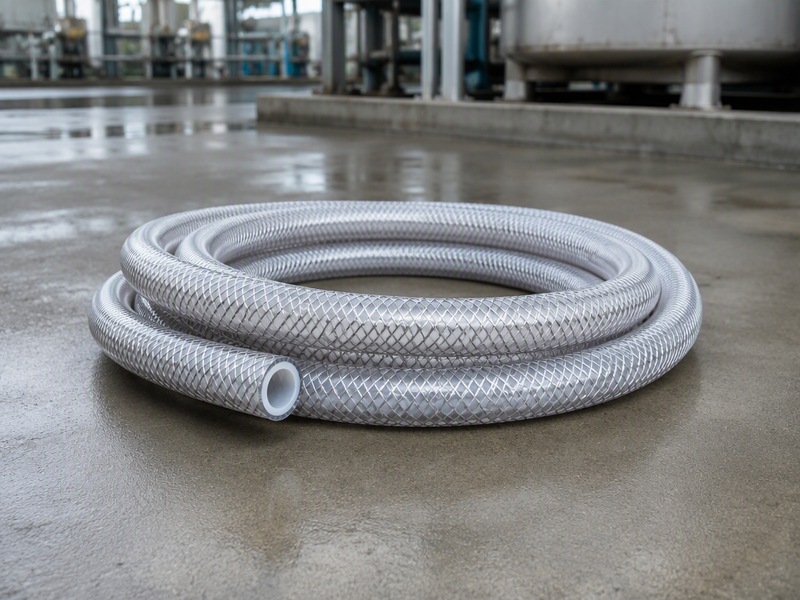
Figure 1. A braided PTFE chemical hose coiled after wash-down on a chemical plant floor.
What Is a PTFE Chemical Hose Made Of?
Every PTFE chemical hose is a three-part build: a fluoropolymer liner, or lining, that touches the acid, a braided reinforcement that carries the pressure, and a cover or braid jacket that protects both. Understanding that split explains almost every selection decision that follows, because each layer answers a different question.
The Lining
The lining is the only part that contacts the medium, so it decides chemical suitability. PTFE, or polytetrafluoroethylene, is a fully fluorinated polymer with an extremely strong carbon-fluorine bond. That bond resists attack by strong acids, bases and most solvents. A PTFE hose liner is extruded as a smooth bore tube, then tested for porosity, because a pinhole defeats the whole layer. Wall thickness is the other variable: a thicker PTFE hose liner slows vapour migration and extends service life, at some cost in flexibility.
PTFE keeps its chemical resistance across a wider span than any other common liner material, with a continuous service ceiling near +260 °C. Above that figure the material starts to soften and creep. Below about -70 °C it remains flexible, which matters on cold loading racks where rubber linings stiffen and crack.
The Reinforcement
The reinforcement carries the pressure, not the lining. Most acid-duty hose uses a single or double layer of stainless steel braid over the liner. The braid also limits liner expansion, which reduces the chance of a fatigue failure at the couplings.
A stainless steel braid is usually type 304 or 316. Type 316 is the better choice where chlorides are present, because it resists pitting more effectively. The braid does not touch the medium, but any wire that works loose can abrade the liner from the outside, so cover quality matters as much as braid count.
A common acid-duty build pairs a PTFE liner with a stainless steel braid over it, which is the construction SAE 100R14 describes. Braid count and wire diameter set the pressure the assembly can hold.
The Cover
The cover protects the stainless steel braid and the liner from the environment rather than from the medium. Options include an extruded rubber or thermoplastic jacket, a silicone sleeve for heat, or an open braid for maximum flexibility. Choose a cover that resists the splash and spill of the plant you are in, because acid spill that sits on bare braid will attack the wire.
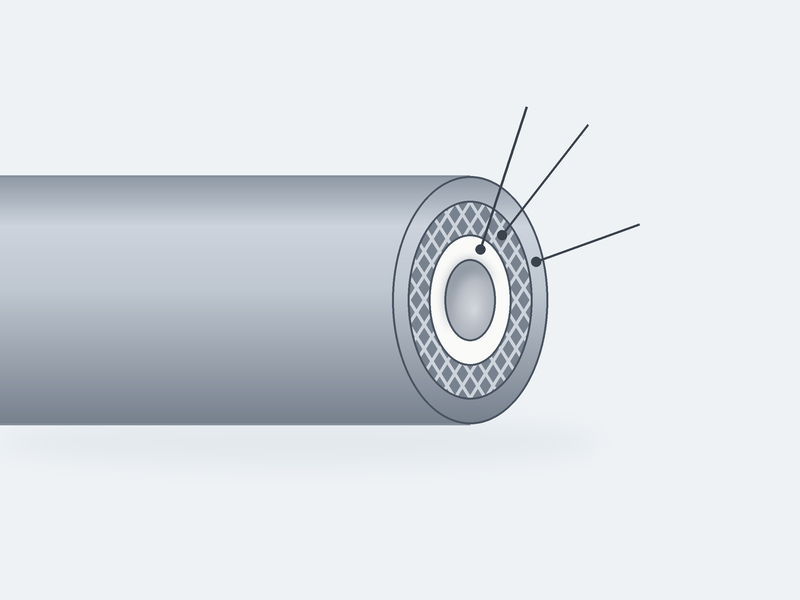
Figure 2. The layer order: PTFE liner, stainless steel braid, protective cover.
Why Hydrochloric Acid Punishes the Wrong Hose
Hydrochloric acid is a strong mineral acid that dissociates almost completely in water, so a wetted metal surface is attacked quickly. Even 316 stainless steel corrodes in hydrochloric acid at ordinary concentrations, which is why the wetted path of an acid hose is normally a polymer rather than a metal.
The acid also generates chloride ions that drive pitting and crevice corrosion. That is why fittings are frequently lined with PTFE or PFA (perfluoroalkoxy), or made from PVDF (polyvinylidene fluoride), so the metal never sees the acid. An unlined stainless coupling may look cheaper at the point of purchase, but a pitted sealing face leaks at the worst possible moment.
Wet hydrogen chloride gas is a separate problem again. Dry gas is comparatively mild, but once moisture is present the gas becomes an acid, and any condensation point inside the hose becomes a corrosion site. Where a line runs both gas and liquid, specify one liner that handles both states and keep the line above the dew point where practical.
Mixtures make selection harder still. Hydrochloric acid combined with an oxidiser, or with an organic solvent, can attack materials that resist the acid alone. For those duties, treat the resistance tables as a starting point and confirm against the supplier’s data before you buy.
PTFE vs FEP vs ECTFE vs UHMWPE vs PP: Lining Choice for Acid Service
Five lining families cover most acid duties, and they differ mainly in temperature ceiling, chemical breadth and cost. Table 1 summarises the trade-offs for hydrochloric acid service.
Table 1. Typical hose lining materials for hydrochloric acid and aggressive media
| Lining | Continuous Temperature | Acid Resistance | Solvent Resistance | Typical Position |
|---|---|---|---|---|
| PTFE | Up to about +260 °C | Excellent | Excellent | Widest duty range, highest cost |
| FEP | Up to about +204 °C | Excellent | Excellent | Similar chemistry, easier to inspect |
| ECTFE / PVDF | Up to about +150 °C | Excellent | Good | Balance of strength and cost |
| UHMWPE | Around +80 °C | Good | 中程度 | Best abrasion resistance |
| Polypropylene | Around +100 °C | Good, non-oxidising | Poor | Lowest cost, composite hose |
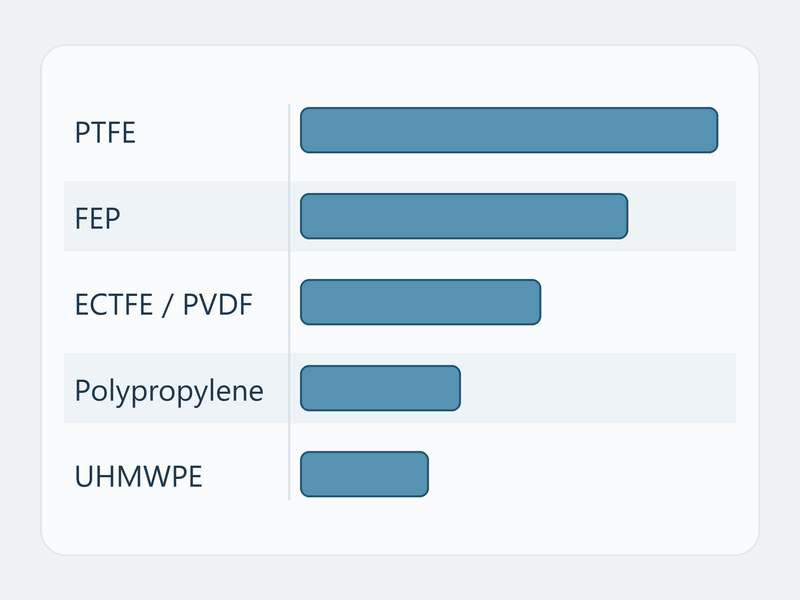
Figure 3. Lining families ranked by temperature ceiling and breadth of chemical resistance.
Read Table 1 as engineering convention; the supplier’s chemical resistance table, published as EN 12115 Annex F, governs. Polypropylene handles dilute hydrochloric acid well and is the workhorse of composite chemical hose, but it is attacked by aromatic and chlorinated solvents. UHMWPE adds abrasion resistance and chemical resistance to acid slurries, yet its temperature ceiling is well below the fluoropolymers.
When two linings both appear suitable, choose on temperature, then on abrasion, then on cost. A hot acid line needs a fluoropolymer. A cold, abrasive slurry line may do better with UHMWPE, because wear rather than chemistry becomes the limit. Only after those two questions are settled does the difference in price matter.
Smooth bore liners are usually preferred for acid service because they drain fully and clean easily. A smooth bore also reduces the chance that solids settle in a corrugation and hold acid against the wall. Where maximum flexibility is needed, a convoluted liner may still be the only practical option, and a smooth bore is then unavailable. Plan the drain point carefully in that case.
Pressure and Temperature: What the Numbers Actually Mean
Two figures govern safe use: the working pressure and the temperature range. The first is the pressure the assembly may see continuously in service, and it is always lower than the burst pressure. The margin between the two is the safety factor, and for lined industrial hose it is commonly four to one. The working pressure figure itself is proven in a hydrostatic test to EN ISO 1402.
The temperature range on a datasheet usually describes the limits within which the materials stay serviceable, not the range within which the full pressure rating applies. Pressure capability falls as temperature rises, because both the polymer and the braid lose strength. Table 2 shows how to read the two figures together.
Table 2. How to read pressure and temperature data on a PTFE chemical hose datasheet
| Datasheet Field | What It Means | How to Use It |
|---|---|---|
| Working pressure | Continuous pressure at the stated reference temperature | Compare with the highest sustained pressure at the pump |
| Burst pressure | Pressure at which the assembly fails in test | Never a service figure; it defines the safety factor |
| 温度範囲 | Limits within which the materials remain serviceable | Confirm the rated pressure still applies at your temperature |
| Vacuum rating | Negative pressure the hose resists without collapse | Required for suction duty and for full drain-down |
| Minimum bend radius | Tightest bend that does not kink or stress the braid | Route the line to stay above this figure in every position |
Check the rated pressure at the temperature you actually run, because the two limits do not apply together. Ask the supplier for that figure on the quotation, and keep it with your purchase record. This is also where unit confusion starts, so agree whether figures are quoted in bar, psi or megapascals before comparing offers.
Permeation: The Limit Most Buyers Miss
Permeation is the slow migration of a chemical through an intact polymer wall. Because the wall stays intact, the hose may pass every pressure test while still allowing a small amount of vapour to reach the braid and the outside air. For hydrochloric acid, permeation matters because the migrating species is aggressive to metals.
Permeation rises with temperature and with concentration, and it falls as wall thickness increases. A thin PTFE hose liner that performs well at ambient temperature may allow noticeably more vapour to pass at 80 °C. Where the braid sits directly over a thin liner, that vapour has nowhere to go except outward, and it can attack the wire from inside the jacket.
The practical controls are straightforward.
- Wall thickness — use the thickest liner the duty allows, because vapour migration falls as the wall gets thicker.
- Temperature — keep the operating temperature as low as the process permits.
- Airflow — provide airflow around the hose in enclosed spaces, because a sealed trench traps the migrated vapour.
Where a line runs continuously hot, a vented cover or an open braid arrangement lets the migrated vapour disperse instead of accumulating.
Fittings, End Connections, and Gaskets for HCl Service
The connection is the part of the assembly most likely to fail first, because it concentrates stress and where two materials meet. Table 3 lists the common families for acid duty and where each belongs; the wider catalogue of hose couplings and end connections covers the families this guide does not.
Table 3. End connections for a PTFE chemical hose in hydrochloric acid service
| Connection | Wetted Material | Best Used For | Watch Out For |
|---|---|---|---|
| Camlock coupling | Polypropylene or lined metal | Fast, frequent connection and disconnection | Gasket material must match the acid |
| Flanged end | Lined steel or PVDF | Fixed plant piping and large bore | Liner must seal over the flange face |
| Threaded end | PTFE or PFA lined | Small bore and instrument lines | Thread sealant must be acid compatible |
| Sanitary clamp | PTFE or PVDF | Clean service and quick stripping | Clamp pressure must not crush the liner |
Gaskets deserve the same care as the liner. Polytetrafluoroethylene envelope gaskets and PTFE-encapsulated elastomer gaskets are common in acid service because the wetted face is inert. Plain rubber gaskets may swell or harden, and a hardened gasket leaks. Replace gaskets at every reconnection where the duty is aggressive rather than reusing them until they weep.
Threaded joints in acid service should be sealed with a PTFE tape or an acid-resistant paste, never with a general-purpose pipe dope. The sealant must be compatible with the medium, because a degraded sealant becomes a pathway rather than a barrier. Tape applied in the wrong direction will unwind as the fitting is tightened, so wrap it with the thread, not against it.
How to Specify a PTFE Chemical Hose for Acid Duty
A supplier can quote accurately from a short, written specification. Give the following fields and you remove most of the guesswork from the enquiry.
- Medium and concentration — name the chemical and the strength, for example 33 percent hydrochloric acid.
- Continuous and peak temperature — state both, because the rated pressure depends on the higher figure.
- Continuous and peak pressure — include surge and water hammer if the line is on a positive displacement pump.
- Duty type — pressure only, suction only, or suction and delivery where the hose must resist vacuum.
- Bore and length — inside diameter in millimetres or inches, and the overall length including fittings.
- End connections — type, size, material and the thread or flange standard at each end.
- Environment and approvals — indoor or outdoor, wash-down chemicals, and any electrical or area classification.
- ドキュメント — proof test certificate, marking requirements and any material declaration you must retain.
Electrical behaviour is a grade, not an option. EN 12115:2021 sets four electrical grades. Grade M is electrically bonded to its end fittings. Grade Ω uses a conductive lining with a lining resistance of 10⁶ Ω or less, and Grades M/T and Ω/T add a through-wall resistance of 10⁹ Ω or less. Lining and through-wall resistance are measured to EN ISO 8031. Where flammable vapour may be present, state the grade you need when you place the bulk order.
One scope point decides the standard. EN 12115:2021 covers hose with a single lining; multilayer assemblies sit under EN 13765 and EN 13766. State the standard the assembly must meet, and the supplier can quote to it.
Wait for the supplier to confirm the pressure rating at your stated temperature in writing before you place a bulk order. Ask them to confirm that the PTFE hose liner grade and thickness also match the duty you described, and to state the current lead time for a second bulk order. Written confirmation prevents the most expensive mistake in acid hose purchasing: buying to the ambient figure and then running the line hot.
Three buyers work from one written specification. A maintenance engineer replacing a line needs the bore and the end connections. A distributor needs a repeatable specification and a price that holds across a bulk order. An OEM needs the proof test certificate and the marking.
Safety: What Must Be Replaced, Never Repaired
Replace, never repair. A chemically attacked liner, a braid with broken or corroded wires, a coupling that shows corrosion at the sealing face, or a blister under the cover are all stop-use conditions. None of them can be corrected with tape, sealant or a clamp. The correct action is to tag the assembly out of service, drain and neutralise it, and destroy it so it cannot return to the plant.
Additional stop-use conditions include a hose that has been kinked below its minimum bend radius, one that has been dragged over a sharp edge, and one whose cover has been cut deeply enough to expose the braid. A liner that has absorbed acid can also become brittle with no external sign. Retire or pressure test a hose that has carried hot acid for a full service interval, on schedule rather than on appearance.
Between shifts, keep the hose drained and stored off the floor with the ends capped. Do not leave an acid hose pressurised and idle, because vapour migration continues and the trapped volume raises the exposure of the braid. Personnel should wear the protection the site assessment requires, with face and hand protection selected for the specific acid.
PTFE Chemical Hose for Hydrochloric Acid: FAQs
Is a PTFE chemical hose suitable for all concentrations of hydrochloric acid?
For practical plant conditions, yes. PTFE resists hydrochloric acid across the concentrations normally encountered in industry, including the concentrated grades, and it also handles the wet gas. The limits come from temperature and from vapour migration rather than from the acid itself. Confirm the exact figures against the supplier data sheet, and review mixtures with oxidisers or solvents separately.
How do I know the pressure rating at 80 °C rather than at room temperature?
You ask for it in writing. A figure quoted at ordinary ambient conditions holds only at that temperature. Give the supplier the continuous and peak temperatures and request the derated working pressure for each; also ask which temperature range the datasheet figure was measured against. Keep that confirmation with the purchase record so the rating can be checked during an audit.
Why does the braid corrode when the acid never touches it?
Because of vapour migration. Small amounts of acid vapour pass through the liner wall and reach the braid, where they attack the wire from inside the jacket. The effect grows with temperature and concentration. A thicker liner, a lower running temperature and better airflow around the hose all reduce it.
Can I use the same hose for acid and for solvent?
Only if the liner suits both and the duty has been reviewed as a mixture. PTFE handles most of each alone, which is why it is the usual choice for mixed service. Polypropylene, by contrast, tolerates dilute acid but is attacked by aromatic and chlorinated solvents. Review the combination as its own duty, because a material that passes each fluid separately may still fail the mixture.
Should the fittings be metal or plastic?
The wetted surface should be inert, so either a polymer body or a metal body with a fluoropolymer lining works. Unlined stainless steel is a poor choice because chlorides cause pitting. For frequent connection and disconnection, a plastic camlock coupling is convenient, provided the gasket material matches the acid. For fixed piping, a lined flanged end is usually more robust.
How often should an acid hose be replaced?
Base replacement on the service interval the supplier recommends for your duty, and shorten it where temperature or concentration is at the upper end of the range. Inspect before each use and pressure test on the schedule your site procedure sets. Any sign of liner hardening, braid corrosion or coupling damage retires the hose immediately. Age alone is not proof of condition, but it is a reason to inspect.
What should I send to get an accurate price?
Send the medium and concentration, the continuous and peak temperature, the pressure and duty type, the bore and length, the end connections with standards, and any documentation you need. With those fields a supplier can quote the correct liner, the correct braid and the correct coupling instead of a generic hose. That is what makes a price comparable between two offers.
Source Acid-Duty Hose Against a Written Specification
An acid hose is only as good as the specification behind it. Sending all eight specification fields, and asking for the temperature-corrected rated pressure in the reply, is what turns a catalogue number into an assembly you can defend in an audit.
HENGHUA manufactures chemical transfer hoses and complete hose assemblies for chemical plants, tank farms, distributors, and OEM brands. Every chemical hose we build is specified by its lining, its reinforcement, and its cover, and the assembly leaves the factory with crimped or reusable stainless steel fittings, a hydrostatic proof test, and a documented pressure rating. Our chemical hose range covers PTFE, FEP, polypropylene, UHMWPE, and EPDM linings from 1/2 inch to 8 inch bore, rated to 16 bar.
Because we control compounding, extrusion, lining, winding, and crimping in one plant, lead times stay short and the specification on the label is the specification you get. A clear specification also makes the price comparable between suppliers. If you are sourcing chemical hoses for a project, a distribution line, or OEM supply, send us your specification and we will quote against it. Get a quote and free samples
If you are still comparing fluoropolymers for the same duty, this comparison of FEP and PTFE chemical hose specifications sets the two side by side.
Final Verdict: Match the Lining to the Medium, Then the Numbers
A PTFE chemical hose works for hydrochloric acid because the liner is inert to the acid and the braid carries the pressure. Fix the liner first, then confirm the working pressure at your real temperature, then choose end connections whose wetted surfaces are also inert. Watch vapour migration on hot lines, replace rather than repair, and order against a documented specification.
Do that and the hose becomes a controlled item in the plant rather than a recurring problem. Review the wider EN 12115:2021 requirements before you commit to a bulk order, and compare UHMWPE against PTFE in abrasive acid service if your line also carries solids.
Written by the HENGHUA engineering team, with input from chemical plant, tank farm, and maintenance teams across North America and Europe. HENGHUA manufactures chemical transfer hoses and hose assemblies with PTFE, FEP, polypropylene, UHMWPE, and EPDM linings, from 1/2 inch to 8 inch bore, rated to 16 bar, with crimped or reusable stainless steel fittings and OEM branding.






 English
  Spanish
  Portuguese
  French
  German
  Arabic
  Russian
  Indonesian
  Japanese
  Korean