

A buying decision on a China chemical hose factory is a due diligence exercise, not a price comparison. The aim is to separate a real producer from a trading intermediary, confirm the documents behind each claim, and control the sample-to-shipment path before money changes hands.
The hard part for an overseas buyer is proving which party makes the liner, builds the carcass, fits the ends, tests the assembly, and ships it under batch control. This guide settles that question, then covers the document pack behind each claim, audit technique on site and by video, tooling and mold ownership, the sample-to-production loop, pre-shipment inspection, and the Incoterms basics that close an order.
About a 16-minute read at 250 words per minute; the tables are yours to reuse.
How to Tell a China Chemical Hose Factory From a Trading Intermediary
Many exporters present themselves as a producer while buying the finished hose elsewhere. The gap matters because control of the process is what lets a party correct a defect and issue batch data. A short set of questions usually reveals which role a vendor plays.
Ask who extrudes the liner, and on how many lines. Ask whether the reinforcement, cover, and helix are built on site. Ask which team crimps the ends, and where the pull-off record is filed. A producer answers with a line, a person, and a document. A trader answers with a partner’s name.
The clearest signals appear on the production floor rather than in a brochure. Capacity claims, machine lists, and photographs can be borrowed. A live walk, or a live video call, is harder to stage.
Table 1. Signals that separate a producing factory from a trading intermediary.
| Production step | What a factory shows | What a trader relies on |
|---|---|---|
| Liner extrusion or tube making | An extruder, resin feed, die, and cooling trough inside the plant. | A third-party name for loose tube, with no line on site. |
| Reinforcement and cover building | Textile winding, helix insertion, and cover application in one flow. | A finished roll bought in, or an outsourced build. |
| Coupling and crimping | A crimp machine, recorded settings, and pull-off or burst data for the joint. | Couplings bought as loose parts and fitted elsewhere. |
| In-house testing | A hydrostatic rig and a resistance meter, with results tied to a batch. | A test report issued by someone else’s laboratory. |
| Warehouse and batch coding | Batch codes on tube, assembly, and carton, with dispatch records. | Neutral cartons and stock that carries no traceable batch. |
Choose a trading intermediary when consolidation, freight, or English-language support is the service you are actually buying. Choose the producer directly when the order depends on a custom end, a private label, or a batch trail that has to reach the metal part. The risk sits in the middle: paying factory economics for a resold product, or relying on a producer’s warranty when the actual maker is unknown.
A China hose supplier that also runs its own line answers these questions without a script. The question to settle is whether the goods and the paper come from the same plant. That is what a disciplined first meeting should establish.
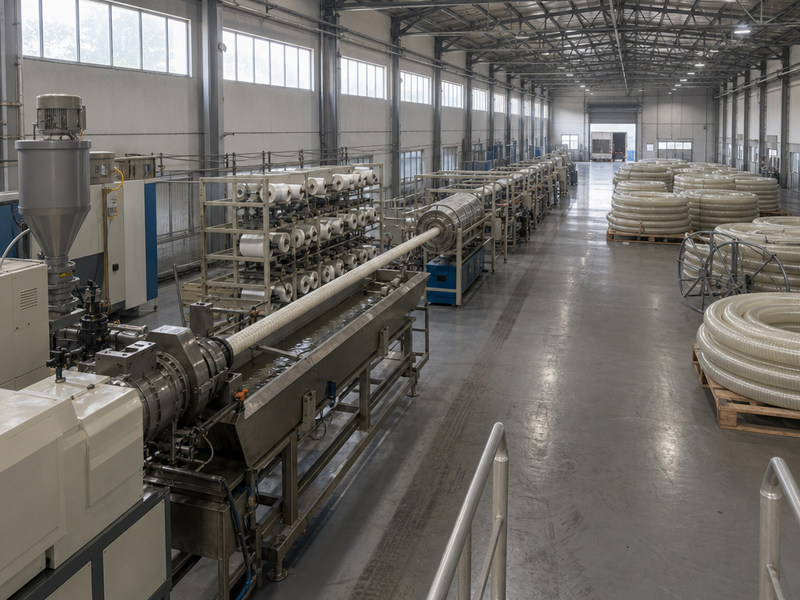
Figure 1. One building, four stages in process order: extruder, reinforcement line, coiled-hose staging, and the dispatch dock, which is the loop a trader cannot show.
A factory that runs a short loop between its liner line and its crimping station can fit an end to a tube that still carries the same batch code. A trader with no line on site cannot show that loop at all.
What to Read in the Paperwork Before Auditing a China Chemical Hose Factory
Documents are the part of due diligence that travels with the goods. Request the full pack before the first order, and read each item for the method it cites rather than the logo on the letterhead. A vendor that answers every technical question but sends no drawing or test data is likely reselling.
A hose factory audit rarely starts on the floor. It starts with the pack, because a document that names a standard and a batch already tells you how the plant is run. For a China hose supplier with an in-house line, the pack is a by-product of normal production.
Every line in the pack should point to a standard, a batch, or a measurement. A resistance figure is only useful when it is tied to EN ISO 8031 and to the sample it was measured on. A pressure claim is only comparable when it has an ISO 1402 hydrostatic record behind it. An inspection document is only traceable when it names a heat number or a test record for the metal part.
A China chemical hose factory that can produce this pack quickly is usually the same one that builds the hose. A trader has to request each document from the actual maker first, so the pack arrives later and in pieces.
Table 2. Document pack to request, and how to cross-check each item.
| Document | Reference to expect | How to cross-check it |
|---|---|---|
| Liner material data sheet | Resin type; FDA 21 CFR 177.1520 or EU 10/2011 where food contact applies. | Compare the resin grade with the construction drawing and the sample. |
| Dimensional drawing | Bore, outside diameter, bend radius, and length tolerance. | Measure the first article against the drawing, not against the carton. |
| Electrical resistance report | EN ISO 8031, class M at or below 10⁶ Ω or class Ω at or below 10⁹ Ω. | Check the method, the electrodes, and the batch number on the sheet. |
| Hydrostatic test report | ISO 1402. | Confirm the test pressure and the batch it covers. |
| Impulse test data | ISO 6803. | Match the pressure and cycle count to the declared duty. |
| Abrasion data | ISO 4649. | Compare the result with the cover compound and the service. |
| Inspection documents | EN 10204, type 3.1 or 3.2. | Ask for the heat or test record behind the metal part. |
| Assembly declaration | EN 12115:2021, Type D for delivery or Type SD for suction and delivery. | Confirm the declared temperature range and working pressure match the order. |
| Fitting conformity record | EN 14420-7 for camlock ends of the cam-and-groove type; EN 1092-1 for a PN flange; ASME B16.5 for a Class flange. | Match the end to the counter-flange or adaptor already on site. |
Read the pack for gaps rather than for polish. A drawing without a bend radius cannot be used for routing. A resistance figure without a method cannot be compared with another vendor. An inspection document that names a type but carries no heat number does not support the traceability it claims. An assembly declared to EN 12115:2021 sits inside a working envelope of -20 °C to +65 °C and 10 bar. A declaration that steps outside that band is a question for the maker rather than a specification to accept.
EN 10204 describes types of inspection document for metal products. Asking whether a maker can issue a 3.1 or 3.2 document is a fair question. Assuming that any supplier already holds one is not. Record the vendor as qualified only after the document is in front of you.
A written checklist makes this faster to repeat across several vendors. The broader framework behind that checklist sits in our supplier qualification framework (planned URL — publish before linking).
On-Site Versus Remote Technique for a Hose Factory Audit
A visit and a video call answer different questions. A visit lets you open a machine guard, read a calibration sticker, and follow a batch card from the extruder to the dock. A remote audit works when each station has a fixed camera and the vendor shares live readings rather than edited clips. It also costs less to repeat. Add one unannounced element: pick a station at random while the call is live, rather than accepting a schedule agreed in advance.
A hose factory audit is strongest when the two methods are combined. Reserve the live call for the line walk, and reserve the physical visit for the calibration records and the warehouse. Ship a sample to both an on-site inspection and your own incoming check, then compare the two.
Table 3. What each audit method verifies, and how to cover the rest.
| Method | What it verifies | Cover the rest with | Best use |
|---|---|---|---|
| On-site visit | Machine condition, calibration records, warehouse control, and batch cards. | A batch that is not built yet: book the visit at first-article stage. | A first order and any new line. |
| Live remote video | The line in motion, batch cards, the dispatch area, and live readings. | Drawings and an idle line: ask for the drawing pack by email before the call. | A repeat order or a low-risk change. |
| Document-only review | Standards cited, batch links, and test methods. | Site address control: confirm it on the visit or the first call. | Screening before either method. |
For a buyer in another hemisphere, the practical sequence is a remote first pass and a physical visit before the second order. A credible China chemical hose factory will welcome a live line walk, because the evidence is already in place.

Figure 2. Left, a buyer walking the line; right, the same line shown on a video call. The two views overlap on the machine floor, and they differ where the paperwork and the warehouse are checked.
Tooling and Mold Ownership When Sourcing From a China Chemical Hose Factory
Custom ends, print blocks, and packaging artwork often need tooling or a mold. Before any of it is paid for, settle who pays, who owns, where it is stored, and what happens if the relationship ends. These are contract questions, and cheaper to settle in writing than in a dispute.
Ownership is separate from possession. A tool can sit in a supplier’s plant for years while the buyer holds title. Name the asset, state who owns it, and say who may use it and when it must be returned.
When a buyer sources a China chemical hose factory for a custom end, the mold is often the only custom asset in the deal. Fixing its ownership early avoids a locked-in position later. A short tooling agreement removes most of the ambiguity, and it is worth pairing with a look at the coupling material guide (planned URL — publish before linking).
Table 4. Tooling and mold questions to settle in writing.
| 項目 | Question to settle | Term to write down |
|---|---|---|
| Custom end mold | Who pays for the tool, and who owns it. | Ownership, storage, and return terms. |
| Jacket print block | Whether the artwork is exclusive to the buyer. | Who may use the block, and for how long. |
| Cut or crimp fixture | Whether the fixture is dedicated to this part. | Storage location and maintenance responsibility. |
| Packaging plate | Who holds the plate after the order closes. | Return or buy-out at the end of the relationship. |
How Does the Sample-to-Production Control Loop Work?
A sample is a rehearsal for the series, and it only has value when the same settings are used for both. Approve one assembly against the drawing, keep it as the reference, and hold the series order until the loop closes. The approved sample then becomes the physical definition of the product.
Repeatability is what matters here: a China chemical hose factory proves itself on the second batch, not on a single good sample. A sample that passes only when a senior operator stands at the machine is a warning, not an approval. A chemical hose manufacturer should be able to reproduce the sample without a special setup.
Table 5. Sample-to-production control loop, stage by stage.
| Stage | Owner | Output | Release criterion |
|---|---|---|---|
| Sample request | Buyer | Drawing, material callout, service conditions. | The package is complete and unambiguous. |
| Sample build | Maker | One assembly with its test data. | Built to the drawing with recorded settings. |
| Dimensional check | Buyer | Measurement report. | Within drawing tolerance. |
| Pressure and resistance check | Maker or third-party lab | Hydrostatic and resistance results. | Meets ISO 1402 and EN ISO 8031. |
| Golden-sample sign-off | Buyer | Signed approval record. | Approved for series production. |
| First batch release | Both | Batch certificate and inspection record. | The batch matches the approved sample. |
Two outcomes matter here. The first is conformity: does the sample match the drawing and the declared performance? The second is repeatability: can the vendor reproduce it without a special setup? The same loop applies to a system built from several parts, as the system approach guide sets out (planned URL — publish before linking).
Inspection Before Shipment: What to Check and When
Pre-shipment inspection is the last point at which a defect can be corrected without a return. Agree the inspection plan before production starts, so the checks are known and the paperwork is ready. Inspect against the approved sample, the drawing, and the batch records together.
The order of the checks is not arbitrary. Dimensions come first, because a length or end error invalidates every later result; pressure and resistance records follow, once the assembly is confirmed as the ordered build. Packing, marking, and count are checked last, and they decide whether the container can be loaded at all.
The physical check is what confirms a China chemical hose factory shipped the approved design. Ask the maker for time-stamped photos and the batch records alongside the inspection report, then store them with the pack. The routine behind this step is described in our complete chemical hose guide.
Table 6. Pre-shipment inspection checks and the record to keep for each one.
| Check | What to compare | Record to keep |
|---|---|---|
| Dimensions | Bore, outside diameter, length, and end configuration against the drawing. | Measurement sheet for the batch. |
| Pressure integrity | Hydrostatic result against ISO 1402. | Test report tied to the batch. |
| Static control | Resistance against EN ISO 8031, at the class the order declares. | Resistance report with method notes. |
| Packing and marking | Carton batch, size, and pressure class against the order. | Packing list and time-stamped photos. |
| Quantity and dispatch | Units per carton against the packing list. | Count sheet signed before release. |
| Container loading | Carton count against the loading list, photographed at the container door. | Seal number and loading photos filed with the pack. |
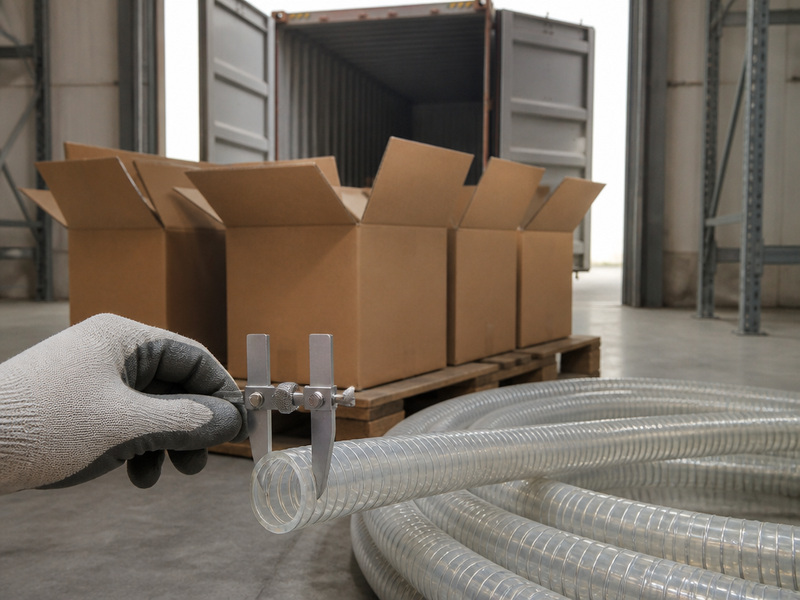
Figure 3. A pre-shipment hold point before the cartons are sealed keeps a nonconforming batch away from the container.
Incoterms, Packing, and Export Documentation Basics
Incoterms decide who pays freight and insurance, and where risk passes. EXW and FOB leave more of the shipping work with the buyer, while CIF and DAP place more of it with the seller. The right choice depends on how much control you want over the carrier. Name the term, the named place, and the edition year on the purchase order.
Packing follows the route. Coils, reels, and straight lengths load and flex differently inside a container, and a coil restrained past its natural bend can flatten a liner before the hose is ever used. That is why the packing method is agreed with the order rather than chosen at the loading dock.
A China hose supplier and a Chinese trading company often quote the same product on different terms. Compare the delivery term, the place it names, and the document set before you compare the number, because those three items decide the real landed cost. The cost drivers behind a quoted unit live in our price and MOQ factors (planned URL — publish before linking).
Table 7. Common Incoterms and where each one places the work and the risk.
| Term | Who arranges main freight | Where risk passes | What it means for the buyer |
|---|---|---|---|
| EXW | Buyer | At the seller’s own site. | The buyer controls the whole route. |
| FOB | Buyer | Once the goods are on board at the port of loading. | The buyer keeps freight visible. |
| CIF | Seller | Once on board, with freight and insurance paid to the destination port. | A simple first import. |
| DAP | Seller | At the named destination, before import clearance. | Door delivery without customs work. |
The export pack usually holds a commercial invoice, a packing list, a bill of lading, a certificate of origin, and the test records and drawings that support the batch. Ask which party issues each one, and check that the invoice description matches what a chemical hose manufacturer declared for the batch. A short review of the chemical hose product range before dispatch helps confirm that the ordered specification, not a generic one, is what is moving.
China Chemical Hose Factory FAQs
What should an overseas buyer check first?
Start with the liner line and the crimping station, because those two steps decide most of the quality. Ask to see the extruder and the resin feed, then watch an end being crimped against a recorded setting, and confirm that both steps share a batch code. A vendor who deflects either request has told you what you needed to know, whatever the paperwork says.
How can I tell a factory from a trading company?
Ask who performs each production step and where the record is filed. A factory names a line, an operator, and a batch card. A trader names a partner and forwards documents later. Confirm the answer on a live call. Check that the address on the invoice, the plant, and the test reports agree, because neutral cartons and a stock-only warehouse are common signs of a reseller.
Which documents should I request from a chemical hose manufacturer?
Request six groups: the liner sheet, the dimensional drawing, the test reports, the metal documents, the assembly declaration, and the fitting conformity record. Read the drawing first, because the dimensional checks in every other sheet are taken against it, and the resistance, hydrostatic, impulse, and abrasion results only mean something once the bore, the length, and the end configuration are fixed. A chemical hose manufacturer who holds the pack can usually send it quickly, because these files are part of routine production control.
What is EN 10204 in a hose document pack?
EN 10204 is the standard that lists the inspection-document types used for metal products. Type 3.1 or 3.2 is the level normally asked for on couplings and flanges, because each one ties a metal part to a heat or test record. Read the reference on the paper, then check that the heat number on it matches the parts in the crate. Order the crates only after that match is on your desk.
How do I run a remote factory audit?
Book a live call with the China chemical hose factory and ask for a fixed camera at each station, because a handheld tour shows only what the host chooses to show. Follow the line as it runs: extrusion, build, crimping, test bench, and the packing bench where cartons are marked. Ask for readings to be taken while you watch, and close with time-stamped photos of the batch card and the dispatch area. Leave the warehouse count to a visit, where cartons can be opened and weighed.
Who should own the molds and tooling?
Ownership is settled before the tool is paid for, because a mold with no named owner turns into a negotiation at the worst moment: when the buyer wants to move production. List the tool in the agreement, name who pays for it, and fix the route for returning or buying out the tool up front. Any buy-out figure quoted at that stage is a planning figure rather than a fixed number.
What does a sample approval cover?
A sample approval is a signed record that ties the approved sample to a drawing revision, a batch number, and the test data behind it. It should state what was measured, what the limits were, and who approved it. Keep the sample or a photo record with the paperwork. Every later batch is then compared with that reference, which makes drift visible before it reaches the end user.
When should pre-shipment inspection happen?
Before the goods are packed, so a defect can still be corrected at the plant. Compare the batch against the signed sample, the drawing revision, and the batch records, item by item. Check dimensions, pressure and resistance records, then carton marking, quantity, and batch code. If a third party is used, fix the hose factory audit plan before production starts and share it with the maker.
Which Incoterm is best for a first order?
Choose the Incoterm by how much of the route you want to control. FOB keeps the carrier choice with the buyer, which leaves freight visible while the China hose supplier is still unproven. CIF and DAP hand more of the shipping work to the seller, and they are simpler to compare on a landed-cost basis. Match the term to your own customs capability, then state it and the named place on the purchase order.
How do packing and marking affect a shipment?
Packing and marking decide how fast the shipment clears your own receiving check. Agree the packing method in writing before the order is confirmed, then compare the first delivery against it. A carton that states its batch code and pressure class can be verified at the dock in one pass, while an unmarked carton has to be opened.
Next Steps and About HENGHUA
Build the due diligence file once and reuse it. Few candidates pass the full loop on the first attempt, and that is expected. Start with the role question, request the document pack, run the audit, approve a sample, and then inspect before shipment.
Before the next order is placed, a short sequence of steps is worth completing. Identify whether the vendor produces or resells, and confirm it on a live line walk. Request the full document pack and file it by batch number, so that a later claim can be traced. Fix tooling ownership in writing. Approve a first article before any series commitment, and hold a pre-shipment inspection while the goods are still at the plant.
Three reader states change which step matters most. A first-time importer should hold the sequence at the audit and the first-article approval, where an unproven vendor can still be replaced. A distributor adding a single line should test the reorder path instead. A brand owner running a private label program should start at the tooling agreement, because the print block and the mold outlive the order.
HENGHUA is a professional hose and coupling manufacturer supplying global distributors, retailers, and OEM brands. The chemical hose line includes UHMWPE (UPE), XLPE, and PTFE liners, plus rubber constructions in EPDM and oil-resistant synthetic rubber, with high-strength textile reinforcement and a steel helix for suction duty. Coupling options cover camlock (cam and groove), flange, threaded, and clamp-style terminations. Factory-crimped assemblies, custom lengths, jacket printing, private label, and OEM/ODM programs are available, with factory-direct pricing, short bulk lead times, and a warranty.
About the author. This guide was prepared by the HENGHUA hose engineering team, which supports chemical transfer, petroleum, and industrial hose specification for distributors and OEM programs. Questions about a specific service condition can be sent through the contact page.





 English
  Spanish
  Portuguese
  French
  German
  Arabic
  Russian
  Indonesian
  Japanese
  Korean