


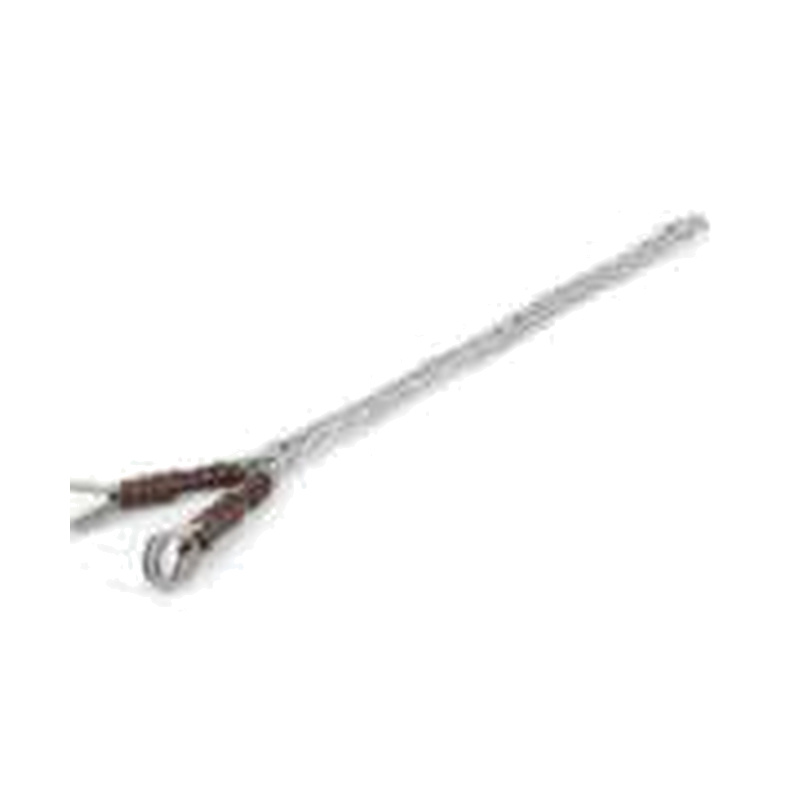
Whipchecks are safety restraints that tether a hose coupling to the tool or to the other hose, so a coupling that lets go cannot whip. They are wire rope assemblies with a loop at each end, and they are not pressure parts: they carry no fluid and they hold no pressure. They are used on compressed air, steam and high-pressure water hose wherever a disconnect would send the hose end flying.
|
|
|
|
|
Whipchecks: what they do and what they do not
| Arrangement | Connects | Protects |
|---|---|---|
| Hose to tool | Hose end to the tool body | The tool-end coupling letting go |
| Hose to hose | One hose end to the other | A joint between two hoses parting |
A whipcheck is a restraint, not a seal and not a load-bearing fitting. It does not stop a coupling from failing; it stops the free end from whipping if it does. That distinction matters at inspection: a whipcheck that has taken a load has done its job once and should be replaced, because the rope has been shock-loaded.
Whipchecks: part numbers
| Part number | Finish |
|---|---|
| HHB1 | Galvanised |
| HHB1SS | Stainless |
| HHB3 | Galvanised |
| HTSR1 | Galvanised |
| HTSR1SS | Stainless |
| HTSR2 | Galvanised |
| HTSR2SS | Stainless |
| HTSR3 | Galvanised |
| HTSR4 | Galvanised |
The two series correspond to the two arrangements: HHB is the shorter restraint for a hose-to-tool joint, HTSR the longer one for hose to hose. The SS suffix is stainless rope and ferrule, and the plain number is galvanised. The digit is the rope size, not the hose bore, so quote the part number and the coupling it has to pass round.
Why the fitting matters as much as the rope
The restraint is only as good as its two anchor points. Each end loops round a coupling or a tool body, and the ferrule that closes the loop is the part that fails when the assembly has been dragged or crushed. A whipcheck left hanging on a hose that is run over by a truck is not a whipcheck any more.
Fit it so the rope has some slack when the joint is made up and comes taut only if the joint opens. A rope that is tight in service is being loaded continuously and will fail at the ferrule rather than at the moment it is needed.
Where they are required, and where they are not
Compressed air above a few bar, steam hose, and high-pressure water are the classic cases: a 1 in air line at 8 bar will throw a coupling across a workshop. They are also used on fuel and chemical transfer where a parted joint would spray.
They are not a substitute for a proper clamp or for a locking coupling. On a line that is correctly made up, the whipcheck does nothing at all until something else fails, which is exactly the point.
Sizes and materials
The assemblies are supplied in lengths that suit the hose diameter, with galvanised or stainless rope, and the loop is sized to pass round the coupling body. The published drawing gives the overall length and the rope diameter; there is no pressure or load rating, because the part is a restraint for a failure that should not happen rather than an engineered lifting item.
Inspection
Check before every shift on air and steam, and after any joint that has let go. Look at the rope at the ferrule, not in the middle: that is where a whipcheck fails, because the ferrule is where the load concentrates. A rope with a broken strand at the ferrule is finished, even if the rest of the assembly looks new.
Ordering information
- Arrangement: hose to tool, or hose to hose
- Hose bore or coupling size the loops must pass round
- Rope material: galvanised or stainless
- Length, if a non-standard reach is needed
- Quantity per size
- Replacement ferrules, if the rope is re-made on site
Frequently asked questions
What pressure do whipchecks hold?
None. It carries no pressure; it restrains a hose end if a coupling fails. Describing it as a pressure part is the mistake to avoid.
How tight should it be fitted?
Slack when the joint is made up, taut only if the joint opens. A rope that is tight in service is being loaded all the time.
Can I reuse one after it has taken a load?
No. A shock-loaded rope and ferrule should be replaced, even if it looks intact.
Do I need one on water hose?
On high-pressure water, yes. On a low-pressure delivery line, a correctly made joint is usually enough.
What is the minimum order, and can I get samples?
MOQ, samples and lead time are confirmed per line with the price, because each length is a separate run.
Related reading
- Hose clamps and whipchecks
- Heavy duty hose clamps
- Worm drive and spiral clamps
- Industrial hose couplings
Whipchecks are quoted by arrangement, coupling size and rope material, and they are a restraint rather than a pressure part.
Send the six fields and we come back with the price.


 English
 Spanish
 Portuguese
 French
 German
 Arabic
 Russian
 Indonesian
 Japanese
 Korean