


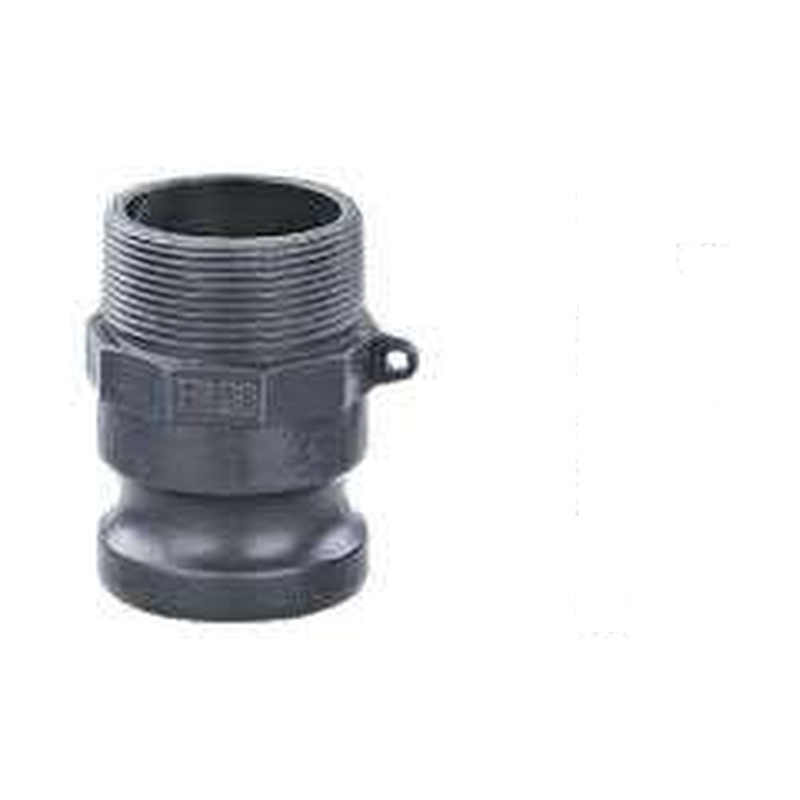
Polypropylene camlock couplings are quick-connect hose fittings closed by two cam arms, moulded in glass-fiber reinforced polymer instead of cast metal. The range covers Types A, B, C, D, E, F, DC and DP from 1/2 in to 4 in, in black polypropylene reinforced with 30% glass fiber. They are used on suction and discharge hose for acids, alkalis, fertilizers, solvents and wastewater in agricultural and industrial service.
Range and working limits by size
| Size | Types | Body | Pressure | Interface |
|---|---|---|---|---|
| 1/2 in | A, B, C, D, E, F, DC, DP | PP, 30% glass fiber | Confirm by size and medium | Cam and groove |
| 3/4インチ | A, B, C, D, E, F, DC, DP | PP, 30% glass fiber | Confirm by size and medium | Cam and groove |
| 1インチ | A, B, C, D, E, F, DC, DP | PP, 30% glass fiber | Confirm by size and medium | Cam and groove |
| 1-1/4インチ | A, B, C, D, E, F, DC, DP | PP, 30% glass fiber | Confirm by size and medium | Cam and groove |
| 1-1/2インチ | A, B, C, D, E, F, DC, DP | PP, 30% glass fiber | Confirm by size and medium | Cam and groove |
| 2インチ | A, B, C, D, E, F, DC, DP | PP, 30% glass fiber | Confirm by size and medium | Cam and groove |
| 3インチ | A, B, C, D, E, F, DC, DP | PP, 30% glass fiber | Confirm by size and medium | Cam and groove |
| 4インチ | A, B, C, D, E, F, DC, DP | PP, 30% glass fiber | Confirm by size and medium | Cam and groove |
Two things derate the assembly rather than the fitting: temperature, because the polymer softens earlier than metal would, and the hose attachment, because a band on a cold-flowing plastic shank is the first joint to move. Neither is published as a number for this range, so both are confirmed per line.
No pressure figure is published for the polypropylene range, and the metal rating table printed beside it is headed for all metals. Treat the plastic range as a low-pressure line and confirm the working pressure against the size, the medium and the temperature before the order is placed.
Part numbers and the 1/2 in suffix
| 種類 | End connections | Part number | Sizes |
|---|---|---|---|
| A | Male adapter × female thread | A-075-PP to A-400-PP | 3/4 in to 4 in |
| A, 1/2 in | Male adapter × female thread | A-050R-PP | 1/2 in × 3/4 in |
| B | Female coupler × male thread | B-075-PP to B-400-PP | 3/4 in to 4 in |
| C | Female coupler × hose shank | C-075-PP to C-400-PP | 3/4 in to 4 in |
| D | Female coupler × female thread | D-075-PP to D-400-PP | 3/4 in to 4 in |
| E | Male adapter × hose shank | E-075-PP to E-400-PP | 3/4 in to 4 in |
| F | Male adapter × male thread | F-075-PP to F-400-PP | 3/4 in to 4 in |
| DC / DP | Dust cap / dust plug | DC-075-PP, DP-075-PP to -400 | 3/4 in to 4 in |
The size code is the bore in hundredths of an inch, so 200 is 2 in and 400 is 4 in. The 1/2 in size is listed as 1/2 in × 3/4 in and carries the suffix R, because the thread is one size up from the body; the same R appears on the 1-1/2 in × 1-1/4 in pair, A-150R-PP. Quote the size pair, not only the body size.
Polypropylene, nylon or metal: which body
Polypropylene is chosen for chemical resistance at low cost and low weight. It stands up to most corrosive acids, alkalis, fertilizers, solvents and wastewater, and it does not corrode, so the outside of the fitting stays clean in washdown and outdoor service. It is also electrically non-conductive.
It is the wrong body where the line runs hot or at pressure, where the medium attacks polypropylene, or where a specifier has called for metal. For those cases the aluminium, brass and SS316 ranges cover the same eight types, and nylon covers the same sizes with a different balance: nylon takes impact and cross-threading better, polypropylene takes a wider spread of chemicals. Neither plastic range should be selected on pressure alone.
Which hoses do polypropylene camlock couplings suit?
Type C and Type E carry a hose shank sized by bore and fixed with a band or a ferrule. Measure the bore, not the outside diameter, and add the wall thickness when the hose is thick-walled.
These fittings go on agricultural suction and discharge hose, fertilizer and chemical transfer hose, and wastewater hose. For composite hose the shank has to be cut to the outside diameter, which is a different fitting family.
Combinations that cover most orders
- Tank to hose: Type A in the tank port, Type E on the hose.
- Hose to hose: Type C on one hose, Type E on the other.
- Pump to hose: Type F at the outlet, Type C on the hose.
- Blind end: DC over an unused adapter, DP in an unused coupler.
Gaskets and seals
A gasket sits in every coupler and is what actually seals the joint; the cam arms only clamp it. Nitrile covers water, oils and mild chemicals, EPDM covers water and dilute acids, and Viton covers solvents and aromatics. Match the gasket to the medium before matching the body, because a correct body with the wrong gasket still leaks.
Is it interchangeable with metal camlocks?
The polypropylene range uses the same cam and groove interface as the metal ranges, so a polypropylene Type C mates with an aluminium Type E of the same size. The dimensional standard A-A-59326D is written for metal couplings, so it is not claimed here; what matters at the joint is the groove, the cam arm and the gasket seat, and those follow the same pattern. Threads are outside any of this and must be stated as NPT or BSP.
Ordering information
- Type and size for each end
- Thread standard on threaded ends
- Medium and concentration
- Working pressure and temperature
- Gasket compound
- Quantity per type and size
Frequently asked questions
Will polypropylene camlock couplings fit metal ones?
Yes, at the same size and type: the groove and gasket seat follow the same cam and groove pattern. The gasket still has to suit the medium, and a plastic coupler on a metal adapter is normal practice.
What pressure can they take?
No figure is given for the plastic range, so we confirm it per size and medium rather than publish one. Do not size a polypropylene line from the metal rating table.
Can polypropylene replace stainless on acid?
Often yes at low pressure and moderate temperature, and it is the cheaper answer for dilute acids and fertilizers. Where the line runs hot, or the acid attacks polypropylene, SS316 is the body to use.
Why does the 1/2 in number end in R?
Because the 1/2 in body is supplied with a 3/4 in thread, the number carries the reducing suffix R. Quote both sizes when ordering.
What is the minimum order, and can I get samples?
MOQ, samples and lead time are confirmed per line with the price, because each size and type is a separate run.
Related reading
- Camlock couplings range
- Aluminum camlock couplings
- Stainless steel camlock couplings
- Camlock gaskets
Polypropylene camlock couplings are quoted by type, size pair and gasket compound, so state all three.
Send the six fields and we come back with the price.



 English
 Spanish
 Portuguese
 French
 German
 Arabic
 Russian
 Indonesian
 Japanese
 Korean