


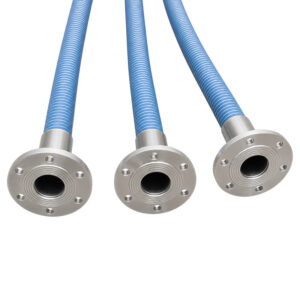
The petroleum suction and discharge hose in this range is a non-vulcanised composite hose for terminals, tankers and loading racks that must pull a vacuum and push product through the same line. Working pressure is 25 bar (370 psi) from DN25 to DN76, 23 bar (345 psi) from DN102 to DN203 and 15 bar (225 psi) at DN254. Bores run from 25 mm to 254 mm (1 in to 10 in), and the service window is -40°C to +110°C.
製品概要
The petroleum suction and discharge hose sits in the liquid-service classes of EN 13765:2018, the standard for thermoplastic multi-layer non-vulcanised hose used with hydrocarbons, solvents and chemicals. Type 3 of that standard covers heavy duty liquid transfer, which is where a 25 bar build with full vacuum and a 3:1 burst margin belongs.
In one sentence, the wall is a multi-ply PP film liner with PE vapor barriers, a fabric carcass, an inner helix that holds the bore open and an outer helix that carries pressure load, under a PVC-coated cover.
Three numbers define the range: 25 bar (370 psi) working pressure to DN76, 0.9 bar full vacuum, and a 254 mm top bore.
Four things make it worth specifying. It pulls full vacuum without a heavy wire carcass, so one person can move a DN50 length. It is anti-static as standard, with the helix bonded to both fittings. It stays flexible at -40°C, and the ends are crimped in-house with digital records.
The users are oil terminals, road tanker fleets, rail car racks, barge and bunker operators, aviation fuel farms, vegetable oil processors and tank builders. Most run it between a fixed pipe and a vehicle that never lines up.
The operating problem is that unloading needs suction at the end of a stroke, then pressure through the same line. A rubber hose that survives vacuum is thick and heavy, and a metal arm needs fixed geometry. The composite build splits the duty: helix against collapse, fabric against pull, helix against hoop.
Every petroleum suction and discharge hose leaves the plant with a test record. We proof test every assembly at 1.5 times working pressure, record each crimp digitally and keep batch records for liner, carcass and helices. The plant holds ISO 9001, MSHA, CE, CCS, ABS, DNV, California Proposition 65, RoHS, API, GOST-R and MA certification.
Product Advantages of the Petroleum Suction and Discharge Hose
- Full vacuum without a heavy wall. The inner helix holds the bore open at 0.9 bar.
- Anti-static as standard. The helix is bonded to both fittings for end-to-end continuity.
- Wide temperature window. Rated -40°C to +110°C, from cold gantry to hot product.
- Long standard lengths. 20 m to DN76 and 10 m from DN102 cuts joints.
- Crimped fittings with records. Every ferrule and press cycle traces to its batch.
- Re-termination instead of scrap. A worn end can be cut back and re-crimped.
Applicable users: terminal operators, tanker fleets, fuel distributors, barge and bunker handlers, vegetable oil processors, OEM tank builders and hose assembly shops.
Detailed Technical Specifications
| Size (DN) | ID(mm) | 外径(mm) | Bend radius (mm) | WP (bar) | 重量(kg/m) | Standard length (m) |
|---|---|---|---|---|---|---|
| 25 | 25 | per build | per build | 25 (370 psi) | per build | 20 |
| 38 | 38 | per build | per build | 25 (370 psi) | per build | 20 |
| 50 | 50 | per build | per build | 25 (370 psi) | per build | 20 |
| 65 | 65 | per build | per build | 25 (370 psi) | per build | 20 |
| 76 | 76 | per build | per build | 25 (370 psi) | per build | 20 |
| 102 | 102 | per build | per build | 23 (345 psi) | per build | 10 |
| 152 | 152 | per build | per build | 23 (345 psi) | per build | 10 |
| 203 | 203 | per build | per build | 23 (345 psi) | per build | 10 |
| 254 | 254 | per build | per build | 15 (225 psi) | per build | 10 |
- Temperature: -40°C to +110°C continuous. Ask for written confirmation before running above that band.
- Safety factor: 3:1 minimum on burst, so a 25 bar hose is designed for 75 bar.
- Vacuum: 0.9 bar full vacuum, with the inner helix sized to the bore.
- Proof test: every assembly at 1.5 times working pressure to EN ISO 1402.
- Tolerances: dimensions and lengths to EN ISO 1307. Cut lengths to order.
- OD, bend radius and weight follow the liner ply count, helix grade and fitting set, so we issue them on the assembly drawing.
Structure and Materials
- Inner helix: galvanised steel or SS304/SS316L wire, pitched to hold the bore open under vacuum.
- Liner: multiple plies of PP film with PE vapor barriers, the layer that touches the product.
- Carcass: woven fabric plies between the helices, carrying axial load.
- 表紙: PP fabric and film under a PVC-coated abrasion-resistant cover.
- Outer helix: high-tensile galvanised steel or SS304/SS316L wire, carrying hoop load.
Why the composite build holds up
A petroleum suction and discharge hose works because each layer does one job and none of them is glued. The inner helix is a steel spring inside the bore. Under vacuum it resists ovalisation, so the flow area stays round instead of flattening like a soft rubber wall. The outer helix takes hoop load when the line is pressurised, which is why the wall can stay thin. The fabric plies between the helices carry the axial pull that appears whenever the hose is dragged or bent around a corner.
The liner is thermoplastic film rather than a cured rubber tube. Film plies are chosen for the medium, so resistance comes from the polymer instead of wall thickness. A PP liner with PE vapor barriers holds petrol and diesel and limits permeation, which matters in a pump room where vapor is monitored. Because the layers are compressed and not bonded, the hose flexes without the cracking seen in a vulcanised wall.
The cover is the wear part. PVC-coated fabric resists abrasion from concrete and decking, and it fails visibly: when the plies show through, the hose is due for retirement.
Safety factor, proof pressure and burst margin
The range is designed on a 3:1 burst ratio, so a 25 bar hose has a design burst near 75 bar. That margin covers the spike when a valve closes against a moving column of product. Every assembly is then proof tested at 1.5 times working pressure, 37.5 bar on the 25 bar sizes, before it leaves the plant. The test checks the assembly rather than the hose alone, so a bad crimp shows up in the factory and not on a jetty.
Put three questions to any supplier. What is the burst ratio, and is it on the datasheet? Is the proof test done on the finished assembly? Can the record be traced to the serial number on the hose?
Chemical Compatibility and Media Guide
Ratings describe the standard PP liner with PE vapor barriers at 20°C to 25°C. Temperature, concentration and contact time all move the rating, so treat this as a screening tool.
| 中 | Rating | Note |
|---|---|---|
| Mineral hydraulic oil | Excellent | Standard duty |
| Diesel | Excellent | Standard duty |
| Gasoline | Excellent | Anti-static build |
| Kerosene | Excellent | Standard duty |
| Crude oil | Excellent | Confirm sulphur level |
| Lubricating oil | Good | Heavier grades flow slower |
| Vegetable oil | Excellent | Includes cooking oil |
| Biodiesel B100 | Good | Confirm blend |
| Ethanol E100 | Good | Barrier limits permeation |
| Methanol | 数量限定 | Swells PP; confirm concentration |
| Toluene | Not recommended | Aromatic attack on PP |
| Xylene | Not recommended | Same aromatic mechanism |
| MEK | Good | Declared duty for this build |
| Acetone | 数量限定 | Swelling risk |
| Ethyl acetate | 数量限定 | Ester attack on PP |
| Dichloromethane | Not recommended | Use PTFE liner |
| Trichloroethylene | Not recommended | Use PTFE liner |
| Sulphuric acid 30% | Excellent | Dilute grade; PE barrier lifts the margin |
| Sulphuric acid 98% | 数量限定 | Oxidising |
| Hydrochloric acid 35% | Excellent | Aqueous grade |
| Sodium hydroxide 50% | Excellent | Caustic service |
| Ammonia 10% | Excellent | Aqueous grade |
| Sodium hypochlorite 12% | 数量限定 | Liner ageing |
| Hydrogen peroxide 30% | 数量限定 | Oxidiser |
| Phosphoric acid 85% | Good | Confirm temperature |
| Nitric acid 65% | Not recommended | Strong oxidiser |
| Acetic acid 99% | Good | Glacial grade |
| Ethylene glycol | Excellent | Coolant service |
| Propylene glycol | Excellent | Food-grade glycols |
| Water | Excellent | Including washdown |
| Sea water | Excellent | Rinse after use |
| Steam condensate | Good | Below +110°C only |
Three rules for reading the chart. Derate for temperature: a rating earned at 20°C does not hold at +110°C. Concentration changes the answer, so 30% and 98% sulphuric acid are different problems for the same polymer. Contact time matters as much as the medium, because a hose that sees a solvent for minutes ages differently from one that sits full of it overnight. Send the medium, concentration and temperature for a written answer and the compatibility chart as a PDF.
Applications and Industries
- Road tanker unloading. Gantry to tanker and tanker to storage, a fuel transfer hose duty with camlock ends on DN50 and DN76 lines.
- Rail car transfer. Bottom unloading, the tanker unloading hose duty that reaches under the frame and still holds vacuum.
- Barge and bunker transfer. A petroleum suction and discharge hose on the barge manifold, with reducing flanges for the shore side.
- Aviation fuel farms. Filter separator to refueller, where the anti-static build and continuity test form part of the site permit.
- Vegetable and cooking oil. Bulk edible oil unloading, where a clean PP liner avoids taste carry-over.
- In-plant transfer. Pump sets and drop lines where a DN25 or DN38 hose bends tightly around equipment.
Selection Guide
Size, flow and pressure drop
Size from the highest flow rate the line will see, then choose the smallest bore that keeps pressure drop and pump load acceptable. Watch velocity, because fast product generates static and erodes the fittings. Where flow is fixed and the bore is tight, ask us to check line loss before you buy.
End fittings and hose assembly
Every assembly is crimped with swaged ferrules, not banded ends. Options are NPT male, BSP male, cam and groove (camlock), fixed flange, floating flange, reducing flange, tank coupling and 37 degree flare adapters, in stainless or carbon steel. Camlocks suit a connection made quickly by a driver in gloves; floating flanges suit a fixed manifold where bolt holes rarely line up.
Carbon steel on a salt-water dock corrodes faster than stainless, and stainless on an inland rack adds cost nobody sees. We crimp in-house, so the ferrule, press setting and test result attach to the assembly serial number.
How it compares
| オプション | 使用圧力 | Vacuum | Where it fits | Trade-off |
|---|---|---|---|---|
| Petroleum suction and discharge composite hose | 15 to 25 bar | 0.9 bar | Tanker, terminal and barge fuel transfer | PP liner limits solvent exposure |
| PP chemical composite hose | 10 bar | 0.9 bar | Acids, alkalis, aqueous chemicals | Lower pressure rating |
| PTFE composite hose | 15 to 20 bar | 0.9 bar | Aromatics, chlorinated solvents, oxidising acids | Higher cost per metre |
| Heavy duty chemical composite hose | 20 bar | Not published | Ship-to-ship oil transfer in exposed weather | Heavier, larger minimum bend |
| Marine composite hose | 14 bar | Suction rated | Salt-water exposure at large bores | Longer lead on the biggest bores |
| Rubber suction and discharge hose to EN 1765 | Lower at the same bore | 数量限定 | General dock work | Heavy, stiff in cold, shorter life |
What drives the price
Four things set the cost of a petroleum suction and discharge hose: bore, liner build, helix material and fitting set. A DN254 length uses far more material than a DN25 length, and the heavy outer wire on large bores is formed slowly. Stainless helices cost more than galvanised ones, so a mixed pair is a common compromise.
Volume changes the unit price. A single repair length and a scheduled annual quantity are quoted differently, because the second can be planned into a run. Wholesale and distributor enquiries are welcome, with your labelling and packaging. Ask for a price per fuel transfer hose against a realistic annual volume rather than a single length.
Common selection mistakes
- Buying on working pressure alone and ignoring vacuum, the harder duty on any fuel transfer hose.
- Specifying a PP liner for a solvent that needs PTFE, then blaming the hose when the liner swells.
- Choosing a bore for the pump rather than the flow rate on a tanker unloading hose, which brings vibration and erosion.
- Fitting a carbon steel camlock on a salt-water dock and replacing it every season.
Installation, Operation and Maintenance
Installation
- Respect the minimum bend radius on the assembly drawing. A tighter bend kinks the hose at the ferrule, and that is where failures start.
- Keep one bore diameter of straight hose behind each fitting before the bend begins.
- Support horizontal runs so the hose does not sag. As a working rule, support DN50 and above every 1.5 m to 2 m.
- Use a swivel or angled adapter at a fixed flange, so the bend happens in the hose.
- Never lift a large bore assembly by its fittings. Use a sling or a protective sleeve.
Inspection and retirement
Check the cover before each shift on a working rack. Look for cuts that expose fabric plies, blisters, soft spots and movement at the ferrule. Run a continuity check on the anti-static path at the interval your site permit sets, and record the reading. Retire the hose when the cover is cut to the carcass, the liner bulges, the ferrule has slipped or a proof test fails. A six-year review is a sensible backstop for tanker duty.
Cleaning, storage and service life
Drain the hose after use and cap the ends. Store it on a rack or a wide reel rather than a concrete floor, never in a coil tight enough to kink, and away from ozone sources such as welding sets. Flush with water and mild detergent for vegetable oil service, then dry before capping. Life depends on bending at the fitting, dragging over edges and chemical exposure, so a carried hose outlasts a dragged one.
Quality Assurance and Test Data
Production runs from incoming material inspection to final marking. Film, fabric, wire and fittings are checked before release to the line. Liner plies are laid up, the carcass is built on the forming table, and the inner helix is formed and pitched. The wall is compressed without vulcanisation, the step that separates this product from a rubber hose. Fittings are crimped with digital records, and every assembly is proof tested at 1.5 times working pressure to EN ISO 1402. Marking follows the test, with size, working pressure, batch and serial number.
The test programme covers hydrostatic proof, impulse, electrical continuity, bend and dimensional testing to the standards in the table below. Packaging is film wrap plus a plywood case for LCL, or bubble wrap and a reel for FCL.
Standards and Certifications
| 標準 | What it covers | What it means for the buyer |
|---|---|---|
| EN 13765:2018 | Thermoplastic multi-layer hose for hydrocarbons | Design basis, Type 3 heavy duty liquid service |
| EN ISO 1402 | Hydrostatic pressure testing | Proof test at 1.5 times working pressure |
| EN ISO 6803 | Impulse testing | Evidence the assembly survives cycling |
| EN ISO 8031 | Electrical resistance and continuity | The anti-static path is measured |
| EN ISO 1746 | Bend testing | Minimum bend radius is verified |
| EN ISO 1307 | Dimensions and tolerances | Bore, wall and length match the drawing |
| EN 1765 | Rubber hose for oil suction and discharge | The comparison standard for rubber |
| IMO IBC Code, OCIMF, USCG 33 CFR 154.810, ADR/RID | Ship and road transfer requirements | Reference rules your terminal may apply |
Certifications on file: ISO 9001 and ISO 18752, plus MSHA, CE, CCS, ABS, DNV, API, GOST-R and MA, with RoHS and California Proposition 65 declarations for the markets that require them.
Frequently Asked Questions for the Petroleum Suction and Discharge Hose
What is the hose made of?
A multi-ply PP film liner with PE vapor barriers, a fabric carcass, an inner helix of galvanised or stainless steel, an outer helix of high-tensile galvanised or stainless steel, and a PVC-coated cover. Nothing in the wall is vulcanised.
What does the 25 bar rating mean?
It is the maximum working pressure in continuous service at DN76 and below, with a 3:1 burst margin and a 1.5 times proof test. Short spikes are covered by the margin, but running above the rating will fatigue the carcass.
Can it handle full vacuum?
Yes. The inner helix holds the bore open at 0.9 bar vacuum, so one line can suck and discharge. A rubber hose needs a much heavier wall for that.
What is the temperature limit?
-40°C to +110°C for the PP liner. The low end covers winter gantries and the top end covers hot product and washdown. Ask in writing before exceeding either limit.
Which chemicals can it carry?
Fuels, oils, glycols, alcohols, dilute acids and alkalis are in range. Aromatics are declared duty but need a contact-time check, and chlorinated solvents need a PTFE composite hose liner. Send the medium for a written answer.
How is it different from a rubber hose?
Rubber is vulcanised, so its layers are bonded and the wall is thick. This hose is compressed, with separate helices for vacuum and hoop load, so it is lighter at the same bore and stays flexible in the cold.
How does it differ from the chemical composite hose?
The standard chemical composite hose is rated 10 bar and built for acids and aqueous chemicals. This one runs to 25 bar, adds PE vapor barriers for fuel and is specified for anti-static tanker duty.
What order size can you start with?
Tell us the quantity and destination and we quote directly. Custom sampling runs on a 48-hour cycle and standard specifications ship within 7 days of approval. Large bores take longer, because the helix and ferrule are made to drawing.
How do I get a quote or a PDF datasheet?
Send the medium, temperature, pressure, bore, length and end connection through the contact form. As a composite hose supplier we reply with a quotation, the datasheet PDF and the compatibility chart for your medium.
Why Source Composite Hose from HENGHUA
We are a composite hose supplier with our own plant, not a trading house. The production base near Hengshui covers 18,000 m2, runs 8 high-speed lines and produces 25 million metres a year, while the Tianjin office handles export documents and technical enquiries. Customers in more than 70 countries buy direct, so the engineer answering your compatibility question sits in the same building as the line that makes the hose.
The certification set matters in fuel work. ISO 9001 covers the quality system, and the plant also holds ISO 18752, MSHA, CE, CCS, ABS, DNV, California Proposition 65, RoHS, API, GOST-R and MA. Classification society approvals are what terminal auditors ask for, and they come with the test documentation.
Assembly is in-house. We crimp the ferrules, record each press cycle, proof test at 1.5 times working pressure and mark every hose with its batch and serial number. You buy a finished hose assembly rather than a length and a box of fittings, and it arrives with a test record instead of a promise.
For OEM and ODM work we handle custom labelling, packaging, fitting selection and private label printing. Sampling for a custom build takes 48 hours and standard specifications ship within 7 days, so a distributor can hold a thin stock position and still fill orders. Bulk pricing is quoted against volume.
Support continues after delivery. Send a photograph of a failed hose with its serial number and we trace the batch, the liner lot and the test record. If the answer is a different liner or a larger bend radius, we will say so. Our engineers will also review a layout and recommend support spacing and fitting type before you order.
お見積りのお申し込み
Send your medium, temperature, pressure, size and end connection to our sales engineers, and we will return a specification and a price for your petroleum suction and discharge hose. Tell us the concentration, operating temperature, working and surge pressure, bore, total length, end connection type and material, quantity, and destination port. We can supply the datasheet PDF, the compatibility chart for your medium and a sample length so your fitters can trial the bend radius on the real rack. We quote as a direct composite hose supplier, so nothing sits between your question and the line. Start the enquiry through the contact form on our site.


 English
 Spanish
 Portuguese
 French
 German
 Arabic
 Russian
 Indonesian
 Japanese
 Korean