
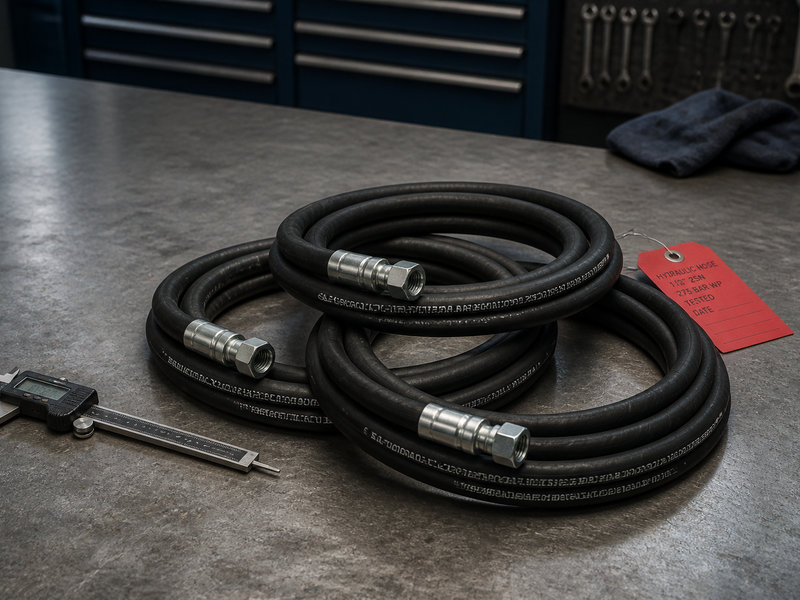
A hydraulic hose lasts two to six years in normal service. Five years is the planning interval used on most mobile and industrial equipment, and ten years from the date of manufacture is the ceiling even when the hose still looks new.
That is the short answer to how long do hydraulic hoses last, and it is deliberately a range rather than a single number. The real figure is set by pressure cycling, fluid temperature, bend radius, abrasion, fluid cleanliness and the quality of the installation.
This guide separates the three clocks a hose runs at once, converts impulse-cycle test data into an estimated service life, gives the end-of-life criteria our failure analysis uses, and lists eight levers that extend hose life. It is written for fleet maintenance managers, buyers comparing quotations on durability, and OEM engineers setting a replacement policy.
How Long Do Hydraulic Hoses Last?
Service life is not one number, because two identical hoses fitted to two different machines are not doing the same job. A hose on a protected return line at 40 bar and 50 °C sees far less fatigue than the same hose on an excavator boom at 250 bar, 80 °C and several hundred thousand pressure cycles a year.
Field replacement intervals therefore group by duty, not by product name.
Table 1: Recommended hydraulic hose replacement intervals by duty class
| Duty class | Typical replacement interval | What defines it |
|---|---|---|
| Severe duty | 1–2 years | Extreme temperature, continuous flexing, abrasive environment, hard shock loads |
| High-pressure continuous duty | 2–3 years | Runs near rated working pressure with a high cycle rate; exposed or safety-critical locations |
| Standard duty, protected run | 4–6 years | Moderate pressure cycling, shielded routing, ambient temperature inside its temperature rating |
| General planning interval | 5 years | The default date-based review point used across mixed fleets; industry planning guidance rather than a clause of a published standard |
| Absolute maximum | 10 years | Age ceiling from the date of manufacture, regardless of appearance |
The ten-year ceiling is the part most people miss. Rubber compounds continue to cure, plasticiser continues to migrate and the tube-to-reinforcement bond continues to age even when a hose sits indoors on a shelf.
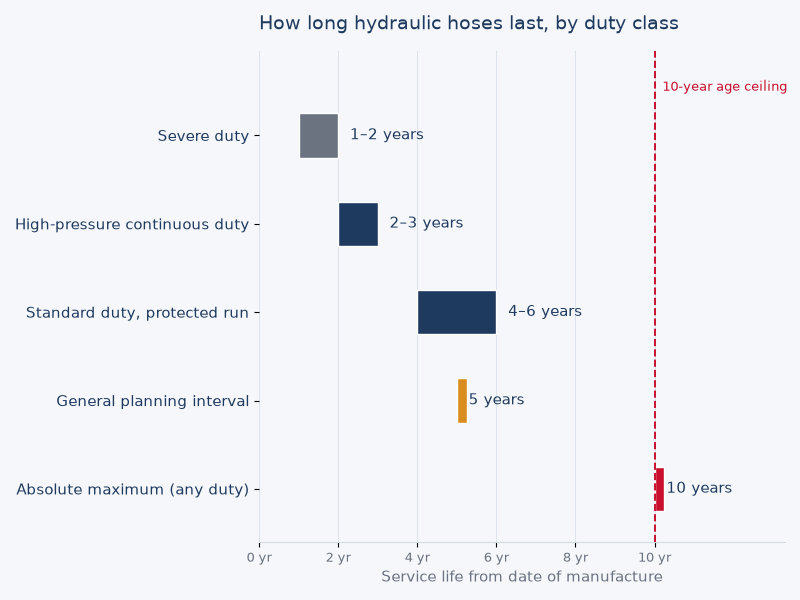
Figure 1: Service life bands by duty class, with the ten-year age ceiling applied to every band.
The two numbers that drive everything else are the number of pressure cycles the hose will see and the temperature at which it sees them. Everything in the rest of this article is a way of estimating those two numbers more accurately.
Three Clocks Run at the Same Time: Shelf Life, Service Life and Impulse Life
Most arguments about hydraulic hose lifespan come from mixing three different measurements that share one word: life.
Each of the three clocks starts at a different moment and stops for a different reason:
- Shelf or acceptance life: starts at the cure date, applies while the hose is unused, and stops when proper storage conditions are broken.
- Service life: starts at installation and stops when the assembly reaches its end-of-life criteria in the field.
- Impulse or fatigue life: a laboratory figure expressed in pressure cycles, used as a proxy for service life before a hose is ever fitted.
A hose can be new in the box and still be unserviceable, because its shelf-life clock runs whether or not anyone uses the hose. A hose can also be visually flawless and still be at the end of its fatigue clock, because the reinforcement inside the rubber is not visible.
Why a Hose That Looks New Can Still Be Too Old to Use
Cover condition describes the outside of the assembly. It says very little about the wire layers, which carry the pressure load and fail by fatigue rather than by appearance.
Three mechanisms age a hose without changing how it looks:
- Compression set in the tube, which reduces the sealing margin at the fitting interface.
- Adhesion loss between the tube and the reinforcement, which allows the wire layers to work against each other.
- Plasticiser migration in the cover, which leaves a hose that feels dry and hard rather than cracked.
This is why published guidance treats age as an independent replacement trigger. Both the five-year planning interval and the ten-year ceiling exist precisely because the internal condition of a hydraulic hose cannot be judged by eye.
The Ten-Year Ceiling and Why It Exists
The ten-year age ceiling is a date-based replacement rule rather than a fatigue limit, and it covers hose that has carried pressure as well as hose that has not. The method behind the figure (age control from the cure date) comes from SAE J1273, whose forty-quarter bench mark is written for bulk rubber hose in controlled storage. For an installed assembly, ten years is an industry practice ceiling rather than a value fixed by a standard clause. Three degradation processes continue in a hose that sits idle:
- Cure continuation, where the compound keeps cross-linking and the cover loses elasticity.
- Plasticiser migration, where the ingredients that keep the rubber soft gradually leave the material.
- Adhesion loss, where the bond between the tube and the reinforcement weakens.
A hose that has spent ten years in a warehouse and a hose that has spent ten years on a machine share the same chemistry problem, and only the fatigue budget separates them. A register built on installation dates alone therefore gives a false sense of security, because it starts every clock at the moment the hose was fitted.
What Actually Ends a Hydraulic Hose’s Life?
A hose assembly fails at whichever of its four structural elements reaches its limit first: the cover, the reinforcement, the tube or the crimped fitting.
Our field records, customer failure reports and on-site inspections across construction, mining and agricultural equipment show that the distribution is far from even.
Table 2: Field frequency of hydraulic hose failure causes, from our field records on construction, mining and agricultural equipment
| Rank | Failure cause | Share of field failures | Most common on |
|---|---|---|---|
| 1 | Abrasion and cover wear | 35–40% | Excavators, loaders, cable reels |
| 2 | Incorrect routing and installation | 25–30% | All equipment types |
| 3 | Fitting and coupling failure | 15–20% | High-vibration applications |
| 4 | Temperature degradation | 10–15% | Mobile equipment near engines |
| 5 | Fluid incompatibility and contamination | 5–10% | Systems with poor filtration |
The practical reading of Table 2 is uncomfortable but useful: roughly two-thirds of premature failures are caused by how the hose was installed and where it was routed, not by the hose itself. A premium four-spiral assembly routed against a steel edge will fail earlier than a standard two-wire braid assembly routed correctly.
Each mechanism below is covered in more detail, together with the diagnostic steps that separate it from the others, in the guide to the failure causes seen most often in the field.
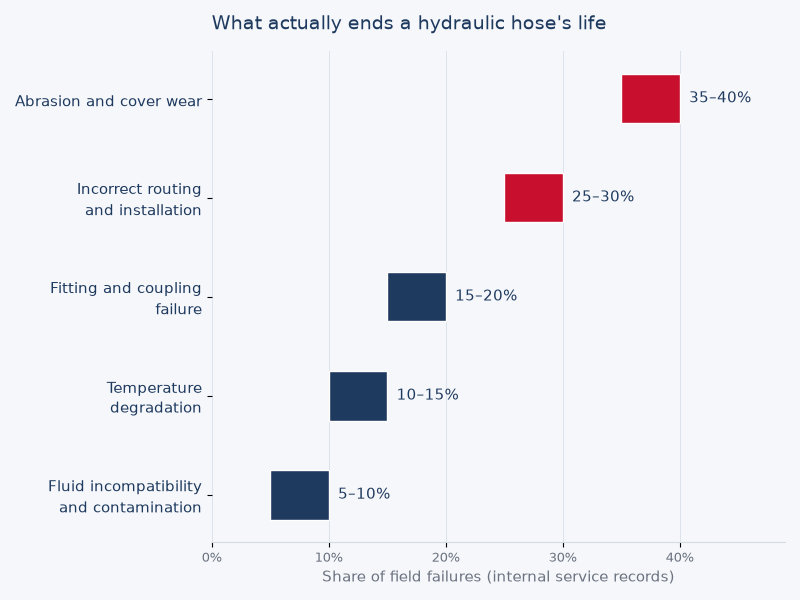
Figure 2: Failure causes ranked by field frequency. Cover damage and installation errors together account for about two-thirds of premature replacements.
Abrasion: The Failure That Starts on the Outside
Abrasion removes the cover, exposes the steel wire and lets moisture reach the reinforcement. Rust then reduces the wire’s load capacity, and the hose eventually bursts at a pressure far below its pressure rating. The failure looks sudden, but the damage took months.
Where the routing cannot be changed, a fitted protective sleeve converts a wear point into a sacrificial layer. Our field records show abrasion leading the failure table on excavators, loaders and cable reels, which is exactly where sleeves repay their cost within the first replacement cycle, because the replacement interval there is one to two years.
Reinforcement Fatigue: The Failure That Starts Inside the Wire
Every pressure pulse flexes the wire strands. Where a hose bends, the strands on the outside of the bend stretch and the strands on the inside compress, and they rub against each other as the pressure rises and falls. The wire fatigues one cycle at a time and finally cracks at the point of highest bending stress.
Tube Degradation: Heat, Fluid and Contamination
The tube is the only element that touches the fluid, so it absorbs every chemistry problem in the system. Overheating hardens it, incompatible fluid swells it, and hard particles erode it. All three reduce the wall thickness that keeps the fluid inside.
The fluid compatibility data for inner tube compounds shows which elastomer suits which fluid group, and the tube selection decision is worth making before the pressure rating is chosen.
Fitting and Crimp: The Joint That Decides Assembly Life
A hose assembly is only as strong as the crimp that joins the hose to the fitting. Under-crimping allows the fitting to creep and eventually blow off; over-crimping cuts into the reinforcement and creates a stress riser at the fitting edge. Impulse performance belongs to the complete assembly, which is why a high-cycle hose paired with an ordinary crimp still fails early.
Crimp specification is a controlled process rather than a workshop preference, and the assembly crimping guide covers how crimp diameter is defined, measured and verified against a go or no-go gauge.
How to Convert Impulse Cycles into Years of Service
Impulse testing is the only laboratory method that correlates well with real service life, because it reproduces the mechanism that actually wears a hose out.
The impulse test procedure in SAE J343 and ISO 6605 applies pressure pulses at 133% of the maximum working pressure, holds the fluid at the rated temperature, and cycles at 0.5 to 1.3 Hz until the assembly leaks or bursts.
The impulse test method behind those cycle counts also explains why the test is run on the complete assembly rather than on the hose alone. It is the only laboratory figure that translates into an answer to how long do hydraulic hoses last on a high-cycle circuit.
Table 3: Impulse rating levels and what they mean for expected service life
| Qualification level | Cycles at 133% of working pressure | Equivalent cycles at working pressure | Typical application |
|---|---|---|---|
| Standard (SAE 100R series baseline, ISO 18752 base grade) | 200,000 | About 5,000,000 | Protected industrial circuits, moderate cycling |
| Enhanced durability | 400,000 | About 10,000,000 | Mobile equipment with steady pressure cycling |
| Premium (top ISO 18752 grade) | 1,000,000 | About 25,000,000 | Excavator boom and arm circuits, mining, injection moulding |
Why Testing at 133% Working Pressure Buys a Factor of About 25
Fatigue damage does not scale linearly with pressure amplitude. Because the pressure-to-cycles relationship follows a power law, raising the test pressure to 133% of working pressure accelerates damage by roughly twenty-five times. Testing at 133% of working pressure therefore compresses several years of field fatigue into a one-month laboratory test.
A Worked Example: Turning Cycles into Years
Take a 20-tonne excavator running a two-shift schedule. The boom circuit performs about 120 working cycles per hour when the machine is producing, and the machine runs 3,000 hours a year. These figures are the stated assumptions of this worked example rather than measured field averages. Cycle counting turns operating hours into a number comparable with an impulse rating:
- Annual pressure cycles: 120 cycles per hour × 3,000 hours = 360,000 cycles per year.
- Fatigue budget of a baseline 200,000-cycle assembly: exhausted in about seven months.
- Fatigue budget of a 1,000,000-cycle assembly: about 2.8 years of boom-circuit cycling.
That calculation is the reason boom, arm and bucket circuits are specified with premium impulse ratings. On the same machine, a return-line hose cycling at a fraction of that rate may sit comfortably inside a baseline impulse rating for its whole life. Two hoses of identical construction can differ by a factor of ten in service life when one circuit cycles a hundred times more often per hour than the other.
Which Six Variables Change How Long Hydraulic Hoses Last?
Impulse cycles set the budget, but six operating variables decide how fast the budget is spent, and therefore how long do hydraulic hoses last on one machine rather than another.
Table 4: Operating variables that control hydraulic hose service life
| Variable | Effect on service life | Practical control |
|---|---|---|
| Pressure amplitude | Dominant for fatigue; spikes above working pressure cost far more than steady pressure | Relief valves, accumulators, correct hose pressure class |
| Fluid and ambient temperature | Every 10 °C above the compound’s comfort range roughly halves rubber life | Hose rated above the hottest fluid and ambient value; heat shields |
| Bend radius and flexing | Flexing below the dynamic bend radius multiplies strain per cycle | Route at 1.5× the static minimum where the hose moves |
| Abrasion and environment | Cover loss exposes reinforcement to rust and impact | Sleeves, spiral guards, rerouting, clamp separation |
| Fluid cleanliness and compatibility | Particles erode the tube; wrong fluid swells or hardens it | ISO 4406 18/16/13 or better, 10–25 µm filtration, verified compatibility |
| Installation quality | Twist, wrong length and missing clamps shorten life on their own | Straight layline, 2–4% slack, clamps every 600–900 mm |
Pressure Amplitude Matters More Than Pressure Level
A circuit running steadily at 200 bar can outlast a circuit running at 120 bar with a 260 bar spike on every machine cycle. Fatigue responds to amplitude and cycle count, and pressure spikes are the single largest source of hidden fatigue in a hydraulic system. Reducing a spike with a correctly set relief valve or an accumulator often extends hydraulic hose service life more than upgrading the hose.
Temperature: The Ten-Degree Rule of Thumb
Rubber ageing follows the Arrhenius relationship, so the rate of degradation roughly doubles for every 10 °C rise. A hose that would last eight years at 60 °C has an expected life near four years at 70 °C and near two years at 80 °C. That single rule explains most of the difference between the two-to-three year interval for hot mobile equipment and the four-to-six year interval for cooler, protected industrial circuits.
Standard SAE hoses are typically rated to +100 °C, with high-temperature versions available to +121 °C. At the cold end, standard compounds stiffen below −40 °C, and bend radius requirements roughly double at −20 °C compared with room temperature.
Where either end of that range is exceeded, hose selection for extreme temperatures sets out the compound changes that restore the margin.
Bend Radius and Dynamic Flexing
Every hose has a minimum bend radius, and the value changes depending on whether the hose is static or moving. Published bend radius figures are stated as multiples of the inside diameter (ID). The relationship between bend radius, flow and machine life explains what happens inside the reinforcement at each bend:
- Standard two-wire braid hose, SAE 100R2: about 3× the inside diameter.
- Compact four-spiral hose, SAE 100R12: about 1.5× the inside diameter.
- Thermoplastic hose, SAE 100R7 and 100R8: about 0.75× the inside diameter.
For any hose that flexes during operation, the dynamic bend radius is typically 1.5× the published static figure. In our impulse testing on excavator thumb cylinders, the two-wire braid assembly failed at the bend, while the compact four-spiral assembly completed the full premium cycle count at a tighter radius. Construction matters, but running inside the correct radius for the construction matters more.
Abrasion, Installation and Fluid: The Three Fixable Causes
Abrasion, routing and fluid quality are the three items in Table 2 that a maintenance team can change without buying different hoses. Three actions cover most of the gain:
- Add nylon sleeves or steel coil guards at every contact point, then re-check the routing after fitting them.
- Check the layline for straightness after installation; about 5 degrees of twist can cut service life by up to 70%, and about 7 degrees by up to 90%.
- Keep fluid cleanliness at ISO 4406 18/16/13 or better, and hold fluid velocity below 7.6 m/s (25 ft/s) on suction lines and 10.7 m/s (35 ft/s) on pressure lines.
Of the six variables, these three are also the cheapest to control. That makes them the right place to start when the goal is how to extend hydraulic hose life across a whole fleet rather than on a single machine.
For routing work, the guide to installation mistakes that shorten hose life lists the specific errors that recur in warranty claims. For fluid condition, the cleaning procedures and ISO 4406 cleanliness classes give the target figures to work back from.
How Long Do Hydraulic Hoses Last on Different Machine Types?
Duty class is set by the machine, and each machine type we see in failure analysis wears hoses through a different dominant mechanism. The bands below answer how long do hydraulic hoses last on the equipment types that generate the most replacement work.
Table 5: Service life expectations by machine type
| Machine type | Dominant stress | Typical replacement interval | Priority check |
|---|---|---|---|
| Excavators and earthmoving | High cycle rate at high pressure on boom, arm and bucket circuits | 2–3 years on boom and arm circuits; 4–6 years on return circuits | Abrasion at the boom pivot and articulation points |
| Mining and quarry equipment | Pressure plus abrasion plus long uninterrupted shifts | 1–2 years | Cover wear and fitting movement |
| Agricultural machinery | Seasonal peaks, ultraviolet exposure, cold starts, wide temperature swings | 3–5 years in service, with a five-year age review | Cover cracking and ozone damage |
| Industrial hydraulics and presses | Steady pressure, low cycle rate, clean environment | 4–6 years | Heat sources and pinch points |
| Injection moulding machines | Continuous cycling next to heater bands | 2–4 years | Surface temperature at platen hoses |
| Forklifts and material handling | High cycle rate at moderate pressure through mast channels | 2–4 years | Chafing inside the mast and contact with chains |
| Waste and municipal fleets | Thousands of daily cycles, stop-start operation, road vibration | 2–3 years | Fitting torque loss and daily pre-shift leaks |
Excavators and Earthmoving Equipment
Boom, arm and bucket circuits are the hardest hose application on earthmoving equipment. Pressures are high, the hoses flex through a wide arc on every stroke, and the routing runs close to steel structure. Abrasion ranks first and routing errors second in our field records for these circuits.
Planning starts with the cycle count rather than the calendar. A premium impulse rating on the boom circuit is a fatigue decision, while a protected return line can stay on a baseline assembly for its whole life.
Mining and Quarry Equipment
Mining equipment adds abrasion and thermal load to an already high-cycle duty. Rock dust, sharp aggregate and round-the-clock operation remove cover material faster than in any other environment we test in. Hoses on these machines are usually replaced on a one-to-two year interval, and the cost of downtime makes a planned replacement far cheaper than a mid-shift failure.
Agricultural Machinery
Agricultural hoses often reach their ten-year age ceiling before their fatigue limit. Seasonal use means low annual hours, but the hoses spend winters cold and summers under ultraviolet light, and both conditions promote cover cracking and stiffening. A five-year age review is the practical control, with earlier replacement on folding implement circuits that flex continuously during work.
Industrial Hydraulics and Injection Moulding
Industrial systems run steady pressure at a modest cycle rate, which is the easiest duty in this table, and hoses routed away from heat regularly reach their ten-year ceiling with fatigue budget unused. Injection moulding is the exception on the same shop floor. Hoses close to heater bands and moving platens combine continuous cycling with radiant heat, which puts them in the two-to-four year band.
Forklifts and Material Handling
Mast and tilt circuits cycle many thousands of times per shift, and the mast channel is a natural chafing point. Sleeving the mast runs and checking for a worn groove move the replacement date furthest. Those two actions are also the simplest answer to how to extend hydraulic hose life on a material handling fleet.
What Does a Remaining-Life Estimate Need on a Working Machine?
A date on a spreadsheet is an assumption. A hose register built from the actual assemblies on the machine is evidence, and it is the basis of every credible remaining-life estimate.
The register starts with the layline. Each hose carries a printed line with the standard, the inside diameter, the working pressure and a date code. A code of 0125 means week 1 of 2025, so recording it at installation converts an unknown hose into a dated one. The method for reading the layline correctly also covers what to do when the marking has worn away.
The hydraulic hose inspection checklist covers the full field procedure. What follows concentrates on the checks that maintenance teams most often skip, because those are the ones that actually change a replacement date.
Table 6: Inspection and replacement cadence by duty class
| Activity | Standard duty | High-pressure continuous | Severe duty |
|---|---|---|---|
| Operator visual check | Daily, 2–3 minutes | Daily | Every shift |
| Detailed technician inspection | Quarterly | Monthly | Monthly, plus after every pressure event |
| Register and condition audit | Annually | Every six months | Quarterly |
| Planned replacement | By 5 years or 4–6 years of service | 2–3 years | 1–2 years |
Two adjustments are worth writing into any schedule. First, shorten the interval whenever the equipment works in extreme temperature, near continuous flexing or an abrasive environment. Second, shorten it again once a hose passes the halfway point of its expected interval, because hoses age faster at the end of their lives than at the start.
A Worked Example: Boom Circuit on a 20-Tonne Excavator
The 20-tonne excavator running 360,000 cycles a year shows how the stated assumptions combine into a decision:
- Fatigue budget at 360,000 cycles per year: a baseline assembly is spent in about seven months, so the circuit is specified with a premium impulse rating.
- Temperature: an assumed cover temperature of 78 °C stays inside the +100 °C temperature rating, so no derating is applied.
- Abrasion: the boom pivot is a known contact point, so a sleeve is fitted and the contact is checked monthly.
- Replacement: planned at 2.5 years, with the ten-year ceiling irrelevant because the cycle count is reached long before the calendar does.
On this circuit, the useful fatigue budget is about 2.5 years. It falls as soon as the cover temperature rises or the abrasion point is left unprotected.
Which Circuits Should Be Replaced First?
Rank circuits by the fatigue budget they consume per operating hour, not by how visible the wear looks. Boom, arm and bucket circuits on earthmoving equipment and mast or tilt circuits on forklifts cycle thousands of times per shift, so they reach their limit long before a protected return line does. On a 20-tonne excavator working two shifts, the boom, arm and bucket circuits reach 360,000 cycles a year while the return line logs a fraction of that count.
What Can You Measure in the Field to Sharpen a Remaining-Life Estimate?
Five measurements are available to any maintenance team without laboratory equipment, and each one replaces an assumption with a number. No measurement replaces the register, but together they turn a generic interval into a specific answer to how long do hydraulic hoses last on one circuit.
Table 7: Field measurements that refine a service life estimate
| Measurement | How to take it | What it changes |
|---|---|---|
| Cycle count | Count function cycles over 15 minutes, then multiply by the shift pattern | Converts operating hours into a fatigue budget |
| Surface temperature | Measure at the hose cover near the hottest point once the machine reaches working temperature | Applies or cancels a temperature derating |
| Installed bend radius | Measure the inside radius of the tightest bend and compare with the dynamic bend radius rating | Reveals bending strain above the design value |
| Contact points | Mark every place the hose touches structure, another hose or a moving part | Quantifies abrasion exposure |
| Fluid cleanliness | Sample the fluid and read the ISO 4406 code from a particle count | Flags internal tube erosion risk |
Counting Cycles Without a Data Logger
Fifteen minutes of observation is enough. Count the number of times the function completes a full stroke, multiply by four for an hourly figure, then multiply by annual operating hours. On a 20-tonne excavator, 30 strokes in fifteen minutes gives 120 cycles per hour, which is the figure carried into the fatigue calculation.
Using Surface Temperature as a Derating Trigger
Measure at the cover, at the hottest location, once the machine has reached working temperature. Treat any reading above the hose temperature rating as a design problem to fix rather than a hose to upgrade. Keep roughly 10 °C of margin between the measured value and the rated limit, so that a hot day or a heavy work cycle stays inside the limit.
What a Hydraulic Hose Inspection Proves and What It Misses
A hydraulic hose inspection is a strong instrument for external condition and a weak instrument for internal condition. It reliably finds cover damage, fitting leakage, corrosion and routing faults, because all four are visible. For internal condition, retire on age and cycle count instead: adhesion loss, tube hardening and consumed fatigue cycles stay invisible from the outside, and the ten-year age ceiling and the impulse budget are the two triggers that still apply.
Documenting the Result
Record the equipment identifier, the hose location, the layline date code, the measurement values and the action taken. A quarterly review of those records shows which circuits consume fatigue faster than planned, and that pattern is the evidence that justifies a shorter interval or a higher impulse rating on one specific circuit.
What Changes on a Machine That Works Two Shifts a Day?
On a 20-tonne excavator running two 10-hour shifts, the annual cycle count doubles, so a baseline 200,000-cycle assembly is spent in about three months rather than seven. Compare accumulated cycles against the rated figure rather than against the installation date.
When to Replace a Hydraulic Hose: End-of-Life Criteria
Condition beats the calendar every time a hose shows a defect, and the calendar beats appearance every time a hose reaches its ten-year age ceiling without one. Any decision about when to replace hydraulic hose therefore combines a condition test with a duty-based interval.
Table 8: When to replace hydraulic hose by observed condition
| Condition | Action | Reason |
|---|---|---|
| Exposed wire reinforcement | Replace immediately, tag the machine out | Corrosion and impact protection are already gone |
| Bulging or blistering | Replace immediately, tag the machine out | Internal separation is under way; failure is imminent |
| Any active leak or weeping, including pinholes | Replace immediately, tag the machine out | Leak paths grow under pressure and create injection risk |
| Fitting movement or separation | Replace immediately, tag the machine out | The crimp has lost retention |
| Cracked, stiff or brittle cover | Replace as soon as possible | Flexibility is lost; fracture risk rises with every cycle |
| Severe abrasion without exposed wire | Replace within 30 days, add a sleeve | Cover thickness in reserve is unknown |
| Corroded or damaged fittings | Replace as soon as possible | Sealing surfaces are compromised |
| Heat discolouration | Replace and fix the heat source | The new hose fails the same way without a routing change |
| Unknown age or history | Plan replacement | No fatigue budget can be estimated |
| Past the interval for its duty class | Plan replacement | Internal ageing is not visible from outside |
Three rules matter more than the table itself. Stop the machine rather than limping it to the workshop when a critical sign is present. Use cardboard, wood or paper to trace a suspected pinhole leak instead of a hand, because hydraulic fluid at pressure can penetrate skin. And treat repeated failures of the same circuit as a design problem rather than a hose problem.
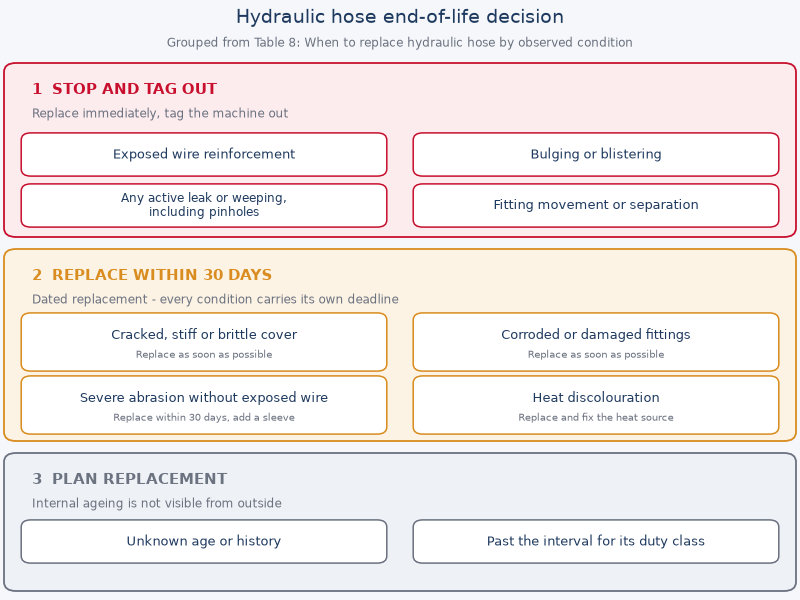
Figure 3: End-of-life decision flow. Critical signs stop the machine; marginal signs trigger a dated replacement.
Repair or Replace: What the Assembly Allows
Field repair applies only to low-pressure, non-critical circuits, and only where the equipment owner’s engineering authority accepts the reduced margin. A reusable fitting cannot reproduce the crimp geometry the assembly was qualified against, so the pressure rating and safety factor printed on the layline stop applying to the repaired assembly. High-pressure circuits are therefore replaced with a factory-crimped assembly.
The economics decide when to replace hydraulic hose, and they are one-sided. Replacing a hose on a planned schedule costs a standard part plus ordinary labour. Replacing it after a mid-route burst adds premium parts, emergency labour, lost production, hydraulic fluid loss and cleanup, and in the worst case a safety incident.
How to Extend Hydraulic Hose Life: Eight Practical Levers
Eight changes are available without altering the machine’s pressure or flow requirements, and each one targets a mechanism from Table 2.
Table 9: Eight levers that extend hydraulic hose life
| Lever | Action | Mechanism it addresses |
|---|---|---|
| 1. Size the pressure class correctly | Specify the hose for the highest sustained working pressure, not the average | Reinforcement fatigue |
| 2. Control pressure spikes | Set relief valves properly and add accumulators where valve closure is fast | Amplitude-driven fatigue |
| 3. Route away from heat | Minimum routing clearance: keep 150 mm or more from exhaust components and add a heat shield where clearance is impossible | Thermal ageing of tube and cover |
| 4. Protect every contact point | Fit nylon sleeves, spiral wraps or steel coil guards, then re-check clearance | Abrasion |
| 5. Respect dynamic bend radius | Use 1.5× the static minimum on any hose that flexes | Bending strain per cycle |
| 6. Install without twist | Verify a straight layline after tightening; add 2–4% slack | Reinforcement misalignment |
| 7. Clamp and separate | Support long runs every 600–900 mm and keep hoses from rubbing each other | Relative movement and chafing |
| 8. Hold fluid cleanliness | Target ISO 4406 18/16/13 or better with 10–25 µm filtration | Tube erosion and internal degradation |
Two of these are routinely underestimated. Heat clearance is one, because a hose can pass its pressure and bend requirements and still cook against an exhaust component. Clamping is the other, because a supported run flexes in one clean plane while an unsupported run whips, and whipping accelerates exactly the fatigue that impulse ratings measure.
How Does Construction Change Expected Hose Life?
Construction sets the ceiling that operating conditions then eat into. It is the first decision that changes the answer to how long do hydraulic hoses last, because the reinforcement geometry distributes bending stress differently. The same duty on a two-wire braid hose and a compact four-spiral hose produces a different expected service life. The gap between the two shows up as a difference in hydraulic hose lifespan of roughly a factor of two on the same circuit.
Table 10: Expected service life by hydraulic hose construction
| 建設 | Typical service life | What usually limits it | Best suited to |
|---|---|---|---|
| One-wire braid (SAE 100R1) | 3–5 years | Cover abrasion; lower pressure ceiling | Return lines and low-pressure circuits |
| Two-wire braid (SAE 100R2) | 3–6 years | Reinforcement fatigue in high-cycle duty | General mobile and industrial hydraulics |
| Four-spiral (SAE 100R12, EN 856 4SP) | 5–8 years | Crimp integrity and thermal ageing | High pressure, high cycle, boom circuits |
| Thermoplastic (SAE 100R7, 100R8) | 4–8 years | Cover cracking under UV; lower temperature ceiling | Tight routing, pilot lines, compact machinery |
| PTFE (SAE 100R14 and similar) | 8–10 years and beyond | Fitting attachment rather than the tube material | Chemicals, steam and extreme temperature |
These bands are planning aids rather than guarantees. A four-spiral hose installed with a twist and routed against a steel edge will not reach the bottom of its band, and a two-wire braid hose on a protected low-cycle circuit can reach the ten-year ceiling and be retired on age alone. For two-wire braid construction, the steel wire braided hydraulic hose range lists the pressure classes we supply.
Why Compact Spiral Hose Often Wins on High-Cycle Equipment
Compact spiral construction packs more reinforcement into a smaller envelope, which lowers the achievable bend radius and reduces the peak strain on each wire per cycle. On equipment where routing space is fixed and cycle counts are high, moving from a standard two-wire braid hose to a compact four-spiral hose frequently converts a recurring failure into a planned replacement, even before the pressure rating is considered.
The trade-offs between the two families, including abrasion resistance and pressure ceiling, are compared in braided versus spiral construction, and the spiral hydraulic hose range covers the compact spiral assemblies built for that duty.
How Cold, Heat and Season Change Hydraulic Hose Life
The two ends of the temperature range attack a hose differently, and both are usually misdiagnosed as a quality problem with the hose itself.
Table 11: Temperature effects across the hydraulic hose life cycle
| Condition | What happens to the hose | Control |
|---|---|---|
| Cold start below −20 °C | Tube and cover are stiff, the bend radius requirement roughly doubles, and the reinforcement takes a shock load on first movement | Warm the machine, circulate oil before working the function, specify a low-temperature compound |
| Continuous operation above +100 °C | Tube hardens, cover cracks, and the ageing rate roughly doubles for each further 10 °C | High-temperature construction to +121 °C, heat shields, routing changes |
| Wide daily temperature swings | Repeated contraction and expansion work the fitting interface | Correct slack, correct clamps, periodic torque verification |
| Seasonal idle or storage periods | The storage clock keeps running while the machine is parked | Record installation dates and review age at reactivation |
Cold-Start Damage Is a Fatigue Event
A cold hose bent to its normal working radius sees far higher strain than the same hose at operating temperature, so the first minutes of a winter shift consume more fatigue than an hour of steady work. Circulating warm oil before any function is moved through a full stroke is the cheapest protection available, and a low-temperature compound extends the range further.
Summer Heat and Fluid Viscosity
High ambient temperature raises fluid temperature, lowers viscosity and increases internal leakage and heat generation in the circuit. A hose measured at a safe temperature in spring can therefore exceed its temperature rating during a hot working season, particularly on machines that work hard in still air. Measuring in the hottest month rather than the first available month gives a more honest derating decision.
Seasonal Changeover as the Review Point
Seasonal changeover is the natural moment to run a full hose inspection and to review the register. Hoses past the halfway point of their expected interval are scheduled for the coming season, and hoses with an unreadable date code are dated or retired. Ambient extremes shift hydraulic hose lifespan more than most maintenance teams expect, and a changeover review is the cheapest place to catch it.
How Does Seasonal Use Change the Replacement Date?
On a machine that runs its 3,000 annual hours in one season and then stands idle, the fatigue clock barely moves for the rest of the year. That is why seasonal equipment is reviewed on the calendar rather than on an hours counter, while the ten-year age ceiling still runs from the date of manufacture.
What a Longer-Life Hose Costs, and What a Failure Costs
Buyers comparing quotations usually compare hose price. The number that decides the outcome is cost per year of service, and the number that decides it in practice is the cost of an unplanned failure.
Table 12: Typical hydraulic hose assembly cost bands and the cost components of a failure
| 項目 | Typical range | Notes |
|---|---|---|
| Small industrial assembly | $50–$150 | Short lengths, small bore, standard two-wire braid |
| Construction equipment assembly | $150–$500 | Larger bore, field-fitted fittings, longer lengths |
| Large mining assembly | $500–$1,500 and above | High pressure, four-spiral construction, large bore |
| Failure cost components | Downtime, emergency labour, fluid loss, cleanup, collateral damage | Each adds to the replacement part price; a single event can exceed the annual hose budget for that machine |
The arithmetic favours replacing early. Upgrading one circuit from a standard to a premium impulse rating costs a fraction of a single unplanned breakdown, and it removes that circuit from the emergency-parts path entirely.
Does a Higher Impulse Rating Always Pay for Itself?
The upgrade pays where the circuit consumes cycles fast enough to exhaust a baseline impulse rating inside the interval the machine already accepts. On a two-shift 20-tonne excavator, the premium impulse rating moves the boom circuit from a seven-month replacement to one planned every two and a half years. On a protected return line the same upgrade is retired on age before its cycles are spent.
How to Compare Two Quotations Fairly
Three figures turn a quotation comparison into an engineering comparison:
- Impulse cycles at 133% of working pressure, tested on the complete assembly with the fittings that will be supplied.
- The bend radius used during that test, and whether it matches the tightest bend on the machine.
- The maximum age at delivery, so the shelf clock does not consume part of the service life before installation.
Which Clauses Put Service Life into a Purchase Specification?
Most hose specifications define the product and say nothing about how long it must last. Adding durability clauses converts an expectation into a contractual requirement.
Table 13: Clauses that turn service life expectations into a specification
| Clause | What to write | Why it matters |
|---|---|---|
| Duty statement | Working pressure, fluid and ambient temperature, and an estimated annual cycle count | Defines the fatigue budget the hose must survive |
| Pressure envelope | Maximum working pressure; proof test at 1.5–2× working pressure; burst not below 4× working pressure | Separates a strength claim from a durability claim |
| Impulse qualification | Required impulse rating (qualification) cycles at 133% of working pressure, on the complete assembly, at the specified bend radius and temperature | Impulse performance depends on the crimp as much as the hose |
| Bend radius | Static and dynamic minimum values in writing | Dynamic routing is where most bending fatigue occurs |
| Cover requirements | Abrasion resistance and ozone or UV resistance for outdoor duty | Cover loss is the most common field failure |
| マーキング | Layline with standard, inside diameter, working pressure and date code | Makes age-based replacement possible in the field |
| Traceability | Batch-to-assembly records and test certificates on request | Supports failure analysis and warranty claims |
| Delivery age | Maximum age at delivery, for example 12 months from cure date | Protects the ten-year ceiling for the end user |
Two reference sets support those clauses. For equivalent designations across the SAE, DIN, ISO and GB systems, see the hydraulic hose standards comparison and the SAE J517 family structure.
For the test side, the testing methods and standards behind proof, burst and impulse results explain how each figure in the table above is produced and read.
よくある質問
How long do hydraulic hoses last?
A hydraulic hose lasts two to six years in normal service. Five years is the usual planning interval for mixed fleets, and one to two years applies to severe duty such as extreme temperature, continuous flexing and abrasion. Ten years from the date of manufacture is the absolute maximum for any hose, including one that has never been used.
Do hydraulic hoses expire if they are never used?
Yes. Rubber compounds continue to age in storage, and published storage guidance sets limits on how long an unused hose remains acceptable. A hose can therefore be unusable at five years old without ever having carried pressure. Storage temperature, humidity, ozone and light exposure decide how quickly the storage clock runs.
How many hours does a hydraulic hose last?
There is no universal hour count, because hours only become comparable once the cycle rate is known. A circuit that cycles 120 times per hour accumulates 360,000 pressure cycles in 3,000 operating hours, which exhausts a baseline 200,000-cycle assembly but uses only about a third of a premium 1,000,000-cycle assembly.
Can I still use a hydraulic hose that is more than ten years old?
Retire it. Ten years from the date of manufacture is the age ceiling used across the industry regardless of appearance or test history, and no standard clause sets that number for a hose that has already been in service. Tube hardening, adhesion loss and plasticiser migration are not visible from the outside, and an unused hose needs a proof test before release into service.
Does a higher pressure rating give a longer service life?
Not by itself. Pressure class protects against burst and proof requirements, while durability comes from impulse rating and from how the hose is routed. A higher-rated hose installed with a twist, at too tight a bend or against an abrasive edge can fail earlier than a lower-rated hose installed correctly.
Which part of a hydraulic hose fails first?
The cover fails first in most field failures, because abrasion accounts for roughly 35–40% of failures observed in our field records. In high-cycle applications where the routing is protected, the wire reinforcement fatigues first. Fittings account for a further 15–20%.
How often should hydraulic hoses be replaced?
Use duty class as the trigger. Replace severe-duty hoses at one to two years, high-pressure continuous-duty hoses at two to three years, and protected standard-duty hoses at four to six years, with five years as the default review point and ten years as the hard ceiling. The same rule answers when to replace hydraulic hose on a machine with a mixed duty cycle: classify each circuit, then apply the interval for its class.
Does heat shorten hydraulic hose lifespan?
Heat is one of the strongest single influences on hydraulic hose lifespan, because rubber ageing roughly doubles in rate for every 10 °C rise. A hose rated to +100 °C is normally adequate for mobile equipment, and high-temperature four- and six-spiral constructions are available to +121 °C for circuits near engines or exhaust components.
Can a hydraulic hose be repaired instead of replaced?
Field repair suits low-pressure, non-critical circuits where the equipment owner’s engineering authority accepts the reduced margin. High-pressure assemblies are replaced with a factory-crimped assembly, which carries the original pressure rating and safety factor.
How do I find the age of a hydraulic hose?
Read the layline. The printed identification line carries the standard, inside diameter, working pressure and a date code, for example 0125 meaning week 1 of 2025. Photograph the layline before removal, then record the date code in the hose register so the next replacement can be scheduled rather than discovered. The date code is also the first field on any hose inspection record.
What is the difference between hydraulic hose service life and shelf life?
Shelf life runs from the cure date while the hose is unused and measures how long it remains acceptable for installation. Hydraulic hose service life runs from installation and measures how long the assembly lasts in operation. The two clocks do not overlap, and the ten-year age ceiling applies to the total.
Is a 1,000,000-cycle hose ten times better than a 200,000-cycle assembly?
Not exactly, because the acceleration factor applies to both. A 1,000,000-cycle hose does offer roughly five times the fatigue budget of a 200,000-cycle hose under the same conditions, but the practical gain on a machine depends on the actual cycle rate, the temperature and the routing. On a low-cycle protected circuit, the higher impulse rating may never be consumed before the ten-year age ceiling is reached.
Final Verdict: Date It, Inspect It, Replace It on Evidence
There is no single answer to how long do hydraulic hoses last, and any supplier who offers one number is describing a marketing position rather than an engineering one. The defensible answer is a band set by duty class, a five-year planning interval, and a ten-year ceiling that applies even to a hose that looks perfect.
Three habits turn that band into a working number:
- Record the layline date code at installation so every hose has a known age.
- Run a hydraulic hose inspection cadence matched to the duty class, with a short written record of every check.
- Replace on evidence, using condition-based criteria for defects and the duty interval for the hidden ageing that no inspection can see.
Teams that follow those three habits find that the question changes. Instead of asking how to extend hydraulic hose life after a failure, they are scheduling replacements during planned downtime and using the money saved on the machines that actually need it.
About HENGHUA Hydraulic
HENGHUA has manufactured hydraulic hose assemblies for more than 20 years for construction machinery, mining equipment, agricultural machinery and industrial hydraulic systems. Our engineering team works on failure analysis, hose selection and impulse testing, and that work is the source of the internal field data used in this guide.
Capabilities relevant to hose service life:
- One-wire and two-wire braided assemblies to SAE J517 100R series, and four-spiral assemblies for high-pressure, high-cycle duty.
- Impulse testing at 133% of working pressure with 100 °C fluid, validated to 1,000,000 cycles on selected products.
- Custom assemblies built to a stated working pressure, bend radius, length and fitting requirement.
- Batch-to-assembly traceability, with test records available for safety-critical applications.
- Application engineering support for routing reviews, abrasion protection, heat management and replacement interval planning.
We do not describe our hoses as unbreakable or lifetime products. Hydraulic hoses are wearing components, and every assembly we ship will eventually reach the end of its fatigue budget. What we provide is a stated impulse rating, a documented crimp specification, traceable batch records and engineering support to help you spend that budget slowly.
If you are specifying hoses for high-cycle duty, comparing quotations on durability rather than price, or reviewing recurring failures on a specific circuit, send us the working pressure, the temperature range, the equipment model and a photograph of the existing layline. Our engineers will recommend an assembly specification and a realistic replacement interval for that application. You can request a quote and free samples for the same duty, and we will include the impulse test data for the construction we propose.






 English
  Spanish
  Portuguese
  French
  German
  Arabic
  Russian
  Indonesian
  Japanese
  Korean